Authentic Homemade Ginger Ale!

Joined
Jul 12, 2007
Location
Aledo, IL
I am always encouraging people to post pics of the recipes that they cook. Seeing the foods you make is a great treat and encourages others to post recipes and pics.
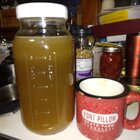
As such, here is a pic of my homemade Ginger Ale that is beginning it's natural carbonation stage. It has naturally been fermenting for eight days! It should be ready to bottle in three days, refrigerate, settle for a few days, then drink!
This is a half-gallon batch, that I will bottle in "flip-top" style bottles and bring to share with my reenacting Pards around camp at our next reenactment (Galesburg, IL) in 12 days!


20230807_202117.jpg
 
Ginger Ale is not that big in my part of the very Deep South.

We normally see it mixed with vodka or gin in Summer wedding reception "punch".

But I did have a little yankee employee that turned me on to Vernors.

She would buy a six pack of Vernors every day, and shared one with me.

After that, I was a Vernors' fan.
 
I would like to try making ginger ale - where could I find a recipe?
Thanks for asking! I wanted to post this, once someone showed an interest in making it!
Feel free to ask questions and let us know how it comes out!
Thanks!

Ginger Ale Fermented


1. Make a "wort" for your ginger ale by placing 3 cups of the water, minced ginger root, sugar, molasses if needed, and salt in a saucepan and bringing to a boil.

  1. Simmer the mixture for about five minutes until sugar is dissolved and mixture starts to smell like ginger.
  2. Remove from heat and add additional water. This should cool it but if not, allow it to cool to room temperature before moving to the next step.
  3. Add fresh lemon or lime juice and ginger bug or whey.
  4. Transfer to a 2 quart glass mason jar with an air-tight lid. Stir well and put lid on.
  5. Leave on the counter for 2-3 days until carbonated. Watch this step carefully. Using whey will cause it to ferment more quickly. It should be bubble and should "hiss" like a soda when the lid is removed. This is very temperature dependent and the mixture may need to be burped or stirred during this fermentation time on the counter.
  6. Transfer to refrigerator where it will last indefinitely.
  7. Strain before drinking.
  • NOTES
  • As with any traditional fermented drink, this is more of an art than a science. The outcome depends greatly on the strength of your culture, the temperature of your house, and the sugar used. The final mixture should smell of ginger and slightly of yeast/fermentation and should be fizzy. Watch carefully that it doesn't become too carbonated as this will cause too much pressure and may result in an exploding jar!
  • The mixture can be strained and transferred to Grolsch style bottles before putting in the refrigerator.


Ginger Bug Recipe


  • 1-2 fresh organic ginger roots
  • ½ cup white sugar
  • 2 cups filtered water
INSTRUCTIONS


1. Cut a piece of ginger root about 1.5 inches long and grate to make 2-3 Tablespoons of grated ginger. You can also finely chop instead of grating. There is some debate about if it is better to peel the root or not. My general rule is that non-organic ginger gets peeled and organic just gets rinsed before grating.


  1. Place the ginger in a quart size mason jar and add an equal amount of white sugar (2-3 Tablespoons). Nourishing Traditions insists that white sugar is needed to create the bug and I've had the best success with this, but a local friend claims that unrefined sugar or sugar with 1 tsp of molasses added works better. Try what you have and adapt as needed.
  2. Add 2 cups of filtered water to the mason jar. Make sure that the water has been filtered so that it does not contain chlorine which can affect the culturing process.
  3. Stir with a non-metal spoon and lightly cover. I cover with a coffee filter and rubber band.
  4. Each day for the next five days, stir the mixture at least once and add 1 Tablespoon of grated ginger root and 1 Tablespoon of sugar. Depending on temperature, it may take up to eight days of adding sugar and ginger to create the desired culture.
  5. You can tell if the culture is active if there are bubbles forming around the top of the mixture, it "fizzes" when stirred, and it takes on a sweet and mildly yeasty smell. It will also become somewhat cloudy and opaque. If mold appears on the top, scrape it off if it can be removed. It this happens more than once, you will need to start again. If the mixture hasn't taken on these characteristics by the 7-8th day, you need to discard it and start again.
  6. Keep the culture away from other cultures like sauerkraut and kombucha or it can cross-culture.
  7. Once the ginger bug has cultured, it can be used to create fermented sodas and drinks at the ratio of ¼ cup ginger bug starter per quart of sweetened herbal mixtures for ginger ale or root beer or diluted fruit juice for fruit flavored sodas.
NOTES

To keep the bug alive and continue growing it, you will need to feed it regularly. Add 1 teaspoon minced ginger and 1 teaspoon sugar per day if kept at room temperature. You can also "rest" it in the fridge and feed it 1 Tablespoon each of ginger and sugar once a week. To reactivate it, remove and let it reach room temperature and begin feeding it again.
 
Thanks for asking! I wanted to post this, once someone showed an interest in making it!
Feel free to ask questions and let us know how it comes out!
Thanks!

Ginger Ale Fermented


1. Make a "wort" for your ginger ale by placing 3 cups of the water, minced ginger root, sugar, molasses if needed, and salt in a saucepan and bringing to a boil.

  1. Simmer the mixture for about five minutes until sugar is dissolved and mixture starts to smell like ginger.
  2. Remove from heat and add additional water. This should cool it but if not, allow it to cool to room temperature before moving to the next step.
  3. Add fresh lemon or lime juice and ginger bug or whey.
  4. Transfer to a 2 quart glass mason jar with an air-tight lid. Stir well and put lid on.
  5. Leave on the counter for 2-3 days until carbonated. Watch this step carefully. Using whey will cause it to ferment more quickly. It should be bubble and should "hiss" like a soda when the lid is removed. This is very temperature dependent and the mixture may need to be burped or stirred during this fermentation time on the counter.
  6. Transfer to refrigerator where it will last indefinitely.
  7. Strain before drinking.
  • NOTES
  • As with any traditional fermented drink, this is more of an art than a science. The outcome depends greatly on the strength of your culture, the temperature of your house, and the sugar used. The final mixture should smell of ginger and slightly of yeast/fermentation and should be fizzy. Watch carefully that it doesn't become too carbonated as this will cause too much pressure and may result in an exploding jar!
  • The mixture can be strained and transferred to Grolsch style bottles before putting in the refrigerator.


Ginger Bug Recipe


  • 1-2 fresh organic ginger roots
  • ½ cup white sugar
  • 2 cups filtered water
INSTRUCTIONS


1. Cut a piece of ginger root about 1.5 inches long and grate to make 2-3 Tablespoons of grated ginger. You can also finely chop instead of grating. There is some debate about if it is better to peel the root or not. My general rule is that non-organic ginger gets peeled and organic just gets rinsed before grating.

  1. Place the ginger in a quart size mason jar and add an equal amount of white sugar (2-3 Tablespoons). Nourishing Traditions insists that white sugar is needed to create the bug and I've had the best success with this, but a local friend claims that unrefined sugar or sugar with 1 tsp of molasses added works better. Try what you have and adapt as needed.
  2. Add 2 cups of filtered water to the mason jar. Make sure that the water has been filtered so that it does not contain chlorine which can affect the culturing process.
  3. Stir with a non-metal spoon and lightly cover. I cover with a coffee filter and rubber band.
  4. Each day for the next five days, stir the mixture at least once and add 1 Tablespoon of grated ginger root and 1 Tablespoon of sugar. Depending on temperature, it may take up to eight days of adding sugar and ginger to create the desired culture.
  5. You can tell if the culture is active if there are bubbles forming around the top of the mixture, it "fizzes" when stirred, and it takes on a sweet and mildly yeasty smell. It will also become somewhat cloudy and opaque. If mold appears on the top, scrape it off if it can be removed. It this happens more than once, you will need to start again. If the mixture hasn't taken on these characteristics by the 7-8th day, you need to discard it and start again.
  6. Keep the culture away from other cultures like sauerkraut and kombucha or it can cross-culture.
  7. Once the ginger bug has cultured, it can be used to create fermented sodas and drinks at the ratio of ¼ cup ginger bug starter per quart of sweetened herbal mixtures for ginger ale or root beer or diluted fruit juice for fruit flavored sodas.
NOTES

To keep the bug alive and continue growing it, you will need to feed it regularly. Add 1 teaspoon minced ginger and 1 teaspoon sugar per day if kept at room temperature. You can also "rest" it in the fridge and feed it 1 Tablespoon each of ginger and sugar once a week. To reactivate it, remove and let it reach room temperature and begin feeding it again.
Lord have mercy !

We can turn out 200 gallons of moonshine before ya'll make a pint of fermented ginger ale.

But it sounds like you know what you're doing.
I'm sure this hard ginger ale is worth the wait.


:smile coffee:
 
I make my own beer, too, but it's been a while! I need to start that back up.
I have a couple of friends that were experts at brewing their own beer.
They tried to teach me, but it never worked out.

I understood the fermentation process, but properly sterilizing the bottles was my weak point.

Yeah, I know that's embarrassing, but as "they say" ... better safe than sorry.
 
I have a couple of friends that were experts at brewing their own beer.
They tried to teach me, but it never worked out.

I understood the fermentation process, but properly sterilizing the bottles was my weak point.

Yeah, I know that's embarrassing, but as "they say" ... better safe than sorry.

I have friends that tried brewing. I was told it can be a somewhat laborious process and it can be soul destroying when you don't like your own beer that you have slaved so hard over. Leave it to the professionals I say.
 
I have friends that tried brewing. I was told it can be a somewhat laborious process and it can be soul destroying when you don't like your own beer that you have slaved so hard over. Leave it to the professionals I say.
The trouble with making beer is that they already make some darn good stuff, it's much easier to just buy it.
Real Ginger Ale though - I don't know where to buy that!

Agreed.

It's much easier to walk into one's local "beer cave" and walk out with a case of safe brew.
 

Learn About Us
►About CivilWarTalk
►Contact the Webmaster
►Meet the Staff
►Link to CivilWarTalk
Join Our Community
►Register
►Browse Forums
►View Today's Discussions
►Search the Forum
Get Help
►FAQ
►Student Guide
►Forum Rules & Etiquette
►Copyright / DMCA

     Contact Us CivilwarTalk on Facebook CivilWarTalk on YouTube CivilWarTalk on Twitter RSS Feed

Bringing the American Civil War and More to Life.
© 1999 - , CIVILWARTALK, LLC - Site Version 10.0

SlaveryTalk.com - SecessionTalk.com - CivilWarTalk.com - ReconstructionTalk.com
Back
Top