
Billy1977
Sergeant
- Joined
- Mar 18, 2016
- Location
- Flippin, Arkansas (near Yellville)
Hello everybody, I was wondering if someone familiar with the heavy James Rifles such as participated in the bombardment of Fort Pulaski would be able to post pictures of them. Someone must have taken pictures of these experimental rifles right?
Here's what I know about them: There were only five James Rifle conversions that took part in the bombardment and they were at two of the batteries. Battery Sigel had the one 24-pdr. Model 1819 siege gun rifled to the James pattern, confusingly making it a "42-pdr. James Rifle". It was on a siege carriage according to page 80 of the appendix of Professional Papers of the Corps of Engineers of the United States, Volume 8 found here
https://books.google.com/books?id=Y...AJ#v=onepage&q=84-pounder james rifle&f=false
The other four James conversions were in Battery McClellan. Two of the other four were converted 32-pdr. garrison guns (becoming "64-pdr. James Rifles") and they were both on wooden barbette carriages. The two largest Jameses were the converted 42-pdr. seacoast guns (becoming "84-pdr. James Rifles") and they were both also on wooden barbette carriages as per page 79 of the same.
So I would suppose the "42-pdr. James Rifle" on a siege carriage made from a 24-pdr. siege gun would just look like this
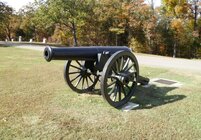
but with the barrel rifled to the James pattern if you were to look inside the muzzle. As for the other two I'm guessing they would look like this for the "64-pdr." James Rifle
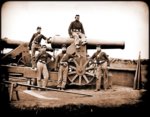
but with rifling of course and like this for the "84-pdr."
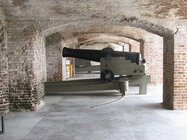 except on a barbette carriage instead of a casemate carriage and with the barrel rifled to the James pattern. Is that right? And were these heavy James Rifles that bombarded Pulaski considered siege guns even though (except for the 24-pdr. conversion) they weren't originally intended for the siege role? My main question is does anyone have pictures of the actual James Rifles that were on Tybee Island that participated in the Pulaski bombardment? Or any others that we know were actually rifled to the James pattern instead of simply photos like I have of the original guns of the same type as were rifled.
My second question is were these five James Rifles, the one "48-pdr." and the two "64-pdrs." and two "84-pdrs." the only five heavy James Rifles of these types that were converted and saw service in the war? Because Craig Swain on the excellent blog To the Sound of the Guns wrote that the Jameses were phased out soon after the Fort Pulaski bombardment and these individual pieces probably went on to arm ironclad river gunboats like USS Cairo. So were these five the only heavy James Rifles made and used in the war and they're famous now instead of a footnote only because of their important role in reducing Fort Pulaski?
Here's what I know about them: There were only five James Rifle conversions that took part in the bombardment and they were at two of the batteries. Battery Sigel had the one 24-pdr. Model 1819 siege gun rifled to the James pattern, confusingly making it a "42-pdr. James Rifle". It was on a siege carriage according to page 80 of the appendix of Professional Papers of the Corps of Engineers of the United States, Volume 8 found here
https://books.google.com/books?id=Y...AJ#v=onepage&q=84-pounder james rifle&f=false
The other four James conversions were in Battery McClellan. Two of the other four were converted 32-pdr. garrison guns (becoming "64-pdr. James Rifles") and they were both on wooden barbette carriages. The two largest Jameses were the converted 42-pdr. seacoast guns (becoming "84-pdr. James Rifles") and they were both also on wooden barbette carriages as per page 79 of the same.
So I would suppose the "42-pdr. James Rifle" on a siege carriage made from a 24-pdr. siege gun would just look like this
but with the barrel rifled to the James pattern if you were to look inside the muzzle. As for the other two I'm guessing they would look like this for the "64-pdr." James Rifle
but with rifling of course and like this for the "84-pdr."
except on a barbette carriage instead of a casemate carriage and with the barrel rifled to the James pattern. Is that right? And were these heavy James Rifles that bombarded Pulaski considered siege guns even though (except for the 24-pdr. conversion) they weren't originally intended for the siege role? My main question is does anyone have pictures of the actual James Rifles that were on Tybee Island that participated in the Pulaski bombardment? Or any others that we know were actually rifled to the James pattern instead of simply photos like I have of the original guns of the same type as were rifled. My second question is were these five James Rifles, the one "48-pdr." and the two "64-pdrs." and two "84-pdrs." the only five heavy James Rifles of these types that were converted and saw service in the war? Because Craig Swain on the excellent blog To the Sound of the Guns wrote that the Jameses were phased out soon after the Fort Pulaski bombardment and these individual pieces probably went on to arm ironclad river gunboats like USS Cairo. So were these five the only heavy James Rifles made and used in the war and they're famous now instead of a footnote only because of their important role in reducing Fort Pulaski?

 Forum Host


 Bringing the