
- Joined
- Dec 30, 2019
This weekend, about a dozen or so Licensed Battlefield Guides will be posted at various points in the Gettysburg National Cemetery to tell stories about the soldiers buried there and a bit about the cemetery itself. The program is FREE and begins at 2:00 Saturday afternoon, October 24, 2020. The program will include stories like the one below.
Of 64 men awarded a Medal of Honor for actions at the Battle of Gettysburg, only one is also buried in the Gettysburg National Cemetery. He is Captain William E. Miller of Company H, 3rd Pennsylvania Cavalry.
William E. Miller was born February 5, 1836, in Cumberland County, Pennsylvania, on a farm just west of Plainfield. He grew up helping his Father with the farm work and and also helping to look after 5 younger siblings. He joined a local cavalry militia unit at age 16. When the Civil War started his militia unit volunteered for service, and Miller was mustered in as 2d Lieutenant of Company H, 3rd Pennsylvania Cavalry on August 8, 1861, at the age of 25. At that time, William Miller was the single parent of two young daughters, Carrie and Elizabeth. His wife, Elizabeth Ann had died of Typhoid in 1859. The absentee father would be away at the war when the younger of the two girls died in 1862.
During training exercises, it was not unusual for some of the militia officers to fail to retain their commissions. Miller, however, was an exception, perhaps because of his 9 years of experience with the militia unit.
Miller first saw action in the Peninsula Campaign in 1862. There he received commendations for being able to deliver an important message to General McClellan. In September, 1862 he was promoted to Captain for his bravery at the Battle of Antietam.
He arrived in Gettysburg in command of a squadron of cavalry consisting of a consolidation of four companies including Company H. All told, Miller had between 80 and 100 men under him. Miller and his men were engaged against the 2d VA Infantry in the fight on Brinkerhoff Ridge on July 2. It seems there was a mad rush by both sides to occupy a certain fence line. The Pennsylvanians made it first and held it throughout that afternoon.
July 3 found the 3rd Pennsylvania Cavalry, along with the rest of Col. John B. McIntosh's Brigade, in the vicinity of the intersection of Hanover and Low Dutch Roads. The 3rd Pennsylvania Cavalry was split, with Miller's squadron being ordered to guard the right of the Union battle line, while the balance of the regiment was sent toward the left flank. Miller deployed his men in a skirmish line and prepared to carry out his instructions to hold that position.
A Confederate Cavalry charge was met by the 7th Michigan Cavalry, led by their brigade commander George A. Custer, then a newly minted Brevet Brigadier General. Although the 7th Michigan was itself forced back, the Confederates also withdrew because their formations had become scattered and disorganized, not only from the fight with the 7th Michigan, but also from flanking fire on both sides, part of which came from Miller's squadron.
But the Confederates were soon reinforced by elements of Hampton's and Fitz Lee's Brigades. The Confederate troopers' advance was described as a grand spectacle. Miller tells us that they advanced with " . . . their polished saber-blades, dazzling in the piercing rays of a bright summer's sun. . . ." Accurate Union artillery fire soon cut gaps in the Confederate formation, but these were quickly closed up as if correcting an error in a dress parade.
As they picked up speed, the 1st Michigan Cavalry, also part of Custer's Brigade, likewise charged forward. The antagonists collided violently. Eyewitnesses said that horses were turned end over end, crushing and injuring their riders under them. Miller recalled that the air was filled with "the clashing of sabres, the firing of pistols, the demands for surrender and the cries of the contestants".
Miller's squadron was in perfect position to strike the enemy in the flank. Yet his orders were to hold his position. He quickly consulted with his lieutenants. Miller is reputed to have told Lt. Brooke-Rawle that he would order a charge if Brooke-Rawle would support him in case Miller was court martialed for disobedience of orders. It seems that Brooke-Rawle was more than ready to support his captain. The formation was quickly tightened, and after delivering a volley the squadron charged forward, cutting off about a third of the attacking column. Although some men were separated and others made casualties, Miller and several of his troopers advanced all the way to the Rummel farm buildings on the other side of the battlefield. There, they found themselves only 100 yards from Breatherd's Confederate Battery. Yet the number of men still with Miller was too few to attempt to capture the guns. Indeed the time had come to start fighting their way back to their original position.
Near the Rummel wagon shed, a Confederate trooper slashed at Miller with his saber. Miller parried the blow with his own sword, but the enemy's blow was so violent that Miller's saber was snapped off. Miller quickly tossed aside the now useless hilt and drew his side arm. Covered by Miller's pistol at point blank range, the Confederate surrendered.
Miller pulled his men into a tighter formation and they began cutting their way back to the position on the right of the Union line. This time they were not cutting through attacking Confederates, but rather through Confederates in retreat, as Custer and Gregg's men had by that time gotten the upper hand. During the fight, Miller received a wound in his right arm.
Far from being in trouble for disobeying orders, upon his return Miller was complimented by General McIntosh. On July 21, 1897, Captain Miller was awarded the Medal of Honor. The citation reads: "Without orders, led a charge of his squadron upon the flank of the enemy, checked his attack, and cut off and dispersed the rear of his column."
Captain Miller continued to serve until the end of his three year enlistment in August of 1864, when he returned to Cumberland County. For a number of years he operated a hardware store on Hanover Street in Carlisle. Later, he sold fire insurance. Miller was active in local politics with the Democratic Party. He served as Chief Burgess of Carlisle and in 1898 was elected to the Pennsylvania State Senate.
William E. Miller died on December 10, 1919, at the age of 83.
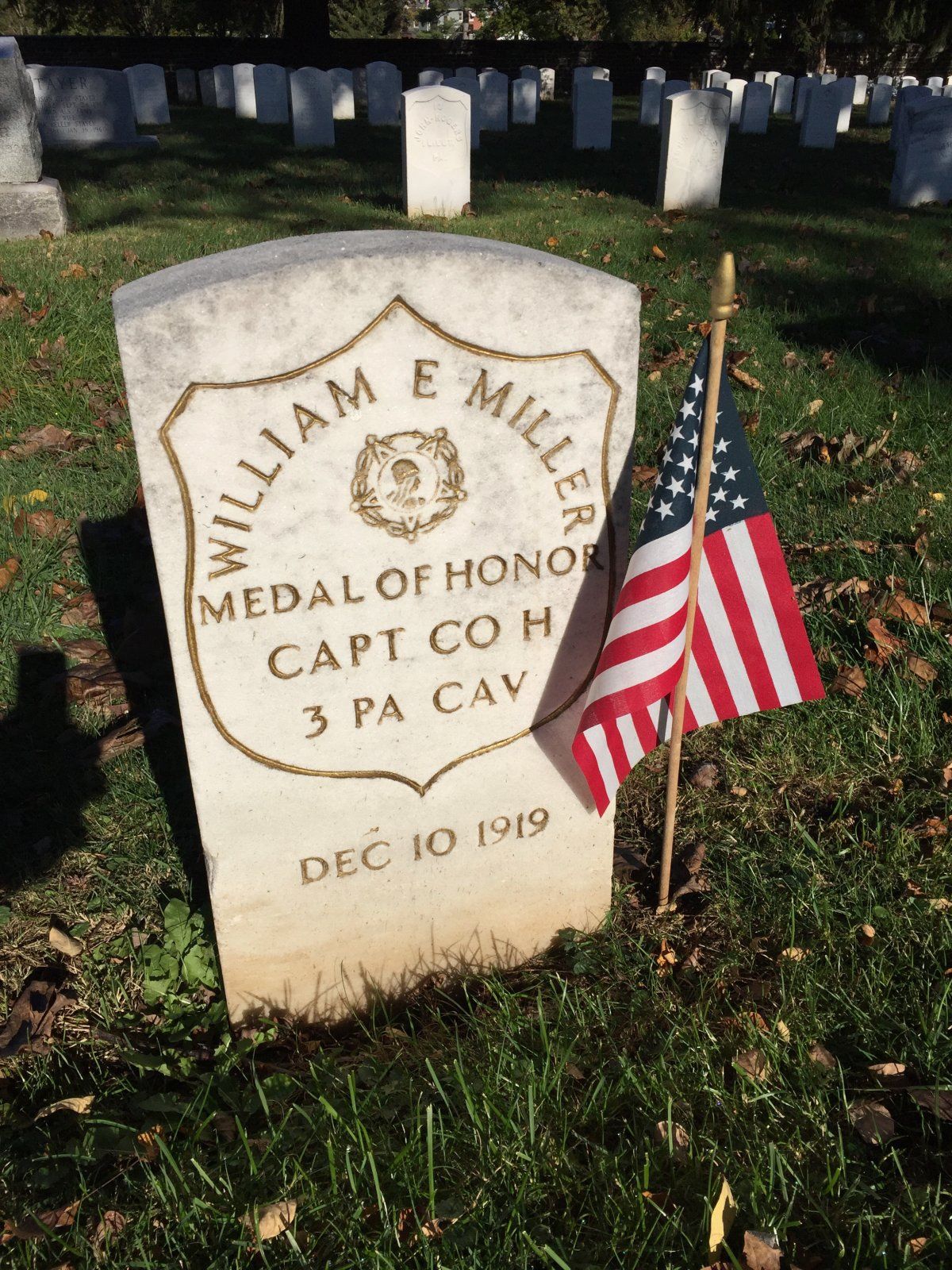
Of 64 men awarded a Medal of Honor for actions at the Battle of Gettysburg, only one is also buried in the Gettysburg National Cemetery. He is Captain William E. Miller of Company H, 3rd Pennsylvania Cavalry.
William E. Miller was born February 5, 1836, in Cumberland County, Pennsylvania, on a farm just west of Plainfield. He grew up helping his Father with the farm work and and also helping to look after 5 younger siblings. He joined a local cavalry militia unit at age 16. When the Civil War started his militia unit volunteered for service, and Miller was mustered in as 2d Lieutenant of Company H, 3rd Pennsylvania Cavalry on August 8, 1861, at the age of 25. At that time, William Miller was the single parent of two young daughters, Carrie and Elizabeth. His wife, Elizabeth Ann had died of Typhoid in 1859. The absentee father would be away at the war when the younger of the two girls died in 1862.
During training exercises, it was not unusual for some of the militia officers to fail to retain their commissions. Miller, however, was an exception, perhaps because of his 9 years of experience with the militia unit.
Miller first saw action in the Peninsula Campaign in 1862. There he received commendations for being able to deliver an important message to General McClellan. In September, 1862 he was promoted to Captain for his bravery at the Battle of Antietam.
He arrived in Gettysburg in command of a squadron of cavalry consisting of a consolidation of four companies including Company H. All told, Miller had between 80 and 100 men under him. Miller and his men were engaged against the 2d VA Infantry in the fight on Brinkerhoff Ridge on July 2. It seems there was a mad rush by both sides to occupy a certain fence line. The Pennsylvanians made it first and held it throughout that afternoon.
July 3 found the 3rd Pennsylvania Cavalry, along with the rest of Col. John B. McIntosh's Brigade, in the vicinity of the intersection of Hanover and Low Dutch Roads. The 3rd Pennsylvania Cavalry was split, with Miller's squadron being ordered to guard the right of the Union battle line, while the balance of the regiment was sent toward the left flank. Miller deployed his men in a skirmish line and prepared to carry out his instructions to hold that position.
A Confederate Cavalry charge was met by the 7th Michigan Cavalry, led by their brigade commander George A. Custer, then a newly minted Brevet Brigadier General. Although the 7th Michigan was itself forced back, the Confederates also withdrew because their formations had become scattered and disorganized, not only from the fight with the 7th Michigan, but also from flanking fire on both sides, part of which came from Miller's squadron.
But the Confederates were soon reinforced by elements of Hampton's and Fitz Lee's Brigades. The Confederate troopers' advance was described as a grand spectacle. Miller tells us that they advanced with " . . . their polished saber-blades, dazzling in the piercing rays of a bright summer's sun. . . ." Accurate Union artillery fire soon cut gaps in the Confederate formation, but these were quickly closed up as if correcting an error in a dress parade.
As they picked up speed, the 1st Michigan Cavalry, also part of Custer's Brigade, likewise charged forward. The antagonists collided violently. Eyewitnesses said that horses were turned end over end, crushing and injuring their riders under them. Miller recalled that the air was filled with "the clashing of sabres, the firing of pistols, the demands for surrender and the cries of the contestants".
Miller's squadron was in perfect position to strike the enemy in the flank. Yet his orders were to hold his position. He quickly consulted with his lieutenants. Miller is reputed to have told Lt. Brooke-Rawle that he would order a charge if Brooke-Rawle would support him in case Miller was court martialed for disobedience of orders. It seems that Brooke-Rawle was more than ready to support his captain. The formation was quickly tightened, and after delivering a volley the squadron charged forward, cutting off about a third of the attacking column. Although some men were separated and others made casualties, Miller and several of his troopers advanced all the way to the Rummel farm buildings on the other side of the battlefield. There, they found themselves only 100 yards from Breatherd's Confederate Battery. Yet the number of men still with Miller was too few to attempt to capture the guns. Indeed the time had come to start fighting their way back to their original position.
Near the Rummel wagon shed, a Confederate trooper slashed at Miller with his saber. Miller parried the blow with his own sword, but the enemy's blow was so violent that Miller's saber was snapped off. Miller quickly tossed aside the now useless hilt and drew his side arm. Covered by Miller's pistol at point blank range, the Confederate surrendered.
Miller pulled his men into a tighter formation and they began cutting their way back to the position on the right of the Union line. This time they were not cutting through attacking Confederates, but rather through Confederates in retreat, as Custer and Gregg's men had by that time gotten the upper hand. During the fight, Miller received a wound in his right arm.
Far from being in trouble for disobeying orders, upon his return Miller was complimented by General McIntosh. On July 21, 1897, Captain Miller was awarded the Medal of Honor. The citation reads: "Without orders, led a charge of his squadron upon the flank of the enemy, checked his attack, and cut off and dispersed the rear of his column."
Captain Miller continued to serve until the end of his three year enlistment in August of 1864, when he returned to Cumberland County. For a number of years he operated a hardware store on Hanover Street in Carlisle. Later, he sold fire insurance. Miller was active in local politics with the Democratic Party. He served as Chief Burgess of Carlisle and in 1898 was elected to the Pennsylvania State Senate.
William E. Miller died on December 10, 1919, at the age of 83.
Last edited by a moderator:

 Forum Host


 Bringing the