
- Joined
- Jan 16, 2015
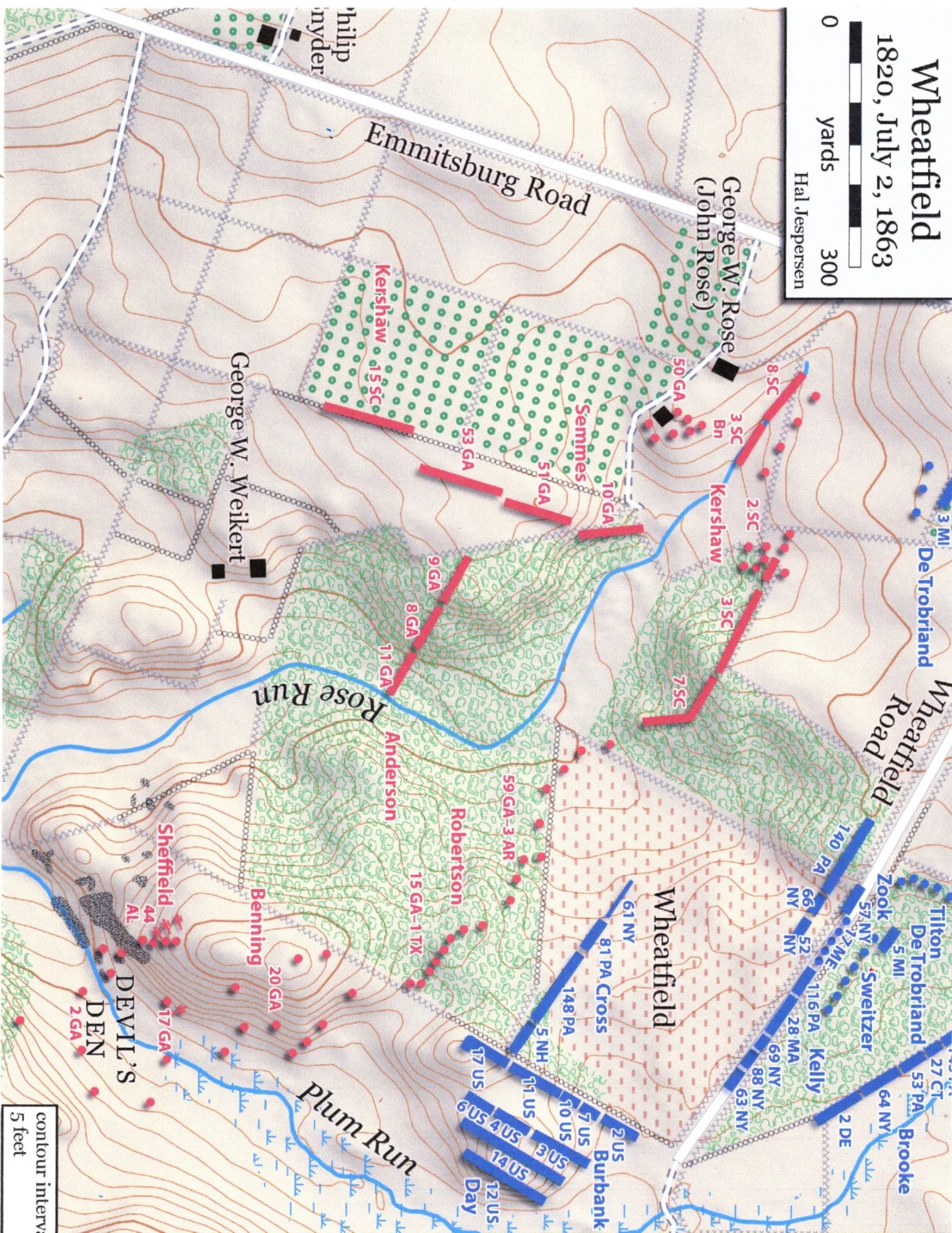
Cross' brigade advances into the Wheatfield and engages Confederate units in Rose's woods. Zook is mortally wounded while leading his brigade forward; Freudenberg assumes command. Kershaw adjusts the right of his line before seeking reinforcements. Semmes' left wavers under Federal artillery fire. Map reflects developments as of 6:20 p.m.
"At this time the left flank was much exposed to the enemy's sharpshooters, and the left company of the Seventeenth U.S. Infantry was thrown back to confront this fire and to a more secure position under a slight rise of ground. During this time another army corps (the Second, I think) was advancing across our front and perpendicular to my line, to attack the enemy to the left." – Colonel Sidney Burbank.
"The fire was so galling that the two left companies of the Seventeenth Infantry (the left regiment) were thrown slightly further back." – 1st Lieutenant Richard Robbins, Company D, 11th U.S. Infantry.
"Part of the Second Corps was in front, and we could not fire with safety." – 1st Lieutenant James P. Pratt, Company E, 11th U.S. Infantry.
"The men, seeing him [Captain Charles A. Bell of Company B] run back with the flag … started themselves to the rear." – Captain Erasmus C. Gilbreath, Company I, 20th Indiana.
"I ordered Colonel [Edward E.] Cross, commanding the First Brigade, to advance in line of battle through a wheat-field, his left resting on the woods which skirted the field. He had advanced but a short distance when he encountered the enemy, and opened upon him a terrific fire, driving him steadily to the farther end of the wheat-field." – Brigadier General John C. Caldwell.
"The moment the heads of Cross' line appear above the crest of the hill the edge of the wood along his entire front and right flank is fringed with a blaze of musketry." – Lieutenant William P. Wilson, Mustering Officer on the staff of Brigadier General John C. Caldwell.
"Engaged the enemy in the woods to the left of the wheatfield, holding the left of the line of the brigade" – Lieutenant Colonel Charles E. Hapgood, 5th New Hampshire.
"Advancing into the wheat-field a short distance, a second halt for a few minutes was made – Captain R. H. Forster, Company A, 148th Pennsylvania.
"We took our position on a knoll in an open field, on the edge of which the enemy lay, under cover of a stone wall and partly concealed by a dense wood." – Lieutenant Colonel Amos Stroh, 81st Pennsylvania.
"Advanced to the front for about 200 yards, and engaged the enemy, who was mostly sheltered behind a stone-wall fence … The enemy's fire was particularly severe" – Lieutenant Colonel K. Oscar Broady, 61st New York.
"We scaled the fence and … advanced, officers and file closers ahead of the men. … We were without any cover. /// We were halted, markers thrown out, and we lined up. As soon as the alignment was perfected, the officers and file closers passed through the ranks and got in rear of the men. Up to this time not a Confederate had been seen in our front. … I kept my eyes to the front, and in a few seconds I saw first one or two men come toward us on a run, and throw themselves down behind this partial stone wall. But a brief time passed when a solid line of men in gray appeared and … the firing opened by both sides." – 2nd Lieutenant Charles A. Fuller, Company C, 61st New York.
"The troops upon my left were driven back, and my left was exposed, when, directing Capt. H. [Henry] E. Moss, Company D, to take charge of the colors, and retaining them there with a few men to hold the hill until the regiment could safely retire, I ordered the regiment to fall back to a stone fence … in rear." – Lieutenant Colonel Philip A. Work, 1st Texas.
"I discovered a large body of the enemy moving so as to put themselves between me and the troops on my left and in my rear, and thereby cut me entirely off from support. /// I learned that a fresh column was moving upon my left flank and were very near me. I immediately halted my line, about-faced, and wheeled it to the then left in order to front the enemy when I again faced to the front. … The enemy were within 150 or 200 yards. I ordered my men to fire and check the further advance of the Yankees." – Colonel Dudley M. DuBose, 15th Georgia.
"We then came into a position where a crossfire from the enemy's infantry took us. On that little knoll I was wounded, and placed in the crevice of some rocks … Our men held position for two or three volleys." – Captain Benton H. Miller, Company D, 59th Georgia.
"A heavy column moved … across the wheat-field to attack my position in such manner as to take the 7th [South Carolina] Regiment in flank on the right. The right wing of this regiment was … thrown back to meet this attack, under the command of Lieutenant Colonel [Elbert] Bland. I then hurried in person to [Brigadier] General [Paul] Semmes, then 150 yards in my right rear, to bring him up to meet the attack on my right, and also to bring forward my right regiment, the 15th [South Carolina], commanded by Colonel W. D. De Saussure, which … was cut off by Semmes' brigade. In the act of leading his regiment, this gallant and accomplished commander of the 15th had just fallen when I reached it." – Brigadier General Joseph B. Kershaw.
"Sheltering ourselves behind some rocks and trees" – Major Robert C. Maffett, 3rd South Carolina.
"The Fifteenth [South Carolina] Regiment met a heavy obstruction, a mock-orange hedge, and it was just after passing this obstacle that Colonel De Saussure fell." – 1st Lieutenant D. Augustus Dickert, Company H, 3rd South Carolina.
"The work of death and destruction did not cease. You could constantly see men falling on all sides" – 2nd Lieutenant Alexander McNeill, Company F, 2nd South Carolina.
"I was shot through the right ankle with an iron from a piece of canister shot" – 5th Sergeant William M. Jones, Company K, 50th Georgia.
"We passed out of the field into a strip of woods" – Captain Andrew J. McBride, Company E, 10th Georgia.
"We come to the edge of the woods … the line was halted for a moment to get breath … One of our regiments [50th Georgia] faltered. General Semmes was standing out in front exhorting them to stand firm; Captain [Andrew J.] McBride ordered the writer and Adjutant [Russell G.] Strickland to 'run down there and rally those men.'" – Sergeant L. L. Cochran, Company E, 10th Georgia.
"Relieved by the advance of [Major General Lafayette] McLaws' division, which finally came up on our left." – Captain George Hillyer, Company C, 9th Georgia.
"[Brigadier] General [Samuel K.] Zook … was fatally shot, a shell having torn open his left shoulder and chest, exposing the heartbeats to observation." – Surgeon William W. Potter, 57th New York.
"As General Zook was jumping his horse over a stone wall, he received the bullet that put an end to his service and his life." – 2nd Lieutenant Gilbert H. Frederick, Company B, 57th New York.
"Captain J. [John] F. McCullough … called out: 'There goes poor Zook!' and looking around I saw him reeling in the saddle, caught in the arms of Capt. J. [Josiah] M. Favill [Faville] and Lieut. C. H. H. Broome, of his staff" – Lieutenant J. Jackson Purman, Company A, 140th Pennsylvania.
"Crossing the edge of the wheatfield we enter the rocky woodland /// in which were scores of huge uprising boulders, so thickly set that we had great difficulty to preserve our alignment." – 1st Lieutenant and Adjutant William S. Shallenberger, 140th Pennsylvania.
"After Gen. Zook was wounded … I took command of the brigade, gave the order 'cease firing' then "forward march,' placing myself in front of the 52d N.Y." – Lieutenant Colonel Charles G. Freudenberg, 52nd New York.
"Halted [and] reformed" – 1st Lieutenant and Adjutant Charles W. Roberts, 17th Maine.
"On reaching the crossroad messengers were sent to procure ammunition … but we got none at the road." –2nd Lieutenant George W. Verrill, Company C, 17th Maine.
"Halted a moment … to take breath" – 1st Lieutenant Edwin B. Houghton, Company H, 17th Maine.
"Deployed and formed" – Major St. Clair A. Mulholland, 116th Pennsylvania.
"I brought the 18th and 22d Mass. to a front and sent for 1st Mich. and 118th [Pa.] who had gone to the rear." – Colonel William S. Tilton.
"We … faced about, and were now fronting … towards the peach orchard. Although our line was broken and irregular, every man kept his eyes on the colors, and each company organization was complete." – Corporal John L. Parker, Company F, 22nd Massachusetts.
"We shook ourselves clear of our Second Corps brothers" – Private Robert G. Carter, Company H, 22nd Massachusetts.
"Reformed our line." – Captain George Lockley, Company A, 1st Michigan.
Sources:
-Official report of Col. S. Burbank.
-The Regular Troops at Gettysburg, by Richard Robbins, Philadelphia Weekly Times, January 4, 1879, p. 1, Greg Coco Collection, Gettysburg National Military Park.
-July 13, 1863, letter of James Pratt to his father, The Soldier of Indiana, p. 116, Greg Coco Collection, Capt. John Ames file, on file at Gettysburg National Military Park.
-Facing Pickett's Charge, by Erasmus C. Gilbreath, Military History Quarterly, Summer 2015, p. 26.
-Official report of John C. Caldwell.
-February 1886, statement of Lt. William P. Wilson, Bachelder Papers, 2:1196.
-Report of Charles E. Hapgood, A History of the Fifth Regiment New Hampshire Volunteers in the American Civil War, 1861-1865, by William Child, Bristol, NH: 1893.
-Address of Maj. R. H. Forster, Dedication of Monument to the 148yh Regiment Infantry, September 11, 1889, Pennsylvania at Gettysburg, II:729.
-Official reports of Lt. Col. Amos Stroh, Lt. Col. K. O. Broady.
-Oration of Lt. Charles A. Fuller, Dedication of the 61st New York Monument, New York at Gettysburg, II:460; Personal Recollections of the War of 1861, by Charles A. Fuller, Sherburne, NY: News Job Printing House, 1906, pp. 93-94.
-Official report of Lt. Col. P. A. Work.
-Official report of Col. D. M. DuBose; Extract of postwar letter of Colonel Dudley McIver DuBose, Fifteenth Georgia Infantry, to Brigadier General Edward Porter Alexander, August 23, 1866, Supplement to the Official Records of the Union and Confederate Armies, ed. by Janet B. Hewett, Noah A. Trudeau, Bryce A. Suderow, Part I, vol. 5, ser. no. 5, Wilmington, NC: Broadfoot Publishing Company, 1995, p. 344.
-Statement of Captain Benton H. Miller, 59th Georgia, Battle of Gettysburg and the Christian Commission, by Andrew B. Cross, Baltimore, MD: 1865, p. 26.
-Kershaw's Brigade at Gettysburg, by J. B. Kershaw, Battles and Leaders of the Civil War, 3:336.
-Official report of Maj. R. C. Maffett.
-History of Kershaw's Brigade, by D. Augustus Dickert, Press of Morningside Bookshop, 1973, pp. 238-239.
-Letters of Alex McNeill, The South Caroliniana Library, University of South Carolina, Columbia.
-War Service and Diary of Sgt. William Moore Jones, Confederate Reminiscences and Letters, 1861-1865, Georgia Division, United Daughters of the Confederacy, Atlanta, GA, 1995, vol. V, p. 118.
-Some Incidents of the March to Gettysburg, by Col. A. J. McBride, The Atlanta Journal, Atlanta, Georgia, August 31, 1901, p. 14.
-The Tenth Georgia Regiment at Gettysburg, by L. L. Cochran, Atlanta Journal, February 23, 1901, on file at Gettysburg National Military Park. (Cochran wrote that Captain McBride had assumed command of the regiment when Colonel John B. Weems became suddenly sick.)
-Official report of Capt. Geo. Hillyer.
-One Surgeon's Private War, Doctor William W. Potter, ed. by John Michael Priest, Shippensburg, PA: White Mane Publishing Co., 1996, pp. 73-74.
-Historical Notes by Rev. Gilbert Frederick, D. D., Dedication of the Monument to the 57th New York, New York at Gettysburg, I:420.
-Recitals and Reminiscences, by 1st Lieutenant J. J. Purman, Co. A, 140th Pennsylvania, National Tribune, March 25, 1909. [Company A was the far left company of the regiment.]
-Address of 1st Lt. and Adjutant W. S. Shallenberger, Dedication of Monument to the 140th Pennsylvania, Pennsylvania at Gettysburg, II:688; History of the One Hundred and Fortieth Regiment Pennsylvania Volunteers, by Prof. Robert Laird Stewart, D.D., Historian, Published by the Authority of the Regimental Association, William S. Shallenberger, 1912, p. 104.
-June 16, 1880, letter of Lt. Col. Charles G. Freudenberg to Colonel John B. Bachelder, Bachelder Papers, 1:667.
-At Gettysburg in 1863 and 1888, by Lieutenant and Adjutant Charles W. Roberts, Read December 5, 1888, War Papers, Maine, Military Order of the United States, vol. 1, p. 51.
-The Seventeenth Maine at Gettysburg and the Wilderness, by Capt. George W. Verrill, War Papers, read May 2, 1894, Portland, Maine, vol. 1, p. 268.
-The Campaigns of the Seventeenth Maine, by Edwin B. Houghton, Portland, ME: Short & Loring, 1866, p. 93.
-The Story of the 116th Regiment, Pennsylvania Infantry, by Brevet Major General St. Clair A. Mulholland, Philadelphia, PA: Printers: F. McManus Jr. & Co., 1899, p. 136.
-Diaries of William S. Tilton, Massachusetts Historical Society, on file at Gettysburg National Military Park.
-History of the Twenty-Second Massachusetts Infantry, by John L. Parker, assisted by Robert G. Carter and the Historical Committee, Boston, MA: 1887, p. 335.
-Four Brothers in Blue, by Captain Robert Goldthwaite Carter, Austin, TX: University of Texas Press, Austin, TX: 1978, p. 310.
-George Lockley Papers, Pocket Diary 1863, Bentley Historical Society, University of Michigan (online).
"At this time the left flank was much exposed to the enemy's sharpshooters, and the left company of the Seventeenth U.S. Infantry was thrown back to confront this fire and to a more secure position under a slight rise of ground. During this time another army corps (the Second, I think) was advancing across our front and perpendicular to my line, to attack the enemy to the left." – Colonel Sidney Burbank.
"The fire was so galling that the two left companies of the Seventeenth Infantry (the left regiment) were thrown slightly further back." – 1st Lieutenant Richard Robbins, Company D, 11th U.S. Infantry.
"Part of the Second Corps was in front, and we could not fire with safety." – 1st Lieutenant James P. Pratt, Company E, 11th U.S. Infantry.
"The men, seeing him [Captain Charles A. Bell of Company B] run back with the flag … started themselves to the rear." – Captain Erasmus C. Gilbreath, Company I, 20th Indiana.
"I ordered Colonel [Edward E.] Cross, commanding the First Brigade, to advance in line of battle through a wheat-field, his left resting on the woods which skirted the field. He had advanced but a short distance when he encountered the enemy, and opened upon him a terrific fire, driving him steadily to the farther end of the wheat-field." – Brigadier General John C. Caldwell.
"The moment the heads of Cross' line appear above the crest of the hill the edge of the wood along his entire front and right flank is fringed with a blaze of musketry." – Lieutenant William P. Wilson, Mustering Officer on the staff of Brigadier General John C. Caldwell.
"Engaged the enemy in the woods to the left of the wheatfield, holding the left of the line of the brigade" – Lieutenant Colonel Charles E. Hapgood, 5th New Hampshire.
"Advancing into the wheat-field a short distance, a second halt for a few minutes was made – Captain R. H. Forster, Company A, 148th Pennsylvania.
"We took our position on a knoll in an open field, on the edge of which the enemy lay, under cover of a stone wall and partly concealed by a dense wood." – Lieutenant Colonel Amos Stroh, 81st Pennsylvania.
"Advanced to the front for about 200 yards, and engaged the enemy, who was mostly sheltered behind a stone-wall fence … The enemy's fire was particularly severe" – Lieutenant Colonel K. Oscar Broady, 61st New York.
"We scaled the fence and … advanced, officers and file closers ahead of the men. … We were without any cover. /// We were halted, markers thrown out, and we lined up. As soon as the alignment was perfected, the officers and file closers passed through the ranks and got in rear of the men. Up to this time not a Confederate had been seen in our front. … I kept my eyes to the front, and in a few seconds I saw first one or two men come toward us on a run, and throw themselves down behind this partial stone wall. But a brief time passed when a solid line of men in gray appeared and … the firing opened by both sides." – 2nd Lieutenant Charles A. Fuller, Company C, 61st New York.
"The troops upon my left were driven back, and my left was exposed, when, directing Capt. H. [Henry] E. Moss, Company D, to take charge of the colors, and retaining them there with a few men to hold the hill until the regiment could safely retire, I ordered the regiment to fall back to a stone fence … in rear." – Lieutenant Colonel Philip A. Work, 1st Texas.
"I discovered a large body of the enemy moving so as to put themselves between me and the troops on my left and in my rear, and thereby cut me entirely off from support. /// I learned that a fresh column was moving upon my left flank and were very near me. I immediately halted my line, about-faced, and wheeled it to the then left in order to front the enemy when I again faced to the front. … The enemy were within 150 or 200 yards. I ordered my men to fire and check the further advance of the Yankees." – Colonel Dudley M. DuBose, 15th Georgia.
"We then came into a position where a crossfire from the enemy's infantry took us. On that little knoll I was wounded, and placed in the crevice of some rocks … Our men held position for two or three volleys." – Captain Benton H. Miller, Company D, 59th Georgia.
"A heavy column moved … across the wheat-field to attack my position in such manner as to take the 7th [South Carolina] Regiment in flank on the right. The right wing of this regiment was … thrown back to meet this attack, under the command of Lieutenant Colonel [Elbert] Bland. I then hurried in person to [Brigadier] General [Paul] Semmes, then 150 yards in my right rear, to bring him up to meet the attack on my right, and also to bring forward my right regiment, the 15th [South Carolina], commanded by Colonel W. D. De Saussure, which … was cut off by Semmes' brigade. In the act of leading his regiment, this gallant and accomplished commander of the 15th had just fallen when I reached it." – Brigadier General Joseph B. Kershaw.
"Sheltering ourselves behind some rocks and trees" – Major Robert C. Maffett, 3rd South Carolina.
"The Fifteenth [South Carolina] Regiment met a heavy obstruction, a mock-orange hedge, and it was just after passing this obstacle that Colonel De Saussure fell." – 1st Lieutenant D. Augustus Dickert, Company H, 3rd South Carolina.
"The work of death and destruction did not cease. You could constantly see men falling on all sides" – 2nd Lieutenant Alexander McNeill, Company F, 2nd South Carolina.
"I was shot through the right ankle with an iron from a piece of canister shot" – 5th Sergeant William M. Jones, Company K, 50th Georgia.
"We passed out of the field into a strip of woods" – Captain Andrew J. McBride, Company E, 10th Georgia.
"We come to the edge of the woods … the line was halted for a moment to get breath … One of our regiments [50th Georgia] faltered. General Semmes was standing out in front exhorting them to stand firm; Captain [Andrew J.] McBride ordered the writer and Adjutant [Russell G.] Strickland to 'run down there and rally those men.'" – Sergeant L. L. Cochran, Company E, 10th Georgia.
"Relieved by the advance of [Major General Lafayette] McLaws' division, which finally came up on our left." – Captain George Hillyer, Company C, 9th Georgia.
"[Brigadier] General [Samuel K.] Zook … was fatally shot, a shell having torn open his left shoulder and chest, exposing the heartbeats to observation." – Surgeon William W. Potter, 57th New York.
"As General Zook was jumping his horse over a stone wall, he received the bullet that put an end to his service and his life." – 2nd Lieutenant Gilbert H. Frederick, Company B, 57th New York.
"Captain J. [John] F. McCullough … called out: 'There goes poor Zook!' and looking around I saw him reeling in the saddle, caught in the arms of Capt. J. [Josiah] M. Favill [Faville] and Lieut. C. H. H. Broome, of his staff" – Lieutenant J. Jackson Purman, Company A, 140th Pennsylvania.
"Crossing the edge of the wheatfield we enter the rocky woodland /// in which were scores of huge uprising boulders, so thickly set that we had great difficulty to preserve our alignment." – 1st Lieutenant and Adjutant William S. Shallenberger, 140th Pennsylvania.
"After Gen. Zook was wounded … I took command of the brigade, gave the order 'cease firing' then "forward march,' placing myself in front of the 52d N.Y." – Lieutenant Colonel Charles G. Freudenberg, 52nd New York.
"Halted [and] reformed" – 1st Lieutenant and Adjutant Charles W. Roberts, 17th Maine.
"On reaching the crossroad messengers were sent to procure ammunition … but we got none at the road." –2nd Lieutenant George W. Verrill, Company C, 17th Maine.
"Halted a moment … to take breath" – 1st Lieutenant Edwin B. Houghton, Company H, 17th Maine.
"Deployed and formed" – Major St. Clair A. Mulholland, 116th Pennsylvania.
"I brought the 18th and 22d Mass. to a front and sent for 1st Mich. and 118th [Pa.] who had gone to the rear." – Colonel William S. Tilton.
"We … faced about, and were now fronting … towards the peach orchard. Although our line was broken and irregular, every man kept his eyes on the colors, and each company organization was complete." – Corporal John L. Parker, Company F, 22nd Massachusetts.
"We shook ourselves clear of our Second Corps brothers" – Private Robert G. Carter, Company H, 22nd Massachusetts.
"Reformed our line." – Captain George Lockley, Company A, 1st Michigan.
Sources:
-Official report of Col. S. Burbank.
-The Regular Troops at Gettysburg, by Richard Robbins, Philadelphia Weekly Times, January 4, 1879, p. 1, Greg Coco Collection, Gettysburg National Military Park.
-July 13, 1863, letter of James Pratt to his father, The Soldier of Indiana, p. 116, Greg Coco Collection, Capt. John Ames file, on file at Gettysburg National Military Park.
-Facing Pickett's Charge, by Erasmus C. Gilbreath, Military History Quarterly, Summer 2015, p. 26.
-Official report of John C. Caldwell.
-February 1886, statement of Lt. William P. Wilson, Bachelder Papers, 2:1196.
-Report of Charles E. Hapgood, A History of the Fifth Regiment New Hampshire Volunteers in the American Civil War, 1861-1865, by William Child, Bristol, NH: 1893.
-Address of Maj. R. H. Forster, Dedication of Monument to the 148yh Regiment Infantry, September 11, 1889, Pennsylvania at Gettysburg, II:729.
-Official reports of Lt. Col. Amos Stroh, Lt. Col. K. O. Broady.
-Oration of Lt. Charles A. Fuller, Dedication of the 61st New York Monument, New York at Gettysburg, II:460; Personal Recollections of the War of 1861, by Charles A. Fuller, Sherburne, NY: News Job Printing House, 1906, pp. 93-94.
-Official report of Lt. Col. P. A. Work.
-Official report of Col. D. M. DuBose; Extract of postwar letter of Colonel Dudley McIver DuBose, Fifteenth Georgia Infantry, to Brigadier General Edward Porter Alexander, August 23, 1866, Supplement to the Official Records of the Union and Confederate Armies, ed. by Janet B. Hewett, Noah A. Trudeau, Bryce A. Suderow, Part I, vol. 5, ser. no. 5, Wilmington, NC: Broadfoot Publishing Company, 1995, p. 344.
-Statement of Captain Benton H. Miller, 59th Georgia, Battle of Gettysburg and the Christian Commission, by Andrew B. Cross, Baltimore, MD: 1865, p. 26.
-Kershaw's Brigade at Gettysburg, by J. B. Kershaw, Battles and Leaders of the Civil War, 3:336.
-Official report of Maj. R. C. Maffett.
-History of Kershaw's Brigade, by D. Augustus Dickert, Press of Morningside Bookshop, 1973, pp. 238-239.
-Letters of Alex McNeill, The South Caroliniana Library, University of South Carolina, Columbia.
-War Service and Diary of Sgt. William Moore Jones, Confederate Reminiscences and Letters, 1861-1865, Georgia Division, United Daughters of the Confederacy, Atlanta, GA, 1995, vol. V, p. 118.
-Some Incidents of the March to Gettysburg, by Col. A. J. McBride, The Atlanta Journal, Atlanta, Georgia, August 31, 1901, p. 14.
-The Tenth Georgia Regiment at Gettysburg, by L. L. Cochran, Atlanta Journal, February 23, 1901, on file at Gettysburg National Military Park. (Cochran wrote that Captain McBride had assumed command of the regiment when Colonel John B. Weems became suddenly sick.)
-Official report of Capt. Geo. Hillyer.
-One Surgeon's Private War, Doctor William W. Potter, ed. by John Michael Priest, Shippensburg, PA: White Mane Publishing Co., 1996, pp. 73-74.
-Historical Notes by Rev. Gilbert Frederick, D. D., Dedication of the Monument to the 57th New York, New York at Gettysburg, I:420.
-Recitals and Reminiscences, by 1st Lieutenant J. J. Purman, Co. A, 140th Pennsylvania, National Tribune, March 25, 1909. [Company A was the far left company of the regiment.]
-Address of 1st Lt. and Adjutant W. S. Shallenberger, Dedication of Monument to the 140th Pennsylvania, Pennsylvania at Gettysburg, II:688; History of the One Hundred and Fortieth Regiment Pennsylvania Volunteers, by Prof. Robert Laird Stewart, D.D., Historian, Published by the Authority of the Regimental Association, William S. Shallenberger, 1912, p. 104.
-June 16, 1880, letter of Lt. Col. Charles G. Freudenberg to Colonel John B. Bachelder, Bachelder Papers, 1:667.
-At Gettysburg in 1863 and 1888, by Lieutenant and Adjutant Charles W. Roberts, Read December 5, 1888, War Papers, Maine, Military Order of the United States, vol. 1, p. 51.
-The Seventeenth Maine at Gettysburg and the Wilderness, by Capt. George W. Verrill, War Papers, read May 2, 1894, Portland, Maine, vol. 1, p. 268.
-The Campaigns of the Seventeenth Maine, by Edwin B. Houghton, Portland, ME: Short & Loring, 1866, p. 93.
-The Story of the 116th Regiment, Pennsylvania Infantry, by Brevet Major General St. Clair A. Mulholland, Philadelphia, PA: Printers: F. McManus Jr. & Co., 1899, p. 136.
-Diaries of William S. Tilton, Massachusetts Historical Society, on file at Gettysburg National Military Park.
-History of the Twenty-Second Massachusetts Infantry, by John L. Parker, assisted by Robert G. Carter and the Historical Committee, Boston, MA: 1887, p. 335.
-Four Brothers in Blue, by Captain Robert Goldthwaite Carter, Austin, TX: University of Texas Press, Austin, TX: 1978, p. 310.
-George Lockley Papers, Pocket Diary 1863, Bentley Historical Society, University of Michigan (online).


 Forum Host


 Bringing the