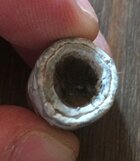
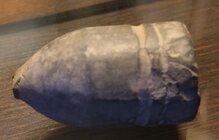
Gardner One-Ring Minie Ball?

skb8721

Corporal
Joined
Sep 10, 2014
Location
New Iberia, Louisiana, on Bayou Teche
I found this Minie ball this morning while walking the Fort Bisland battlefield in Louisiana (with permission of the landowner). As best I can tell, it's a Gardner, though when I measure the caliber it comes out to .5625. (I don't have calipers; I just measured the diameter against a ruler, and it came out to 9/16 of an inch, which = .5625 caliber.) Do you all concur it's a Gardner .56 (was there even such a thing?) and is it therefore necessarily Confederate? Thanks!
 

Attachments

  • Photo Feb 05, 1 52 27 PM.jpg
    Photo Feb 05, 1 52 27 PM.jpg
    124.8 KB · Views: 318
  • Photo Feb 05, 2 21 08 PM.jpg
    Photo Feb 05, 2 21 08 PM.jpg
    87.1 KB · Views: 286
It's defiantly has a Gardner insert, it hard to tell from the photo does it have one or 2 grooves? I believe it listed in McKee and Mason's book as #176 as a .577 CSA with a length of .980 and a diameter of .571
 
It's defiantly has a Gardner insert, it hard to tell from the photo does it have one or 2 grooves? I believe it listed in McKee and Mason's book as #176 as a .577 CSA with a length of .980 and a diameter of .571

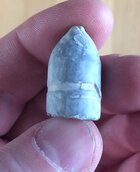
Thanks for your reply. Here's another image of the ball: note it has one ring and then a small groove below that ring. Also, the length is .9, more or less.
 

Attachments

  • Photo Feb 05, 4 12 21 PM.jpg
    Photo Feb 05, 4 12 21 PM.jpg
    76.5 KB · Views: 268
From that photo it appears to have carved on just a little.
 
The second photo with better detail seems to show the common Gardner two ring.

Although, if I may, what is seen in the base as an "insert" is actually an integral part of the bullet itself. The Gardner bullet was cast with a wide "Saturn-like" flange ring around the circumference. In constructing the cartridge, the smaller diameter base of the bullet was inserted into the paper cartridge tube, then the whole thing went into a press which pressed, or flanged, the wide ring down over the paper tube making the whole cartridge one piece. Then the powder charge was poured into the open end of the tube. The final step was to fold the tail end of the paper tube over.
J.
 
Looks to be a fired Gardner with ramrod imprint was this lying on the ground exposed to the weather or dug only asking because of the lack of a patina.
 
was this lying on the ground exposed to the weather or dug only asking because of the lack of a patina.

It was lying on the ground.

The Fort Bisland battlefield is today, as it was at the time of the battle, a sugarcane field. Because harvest had recently occurred, the field was bare; and it's been dry lately. So conditions were good for artifact hunting.

I went out with my metal detector (again, with permission of the land owner), gauged my metal detector to a Minié ball that someone else had found the day before, and started looking. I ignored all hits that did not match the signature of the Minié ball I had used for gauging my detector, and within 5 or 10 minutes I had a matching hit. I began to move away the top soil with my hands, and there it was, sitting right there on the surface. (I spent about 2 hours metal detecting, and this was the only battle-related artifact I found, or at least that I could be sure of.)
 
That's a neat find I've found 2 or 3 minieballs over the years that were blue like that but most have a white or some other type of patina. I always wondered why once in a while a blue one is found maybe it's something in the lead.
 
That's a neat find I've found 2 or 3 minieballs over the years that were blue like that but most have a white or some other type of patina. I always wondered why once in a while a blue one is found maybe it's something in the lead.

Its in the soil, fertilizer, lime content etc. Ive found minnies at Fort Morgan and Fort Gaines (beach sand) that were encrusted in a black ball and you had to crack them open and the bullet would be black.
 
Its in the soil, fertilizer, lime content etc. Ive found minnies at Fort Morgan and Fort Gaines (beach sand) that were encrusted in a black ball and you had to crack them open and the bullet would be black.
I agree with you ucvrelics the ones I've found were always out of working farm fields and are white and chalky I've only ever found 3 or so that could be considered blue or actual lead color.
 

Learn About Us
About CivilWarTalk
Contact the Webmaster
Meet the Staff
Link to CivilWarTalk
Join Our Community
Register
Browse Forums
View Today's Discussions
Search the Forum
Get Help
FAQ
Student Guide
Forum Rules & Etiquette
Copyright / DMCA

     Contact Us CivilwarTalk on Facebook CivilWarTalk on YouTube CivilWarTalk on Twitter RSS Feed

Bringing the American Civil War and More to Life.
© 1999 - , CIVILWARTALK, LLC - Site Version 10.0

SlaveryTalk.com - SecessionTalk.com - CivilWarTalk.com - ReconstructionTalk.com
Back
Top