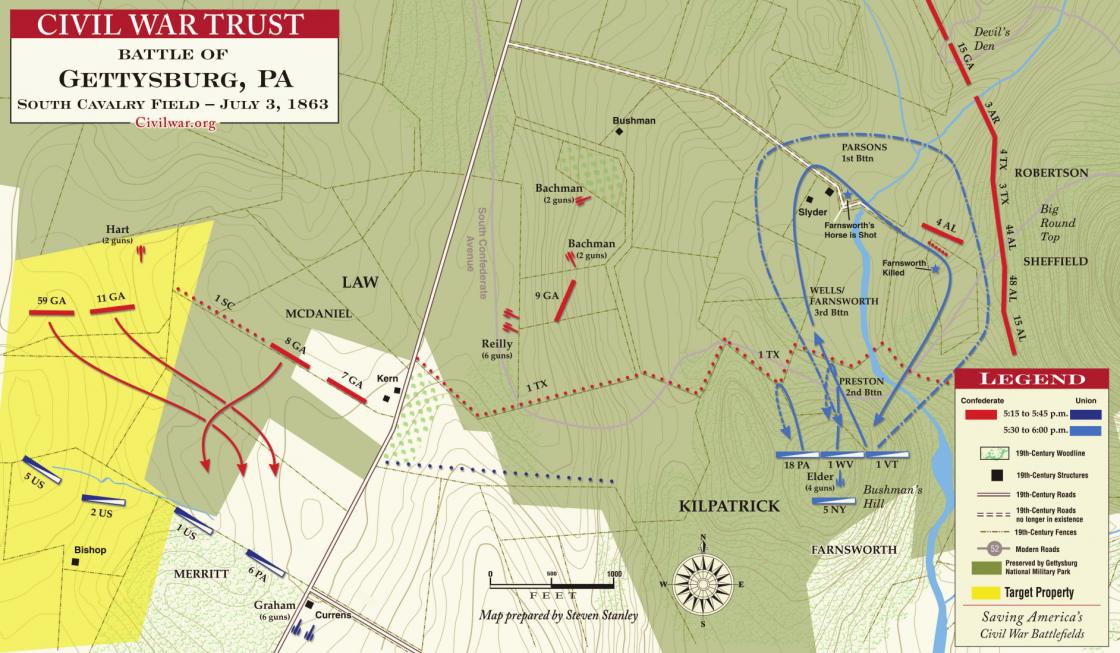
Attached map attempts to clarify the encounter near the Slyder buildings between the 1st Vermont Cavalry and 4th Alabama Infantry, principally relying on the accounts of Lieutenant Parsons of the 1st Vermont Cavalry (who includes an account by Captain James T. Jones of Company D, 4th Alabama) and a detailed account from another officer from the 4th found in Coles' History of the 4th Regiment Alabama Volunteer Infantry.
These accounts agree that the encounter was a surprise for both parties, the men of the 4th Alabama emerging from the woods to find a portion of the 1st Vermont Cavalry moving upon them at close range. (It reminds me of Wofford's men emerging from the woods to find the 4th Michigan right in front of them, on July 2.)
My previous research had positioned the 4th Alabama on the west slope of Big Round Top as shown. Facing to the rear and advancing in disorder would have them emerging from the woods with the Vermont cavalry coming down the road (per Parsons) to their right. This contention is sustained in the Coles' account, when the officer stated that Private Samuel T. Whitworth of Company F swung his weapon around to the right so quickly that he struck the officer in the head with the barrel.
What happened next is not so clear cut. The 4th Alabama was said to have cleared their front and advanced eastward toward their artillery across the valley. In that direction they soon saw Federal cavalry – my guess is the same force they had just repulsed. Parsons seems to describe another route taken, back in the direction they came from, so I have put question marks on the retreating lines. Neither of the 4th Alabama sources indicate that some of the Federal cavalry went past them to skirt the base of Big Round Top.
Pertinent portions of the aforementioned accounts:
(Farnsworth's Charge and Death, by H. C. Parsons, Captain, 1st Vermont Cavalry, Battles and Leaders of the Civil War) We rode through the enemy's skirmish line across the fields, over the low stone fences, past the Slyder house, and down the road. The sun was blinding; Captain Cushman shaded his eyes with his hand and cried, "An ambuscade!" We were immediately upon the enemy, within thirty paces, and the deadly volley, which is referred to in Confederate reports, was fired, but it passed over our heads; although they report that half our saddles were emptied, not a man was shot, yet the fire was the close and concentrated volley our a regiment. Captain (afterwards Colonel) Jones, who commanded the right of the 4th Alabama, says: "I was ordered to face about to resist cavalry; we marched rapidly to the rear over the rocks, and the Vermonters were upon us before we could form. They were within a few paces when we gave the order to fire." … The whole regiment fired, but when the smoke cleared I only saw one horse fall. A private at my left said, "Captain, I shot that black." I said, "Why didn't you shoot the rider?" He replied, "Oh, we'll get him anyhow, but I'm a hunter, and for three years I haven't looked at a deer's eye – I couldn't stand it." Taken by surprise, they had shot over us; the next, a random volley, was effective. With the head of the column we cleared the wall at the right and formed under cover of the hill. The rear companies fell back and formed behind a cross fence and in the edge of the timber.
(From Huntsville to Appomattox: R. T. Coles' History of 4th Regiment Alabama Volunteer Infantry, C. S. A., Army of Northern Virginia) A courier [Law's staff officer, Lt. Wade] came rushing up to the regiment at full speed with orders to double quick to the right. Without awaiting orders from Lt. Col. Scruggs, who had early that morning returned from the hospital partially recovered from his [heat] exhaustion of the evening before, everyone, without the semblance of order, with rear in front, and only keeping with each other, companies all commingled, the most fleet-foot leading, ran through the woods in the direction of the firing. … Just as we were about to emerge from the timber into the open field, we saw a squadron of Union cavalry bearing down upon us at a gallop. It came in smashing style from the direction of Capt. Reilly's battery … men … unusually nervous … limbs were stiffened and sore from over exertion … One little fellow of C Company was particularly rattled … when Lt. Vaughn of his company called out in a loud voice, "Cavalry, boys, cavalry' this is no fight, only a frolic; give it to 'em." … In the confusion Sam Whitworth of F Company, not seeing me in his front, threw his rifle around to his right as the Vermonters came down in gallant style from that direction, and struck me on the left side of my head with the barrel of his piece and fired. I was only shocked for an instant … When Sam fired, the Union troopers leading the charge were not ten paces from us, and our whole line scattered along the edge of the timber was pouring a deadly fire into their ranks. A young trooper's beautiful sorrel mare fell, shot in the breast only a few paces from our line. The trooper came down with her, standing erect on his feet, astride of her. Instead of surrendering he quickly threw up his carbine and discharged it directly in our faces, but fortunately no harm was done. Then, throwing down his gun, he jumped from over his horse and ran. A puff of dust flew out of his blouse … as the bullet penetrated between his shoulders, and he fell, meeting the same fate as his horse. Clearing our front we rapidly advanced eastward across the open field … in the direction of Capt. Reilly's battery could be seen a small force of Union cavalry.




 Keeper of the Scales


 Bringing the