Decisions at Raymond Part 5

tony_gunter

2nd Lieutenant
Joined
Feb 19, 2011
Location
Mississippi
Edit: On May 9th, McPherson receives intel from the citizens of Utica that Beauregard is moving to Jackson at the head of an army of reinforcements. On May 11th, his cavalry raid returns with intel that up to 14,000 troops have passed through Crystal Springs from Port Hudson.

The same day, McPherson receives orders to push into Raymond on the 12th. His men are up and marching at first light. After marching for 8 miles, firing is heard up ahead. The column is stopped and ordered to close up. A courier rides to confer with McPherson.

The consolidated escort companies McPherson is using as cavalry to screen his advance has surprised the company of Mississippi State cavalry and put them to chase for 2 miles, but runs into infantry pickets guarding the bridge at Fourteen Mile Creek. McPherson orders the leading brigade (Dennis') into line of battle with skirmishers well out front. They march through the thick underbrush like this for a mile, battling briars and struggling to maintain the integrity of the line. The men begin to grumble and question the backbone and sanity of the ad hoc cavalry battalion. McPherson shortens the line to two regiments and pushes on. When they emerge into a field facing Fourteen Mile Creek, gunfire erupts. The brigade has met the pickets guarding the creek. DeGolyer's Battery is called forward and scatters the defenders. McPherson orders the brigade to form on the far edge of the field and stack arms to rest.

McPherson then orders the next brigade in line (Smith's) to form line of battle to the right of the road where they are, 1/2 mile to the rear, and march through the woods into place beside Dennis' Brigade. Smiths Brigade runs out of room in the field, and the 68th Ohio is ordered to pull out of line and move to the extreme left. Smith still does not have room in the field, so the 23rd Indiana and 31st Illinois end up forming line in the woods. The 31st Illinois forms perpendicular to the 23rd Indiana, a refused flank. The escort companies also push into the woods to watch the right flank.

McPherson also calls up Stevenson's Brigade and orders them to form into line where Smith had first formed. He then sends back word to Crocker to have his men rest where they are.

Ominous clouds of dust arise in the distance, moving from Raymond to the Federal right flank, signaling Confederate intent to oppose the crossing of the creek. A half mile away, a Confederate battery opens up shelling the tree line where Dennis' brigade is sheltering from the oppressive sun.

Logan is incensed at this very deliberate deployment. He demands that McPherson call up his available force in full and push across the creek en masse. But McPherson stands firm. Once Stevenson is in place as a reserve, he orders the leading brigades to cross the creek. The company and brigade musicians have been ordered into line with rifles, so the orders are carried verbally.

Why the deliberate deployment? Why not bring up Crocker? Will having the edge of the right wing deployed in the woods cause problems? Any advantages / disadvantages by silencing the drums and bugles? Is the line correctly arranged for the situation?
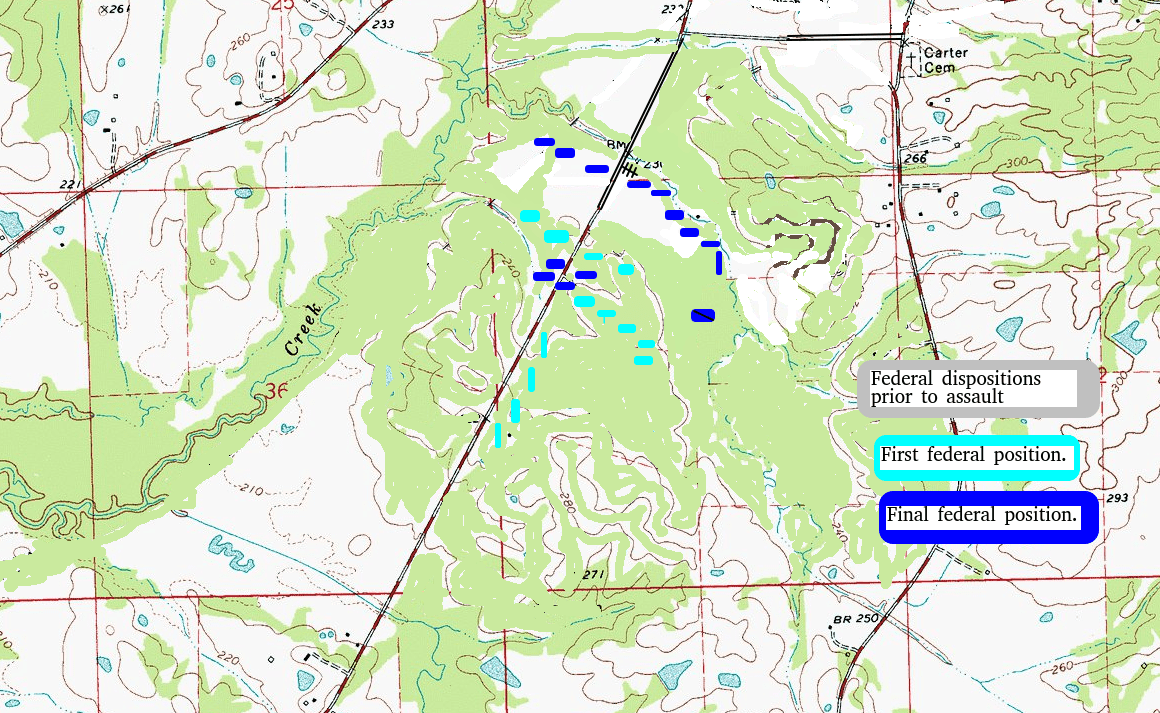
approach1.png
 
Last edited:
McPherson receives orders May 11th to push into Raymond on the 12th. His men are up and marching at first light. After marching for 8 miles, firing is heard up ahead. The column is stopped and ordered to close up. A courier rides to confer with McPherson.

The consolidated escort companies McPherson is using as cavalry to screen his advance has surprised the company of Mississippi State cavalry and put them to chase for 2 miles, but runs into infantry pickets guarding the bridge at Fourteen Mile Creek. McPherson orders the leading brigade (Dennis') into line of battle with skirmishers well out front. They march through the thick underbrush like this for a mile, battling briars and struggling to maintain the integrity of the line. The men begin to grumble and question the backbone and sanity of the ad hoc cavalry battalion. McPherson shortens the line to two regiments and pushes on. When they emerge into a field facing Fourteen Mile Creek, gunfire erupts. The brigade has met the pickets guarding the creek. DeGolyer's Battery is called forward and scatters the defenders. McPherson orders the brigade to form on the edge of the field and stack arms to rest.


General Logan says once Dennis' brigade was deployed into line, the two cavalry escort companies advanced in front of them as skirmishers to recon.

1728009509491.png


Regarding the Confederate's advance position in the creek bank at the outset of the action, a correspondent with the Cincinnati Commercial reported of it...

1728011950455.png


Same account says the locals said Gregg's force was ca. 3,000, but the Union officers estimated at twice that given the various units represented by prisoners...

1728012080490.png


McPherson then orders the next brigade in line (Smith's) to form line of battle to the right of the road where they are, 1/2 mile to the rear, and march through the woods into place beside Dennis' Brigade. Smiths Brigade runs out of room in the field, and the 68th Ohio is ordered to pull out of line and move to the extreme left. Smith still does not have room in the field, so the 23rd Indiana and 31st Illinois end up forming line in the woods. The 31st Illinois forms perpendicular to the 23rd Indiana, a refused flank. The escort companies also push into the woods to watch the right flank.

McPherson also calls up Stevenson's Brigade and orders them to form into line where Smith had first formed. He then sends back word to Crocker to have his men rest where they are.

General McPherson reported that Dennis' brigade was deployed across the road. So when Smith's brigade was formed it was formed on the right of Dennis' brigade, but yes, somewhere to the right of the road, but not on the road.

1728010721208.png


Gen. Logan reports same...
1728010871247.png


Crocker's men didn't rest. they were placed in reserve. Per McPherson:

1728011144588.png
 
General Logan says once Dennis' brigade was deployed into line, the two cavalry escort companies advanced in front of them as skirmishers to recon.

View attachment 523617

Regarding the Confederate's advance position in the creek bank at the outset of the action, a correspondent with the Cincinnati Commercial reported of it...

View attachment 523621

Same account says the locals said Gregg's force was ca. 3,000, but the Union officers estimated at twice that given the various units represented by prisoners...

View attachment 523622


General McPherson reported that Dennis' brigade was deployed across the road. So when Smith's brigade was formed it was formed on the right of Dennis' brigade, but yes, somewhere to the right of the road, but not on the road.

View attachment 523618

Gen. Logan reports same...
View attachment 523619


Crocker's men didn't rest. they were placed in reserve. Per McPherson:

View attachment 523620
The federal reports were all written weeks after the battle, so they're not terribly descriptive and they compress the time into a veni vidi vici format. 😃

You have to pick out the little details. From the 23rd Indiana:

"At 11 o'clock a.m. of May 12, the Twenty-third Regiment Indiana Volunteers was ordered to take position upon the right of the main road, on the right of the brigade. Having taken this position, we moved forward in line of battle, across open fields, to the edge of some timber, distant about half a mile."

So the second brigade was formed half a mile from the front line to the right of the road and marched into place while the first brigade rested and waited. The description makes it sound like it was open fields for that half mile.

The third brigade report makes it sound like they just marched right up the road and jumped into the fray:

"I caused the command to move with alacrity, coming up to the crest of a hill in full view of the field."

But look at how the Confederates describe their first glimpse of the third brigade:

"It was not long before General [John] Gregg rode up and ordered me to move through an old field into a woods in rear of the enemy's battery, and attack the battery in rear unless I should find it too strongly protected by infantry, and, in the latter event, to fall back, maintaining as good order as possible. The Tenth and Thirtieth Tennessee Regiments, under Colonel [R. W.] MacGavock, were ordered to support me in the attack. On passing the picket station in the field, I was informed by one of the sentinels that the enemy had possession of the woods, and that the commands of their officers could be distinctly heard. I deployed skirmishers in advance of the regiment and moved cautiously into the woods. The skirmishers had to pass over a running stream of water, with steep, abrupt banks, up which they pulled themselves by the roots of trees and bushes, preserving their line and marching all the while in admirable order. The regiment followed at proper distance, observing the general's precaution to maintain perfect silence. They had just crossed the creek when a rapid firing of the skirmishers indicated the presence of the enemy. I proceeded at once to the front, and found that the fire had been directed on a body of the enemy's cavalry. The effect of the fire was highly satisfactory. The enemy fled in every direction, many of the horses without riders, and many of the riders without horses, while a considerable number were left dead on the field. We continued to fire on them as long as they were in sight.

On reconnoitering the position, I found that the battery was supported by a line of infantry, which extended as far as I could see toward our right, their right resting in the woods in which we were standing. On our left another body of troops was seen, but their strength could not be estimated, as they were hidden from view, with the exception of one regiment, by the timber."

The brigade was hidden in the woods except for one regiment, probably the 81st Illinois that had been ordered to fill a gap in the front line.

So that section of the battlefield wasn't open fields, and the third brigade didn't just march right up to a hill overlooking the field of battle. McPherson is very deliberately expending precious time to use the woods to hide his deployment from view. Why?
 
So that section of the battlefield wasn't open fields, and the third brigade didn't just march right up to a hill overlooking the field of battle. McPherson is very deliberately expending precious time to use the woods to hide his deployment from view. Why?

I would imagine for the same reason Gregg employed to terrain to hide his.

McPherson noted...

1728043563081.png


I suppose if the tables were turned, and he was the one forced to retreat, he'd want his antagonist to make the same complaint.
 
I would imagine for the same reason Gregg employed to terrain to hide his.

McPherson noted...

View attachment 523640

I suppose if the tables were turned, and he was the one forced to retreat, he'd want his antagonist to make the same complaint.
Gregg just doesn't do as good a job of it because he's marching his regiments on the road, which telegraphs his flank attack by raising dust clouds. 😃

But McPherson, watching the clouds rise in the distance, realizes he's not facing a large force. He's seen pickets from one regiment on the Utica Road to his front. Surely the Dry Grove Road is covered by a second regiment to his right. The dust clouds in the distance indicate a third regiment marching to his right.

He's facing three maybe four regiments, so a brigade is to his front. Why not just bring up both divisions and brute force his way across the creek?
 
Gregg just doesn't do as good a job of it because he's marching his regiments on the road, which telegraphs his flank attack by raising dust clouds. 😃

But he did convince McPherson, etc. he had more than twice the force he did in fact have.

S.A. Cunningham, in Confederate Veteran, 1901 mentions Gregg's extended frontage...

1728049870293.png
 
But he did convince McPherson, etc. he had more than twice the force he did in fact have.

McPherson sent Grant word a couple of hours into the fight saying he was fighting about 1,000 men (accurate at the time, only the 7th TX and 3rd TN had pitched in, the others executing a strategic withdrawal after getting a glimpse of the size of the federal force). By the end of the day, he sent word to Grant that he had seen 5,000 men in two brigades, all of which retreated in the direction of Jackson.

Gregg had 2750 effectives by last count. Wirt Adams showed up with a cavalry brigade of 800 late in the day. The 3rd Kentucky Mounted Infantry showed up late in the day with six companies (300 men?). That's almost 4,000 men in two brigades, which retreated to join WHT Walker with 1,000 a few miles away. If he's trying to convince Grant that a large force is concentrating at Jackson, that's a pretty accurate assessment.
 
Last edited:
But he did convince McPherson, etc. he had more than twice the force he did in fact have.
I added this to my previous post after you read it, I believe:

McPherson, watching the clouds rise in the distance, realizes he's not facing a large force. He's seen pickets from one regiment on the Utica Road to his front. Surely the Dry Grove Road is covered by a second regiment to his right. The dust clouds in the distance indicate a third regiment marching to his right.

He's facing three maybe four regiments, so a brigade is to his front. Why not just bring up both divisions and brute force his way across the creek?
 
McPherson sent Grant word a couple of hours into the fight saying he was fighting about 1,000 men (accurate at the time, only the 7th TX and 3rd TN had pitched in, the others executing a strategic withdrawal after getting a glimpse of the size of the federal force). By the end of the day, he sent word to Grant that he had seen 5,000 men in two brigades, all of which retreated in the direction of Jackson.

Gregg had 2750 effectives by last count. Wirt Adams showed up with a cavalry brigade of 800 late in the day. The 3rd Kentucky Mounted Infantry showed up late in the day with six companies (300 men?). That's almost 4,000 men in two brigades, which retreated to join WHT Walker with 1,000 a few miles away. If he's trying to convince Grant that a large force is concentrating at Jackson, that's a pretty accurate assessment.


1728051578496.png
 
I added this to my previous post after you read it, I believe:

McPherson, watching the clouds rise in the distance, realizes he's not facing a large force. He's seen pickets from one regiment on the Utica Road to his front. Surely the Dry Grove Road is covered by a second regiment to his right. The dust clouds in the distance indicate a third regiment marching to his right.

McPherson, May 26:

1728051863206.png


He's facing three maybe four regiments, so a brigade is to his front. Why not just bring up both divisions and brute force his way across the creek?

I'm supposing because he could do it with just Logan's division.

McPherson;

1728051976468.png
 
Also, with regard to this:

1728054109715.png


4,000-5,000 is not a bad guess. The 2 batteries, not so much.

Gregg's Brigade2,750
Wirt Adams800
3rd KY Inf Mtd300
Mississippi State Troops50
Total3900

For what it's worth, a Cincinnati journalist who was riding with XVII Corps reported prisoners from Alabama, but no Alabama unit shows up on any report of the battle.
 
Last edited:
Edit: On May 9th, McPherson receives intel from the citizens of Utica that Beauregard is moving to Jackson at the head of an army of reinforcements. On May 11th, his cavalry raid returns with intel that up to 14,000 troops have passed through Crystal Springs from Port Hudson.

The same day, McPherson receives orders to push into Raymond on the 12th. His men are up and marching at first light. After marching for 8 miles, firing is heard up ahead. The column is stopped and ordered to close up. A courier rides to confer with McPherson.

The consolidated escort companies McPherson is using as cavalry to screen his advance has surprised the company of Mississippi State cavalry and put them to chase for 2 miles, but runs into infantry pickets guarding the bridge at Fourteen Mile Creek. McPherson orders the leading brigade (Dennis') into line of battle with skirmishers well out front. They march through the thick underbrush like this for a mile, battling briars and struggling to maintain the integrity of the line. The men begin to grumble and question the backbone and sanity of the ad hoc cavalry battalion. McPherson shortens the line to two regiments and pushes on. When they emerge into a field facing Fourteen Mile Creek, gunfire erupts. The brigade has met the pickets guarding the creek. DeGolyer's Battery is called forward and scatters the defenders. McPherson orders the brigade to form on the far edge of the field and stack arms to rest.

McPherson then orders the next brigade in line (Smith's) to form line of battle to the right of the road where they are, 1/2 mile to the rear, and march through the woods into place beside Dennis' Brigade. Smiths Brigade runs out of room in the field, and the 68th Ohio is ordered to pull out of line and move to the extreme left. Smith still does not have room in the field, so the 23rd Indiana and 31st Illinois end up forming line in the woods. The 31st Illinois forms perpendicular to the 23rd Indiana, a refused flank. The escort companies also push into the woods to watch the right flank.

McPherson also calls up Stevenson's Brigade and orders them to form into line where Smith had first formed. He then sends back word to Crocker to have his men rest where they are.

Ominous clouds of dust arise in the distance, moving from Raymond to the Federal right flank, signaling Confederate intent to oppose the crossing of the creek. A half mile away, a Confederate battery opens up shelling the tree line where Dennis' brigade is sheltering from the oppressive sun.

Logan is incensed at this very deliberate deployment. He demands that McPherson call up his available force in full and push across the creek en masse. But McPherson stands firm. Once Stevenson is in place as a reserve, he orders the leading brigades to cross the creek. The company and brigade musicians have been ordered into line with rifles, so the orders are carried verbally.

Why the deliberate deployment? Why not bring up Crocker? Will having the edge of the right wing deployed in the woods cause problems? Any advantages / disadvantages by silencing the drums and bugles? Is the line correctly arranged for the situation?
View attachment 523594
I think that McPherson's alignment is appropriate for the situation.
 
Also, with regard to this:

View attachment 523663

4,000-5,000 is not a bad guess. The 2 batteries, not so much.

Gregg's Brigade2,750
Wirt Adams800
3rd KY Inf Mtd300
Mississippi State Troops50
Total3900

For what it's worth, a Cincinnati journalist who was riding with XVII Corps reported prisoners from Alabama, but no Alabama unit shows up on any report of the battle.
Any idea who the Cincinnati journalist was?
 
Any idea who the Cincinnati journalist was?
He signed off as "Mack."


What he reported about the forces engaged:

The Forces Engaged.

The most reliable estimate we can make places the rebel strength at 6,000 men. Citizens tell us they had but 3,000 but there were prisoners captured from ten different regiments— Tennessee, Alabama, Texas, and Mississippi. They were under command of General Gregg, of Texas. We fought them with General Logan's division, of McPherson's Army Corps, between five and six thousand strong. General Crocker's division came up in the afternoon, but not in time to participate in the fight. It is fair to say the forces were very nearly equal—the rebels having the great advantage of position and topographical knowledge, however.

There were elements from 10 different regiments, but even if they were full regiments (one was a single company, two were partial, one was a battery of three guns, and one was a battalion) ten regiments doesn't add up to 6,000 😂
 
Last edited:
I think that McPherson's alignment is appropriate for the situation.
That left wing looks a little in the air. But Gregg was telegraphing an attack on the right.

It's kinda interesting to me that two roads on the left are open to reinforcement from Pemberton's main body, the road shown here (along which Wirt Adams will arrive 3 hours later) and the main road from Raymond to Edwards (just off the north edge of the map).
 

Learn About Us
About CivilWarTalk
Contact the Webmaster
Meet the Staff
Link to CivilWarTalk
Join Our Community
Register
Browse Forums
View Today's Discussions
Search the Forum
Get Help
FAQ
Student Guide
Forum Rules & Etiquette
Copyright / DMCA

     Contact Us CivilwarTalk on Facebook CivilWarTalk on YouTube CivilWarTalk on Twitter RSS Feed

Bringing the American Civil War and More to Life.
© 1999 - , CIVILWARTALK, LLC - Site Version 10.0

SlaveryTalk.com - SecessionTalk.com - CivilWarTalk.com - ReconstructionTalk.com
Back
Top