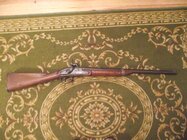
Cut down Model 1816

mikekj

Corporal
Joined
Feb 19, 2014
Location
Cobb Co. Georgia
Many, many, years ago, I bought this 1816 conversion. I really didn't know much about it but it was a good price and I didn't have one.

I brought it home and wiped it down, hung it on the wall.

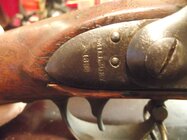
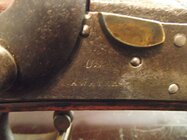
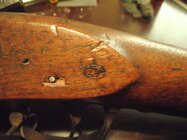
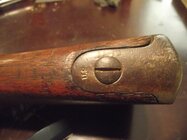
Well, after reading some threads on here about confederates using file marks under the barrels of guns that they worked on, I got curious. I had never pulled this barrel off, so I thought I would today. Guess what I found........file marks.

Here's some photos. 12-214 006.JPG 12-214 007.JPG 12-214 008.JPG 12-214 009.JPG 12-214 011.JPG 12-214 010.JPG 12-214 012.JPG
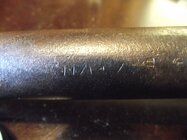
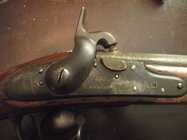
 
Not saying there isn't a possibility that it is a CS gun, but Roman numerals, dots, and Arabic numeral assembly and reassembly marks are found on both Federal and Confederate alterations. You example doesn't have any salient features that ID it as a CS weapon. It appears to be a standard cone-in-barrel "national armory" conversion.
 
So simple assembly marks from the manufacturer?
They could be, and they could also be from the percussion conversion, or the later shortening. His point is that the presence of any of those types of marks does not specifically indicate a connection to the confederacy because such marks can appear on conversions done anywhere and the type of conversion that your gun has is the one that was done at the national armories.
 
You may have a musket that was used in the war and in as issued by an arsenal condition. This does not appear to be a post war hatchet job of a conversion but one made at the time of the war. Look at the way the stock is cleanly cut back near the muzzle. I think there is a good possibility that this was a conversion not only from flint to percussion, but from infantry musket to cavalry carbine at the same time. Very nice looking arm.
 
They could be, and they could also be from the percussion conversion, or the later shortening. His point is that the presence of any of those types of marks does not specifically indicate a connection to the confederacy because such marks can appear on conversions done anywhere and the type of conversion that your gun has is the one that was done at the national armories.

Exactly. I own half a dozen pre-war percussion muskets and the only one that is certainly a Confederate conversion is identifiable because of the unique brazed bolster used by the Union Manufacturing Company. IMHO, the roman numerals on your musket are percussion conversion mating marks. Your lockplate probably has the same thing on the mainspring, and it's possible that VII is penciled on the arm of your stock under the barrel. (being yours has been shortened it may be missing)

Generally speaking CS altered arms are best identified by the conversion method utilized, with brazed bolster alterations being a near guarantee of Confederate usage. Following that would be things like hammer shape (ie flat sided hammers on some Virginia altered cone-in-barrel muskets, or squirrel tail Mississippi conversions of M1819 rifles), and then reassembley marks.

For those interested in US flint to percussion altered arms I highly recommend Moller's American Military Shoulder Arms, Vols. II and III, as well as Confederate Rifles and Muskets by Murphy and Maddaux.

Cheers,
Garrett G.
 

Learn About Us
About CivilWarTalk
Contact the Webmaster
Meet the Staff
Link to CivilWarTalk
Join Our Community
Register
Browse Forums
View Today's Discussions
Search the Forum
Get Help
FAQ
Student Guide
Forum Rules & Etiquette
Copyright / DMCA

     Contact Us CivilwarTalk on Facebook CivilWarTalk on YouTube CivilWarTalk on Twitter RSS Feed

Bringing the American Civil War and More to Life.
© 1999 - , CIVILWARTALK, LLC - Site Version 10.0

SlaveryTalk.com - SecessionTalk.com - CivilWarTalk.com - ReconstructionTalk.com
Back
Top