Custer's Female Wolverine, Irish Bridget

JPK Huson 1863

Brev. Brig. Gen'l
Joined
Feb 14, 2012
Location
Central Pennsylvania
Open Library has a gajillion books, not all of them readable on-line. You can get lucky as with " Women's Work In The Civil War ". I attempted unsuccessfully to arouse interest in Eliza Potter 2 days ago, whose story would have stretch credulity had it not been all too true. And in parts terribly dark, perhaps that's why there's little interest- we like our stories less bedraggled and maggot-ridden. I'd had a testimony from one of the soldiers she had saved, in a prison ' hospital', most pitiful thing I've ever read, a trooper's journey through enemy treatment and Eliza's ministrations. Think I'll save it- ironically, the maggots infesting uncared for wounds are probably what saved their lives.

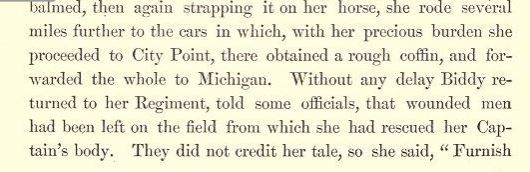
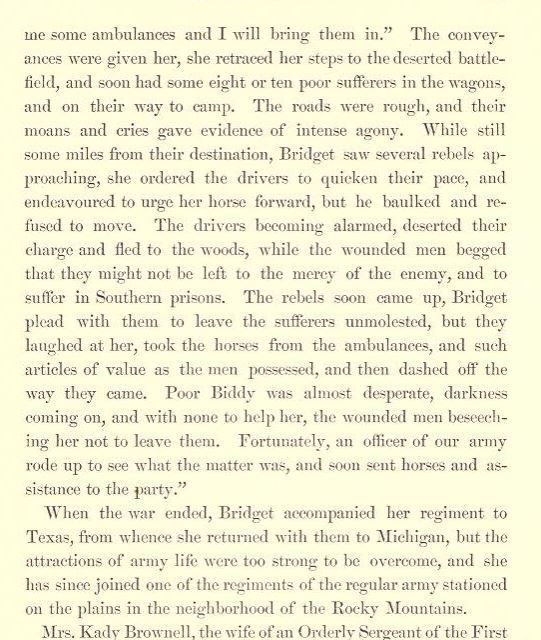
Irish Bridget is in this book. As with a lot of things, had not read this particular chapter of her endless efforts on the part of Michigan Cavalry. One of the weirdest things to me, reading about Bridget is this tendency, to always have an almost disclaimer- " Well, she was amazing, remember, she was from the lower classes- she was Irish toboot . " REALLY cool story if anyone is into female soldiers, undisguised or otherwise, women who were just, plain there. LOVE to have met her gee whiz.

http://irishamericancivilwar.com/2012/08/16/bridget-diver-custers-female-wolverine/

Before relating the story from " Women's Work In The Civil War ". would like to source on of the incidents in this, from another website and eyewitness.
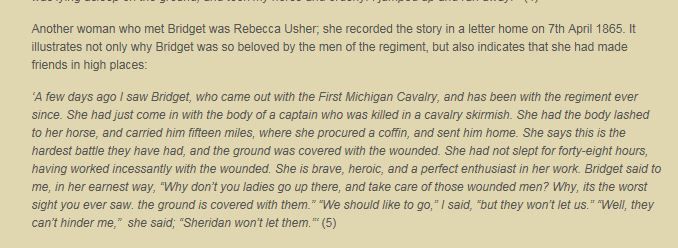
ib7.JPG


As an aside, it must have been terribly difficult for Bridget, and Irish women to battle both an enemy in the war and her own society. In poking around to do just a simple thread on this excerpt from a book, encountered this:
ib8.JPG

So Custer's Female Wolverine, our Bridget Deavers we love so much lived and fought in an era when she was considered not as equal as her purer peers. What's wonderful about Bridget is she doesn't seem to have cared.

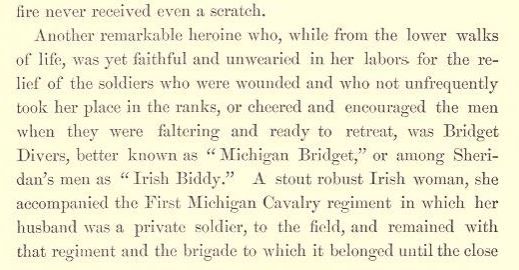
ib5.JPG

ib1.JPG

ib2.JPG

ib3.JPG


ib4.JPG


It's interesting- coming from a Irish family (well-half) my grandmother talks about how her grandparents when they first came across the water, had to endure a whole lot of discrimination and a lot of "No Irish Allowed" signs in restaurants or shops or "No Irish Wanted" when they tried to apply for jobs.

Bridget sounds absolutely incredible. Irish ladies are tough! (My mom can prove it. ;) ).
 
It's interesting- coming from a Irish family (well-half) my grandmother talks about how her grandparents when they first came across the water, had to endure a whole lot of discrimination and a lot of "No Irish Allowed" signs in restaurants or shops or "No Irish Wanted" when they tried to apply for jobs.

Bridget sounds absolutely incredible. Irish ladies are tough! (My mom can prove it. :wink: ).
Some of my relatives went to work in "the Boston States", as they were called up here, and at that time changed the spelling of their name from "Mc" to "Mac" so they could claim to be Scottish rather than Irish, so they could get work.
 
It's interesting- coming from a Irish family (well-half) my grandmother talks about how her grandparents when they first came across the water, had to endure a whole lot of discrimination and a lot of "No Irish Allowed" signs in restaurants or shops or "No Irish Wanted" when they tried to apply for jobs.

Bridget sounds absolutely incredible. Irish ladies are tough! (My mom can prove it. :wink: ).


Yes- the Irish prejudice was incredible and pervasive- ridiculous! " No Irish Need Apply ", was another. Yes look at who ended up being the legendary police, labor leaders, work force. The Irish were so high energy, capable, bright and driven- and released finally from centuries-old bondage of poverty and oppression there was just no holding them back once they encountered what amounted to open vistas. The prejudice had more to do with the fear of job competition at ' entry level ' jobs ( in society at the time ) than anything else. Being Catholic didn't help- and the Irish were terribly devout. You'd have thought being so hugely religious would have helped their image but it didn't, Catholics being held in aversion. What a small minded little society we were.


It's incredible for your family those awful times can be remembered, and in a good way. Like you said- the Irish are indeed tough- and resilient, and at the risk of sounding a little kooky, their's is the color, imagination and effervesence ( only spelled correctly ) mixed with a large spoon into American society. Lucky to have it. Pat Young does a lot on Irish Immigration, have you run into his posts on them? You'd almost imagine he ARE one. :smile: Very worth reading, just go to the Immigration forum, shouldn't be hard to find.
 
Last edited:
Reading through this delightful recounting of Bridget, I couldn't help but wonder how she was dressed; in uniform? Definitely not in skirts! That would be unimaginable. (Wishing this was bumped by the unseen hand of the OP).
Lubliner.
 
It's interesting- coming from a Irish family (well-half) my grandmother talks about how her grandparents when they first came across the water, had to endure a whole lot of discrimination and a lot of "No Irish Allowed" signs in restaurants or shops or "No Irish Wanted" when they tried to apply for jobs.

Bridget sounds absolutely incredible. Irish ladies are tough! (My mom can prove it. :wink: ).
Where were the Irish so discriminated against?
 
Where were the Irish so discriminated against?
This is taken from Series 4, Volume 3, section 1, page 5 and 6 of the Official Records. It is a letter addressed to Jefferson Davis on January 6, 1864 by S. C. Hayes who was a bookseller, publisher, and printer in Philadelphia before 1861.

"....I allude to the Irish element in the Northern population....having [had] quite a number of that class in my employment....I asserted that the native American and Know-Nothing were identical to the Black Republican party. I reminded them that the former had burned their churches in 1844. The Know-Nothing party had proscribed every man who had a 'Mc' or an 'O' to his name during the winter of 1857 and 1858, driving many thousands of families into starvation during the continuance of that short but certainly most severe financial storm, which raged throughout the North at that period...."

Hayes blamed these persecutions on the Know-Nothing party.
Lubliner.
 
Where were the Irish so discriminated against?
In every corner of America touched by Irish immigration. It began in the 18th century, and continued, in varying degrees, through the 19th. The stronger the flow of Irish immigration, the more vocal the discrimination.

 
Last edited:

Learn About Us
About CivilWarTalk
Contact the Webmaster
Meet the Staff
Link to CivilWarTalk
Join Our Community
Register
Browse Forums
View Today's Discussions
Search the Forum
Get Help
FAQ
Student Guide
Forum Rules & Etiquette
Copyright / DMCA

     Contact Us CivilwarTalk on Facebook CivilWarTalk on YouTube CivilWarTalk on Twitter RSS Feed

Bringing the American Civil War and More to Life.
© 1999 - , CIVILWARTALK, LLC - Site Version 10.0

SlaveryTalk.com - SecessionTalk.com - CivilWarTalk.com - ReconstructionTalk.com
Back
Top