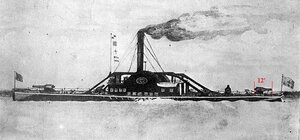
CSS SELMA

rebelatsea

Captain
Joined
Mar 30, 2013
Location
Kent ,England.
This one by request.

Name: CSS Selma


Type: Ironclad protected Steam gunboat Paddles: two side-wheels. Speed: 9 knots

Dimensions: 252ft(OA) x 30 ft (BM) x 6ft (D), 648 tons

Guns: 2 - 9"SB, 1 - 8"SB, 1 - 6.4" Brooke MLR

Armour: 2" iron on thick timber internal citadel around engines and magazines.

3/8" iron deck over engines & magazines

Design: Sydney Porter Built at: Mobile Ala, 1856, rebuilt at New Orleans 1861

History:

CSS SELMA.jpg


From an original plan by Bill Atteridge, modified by the Author.


Coastal mail packet "Florida", acquired in June 1861 for the New Orleans defence Flotilla.

In action at Ship Island, 19 - 22 /10/1861, Horn Island Pass 4/12/1861. Renamed "Selma" July 1862, she was bilged and sunk 5/2/1863, on Dog River bar in Mobile Bay, refloated and took part in the battle of Mobile bay 05/8/1864. Surrendered to USS Metacomet after 60mins fight. Sold for mercantile use 12/07/1865. Final fate unknown.

Notable for the very "modern" centreline ordnance layout, necessitated by the narrow beam.
 
Jason has had the Selma on his list for a while because it is unique. I told him that he had to give me some time to find a source for cannons that was close to the scale he is building. I have found some n scale rodmans and dahlgrens through Shapeways that should work.
 
I really don't understand this vessel. It seems like with 252' in length you could have more guns. Not too mention it seems suicidal the way they have to be manned.
 
View attachment 93039

I know these are just drawings (the one above and the one posted by NFB22), but they show three guns on the aft deck.
Artistic licence, she only had 4 big guns. In the drawing showing three guns aft the artist made a serious mistake - if you look the middle gun is bang against the hog brace with no room for recoil !
She was very strongly constructed, and well able to bear the weights.
 
Funny you should put this up, I've been working on a 1;124th of this as well - and I don't think the original could be anywhere near 252', based on that drawing of her in action.

ONOEsWL.jpg


I've got a collection of period news articles that show she was build in a New York yard in 1850 (not 1856, and in Mobile, as popularly reprinted these days). The Steamer Florida was making runs from Mobile over to NOLA throughout the mid-50s.

The inner wheels of the paddle drive dictate the lower hull beam width, while the outer wheels (plus paddle cover thickness) will dictate the upper deck beam width.

Donor hull marked for slimming.
eK4iIu5.jpg


I'm not going to start cutting until I have a sheet of white lexan in hand, to fit as a 'spacer' between the waterline and lower deck.

RlLFCOT.jpg
 
Last edited:
Every source reports the same dimensions and history for this vessel. This could of course be "received wisdom", with which I have become all too familiar with when researching the CSN.
If you or anyone can find an unimpeachable source which proves something different I for one would be very interested.
Please note the drawing is to scale, and the dimensions clearly show Length overall on deck, hull beam, and draught. I apologiee as my normal practice is to show Beam EX, which is 55ft.
 
Every source reports the same dimensions and history for this vessel. This could of course be "received wisdom", with which I have become all too familiar with when researching the CSN.
If you or anyone can find an unimpeachable source which proves something different I for one would be very interested.
Please note the drawing is to scale, and the dimensions clearly show Length overall on deck, hull beam, and draught. I apologiee as my normal practice is to show Beam EX, which is 55ft.

When I started this build, I first raised my eyebrow at the 1856 build date for Mobile AL - I'm not aware of any shipbuilding facilities that would have supported that construction at that time.

So, I went digging - this is the oldest hit.

Steamer Florida for Jas. L Day, 800 tons by Lawrence & Sneeden.
Ship Building in 1850 at the Port of New York (Copied from the Journal of Commerce). New York Daily Tribune. January 1st 1850. P.6.c.1.

Then this, which mentions the Selma by description not name -

Messrs. Lawrence and Sneeden have launched two steamboats—the Ganonicus, of 400 tons, now at Fall river, and the Tabaga, of 300 tons, probably at Havanna before this time. They are building a steamboat of 250 feet in length, to run between New Orleans and Mobile, of a very fine model, the frame of which is braced together by iron bars, crossing each other diagonally, which will give her great strength.

Debow's Review,: Agricultural, Commercial, Industrial Progress and Resources, Volume 8. J. D. B. DeBow., 1850. p.491

The problem I have with 250' is this - short of having a crewman on deck (assuming he's 5'6" tall), the only 'known length' visible would be the 9" smoothbore (IX gun) which has a tube length of 131" (12', for sake of simple math). That looks like the gun on the fantail to me, and that's about the only 'known length' to work with - so how long is this ship, expressed in multiples of IX tube length?

nb: twenty one IX gun tubes laid end to end would equal 252'.

2HlOPbR.jpg
 
When I started this build, I first raised my eyebrow at the 1856 build date for Mobile AL - I'm not aware of any shipbuilding facilities that would have supported that construction at that time.

So, I went digging - this is the oldest hit.

Steamer Florida for Jas. L Day, 800 tons by Lawrence & Sneeden.
Ship Building in 1850 at the Port of New York (Copied from the Journal of Commerce). New York Daily Tribune. January 1st 1850. P.6.c.1.

Then this, which mentions the Selma by description not name -

Messrs. Lawrence and Sneeden have launched two steamboats—the Ganonicus, of 400 tons, now at Fall river, and the Tabaga, of 300 tons, probably at Havanna before this time. They are building a steamboat of 250 feet in length, to run between New Orleans and Mobile, of a very fine model, the frame of which is braced together by iron bars, crossing each other diagonally, which will give her great strength.

Debow's Review,: Agricultural, Commercial, Industrial Progress and Resources, Volume 8. J. D. B. DeBow., 1850. p.491

The problem I have with 250' is this - short of having a crewman on deck (assuming he's 5'6" tall), the only 'known length' visible would be the 9" smoothbore (IX gun) which has a tube length of 131" (12', for sake of simple math). That looks like the gun on the fantail to me, and that's about the only 'known length' to work with - so how long is this ship, expressed in multiples of IX tube length?

nb: twenty one IX gun tubes laid end to end would equal 252'.

2HlOPbR.jpg
Excellent. Thank you. Logic would suggest the heaviest guns were inboard ,but this print indicates they were the outboard weapons,.
 

Attachments

  • 2HlOPbR.jpg
    2HlOPbR.jpg
    68.1 KB · Views: 65
Glad that helped. All the current references seem to track back to Civil War Naval Chronology, 1861-1865 p.300-301 which also lists a crew complement of 65 to 94.

I could see the logic of placing both IX guns in the #3 & 4 positions, for ease of ammunition supply - with the 6.4" (100 lb Parrot?) at the bow and the (least effective?) gun (8") in the #2 position. Whatever the arrangement, #2 & 3 had their arcs masked by the supporting beams (#2 moreso, obviously).

Famous Dahlgren & crew photo inset to give a sense of scale.

ehqA9Ua.jpg


PS - interesting blog post on the 6.4" rf ML. If the Union had ammunition issues, the CSN might have been relying on the "32lb ball wrapped in canvas" trick.
https://markerhunter.wordpress.com/2010/10/01/6-4-inch-100-pdr-parrott-rifles-part-2/
 
Last edited:
That's exactly what I mean by "received wisdom". It has bedevilled me ever since I started researching the ironclads. Hence my writing papers for CWT on CSS Loisiana and Mississippi going back to what we are told by documentation. I'm currently writing one on the side wheel ironclads.

We don't know if that 6.4" was a Brooke, currently Charlie Robbins is undertaking the thankless task of tracing and identifying all the Brooke guns and their disposal. I think it was a Brooke rifle, but need it confirmed.

That's a great print of Selma, with your permission I will copy it. I will use it ti play with Bill Atteridge's plan.
You are correct in that 2 & 3 would have limited arcs of fire. Nevertheless it is an interesting disposition of ordnance, and a very early example of centre line mounting.
 
Glad that helped. All the current references seem to track back to Civil War Naval Chronology, 1861-1865 p.300-301 which also lists a crew complement of 65 to 94.

I could see the logic of placing both IX guns in the #3 & 4 positions, for ease of ammunition supply - with the 6.4" (100 lb Parrot?) at the bow and the (least effective?) gun (8") in the #2 position. Whatever the arrangement, #2 & 3 had their arcs masked by the supporting beams (#2 moreso, obviously).

Famous Dahlgren & crew photo inset to give a sense of scale.

ehqA9Ua.jpg


PS - interesting blog post on the 6.4" rf ML. If the Union had ammunition issues, the CSN might have been relying on the "32lb ball wrapped in canvas" trick.
https://markerhunter.wordpress.com/2010/10/01/6-4-inch-100-pdr-parrott-rifles-part-2/
Good eye. The bow chaser profile appears to be a banded rifle. Might be a Brooke or possibly one of the 32 pounder conversions. There are reports of some of the heavier 32's being banded at Mobile. The hogging trusses depicted are very similar to the types used on Hudson river boats of the era. If the proportions are correct as to the placement of the bow and stern chasers, then the swing angles of the guns on their circles would allow a good overlap of fire, even allowing for the limits placed by the trusses. It would leave two triangular "dead zones" with the bases at the extreme ends of the hogging truss intersections with the deck and the points outboard. The overlaps of the chaser arcs make it unlikely that any opponent would be able to get close enough to exploit this limitation.
 

Learn About Us
About CivilWarTalk
Contact the Webmaster
Meet the Staff
Link to CivilWarTalk
Join Our Community
Register
Browse Forums
View Today's Discussions
Search the Forum
Get Help
FAQ
Student Guide
Forum Rules & Etiquette
Copyright / DMCA

     Contact Us CivilwarTalk on Facebook CivilWarTalk on YouTube CivilWarTalk on Twitter RSS Feed

Bringing the American Civil War and More to Life.
© 1999 - , CIVILWARTALK, LLC - Site Version 10.0

SlaveryTalk.com - SecessionTalk.com - CivilWarTalk.com - ReconstructionTalk.com
Back
Top