CSS David Drawings for Critique

JohnDLittlefield

Sergeant
Joined
Jan 8, 2016
Location
Charlestonian displaced to Bodrum,Turkey
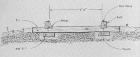
This is a set of drawings I did last year for an article published in Mariner's Mirror. The views are, from top to bottom: looking through the vessel, showing partial frames; looking down on the vessel from the top with the lower half of the drawing in cutaway form, again showing ribs; and a sheer view from the port side.

These represent David in her final form, after Commander Tomb had the spar re-replaced with a movable unit, added iron sheathing above the waterline, and capped the air vents (and stack that is not visible). Obviously missing is the steering mechanism, which I know used a rope and pulley system attached to the tiller (which may be too tall in the drawing- it could not have gone that high without a couple of bends to go around the drive shaft). I have added ceiling planking, which may or may not have been present over the length of the boat, but certainly would have been needed under the boiler and presumably under the small engine. I also conjectured a coal bin just aft of the boiler. There is no direct evidence for this, but they had to have coal onboard (and according to another source, some firewood also for emergencies). The image is copyrighted through the publisher, so please don't disseminate it through publication as that may create a problem for both you and I.

I welcome thoughts, comments, and general critique, as I want to improve the final published drawings to be the best possible.


David  .jpg
 
Last edited:
This is a set of drawings I did last year for an article published in Mariner's Mirror. The views are, from top to bottom: looking through the vessel, showing partial frames; looking down on the vessel from the top with the lower half of the drawing in cutaway form, again showing ribs; and a sheer view from the port side.

These represent David in her final form, after Commander Tomb had the spar re-replaced with a movable unit, added iron sheathing above the waterline, and capped the air vents (and stack that is not visible). Obviously missing is the steering mechanism, which I know used a rope and pulley system attached to the tiller (which may be too tall in the drawing- it could not have gone that high without a couple of bends to go around the drive shaft). I have added ceiling planking, which may or may not have been present over the length of the boat, but certainly would have been needed under the boiler and presumably under the small engine. I also conjectured a coal bin just aft of the boiler. There is no direct evidence for this, but they had to have coal onboard (and according to another source, some firewood also for emergencies). The image is copyrighted through the publisher, so please don't disseminate it through publication as that may create a problem for both you and I.

I welcome thoughts, comments, and general critique, as I want to improve the final published drawings to be the best possible.

Just a couple of comments. The original crew consisted of three men. Was that also true of this version? The original had a commander, a fireman/coal passer and a helmsman. Hard to see where you would pack in another crewman or what he would do. After their experience on the New Ironsides sortie, I can't believe they would go into action without one of those conical caps (perhaps hinged) on top of the stack to prevent down wash from an explosion extinguishing the fire in the boiler.
View attachment 107520
 
That looks about right to me, although the Chapman painting seems to show the added iron sheathing in strakes running both fore-and-aft and athwart-ship. Is that a detail you want to include?
 
Last edited:
That looks about right to me, although the Chapman painting seems to show the added iron sheathing in strakes running both fore-and-aft and athwart-ship. Is that a detail you want to include?

You are right; lengthwise along the coaming and athwart on the rounded portion of the hull. Good point. I had this done at one point, but someone pointed out that it was difficult to tell if if was iron or wood. Perhaps I can replace the white line markers and just add a key to designate the black areas as iron- and maybe a lighter shading color.
Question for you AndyHall, in the photograph 165c-751 of a David in the flats at Charleston, the vessel may be dbl planked aft of the coaming and foreward of the stack... or do you think these are repair sections (or otherwise)? BTW, you can also see iron sheathing running athwart ship at the fore portion of the coaming in this photo, stopping just shy of the rub rail.
CSS_David_photo boat only.jpg
 
Last edited:
Question for you AndyHall, in the photograph 165c-751 of a David in the flats at Charleston, the vessel may be dbl planked aft of the coaming and forward of the stack... or do you think these are repair sections (or otherwise)? BTW, you can also see iron sheathing running athwart ship at the fore portion of the coaming in this photo, stopping just shy of the rub rail. View attachment 107616

Not sure if this is deliberate double-planking or a repair job. I don't know how thick the base planking was; might this be reinforcement on those parts of the deck where men would be standing while in harbor?

Yes, I would interpret those bands running athwartship at the forward end of the hatch as iron plating.
 
Not sure if this is deliberate double-planking or a repair job. I don't know how thick the base planking was; might this be reinforcement on those parts of the deck where men would be standing while in harbor?

Yes, I would interpret those bands running athwartship at the forward end of the hatch as iron plating.

I have pondered the idea of dbl planking for a couple of years and have never been able to decide, planking of repair.
The original planking was supposed to 1.5", tapered on the hood ends where the planking met the conical ends.
 
You are right; lengthwise along the coaming and athwart on the rounded portion of the hull. Good point. I had this done at one point, but someone pointed out that it was difficult to tell if if was iron or wood. Perhaps I can replace the white line markers and just add a key to designate the black areas as iron- and maybe a lighter shading color.
Question for you AndyHall, in the photograph 165c-751 of a David in the flats at Charleston, the vessel may be dbl planked aft of the coaming and foreward of the stack... or do you think these are repair sections (or otherwise)? BTW, you can also see iron sheathing running athwart ship at the fore portion of the coaming in this photo, stopping just shy of the rub rail. View attachment 107616[/QUOTE
just a quick thought. although we don't have a scale for reference, the width of the strips seems much wider than normal for railroad type strip iron. Width for strip iron (rr source) was normally about 2 1/2 inches. I'm wondering if it might be strips of boiler iron. in combination with the plank backing it would give some protection from small arms fire or shell fragments. the secondary standpipes fore and aft of the cuddy are interesting, but their function isn't obvious. the forward unit might be an air source for the firebox on the boiler, but the after pipe seems a bit odd. There is what appears to be a panel of some type propped vertically in the cuddy. It might be something that mounted on supports on edges of the cuddy for overhead protection or as a sunshade.
 

Learn About Us
About CivilWarTalk
Contact the Webmaster
Meet the Staff
Link to CivilWarTalk
Join Our Community
Register
Browse Forums
View Today's Discussions
Search the Forum
Get Help
FAQ
Student Guide
Forum Rules & Etiquette
Copyright / DMCA

     Contact Us CivilwarTalk on Facebook CivilWarTalk on YouTube CivilWarTalk on Twitter RSS Feed

Bringing the American Civil War and More to Life.
© 1999 - , CIVILWARTALK, LLC - Site Version 10.0

SlaveryTalk.com - SecessionTalk.com - CivilWarTalk.com - ReconstructionTalk.com
Back
Top