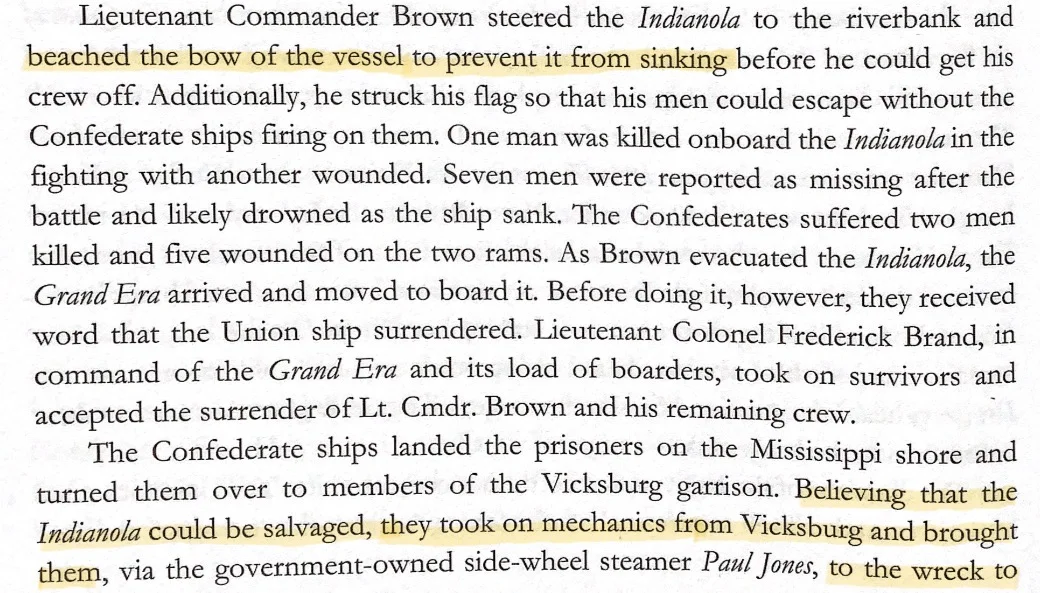
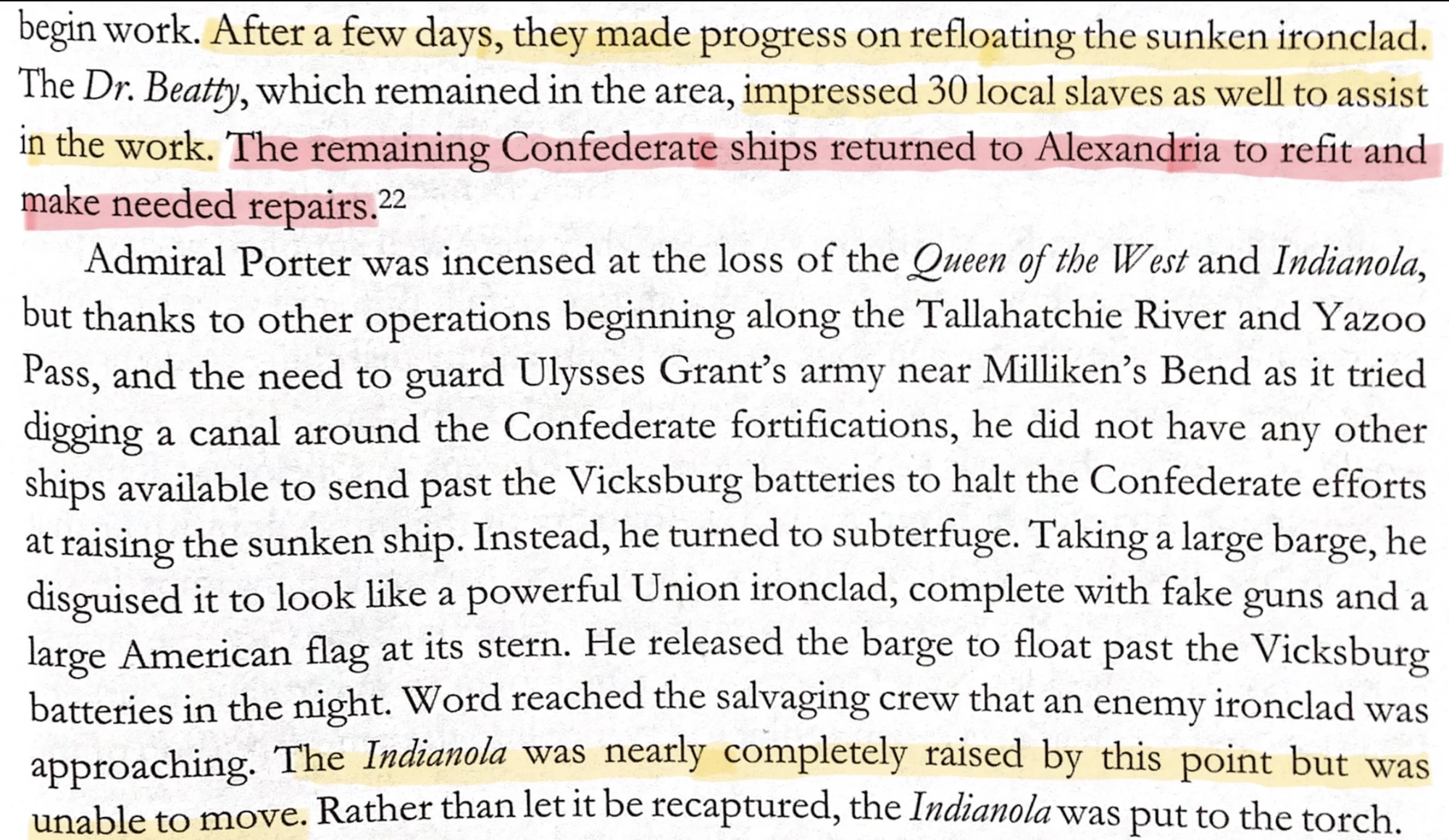
Well…I did some reading in "Defending the Arterias of Rebellion" and on pp. 218-219 found the following account of the blowing up of the "Indianola":
It's essentially the same (pretty cool) story - but now we have
- civilian mechanics from Vicksburg
- 30 impressed slaves
- an immovable ship
- (and liquor?)
What do you expect with such a combination?
The battle of Trafalgar?
Horace King, a former slave and master bridge builder was conscripted into confederate service and forced to help build iron clads in Columbus Georgia for the CSA.
He built many bridges in Georgia and Alabama. Here are some examples of his work. View attachment 579259
Possibly the Columbus/Phoenix city bridge View attachment 579260
Cantilevered staircase in the Alabama state house. View attachment 579261
Not sure which iron clads ship this is but is one he worked on.
That is CSS Jackson, Are you sure that Horace King was not a freedman when he worked for James H Warner?
Many CSN establishments employed freedmen , Tredegar at Richmond, Easons at Charleston, Anderson & Montgomery at Montgomery for example.
Despite being unlawful, many were taught to read, write and calculate or already had aquired the skills.
I've said it before but: New Orleans was N.O.S.D - No overall Strategic Direction.,
That is CSS Jackson, Are you sure that Horace King was not a freedman when he worked for James H Warner?
Many CSN establishments employed freedmen , Tredegar at Richmond, Easons at Charleston, Anderson & Montgomery at Montgomery for example.
Despite being unlawful, many were taught to read, write and calculate or already had aquired the skills.
Tennessee slaves were known as remarkably literate . Here in Rutherford County, the mistresses & daughters at Oaklands, Marymount, The Corners & other plantations held reading lessons for the slave children. The reason given was so that they might read the Bible.
On the practical side, the custom carriage, gunsmiths & construction businesses manned by freedmen & slaves required great skill & the ability to read.
In Middle Tennessee an extended family of freedmen & slaves built many of the great plantation houses. They managed the business & paid their partner / owner a percentage.
Horace King, Encyclopedia of Alabama
Horace King, freed in 1846, was one of the wealthiest black men in Alabama. Those of us interested in antebellum architecture & construction recognize his name immediately. Read more here.
Horace King (1807-1885) was the most respected bridge-builder in Alabama, Georgia, and northeastern Mississippi during the mid-nineteenth century. Enslaved until 1846, King and his owner, John Godwin, worked as partners on major construction projects. By 1860, he was one of the wealthiest free...
I've said it before but: New Orleans was N.O.S.D - No overall Strategic Direction.,
That is CSS Jackson, Are you sure that Horace King was not a freedman when he worked for James H Warner?
Many CSN establishments employed freedmen , Tredegar at Richmond, Easons at Charleston, Anderson & Montgomery at Montgomery for example.
Despite being unlawful, many were taught to read, write and calculate or already had aquired the skills.
He was a free man he got his freedom in 1846. His master was going bankrupt and he did not want to lose him so he granted his freedom and Horace took care of him the rest of his life.
I was employed by a group of people who were interested in replacing a covered bridge burned down in a 1970's. I studied other examples of covered bridges in the area. I drew a new plan for the Jefferson/Maysville covered bridge in Banks County Ga. I learned about Horace King then.
Oh yes, covered bridges are fascinating. A bridge truss you have to see is at Pleasant Hill Shaker Community. The meeting house has a 40 X 50 foot clear first floor ( if memory serves.) Very cleverly, a series of bridge trusses were used to form the roof & two floors below hung from them.
It is the same as the roadways of a double decker bridge.
The timber framing in the attic is exquisitely executed. Read more here.
Oh yes, covered bridges are fascinating. A bridge truss you have to see is at Pleasant Hill Shaker Community. The meeting house has a 40 X 50 foot clear first floor ( if memory serves.) Very cleverly, a series of bridge trusses were used to form the roof & two floors below hung from them.
It is the same as the roadways of a double decker bridge.
Have no idea. I had drawn it up using wooden pegs with an arch. The DOT engineers wanted no pegs and no arch. I redrew it with bolts and no arch sitting on I beams. All the old bridges called for all heart or virgin pine.
After the plan was approved they copied my plan and used their own engineer .
Have no idea. I had drawn it up using wooden pegs with an arch. The DOT engineers wanted no pegs and no arch. I redrew it with bolts and no arch sitting on I beams. All the old bridges called for all heart or virgin pine.
I am looking down a heart of pine floor that I salvaged from a 19th Century plantation house. Fat chance of building a bridge out of that. It is beautiful. The 19th Century original was painted numerous times, which spared the surface from wear.
Probably because there was no knowledge or skills base for constructing them. Most were riverboats because that was the knowledge and skills base that they had. So low freeboard and the sloped side citadel was the norm. All would be basically wooden-built with metal add-on armor. Even that was hard to get hold of. A number were 'armored' with railroad rails, like CSS Arkansas, and many an old boiler was stripped to provide some form of cladding.
USS Kearsarge was armoured with chain inside the outer wooden hull sides.
The best option was a screw boat, but many conversions/adaptions were stern wheelers or sidewheel steamers. Some were merely rafts - floating batteries - towed in and moored! They made do with anything available and suitable.
There were even 'cottonclad' gunboats used on the Mississippi by the Confederates.
The main problem with iron production was that although there were local smelting works, most of the ore used pre-war, came from Pennsylvania! Local ore was available, but little in the way of exploitation was developed and connected. Many merchant steamer ships were purchased and their machinery stripped or the hull modified and 'supplimented' with some form of armor.
He was a free man he got his freedom in 1846. His master was going bankrupt and he did not want to lose him so he granted his freedom and Horace took care of him the rest of his life.
From what I have read of James H Warner, Horace would have been valued and treated as well as was possible.
Interestingly John L Porter was well aware that his constructors were using freedmen, knew there was a drastic shortage of skilled personell, and considered it a necessity where there was no alternative.
In many ways the CSN seems to have been more advanced in it's treatment of men of colour than most Southern institutions, although obviously there must have been exceptions.
Probably because there was no knowledge or skills base for constructing them. Most were riverboats because that was the knowledge and skills base that they had. So low freeboard and the sloped side citadel was the norm. All would be basically wooden-built with metal add-on armor. Even that was hard to get hold of. A number were 'armored' with railroad rails, like CSS Arkansas, and many an old boiler was stripped to provide some form of cladding.
USS Kearsarge was armoured with chain inside the outer wooden hull sides.
The best option was a screw boat, but many conversions/adaptions were stern wheelers or sidewheel steamers. Some were merely rafts - floating batteries - towed in and moored! They made do with anything available and suitable.
There were even 'cottonclad' gunboats used on the Mississippi by the Confederates.
The main problem with iron production was that although there were local smelting works, most of the ore used pre-war, came from Pennsylvania! Local ore was available, but little in the way of exploitation was developed and connected. Many merchant steamer ships were purchased and their machinery stripped or the hull modified and 'supplimented' with some form of armor.
"Most ironclads were river boats", absolutely not. There were conversions yes but to protected gunboats not true ironclads.
The casemate form for armoured vessels had been proposed way back in the 1840s, and was adopted for new build vessels as the best form the South could construct given their physical and technical resources.
The yards that constructed the vessels actually had the skills - the vast majority of vessels having traditional hull forms, what they lacked was the labour to support those skills, largely thanks to the army grabbing everyone they could.
Railroad rails were used initially where rolled iron was not available but the majority of CSN ironclads utilised rolled iron plate.
Stonewall Jackson ( Skerret's watercolour is spot on BTW) and her sister Governor Moore were not CSN but LSN - Louisiana State Navy and acquitted themselves well in action. Wikipedia is wrong in saying they were part of the River Defence Fleet, they fought as part of CSN Captain Mitchell's force at New Orleans.
"Most ironclads were river boats", absolutely not. There were conversions yes but to protected gunboats not true ironclads.
The casemate form for armoured vessels had been proposed way back in the 1840s, and was adopted for new build vessels as the best form the South could construct given their physical and technical resources.
The yards that constructed the vessels actually had the skills - the vast majority of vessels having traditional hull forms, what they lacked was the labour to support those skills, largely thanks to the army grabbing everyone they could.
Railroad rails were used initially where rolled iron was not available but the majority of CSN ironclads utilised rolled iron plate.
Stonewall Jackson ( Skerret's watercolour is spot on BTW) and her sister Governor Moore were not CSN but LSN - Louisiana State Navy and acquitted themselves well in action. Wikipedia is wrong in saying they were part of the River Defence Fleet, they fought as part of CSN Captain Mitchell's force at New Orleans.
Rebelstsea makes a good point. There was a pool of skilled shipwrights in the Confederacy. Fredrick Douglas worked as a caulker in a shipyard before he self liberated, for example.
The very able Robert Smalls is another example of the nautical talent pool that existed.
The issue wasn't just a complete absence of organization at the top. Slaveholding was a profligate waste of human potential. Neither Douglas or Smalls would have been allowed to apply their natural gifts to managing a Confederate shipyard.
Wessyngton Plantation north of Nashville lost a succession of journeyman blacksmiths to good paying jobs in Pennsylvania. The skilled craftsmen that were absolutely critical for any coordinated creation of a flotilla of ironclads was were literally disappearing overnight. This was a double blow to Confederate hopes of independence.
The loss of a single journeyman, often including his family, was a minus one man day of skilled labor & a plus for the Union. That is a net two man days advantage times every self liberated craftsman.
Even had the Confederate government somehow imposed a strategic military plan coupled with a rational allocation of resources, the pool of skilled labor necessary to build the vessels was shrinking like an ice cube in July.
"Pook's Turtles" was the name given to the seven City Class ironclad gunboats built in 1861 were the work of Samuel Pook. The Mississippi Flotilla he created served ably through the brown water war. There is the blueprint for a Confederate ironclad flotilla right where it was really needed. Read more here.
Nelson Tift, one of the Albany, Ga founders, was an industrialist from Conn. He built several factories in Albany, when the war started he moved to Savannah to work on gunboats. Some say he became more southern that most southerners.
U.S. Congressman. Moving to Albany, Georgia, in 1830, he engaged in the mercantile business and opened a saw mill. In 1840, he was elected a as judge for the Inferior Court of Baker County, Georgia, serving until 1849. He also was elected Colonel of the Baker County Militia. Entering politics...
Rebelstsea makes a good point. There was a pool of skilled shipwrights in the Confederacy. Fredrick Douglas worked as a caulker in a shipyard before he self liberated, for example.
The very able Robert Smalls is another example of the nautical talent pool that existed.
The issue wasn't just a complete absence of organization at the top. Slaveholding was a profligate waste of human potential. Neither Douglas or Smalls would have been allowed to apply their natural gifts to managing a Confederate shipyard.
Wessyngton Plantation north of Nashville lost a succession of journeyman blacksmiths to good paying jobs in Pennsylvania. The skilled craftsmen that were absolutely critical for any coordinated creation of a flotilla of ironclads was were literally disappearing overnight. This was a double blow to Confederate hopes of independence.
The loss of a single journeyman, often including his family, was a minus one man day of skilled labor & a plus for the Union. That is a net two man days advantage times every self liberated craftsman.
Even had the Confederate government somehow imposed a strategic military plan coupled with a rational allocation of resources, the pool of skilled labor necessary to build the vessels was shrinking like an ice cube in July.
"Pook's Turtles" was the name given to the seven City Class ironclad gunboats built in 1861 were the work of Samuel Pook. The Mississippi Flotilla he created served ably through the brown water war. There is the blueprint for a Confederate ironclad flotilla right where it was really needed. Read more here.
But that was the point I was making - they had not got the knowledge and skills base. There was nothing to work with. Any Northern crafttsmen - and they were quite a few - had 'disappeared' on sessession. The local men had volunteered for service and were off. The major sea ports were under blockade and all that was left was the riverside yards - including a number built up from scratch. As for design, most were based on the Crimean floating batteries of Sevastopol, mainly bcaue there was little room for manoever on rivers - even the Mississippi. A turning circle was generally in the order of 500 yards or more. (It is also why tugs and ferries often kept their sidewheels - most could contra-rotate and turn the boat around almost on the spot!)
If iron plate was not available anything would do from rails to heavy timber to cotton bales - they were better than nothing. The hulls were generally unarmored since they were low freeboard wooden hulls, often with very shallow draft due to their river use. That is also the main reason they were given rams - the bow is the stongest point.