-
Welcome to CivilWarTalk, a forum about the American Civil War! - Join today! It's fast, simple, and FREE!
You are using an out of date browser. It may not display this or other websites correctly.
You should upgrade or use an alternative browser.
You should upgrade or use an alternative browser.
Corp structure
- Thread starter atlantis
- Start date
Lampasas Bill
First Sergeant
- Joined
- Sep 24, 2018
A two division corps was not very common. Three divisions or sometimes more was the usual.
Wizard of Cozz
Sergeant Major
- Joined
- Aug 20, 2021
Three division
Four Brigades per divison
8k men per division was the optimal amount.
I say four brigades because that way you can have a full support line in your division two in front, two in rear. I say three divisions, because often times, corps with two divisions, struggled to fully make attacks, and were reliant on other corps supporting them.
Four Brigades per divison
8k men per division was the optimal amount.
I say four brigades because that way you can have a full support line in your division two in front, two in rear. I say three divisions, because often times, corps with two divisions, struggled to fully make attacks, and were reliant on other corps supporting them.

Army size is best based on the supply available. Corps size is probably best based on the number of component commands one army commander can manage. Division size is likely best based on the amount of talented division commanders available.

RedRover
Captain
- Joined
- Dec 16, 2019
If I remember right, Bonaparte thought it was best to have Corps d'armee with varying numbers of divisions, if for no other reason than to confuse the opposition about numbers/strength. But corps strength frequently varied by the evident talents of certain officers for commanding large numbers. The Divisions themselves could widely vary in strength.
When the Army of the Potomac was first officially organized into army corps in early March, 1862, the first corps, under Gen. McDowell, had four divisions, and others had three. Banks' corps to the westward had only two divisions, his own and that of Gen. Shields.
Henry W. Halleck had observed in his military textbook in 1846...
"An active army in the field should be commanded by a general, or, as is done in some European countries, by a marshal. These may be regarded as of assimilated rank.
A corps d'armée should, be commanded by a Lieutenant-general. This rule is almost universal in Europe. The number of marshals in France under Napoleon was so great, that officers of this grade were often assigned to corps d'armée.
A grand division of an army should be commanded by a General of Division. In England, the assimilated grade is that of major-general, and in France at the present time, the younger lieutenant-generals, or the maréchaux-de-camp, command divisions.
A brigade should be commanded by a Brigadier-general. At the present time in the French service, maréchaux-de-camp act as commanders of brigades.
The several corps d'armée are designated by numbers, 1st, 2d, 3d, &c., and in the same way the several divisions in each corps d'armée, and the several brigades in each division. When the number of troops are placed on a war footing, each corps d'armée ordinarily contains from twenty to thirty thousand men.
The command of these several corps d'armée, divisions, and brigades, is taken by the officers of the corresponding grades according to seniority of rank, and without reference to arms, unless otherwise directed by the generalissimo, who should always have the power to designate officers for special commands."
At the close of April, 1864 the Army of the Potomac's corps numbered as follows... functionally 20-30K essentially...
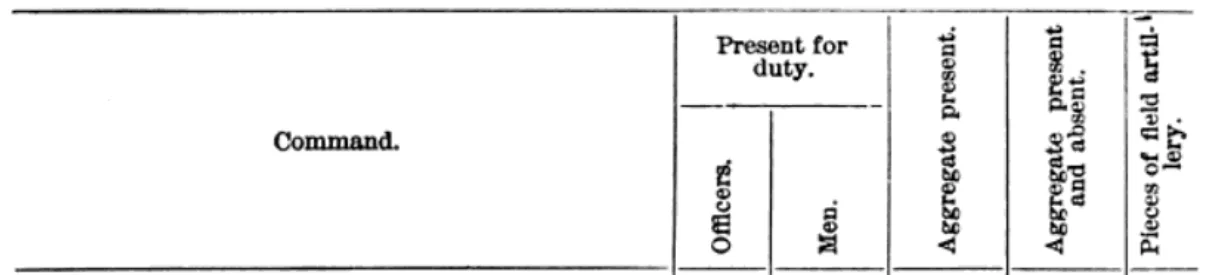

General Sherman opined that no field commander could really handily manage more than 60,000 troops in the field. For his march to the sea, with about that number, he reorganized his force, functionally divided into two wings, (essentially corps d'armee), viz. the Right wing, under Gen. Howard with 33,000, and the Left wing under Gen. Slocum, 30,000.
When the Army of the Potomac was first officially organized into army corps in early March, 1862, the first corps, under Gen. McDowell, had four divisions, and others had three. Banks' corps to the westward had only two divisions, his own and that of Gen. Shields.
Henry W. Halleck had observed in his military textbook in 1846...
"An active army in the field should be commanded by a general, or, as is done in some European countries, by a marshal. These may be regarded as of assimilated rank.
A corps d'armée should, be commanded by a Lieutenant-general. This rule is almost universal in Europe. The number of marshals in France under Napoleon was so great, that officers of this grade were often assigned to corps d'armée.
A grand division of an army should be commanded by a General of Division. In England, the assimilated grade is that of major-general, and in France at the present time, the younger lieutenant-generals, or the maréchaux-de-camp, command divisions.
A brigade should be commanded by a Brigadier-general. At the present time in the French service, maréchaux-de-camp act as commanders of brigades.
The several corps d'armée are designated by numbers, 1st, 2d, 3d, &c., and in the same way the several divisions in each corps d'armée, and the several brigades in each division. When the number of troops are placed on a war footing, each corps d'armée ordinarily contains from twenty to thirty thousand men.
The command of these several corps d'armée, divisions, and brigades, is taken by the officers of the corresponding grades according to seniority of rank, and without reference to arms, unless otherwise directed by the generalissimo, who should always have the power to designate officers for special commands."
At the close of April, 1864 the Army of the Potomac's corps numbered as follows... functionally 20-30K essentially...
General Sherman opined that no field commander could really handily manage more than 60,000 troops in the field. For his march to the sea, with about that number, he reorganized his force, functionally divided into two wings, (essentially corps d'armee), viz. the Right wing, under Gen. Howard with 33,000, and the Left wing under Gen. Slocum, 30,000.
35th MA InfRegt
Sergeant
- Joined
- Jun 9, 2014
The two-division corps with each division having about 10,000 personnel in wartime was actually the model used by the Prussian Army circa 1859. Each division would have two brigades and the brigades have two regiments. Each regiment would have two or three battalions, one of regulars and the others of Landwher (militia). The projected strength of a corps upon mobilization was about 20,000 and included attached cavalry and artillery. The Prussian Army in 1859 had eighteen divisions and nine corps. I believe the two division corps was maintained by Moltke into the Franco-Prussian War era so he must have thought it had some merit.1 Was the Two-division Corp structure the optimal force structure for a Corp.
2 With a division strength of 10,000.
What do you all think is the optimal number of Divisions and division strength.
Optimal is in the eye of the beholder and is obviously tremendously affected by circumstance. From an organizational perspective, keeping the span of control to a level inexperienced commanders can most easily manage is important.
Perhaps a "rule of three" could have been used. Each brigade would have three regiments (of one battalion each as was the Union norm). Three brigades would be assigned to a division and three divisions to a corps. Number of corps assigned to an army would vary by mission.
Mississippian1861
Sergeant
- Joined
- Jan 29, 2019
Perhaps a "rule of three" could have been used. Each brigade would have three regiments (of one battalion each as was the Union norm). Three brigades would be assigned to a division and three divisions to a corps. Number of corps assigned to an army would vary by mission.
IIRC this the idea that McClellan used when he initially formed the corps that made up the Army of the Potomac.
I came out for the Prussian model because of the management issue. Some of the guys on both sides who did well at Division commander really struggled when given Corp command, with a 2 D Corp if someone isn't cutting it in command it probably isn't a problem that can be solved with experience.The two-division corps with each division having about 10,000 personnel in wartime was actually the model used by the Prussian Army circa 1859. Each division would have two brigades and the brigades have two regiments. Each regiment would have two or three battalions, one of regulars and the others of Landwher (militia). The projected strength of a corps upon mobilization was about 20,000 and included attached cavalry and artillery. The Prussian Army in 1859 had eighteen divisions and nine corps. I believe the two division corps was maintained by Moltke into the Franco-Prussian War era so he must have thought it had some merit.
Optimal is in the eye of the beholder and is obviously tremendously affected by circumstance. From an organizational perspective, keeping the span of control to a level inexperienced commanders can most easily manage is important.
Perhaps a "rule of three" could have been used. Each brigade would have three regiments (of one battalion each as was the Union norm). Three brigades would be assigned to a division and three divisions to a corps. Number of corps assigned to an army would vary by mission.
OpnCoronet
Lt. Colonel
- Joined
- Feb 23, 2010
Whatever the theoretical arguments for two Div. Corps, in the reality of facing the over strengthed Confederate Corps.
Did not Union Corps usually required reinforcement from other corps to meet a single Confederate Corps on equal terms?
Did not Union Corps usually required reinforcement from other corps to meet a single Confederate Corps on equal terms?

67th Tigers
Major
- Joined
- Nov 10, 2006
Whatever the theoretical arguments for two Div. Corps, in the reality of facing the over strengthed Confederate Corps.
Did not Union Corps usually required reinforcement from other corps to meet a single Confederate Corps on equal terms?
However, those Army Corps were usually the strength of a full division. Hence Burnside and Meade both "doubled up" their corps into grand divisions, or wings, each of which was essentially an army corps.
The issue is that legally only POTUS can create or disband an Army Corps. No matter how weak they got, they were legally still an Army Corps. At the other extreme, 13th and 14th Army Corps were, when created, really armies and so were divided in wings until sense prevailed.
Saphroneth
Colonel
- Joined
- Feb 18, 2017
Yeah, this is one of those situations where there's theory and practice. Each individual step in the development of Union corps is logical but by the end of the process they are functionally reinforced divisions on average.
The process of development in the East is:
March 1862: the Army of the Potomac has a large number of divisions, which are occasionally task-organized into multi-division units over the winter.
March 1862: Per orders from Lincoln, the AoP is divided into five corps. These five corps distribute what amounts to 14 divisions between them; these are proper corps because each one (aside from 5th) contains three full-strength divisions. Then when Blenker is detached this leaves the corps numbering 3,2,3,3,2 divisions; all of them are corps-scale, and each of their divisions averages about 14 regiments.
April 1862: 1st and 5th Corps removed from the AoP, but Franklin's division returned. The AoP corps structure in divisions is now 2,3,3 with an independent division (Franklin's.)
May 1862: after Williamsburg, permission granted to temporarily reorganize the corps. To equalize them, McClellan elevates Sykes' regular infantry brigade to a division by adding the provost guard and other army-level units; this permits the creation of a five-corps structure 2,2,2,2,2 divisions, though Porter's 5th Corps is the weakest because that's the one that got Sykes' new and understrength division.
June 1862: with the addition of McCall's division, Porter's 5th Corps is now the strongest, though the Peninsular campaign inflicts serious casualties on the AoP; between straggling and so on, the 11 divisions making it up have dropped from about 10,500 men on average to about 8,000 men on average.
Note that this means that a triangular corps would have been 24,000 men (PFD) instead of 31,000 men PFD. Because they're binary, though, the average corps is about 16,000 men (with Porter's 5th Corps being stronger due to its extra division, though not 50% stronger).
In July, Pope combines two departments (Shenandoah and Rappahannock) along with the field force of a third (Mountains) to form his own Army of Virginia. These each becomes a corps of the Army of Virginia, but they're very lopsided - the Dept. Rappahannock was wildly larger than the other two forces and is twice the size of the other two corps, but to equalize them would mean taking lots of troops from McDowell and that was either untenable or didn't occur to anyone.
Note for example that Sigel's corps consists of 22 infantry regiments and 14 of them are from Blenker's division; Banks' corps consists of 23 infantry regiments. McDowell's corps has two divisions, both of which are 16 regiments.
9th Corps meanwhile is a reinforcement force (originally for McClellan, then diverted) which is made up of three small binary divisions. In total size it is somewhat larger than an "original" AoP division, but much less than two. Despite having three divisions it only has 19 regiments.
During the fighting in Second Bull Run I have found it easiest to consider 5th Corps, Banks' Corps, 9th Corps and Sigel's Corps to be overstrength divisions, and that Heintzelman has two divisions and McDowell has three (the third being the Pennsylvania Reserves). It's not a perfect model but it better expresses the size disparity in the corps as a result of their varying histories and regiment counts.
After casualties in Second Bull Run, these disparate corps are combined into a single organization, and the accession of reinforcement regiments expands them somewhat, but because it's not viable or not "the done thing" to dissolve a formal corps the result is that the army that McClellan takes out (which numbers around 90,000 men as it marches out of Washington, before the addition of Morell and Humphreys) consists of elements of at least seven corps; at that, that's with the reinforcements and before the addition of reinforcements it would have been less than 80,000.
Some of this is just casualties. 1st Corps consists of three "full strength" original divisions and so should be 30,000 men or so before new regiments; 2nd Corps should be 20,000 men or so before reinforcements; 6th Corps should also be 20,000 men or so, and 5th Corps should be something like 16,000. Those four corps, without the impact of months of casualties and straggling, should amount to more men than McClellan actually has veterans in his entire army. Then Couch is half of 4th Corps (and so "should" be another 10,000 or so). All of these formations, if full strength, should be "corps size".
But other parts of it are due to formally named corps which were the size they were because they were either created small or had large force transfers out of them. This is 9th Corps (which as created is barely larger than a "full size" division) and Banks' corps (which had started life as the Department of the Shenandoah at 31 regiments, a creditable size for a binary corps, but lost 21 of them to the Dept. of the Rappahannock and only ever got 12 back)
The reason why the 6th Corps is so big comes about as a result of Antietam and afterwards. 6th Corps first isn't heavily engaged at Antietam (so it doesn't suffer further casualties knocking its size down, having already avoided the fighting at Second bull Run; 2nd Corps missed Second Bull Run but then suffered very heavily at Antietam) and then it absorbs Couch's division which had also avoided both sanguinary battles. This makes 6th Corps a "proper" corps, with its replacements in "green" regiments having nearly kept up with casualties and attrition simply because it's not suffered much in heavy battles; all the other AoP corps either started small or have been beaten about heavily enough that they're small now. Consequently they're somewhere closer to half of the "proper" corps size.
3rd Corps is also quite big because it's stuffed with replacements over this period and misses Antietam. As a result it has two very large full-strength divisions and also a third weaker division at the end of Loudoun Valley.
Of course, after that the fighting at Fredericksburg continues the attrition process.
The Confederate trajectory is completely different. At the Seven Days they were still using "divisions" as their highest level of command, though these were often six-brigade divisions that were operated as two "demi-divisions" and so were the same size as Union corps but did not have that title; importantly, when Lee heads north for Northern Virginia and Maryland he is still using an ad-hoc structure at the highest levels. Longstreet's Command and Jackson's command represent real organizations but not formal organizations, and so does DH Hill's reinforcement command; consequently Lee is perfectly at liberty to break up DH Hill's command into its component parts. During Maryland, in fact, Lee effectively operates on an ad-hoc four-corps structure (Jackson, Longstreet, McLaws, DH Hill) with Walker as an independent division; all four of the bracketed formations would not look out of place as Union corps in terms of organizational and numerical strength.
Then after Maryland when Lee actually does formalize his corps structure, for personal reasons (i.e. he does not want to give DH Hill a formal corps command, and DH Hill is third in seniority among his subordinates) he adopts a two-corps structure. The result of this is that Lee's army splits its strength over just two corps at a time when the Army of the Potomac consists of six (1st 2nd 5th 6th 9th 12th), and Lee's corps are much closer to "proper corps" size - very close actually, nearly the same as the AoP corps from March. But in October, take 6th out of the picture and the other five AoP corps are roughly half the size of Lee's corps on average.
This is purely organizational. Lee could very easily have picked a three-corps structure, in which case his corps would be about the size of AoP corps from May 1862 when they were binary; by the time Lee actually does go three-corps he's gained somewhat in strength compared to November 1862, and so his three corps are each a bit bigger than that. Because most of the AoP corps have suffered from expiring enlistments and further attrition, in Gettysburg it's again the case that 6th is the outlier, but once more the other Union corps are much weaker on average than Lee's corps.
It's not until the winter of 1863-4 that the Union corps of the AoP specifically consolidate again.
There are several reasons to have a corps structure, and the most important is probably to break up the top level commander's assets into a manageable number of components, each of which can be somewhere and given a task - it is a way to manage the complexity of operations. The Union rigidity in being unable to dissolve corps to keep the others up to a consistent notional strength probably does make the job of the high level commander more difficult, though not unmanageably so; the way that wings/grand divisions keep emerging to combine multiple weak corps into a single manoeuvre element the size of a "proper corps" shows the utility of the size.
At some point the Union seems to have decided that the corps should be a top-level organizational element for the entire army (thus why an entire army gets designated as a corps) which probably interferes with actually running the army. It probably would have been superior from an organizational level to either leave corps structure entirely up to the field commander, or to formalize the "grand division" concept, or for Lincoln to be willing to take corps out of circulation if they were clearly too small (earlier than this actually happened, that is).
As a separate point I'd argue that the faff about getting cavalry to the Peninsula (for the Union), sheer scarcity of cavalry, and the over-reliance on the idea of massed cavalry for raiding all probably impeded the concept of the corps as a true combined-arms formation. A doctrinal corps should have infantry, artillery and cavalry but that last point is lacking on the org chart - probably mostly because there simply is not enough to go around early on and by Chancellorsville (if not sooner) the pattern of having the cavalry as an independent organization able to do things independently had become set to the detriment of both sides (to different degrees).
The process of development in the East is:
March 1862: the Army of the Potomac has a large number of divisions, which are occasionally task-organized into multi-division units over the winter.
March 1862: Per orders from Lincoln, the AoP is divided into five corps. These five corps distribute what amounts to 14 divisions between them; these are proper corps because each one (aside from 5th) contains three full-strength divisions. Then when Blenker is detached this leaves the corps numbering 3,2,3,3,2 divisions; all of them are corps-scale, and each of their divisions averages about 14 regiments.
April 1862: 1st and 5th Corps removed from the AoP, but Franklin's division returned. The AoP corps structure in divisions is now 2,3,3 with an independent division (Franklin's.)
May 1862: after Williamsburg, permission granted to temporarily reorganize the corps. To equalize them, McClellan elevates Sykes' regular infantry brigade to a division by adding the provost guard and other army-level units; this permits the creation of a five-corps structure 2,2,2,2,2 divisions, though Porter's 5th Corps is the weakest because that's the one that got Sykes' new and understrength division.
June 1862: with the addition of McCall's division, Porter's 5th Corps is now the strongest, though the Peninsular campaign inflicts serious casualties on the AoP; between straggling and so on, the 11 divisions making it up have dropped from about 10,500 men on average to about 8,000 men on average.
Note that this means that a triangular corps would have been 24,000 men (PFD) instead of 31,000 men PFD. Because they're binary, though, the average corps is about 16,000 men (with Porter's 5th Corps being stronger due to its extra division, though not 50% stronger).
In July, Pope combines two departments (Shenandoah and Rappahannock) along with the field force of a third (Mountains) to form his own Army of Virginia. These each becomes a corps of the Army of Virginia, but they're very lopsided - the Dept. Rappahannock was wildly larger than the other two forces and is twice the size of the other two corps, but to equalize them would mean taking lots of troops from McDowell and that was either untenable or didn't occur to anyone.
Note for example that Sigel's corps consists of 22 infantry regiments and 14 of them are from Blenker's division; Banks' corps consists of 23 infantry regiments. McDowell's corps has two divisions, both of which are 16 regiments.
9th Corps meanwhile is a reinforcement force (originally for McClellan, then diverted) which is made up of three small binary divisions. In total size it is somewhat larger than an "original" AoP division, but much less than two. Despite having three divisions it only has 19 regiments.
During the fighting in Second Bull Run I have found it easiest to consider 5th Corps, Banks' Corps, 9th Corps and Sigel's Corps to be overstrength divisions, and that Heintzelman has two divisions and McDowell has three (the third being the Pennsylvania Reserves). It's not a perfect model but it better expresses the size disparity in the corps as a result of their varying histories and regiment counts.
After casualties in Second Bull Run, these disparate corps are combined into a single organization, and the accession of reinforcement regiments expands them somewhat, but because it's not viable or not "the done thing" to dissolve a formal corps the result is that the army that McClellan takes out (which numbers around 90,000 men as it marches out of Washington, before the addition of Morell and Humphreys) consists of elements of at least seven corps; at that, that's with the reinforcements and before the addition of reinforcements it would have been less than 80,000.
Some of this is just casualties. 1st Corps consists of three "full strength" original divisions and so should be 30,000 men or so before new regiments; 2nd Corps should be 20,000 men or so before reinforcements; 6th Corps should also be 20,000 men or so, and 5th Corps should be something like 16,000. Those four corps, without the impact of months of casualties and straggling, should amount to more men than McClellan actually has veterans in his entire army. Then Couch is half of 4th Corps (and so "should" be another 10,000 or so). All of these formations, if full strength, should be "corps size".
But other parts of it are due to formally named corps which were the size they were because they were either created small or had large force transfers out of them. This is 9th Corps (which as created is barely larger than a "full size" division) and Banks' corps (which had started life as the Department of the Shenandoah at 31 regiments, a creditable size for a binary corps, but lost 21 of them to the Dept. of the Rappahannock and only ever got 12 back)
The reason why the 6th Corps is so big comes about as a result of Antietam and afterwards. 6th Corps first isn't heavily engaged at Antietam (so it doesn't suffer further casualties knocking its size down, having already avoided the fighting at Second bull Run; 2nd Corps missed Second Bull Run but then suffered very heavily at Antietam) and then it absorbs Couch's division which had also avoided both sanguinary battles. This makes 6th Corps a "proper" corps, with its replacements in "green" regiments having nearly kept up with casualties and attrition simply because it's not suffered much in heavy battles; all the other AoP corps either started small or have been beaten about heavily enough that they're small now. Consequently they're somewhere closer to half of the "proper" corps size.
3rd Corps is also quite big because it's stuffed with replacements over this period and misses Antietam. As a result it has two very large full-strength divisions and also a third weaker division at the end of Loudoun Valley.
Of course, after that the fighting at Fredericksburg continues the attrition process.
The Confederate trajectory is completely different. At the Seven Days they were still using "divisions" as their highest level of command, though these were often six-brigade divisions that were operated as two "demi-divisions" and so were the same size as Union corps but did not have that title; importantly, when Lee heads north for Northern Virginia and Maryland he is still using an ad-hoc structure at the highest levels. Longstreet's Command and Jackson's command represent real organizations but not formal organizations, and so does DH Hill's reinforcement command; consequently Lee is perfectly at liberty to break up DH Hill's command into its component parts. During Maryland, in fact, Lee effectively operates on an ad-hoc four-corps structure (Jackson, Longstreet, McLaws, DH Hill) with Walker as an independent division; all four of the bracketed formations would not look out of place as Union corps in terms of organizational and numerical strength.
Then after Maryland when Lee actually does formalize his corps structure, for personal reasons (i.e. he does not want to give DH Hill a formal corps command, and DH Hill is third in seniority among his subordinates) he adopts a two-corps structure. The result of this is that Lee's army splits its strength over just two corps at a time when the Army of the Potomac consists of six (1st 2nd 5th 6th 9th 12th), and Lee's corps are much closer to "proper corps" size - very close actually, nearly the same as the AoP corps from March. But in October, take 6th out of the picture and the other five AoP corps are roughly half the size of Lee's corps on average.
This is purely organizational. Lee could very easily have picked a three-corps structure, in which case his corps would be about the size of AoP corps from May 1862 when they were binary; by the time Lee actually does go three-corps he's gained somewhat in strength compared to November 1862, and so his three corps are each a bit bigger than that. Because most of the AoP corps have suffered from expiring enlistments and further attrition, in Gettysburg it's again the case that 6th is the outlier, but once more the other Union corps are much weaker on average than Lee's corps.
It's not until the winter of 1863-4 that the Union corps of the AoP specifically consolidate again.
There are several reasons to have a corps structure, and the most important is probably to break up the top level commander's assets into a manageable number of components, each of which can be somewhere and given a task - it is a way to manage the complexity of operations. The Union rigidity in being unable to dissolve corps to keep the others up to a consistent notional strength probably does make the job of the high level commander more difficult, though not unmanageably so; the way that wings/grand divisions keep emerging to combine multiple weak corps into a single manoeuvre element the size of a "proper corps" shows the utility of the size.
At some point the Union seems to have decided that the corps should be a top-level organizational element for the entire army (thus why an entire army gets designated as a corps) which probably interferes with actually running the army. It probably would have been superior from an organizational level to either leave corps structure entirely up to the field commander, or to formalize the "grand division" concept, or for Lincoln to be willing to take corps out of circulation if they were clearly too small (earlier than this actually happened, that is).
As a separate point I'd argue that the faff about getting cavalry to the Peninsula (for the Union), sheer scarcity of cavalry, and the over-reliance on the idea of massed cavalry for raiding all probably impeded the concept of the corps as a true combined-arms formation. A doctrinal corps should have infantry, artillery and cavalry but that last point is lacking on the org chart - probably mostly because there simply is not enough to go around early on and by Chancellorsville (if not sooner) the pattern of having the cavalry as an independent organization able to do things independently had become set to the detriment of both sides (to different degrees).
BCD
Cadet
- Joined
- Aug 31, 2026
- Location
- Connecticut
It's notable how the Army of Tennessee stuck very consistently to the two-division model in 1863, unlike the AoNV, which was comfortable with several divisions per corps. Makes me wonder why: was it in imitation of the Prussians, perhaps under the influence of Hardee, who studied European tactics and organization?The two-division corps with each division having about 10,000 personnel in wartime was actually the model used by the Prussian Army circa 1859.
Bragg briefly plussed up Hill's Corps to 5 divisions after receiving reinforcements in the lead-up to Chickamauga - notably, that was after Hardee's departure - but quickly restructured to three infantry corps and one reserve corps of two divisions each. That mirrored the Army of the Cumberland's corps organization (although each corps had 3-4 divisions). Was Bragg imitating the Prussians, Rosecrans, or neither?
Saphroneth
Colonel
- Joined
- Feb 18, 2017
There's good reason to aim to have three main corps and possibly a reserve, which is that that gives you left/right/center wings. Lee split his own AoNV into three as soon as he didn't have DH Hill to deal with, so what I suspect is that Bragg wanted at least a minimum number of manoeuvre elements.
Though I do also want to point out that at Perryville and Stones River to my understanding Bragg had just two corps, one unitary and one binary at Perryville and one binary and one triangular at Stones River. He doesn't pick up a third corps until Buckner's department of East Tennessee is merged in, so it could be that this is all a lot more contingent than Bragg having an idea what he wanted and sticking to it.
Though I do also want to point out that at Perryville and Stones River to my understanding Bragg had just two corps, one unitary and one binary at Perryville and one binary and one triangular at Stones River. He doesn't pick up a third corps until Buckner's department of East Tennessee is merged in, so it could be that this is all a lot more contingent than Bragg having an idea what he wanted and sticking to it.
BCD
Cadet
- Joined
- Aug 31, 2026
- Location
- Connecticut
The Army of Mississippi at Perryville was basically just a corps, about 16,000 men, while Hardee's third division at Stones River was a late attachment, an understrength formation not part of the regular order of battle.There's good reason to aim to have three main corps and possibly a reserve, which is that that gives you left/right/center wings. Lee split his own AoNV into three as soon as he didn't have DH Hill to deal with, so what I suspect is that Bragg wanted at least a minimum number of manoeuvre elements.
Though I do also want to point out that at Perryville and Stones River to my understanding Bragg had just two corps, one unitary and one binary at Perryville and one binary and one triangular at Stones River. He doesn't pick up a third corps until Buckner's department of East Tennessee is merged in, so it could be that this is all a lot more contingent than Bragg having an idea what he wanted and sticking to it.
The 3+1 corps structure at Chickamauga makes sense for so large an army, but the particular resemblance to the AotC is striking. I'm not aware of any army other than Rosecrans' and Bragg's that had a full-strength reserve corps: those at Shiloh and the Peninsular Campaign were much smaller than the main wings/corps, while those in the Tennessee theater were similar to the other infantry corps. Their tasking was also distinct: they were assigned to guard the lines of communication during the campaign, but come up on line during the battle itself - an operational reserve, not a tactical reserve. So that still leaves us with the question of why Bragg preserved the two-division structure when the opposing Union corps had 3-4 each - even his two cavalry corps were organized that way.
Saphroneth
Colonel
- Joined
- Feb 18, 2017
What I'm getting at is mostly that I want to flag up that Bragg didn't necessarily have an iron law that he always used binary corps, because he doesn't in most of his actual battles and the organizations fluctuate over time as well. My understanding for example is that when DH Hill takes over the 2nd Corps it has three divisions (Stewart, Cleburne, Breckinridge) and only becomes binary with the reorg after Bragg abandons Chattanooga. Similarly 3rd Corps has three divisions at a later point (Stewart, Preston, BR Johnson) and BR Johnson is detached during Chickamauga to work with Longstreet; since Bragg reorganizes again during Chickamauga, it could just be that we're seeing the snapshots of his rapidly changing org chart that happen to be meaningful.
Then during the Chattanooga phase of the campaign Hardee's corps is square (Cheatham, Hindman, Buckner, Gist) of which triangular present in late Nov/Dec, and Breckinridge is also square (Cleburne, Steward, Bate, Stevenson)
If Bragg had managed to fight at McLemore's Cove as he very much wanted to (instead of Chickamauga, that is), then we might not have a single battle he took part in where all his corps are binary because 3rd at that point was triangular. Which makes it hard to argue that Bragg is especially focused on binary corps, though he may well be more so than average.
Then during the Chattanooga phase of the campaign Hardee's corps is square (Cheatham, Hindman, Buckner, Gist) of which triangular present in late Nov/Dec, and Breckinridge is also square (Cleburne, Steward, Bate, Stevenson)
If Bragg had managed to fight at McLemore's Cove as he very much wanted to (instead of Chickamauga, that is), then we might not have a single battle he took part in where all his corps are binary because 3rd at that point was triangular. Which makes it hard to argue that Bragg is especially focused on binary corps, though he may well be more so than average.
35th MA InfRegt
Sergeant
- Joined
- Jun 9, 2014
Bragg likely wasn't imitating the Prussians. The Prussian Army of that period was not particularly well-regarded and American knowledge of its organizational structure was probably limited. So, I doubt that was the model Bragg adopted.It's notable how the Army of Tennessee stuck very consistently to the two-division model in 1863, unlike the AoNV, which was comfortable with several divisions per corps. Makes me wonder why: was it in imitation of the Prussians, perhaps under the influence of Hardee, who studied European tactics and organization?
Bragg briefly plussed up Hill's Corps to 5 divisions after receiving reinforcements in the lead-up to Chickamauga - notably, that was after Hardee's departure - but quickly restructured to three infantry corps and one reserve corps of two divisions each. That mirrored the Army of the Cumberland's corps organization (although each corps had 3-4 divisions). Was Bragg imitating the Prussians, Rosecrans, or neither?
Saphroneth
Colonel
- Joined
- Feb 18, 2017
If he was trying to copy a European army, I actually wonder if it was the British - he did, after all, have Patrick Cleburne in his army. I don't think it had technically been formalized at this point but British informal practice was, to my understanding, binary corps (though they were quite small).Bragg likely wasn't imitating the Prussians. The Prussian Army of that period was not particularly well-regarded and American knowledge of its organizational structure was probably limited. So, I doubt that was the model Bragg adopted.
Then again, if he'd been copying essentially any European army he'd probably have included cavalry at the corps level. So maybe not.
Mississippian1861
Sergeant
- Joined
- Jan 29, 2019
There's good reason to aim to have three main corps and possibly a reserve, which is that that gives you left/right/center wings. Lee split his own AoNV into three as soon as he didn't have DH Hill to deal with, so what I suspect is that Bragg wanted at least a minimum number of manoeuvre elements.
Though I do also want to point out that at Perryville and Stones River to my understanding Bragg had just two corps, one unitary and one binary at Perryville and one binary and one triangular at Stones River. He doesn't pick up a third corps until Buckner's department of East Tennessee is merged in, so it could be that this is all a lot more contingent than Bragg having an idea what he wanted and sticking to it.
Bragg did not fight at full strength at Perryville. Polk was missing a division. Plus Kirby Smith's forces.
Similar threads
- Question
- Replies
- 0
- Views
- 1

- Question
- Replies
- 14
- Views
- 15
- Replies
- 11
- Views
- 12

- Replies
- 33
- Views
- 495
- Replies
- 2
- Views
- 138
Similar threads
- Replies
- 2
- Views
- 3
- Replies
- 2
- Views
- 83
- Learn About Us
- ►About CivilWarTalk
- ►Contact the Webmaster
- ►Meet the Staff
- ►Link to CivilWarTalk
- Join Our Community
- ►Register
- ►Browse Forums
- ►View Today's Discussions
- ►Search the Forum
- Get Help
- ►FAQ
- ►Student Guide
- ►Forum Rules & Etiquette
- ►Copyright / DMCA
 Bringing the