Converted Musket

Tom Hughes

Sergeant Major
Joined
May 27, 2019
Location
Mississippi
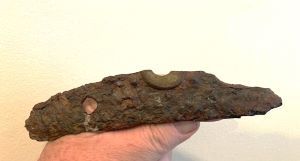
I found this lockplate to a musket I dug in the 34th Indiana camp during the siege of Vicksburg. What's interesting about this lockplate is that it was converted from a flintlock to a percussion firing mechanism. You would think that the Yanks all had updated modern weapons, but that just wasn't the case. When the war broke out, many of these Indiana regiments had older weapons that were issued to them. The Confederates were armed with Enfields during the siege and began to fire with far better accuracy than their counterparts. Evidently, at least one Indiana soldier converted his weapon to a percussion and made it more "modern".
convertedlockplate.jpg
 
Why do you assume it was a Yankee weapon, just because it was left in a Yankee camp?

Or that the entirety of the Confederate garrison of Vicksburg was armed with Enfields?

I'd think some Yankee dragged a Confederate souvenier back to camp and then left it behind when it was time to go away.
 
Why do you assume it was a Yankee weapon, just because it was left in a Yankee camp?

I'd think some Yankee dragged a Confederate souvenier back to camp and then left it behind when it was time to go away.
That's possible. But I read where Indiana units were specifically issued flintlock weapons and then ordered in the field at Vicksburg to convert them. I'll find the record in Grant's memoirs and post it.
 
That's possible. But I read where Indiana units were specifically issued flintlock weapons and then ordered in the field at Vicksburg to convert them. I'll find the record in Grant's memoirs and post it.

The amount of effort needed to convert a Flintlock to Percussion strikes me as requiring far more gunsmithing infrastructure than one could find 'in the field'.
 
Many of the US troops at Vicksburg had altered muskets, etc. Some of these units were reequipped with more modern British Enfields secured after the surrender of Pemberton's army at Vicksburg:

1725659779598.png
 
I don't think they altered them in camp, but were issued converted muskets. They were popular in the early days of the war, and depending on when the regiment marches to the front, they might still have been carrying them. Not as good as a rifled musket, sure. But it wasn't any worse than a model 1842, and they were used late in the war by regiments.
 
I don't think they altered them in camp, but were issued converted muskets. They were popular in the early days of the war, and depending on when the regiment marches to the front, they might still have been carrying them. Not as good as a rifled musket, sure. But it wasn't any worse than a model 1842, and they were used late in the war by regiments.
Some troops preferred the buck and ball loads of .69 smoothbores. Since most battle conditions were very close affairs the extra shot with the ball could cause injury if not death. Pepper them Yanks! Easy to reload also. I imagine mounted Co federates would use something like that on the me'lee.
 
I found this lockplate to a musket I dug in the 34th Indiana camp during the siege of Vicksburg. What's interesting about this lockplate is that it was converted from a flintlock to a percussion firing mechanism. You would think that the Yanks all had updated modern weapons, but that just wasn't the case. When the war broke out, many of these Indiana regiments had older weapons that were issued to them. The Confederates were armed with Enfields during the siege and began to fire with far better accuracy than their counterparts. Evidently, at least one Indiana soldier converted his weapon to a percussion and made it more "modern".View attachment 520332
how can you tell the conversion was not made 10 years before the civilwar?
Large numbers of European flintlocks where converted (in Europe) before being sold.

That Union troops stil used percussion smoothbores by Vicksburg is well documented, but your claim that they had flintlocks is not.
I would like to see some evidence of that
 
The federal government had been thinning out its firearms found to be in poor condition and converting others to percussion for years. Most of the converted guns were cone-in-barrel done at one of the government armories.
 
how can you tell the conversion was not made 10 years before the civilwar?
Large numbers of European flintlocks where converted (in Europe) before being sold.

That Union troops stil used percussion smoothbores by Vicksburg is well documented, but your claim that they had flintlocks is not.
I would like to see some evidence of that
First of all, it very may very well have been converted 10 years prior to the war. No way to know 100%. But in Grant's Memories he specifically addresses the antiquated muskets in the armories and specifically Indiana regiments that got them and had them converted. Since I found this converted musket in the 34th Indiana camp at Vicksburg, where he specifically says they were converted, I admit that I'm make a generalization.
Yes indeed, Union troops had smoothbores at Vicksburg. I've found plenty of evidence of that in my 45 years of digging artifacts in the hill city.
 
I have a Potsdam Musket that was converted to percussion. (Pre-War?)
Some enterprising individual shortened the barrel later I'm assuming due to damage.
No idea if it saw ACW use but would probably make for interesting comments at reenacting.
 

Learn About Us
About CivilWarTalk
Contact the Webmaster
Meet the Staff
Link to CivilWarTalk
Join Our Community
Register
Browse Forums
View Today's Discussions
Search the Forum
Get Help
FAQ
Student Guide
Forum Rules & Etiquette
Copyright / DMCA

     Contact Us CivilwarTalk on Facebook CivilWarTalk on YouTube CivilWarTalk on Twitter RSS Feed

Bringing the American Civil War and More to Life.
© 1999 - , CIVILWARTALK, LLC - Site Version 10.0

SlaveryTalk.com - SecessionTalk.com - CivilWarTalk.com - ReconstructionTalk.com
Back
Top