Contrabands

The use of the word contraband derived from international law. It was permissible in times of war for neutral nations to engage in trade with either or both side at war with each other provided the traded goods were not for military use. Such goods, if found on board a neutral trading ship made the ship and cargo subject to seizure. Arms and ammunition were obvious examples. Other goods, such as provisions, livestock feed, cloth, medicines, etc. were less obvious. International law left it to the admiralty court nation seizing the neutral ship to determine whether the goods were for military use (I think we can guess how those cases turned out).

In the United States several Supreme Court cases had mad it clear that slaves were property, were not citizens and had no constitutional rights. The 5th Amendment to the Constitution prohibits the seizure of property without due process. Benjamin Butler was a capable lawyer and nuanced his actions to avoid the pitfalls that would befall John Fremont and David Hunter in the coming months. Despite many accounts indicating otherwise, I am not certain General Butler ever referred to the escaped slaves as contraband, he did not in his official correspondence.

HEADQUARTERS DEPARTMENT OF VIRGINIA,
Fort Monroe, May 24, 1861.

Lieutenant-General WINFIELD SCOTT:
I have the honor to report my arrival at this post Wednesday morning at 8 o'clock. .....

Saturday, May 25.-I had written thus far when I was called away to meet Major Cary, of the active Virginia volunteers, upon questions which have arisen of very considerable importance both in a military and political aspect, and which I beg leave to submit herewith.

On Thursday night, three negroes, field hands, belonging to Colonel Charles Mallory, now in command of the secession forces in this district, delivered themselves up to my picket guard, and, as I learned from the report of the officer of the guard in the morning, had been detained by him. I immediately gave personal attention to the matter, and found satisfactory evidence that these men were about to be taken to Carolina for the purpose of aiding the secession forces there; that two of them left wives and children (one a free woman) here; that the other had left his master from fear that he would be called upon to take part in the rebel armies. Satisfied of these facts from cautious examination of each of the negroes apart from the others, I determined for the present, and until better advised, as these men were very serviceable, and I had great need of labor in my quartermaster's department, to avail myself of their services, and that I would send a receipt to Colonel Mallory that I had so taken them, as I would for any other property of a private citizen which the exigencies of the service seemed to require to be taken by me, and especially property that was designed, adapted, and about to be used against the United States.

As this is but an individual instance in a course of policy which may be required to be pursued with regard to this species of property, I have detailed to the Lieutenant-General this case, and ask his direction. I am credibly informed that the negroes in this neighborhood are now being employed in the erection of batteries and other works by the rebels, which it would be nearly or quite impossible to construct without their labor. Shall they be allowed the use of this property against the United States, and we not be allowed its use in aid of the United States? .....

Major Cary demanded to know with regard to the negroes what course I intended to pursue. I answered him substantially as I have written above, when he desired to know if I did not fell myself bound by my constitutional obligations to deliver up fugitives under the fugitive-slave act. To this I replied that the fugitive-slave act did not affect a foreign country, which Virginia claimed to be, and that she must reckon it one of the infelicitous of her position that in so far at least she was taken at her word; that in Maryland, a loyal State, fugitives from service had been returned, and that even now, although so much pressed by my necessities for the use of these men of Colonel Mallory's, yet if their master would come to the fort and take the oath of allegiance to the Constitution of the United States I would deliver the men up to him and endeavor to hire their services of him if he desired to part with them. To this Major Cary responded that Colonel Mallory was absent. .....

BENJ. F. BUTLER,
Major-General, Commanding.​
 

On Thursday night, three negroes, field hands, belonging to Colonel Charles Mallory, now in command of the secession forces in this district, delivered themselves up to my picket guard, and, as I learned from the report of the officer of the guard in the morning, had been detained by him. I immediately gave personal attention to the matter, and found satisfactory evidence that these men were about to be taken to Carolina for the purpose of aiding the secession forces there; that two of them left wives and children (one a free woman) here; that the other had left his master from fear that he would be called upon to take part in the rebel armies.​


The three men described where Frank Baker, Sheppard Mallory, and James Townsend. They escaped from Sewall's Point where they were working on fortifying a Confederate artillery battery. Historically, these three men were the first to be designated human contraband of war. It would be interesting to pursue if these men eventually joined the Union Army or Navy. At Fortress Monroe, these three men and thousands others would eventually be exposed to the first experiments transitioning this country to a full-free society. The American Missionary Association had established a school and worked with the Quartermaster and Provost Marshall to supervise this transition. By August of 1861 the AMA reported there being 900 people at Fortress Monroe. Mary S. Peake (a native Virginian) was this school's first teacher and Lewis C. Lockwood (a northern abolitionist) was the superintendent. Two years after Butler's contraband order, 10,000 people had come through Fortress Monroe. "Question How many of the people called contrabands, have come under your observation?" Answer Some 10,000 have come under our control, ...." See http://www.freedmen.umd.edu/wilder.htm which gives evidence that contraband was a used descriptive term. I see it used often in narratives and affidavits. As designated contrabands who were employed by the Union, these people received wages so it's my personal belief/opinion that they knew the term to be a compromised description to protect them being returned to the institution of slavery.

The Fortress Monroe contraband camp with its school gave birth to Hampton University. See http://www.hamptonu.edu/about/history.cfm as a secondary source. The contraband camp in Nashville, Tennessee, became Fisk University. The contraband/refugee camp in Washington DC became Howard University. The Davis Bend, Mississippi, contraband camp was purchased by Benjamin Montgomery, the former slave of its prior owner -- Joseph E. Davis (Jefferson Davis' brother).

-Yulie
 
Last edited:
Thanks for posting.

I've seen these photographs before and question them as being THE Corinth Contraband Camp. The photographs are problematic because they are undated. The contraband camp in Corinth did not acquire prior buildings and was not located this close to the railroad. It was south and in walking distance of the main railroad junction. From all accounts, the camp had built wooden structures and laid out streets by winter 1862/1863. Through my research I could not find any photographs of the Corinth Contraband camp. Also, the lack of photographs has been expressed to me by other researchers. There was a photographer in Corinth during Union occupation but there are no lasting pictures if he took any of the camp. There are only a few sketches of a few buildings and descriptions. Additionally, there are written accounts from the American Missionary Association and the Western Sanitary Commission. These are referenced in this published paper: http://mlsandy.home.tsixroads.com/Corinth_MLSANDY/histcw6.html. Today, a very small portion of the camp is part of the NPS Shiloh system. http://www.nps.gov/shil/planyourvisit/contrabandcamp.htm The USCT artillery battery (then known as the First Alabama Special Siege Artillery) was northeast of the main railroad junction -- where the Corinth CW Interpretive Center is now located. This is the artillery unit that ended up at Fort Pillow on April 12, 1864.

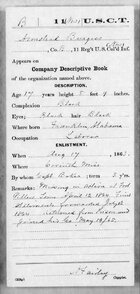
My great grandfather and his brother left Pleasant Site Plantation in Franklin County, Alabama, and ended up in the Corinth contraband camp before enlisting in the Union Army.

Best Regards,
-Y

Thanks for the clarification, Yulie. I've tried to post the titles of the photos as I found them, although sometimes the photographs are listed differently in different places (See the Dechard, Tenn. photo above--post #72 , which is listed as "unidentified" in the earlier reference above).

I used "Contrabands" for the Thread title as that's the Library of Congress title under which some of the photos are found, and it's what might come up on search engines.

Do you know when your great grandfather and uncle reached Corinth and when they enlisted?
 
Last edited:


Yep. This is well worth to highly recommended watching. Dr. Glymph makes an important distinction between African American contrabands and refugees. She analyzes the photograph of the Helena, Arkansas camp as well (which is posted above as "Contraband Camps -- Arkansas.").

The point Dr. Glymph makes is that NOT ALL fleeing enslaved people received the contraband designation. The designation depended on the military command, the location, and whether a particular settlement officially received this designation and could become a labor force for the Union. A supporting factor is also Camp Nelson. A woman and her dependents received the contraband designation and privileges ONLY if her husband was enlisted in the Union Army. When the USCTs left Camp Nelson and headed for Virginia, the new commander expelled all the family members without due notice. There was no shelter for them at Nicholasville or Lexington for these former contraband now refugees. As a result, many died of exposure and are buried in the National Cemetery adjacent to the camp.

-Yulie

P.S. Here's an article that pretty much sums up the contraband expulsion on November 23, 1864 from Camp Nelson: http://www.c-span.org/video/?c4363000/expulsion and http://history.ky.gov/landmark/civil-war-refugees-at-camp-nelson-kentucky-1864-1865/ Regiments from Camp Nelson had fought at Saltville, Virginia the month prior and experienced at horror only to have their families tossed out into the cold. There is a lot of primary material on Camp Nelson contraband camp and surrounding refugee camps. The US Sanitary Commission and the American Missionary Association were there and were in constant flux with each other.[/QUOTE]

This made me cry. I understand it is too sophomoric of anyone to go around with glossy images of an entire race perhaps having come so far, being able to go further with a little help, heck, shelter- it's what's out there. So much for salving national conscience. Never bought that regardless. The truth is just too awful so how easy is it for agenda writers to convince anyone help was there? Or that ' help' amounted to ' charity' and we all know what that word has been torqued in to.

Educating oneself in the History of how our fellow citizens managed to not perish while getting from point a., part of the massive, living, breathing manufacturing system which built so much wealth to b. Some point of dignity AS fellow citizens is beyond difficult. If looking these people in the eye is tough, well, how does one reconcile being one of them, having children thrown into the cold, literally, as a Thank You for serving the country which put one there in the first place.

These educations and links are so, so valuable- thank you. Really cannot comment because trying to do so through lack of education for one thing and horror and tears for another- well, useless.

Died of exposure. God. I'm sorry, just- God.
 
Page 5.jpg
[QUOTE="

Do you know when your great grandfather and uncle reached Corinth and when they enlisted?[/QUOTE]

My great grandfather enlisted on August 17, 1863 and was mustered in on September 7, 1863. I am still sorting out my great uncle. Thus far, I don't know when they left Franklin County. My GG stated that they were "freed" and left the plantation. The person who claimed him as property died in October 1863.
 

Attachments

  • Page 5.jpg
    Page 5.jpg
    211.4 KB · Views: 218
Last edited:
Missing in action, Fort Pillow. Walking down the street, you never know whose DNA is talking to you, what story it's telling. Too many do not know themselves, doesn't mean the stories are not there. Fort Pillow stories, tough to have The Conversation, tends to devolve into who did what and where instead of What Happened to what man- being able to track down an MIA. Maybe someday a freeze frame, you know? There's this program on my computer, ' Snippet', you can turn it on and it stops the screen anywhere, you clip whatever it is you want as a kind of snapshot. Nothing to do with anything around it, just THAT spot, that moment, that concentrated piece. You can use it in a wider structure later, it's just such a good tool, being able to isolate important subjects in some massive whole.

MIA, Fort Pillow, made me think of that.
 
Missing in action, Fort Pillow. Walking down the street, you never know whose DNA is talking to you, what story it's telling. Too many do not know themselves, doesn't mean the stories are not there. Fort Pillow stories, tough to have The Conversation, tends to devolve into who did what and where instead of What Happened to what man- being able to track down an MIA. Maybe someday a freeze frame, you know? There's this program on my computer, ' Snippet', you can turn it on and it stops the screen anywhere, you clip whatever it is you want as a kind of snapshot. Nothing to do with anything around it, just THAT spot, that moment, that concentrated piece. You can use it in a wider structure later, it's just such a good tool, being able to isolate important subjects in some massive whole.

MIA, Fort Pillow, made me think of that.

I didn't want to distract from the topic with the Fort Pillow issue. It's part of that missing history = many of the USCTs who fought at Fort Pillow as Co A and B of the 6th USCHA were recruited from the contraband camps near Corinth. The Union recruiters were pulling able and willing men directly from plantations and established camps. These people were not passive observers into their fate and livelihood and knew that fighting for the Union Army or Navy meant a type of freedom. The fact that thousands of people would walk hundreds of miles to the camps and then enlist to wear the blue uniform is heroic to me. Another Fort Pillow survivor, Peter Williams, was at the Grand Junction and Holly Springs contraband camps with his family (see http://www.tnvacation.com/civil-war/place/2072/grand-junction-contraband-camp/). Also see Bob Lovett's article at http://tennesseeencyclopedia.net/entry.php?rec=305 In his pension papers, Peter Williams' family provided affidavits that he disappeared from the Grand Junction Camp for a short length of time and when he returned he was wearing a blue uniform with red (artillery). He had enlisted and was mustered in at Corinth, Miss. The Williams family had about twelve men who enlisted in the Union artillery from the contraband camps. Only one remained alive after Fort Pillow....

As ForeverFree said earlier in this topic thread, the issue of contraband camps is being mostly overlooked in the 150th CW commemorations. Many of these camps are now being rediscovered and being dedicated; however, these dedications are not being profoundly publicized. One most keep in their eyesight that the military did not conduct themselves in isolation from human contact. The participation of these people (who would eventually become citizens) with the Union Army and Navy in their own southern states is recorded (albeit neglected) history and should be considered when studying the Civil War.

Best Regards,
-Yulie
 
Last edited:
Yes, I guess it would be distracting- and Fort Pillow generally goes POOF as a topic, don't ask me why. Still- one, more moment in American History which requires - demands- soldier by soldier memorials. Stories, not mere over views of the ' battle'. What battle. Such a disservice to History, to our soldiers. If a good percentage then were from the camp at Cornith- not sure it isn't a serious part of ' contraband' and a great one. Holy Heck, no argument here. The conditions for our USCT soldiers is as hard for me to read sometimes as some of what happened to our native tribes. Nobody yell at me it just is- women and children dead from exposure because they had nowhere to live? Brutal retaliations based on skin color? Blind prejudice despite serving, and fighting to serve? It is well documented these men volunteered by the scores- what isn't as well known is what happened to their families.

Have to say, in an entire subject, The American Civil War, main subject of which whirls around ' Slavery ', an entire race- enslaved, imprisoned individuals, 4 million- boggles the mind, also boggles the mind the USCT or any other commemoration was not hoisted to the highest flagpole. Think the neglect has it's genesis in this inane and continuing ' argument', ' What caused the Civil War '. These contrabands were now ' free' , but Tubman and her ilk had been achieving the same thing for what, hundreds of years? Badly impeded too, by laws like the Fugitive Slave Act, they still struggled to free themselves. I could see why, when finally called, zillions would feel impelled to finally serve openly. Must have been tough sometimes. These men may have gotten away from the system which held them captive- the one in which they could be ' equal' could be really brutal, too.

The system of slavery is the vortex of this war- the people who endured it had 4 million faces in 1861.
 
I didn't want to distract from the topic with the Fort Pillow issue. It's part of that missing history = many of the USCTs who fought at Fort Pillow as Co A and B of the 6th USCHA were recruited from the contraband camps near Corinth. The Union recruiters were pulling able and willing men directly from plantations and established camps. These people were not passive observers into their fate and livelihood and knew that fighting for the Union Army or Navy meant a type of freedom. The fact that thousands of people would walk hundreds of miles to the camps and then enlist to wear the blue uniform is heroic to me. Another Fort Pillow survivor, Peter Williams, was at the Grand Junction and Holly Springs contraband camps with his family (see http://www.tnvacation.com/civil-war/place/2072/grand-junction-contraband-camp/). Also see Bob Lovett's article at http://tennesseeencyclopedia.net/entry.php?rec=305 In his pension papers, Peter Williams' family provided affidavits that he disappeared from the Grand Junction Camp for a short length of time and when he returned he was wearing a blue uniform with red (artillery). He had enlisted and was mustered in at Corinth, Miss. The Williams family had about twelve men who enlisted in the Union artillery from the contraband camps. Only one remained alive after Fort Pillow....

As ForeverFree said earlier in this topic thread, the issue of contraband camps is being mostly overlooked in the 150th CW commemorations. Many of these camps are now being rediscovered and being dedicated; however, these dedications are not being profoundly publicized. One most keep in their eyesight that the military did not conduct themselves in isolation from human contact. The participation of these people (who would eventually become citizens) with the Union Army and Navy in their own southern states is recorded (albeit neglected) history and should be considered when studying the Civil War.

Best Regards,
-Yulie

Thank you for providing the information about your family, Yulie. I have some additional internet references about contraband/refugee camps that I collected in searching out these photos. Both you and Forever Free are correct that this area hasn't received the coverage that other areas have, especially given that those who who left the plantations became what Steven Hahn calls "political activists" who forced enormous changes through their decisions and their presence.

Here's a short National Park Service article about the refugees who ended up in Washington, D. C., some 40,000 of them by 1865. http://www.nps.gov/cwdw/historycult...he-capital-during-and-after-the-civil-war.htm
 
A history of the Contraband Hospital in Washington, D. C., which would later become Freedmen's Hospital. http://www.blackpast.org/perspectives/contraband-hospital-1862-1863-heath-care-first-freedpeople

"Contraband Camp and Hospital were constructed as one-story frame buildings and tented structures built by the Union Army to serve as temporary housing and hospital wards for black civilians and soldiers. Separate wards for men and women were established as well as separate tented wards for smallpox patients. In addition to the hospital wards, there was a stable, commissary, dead house (morgue), ice room, kitchen, laundry, dispensary, and living quarters. Within the camp thousands of contraband found refuge and medical care, and by the end of 1863, they had processed over 15,000 individuals and had 685 residents."

Alexander T. Augusta became the first African-American surgeon in charge in 1863. When Contraband Camp was disbanded in 1863, the hospital moved several times, and eventually in 1864 to the grounds of Campbell Army Hospital in D.C. Dr. Augusta encouraged the hiring of African Americans as surgeons and head nurses. Previously, the nurses, laundresses and cooks had been black, the surgeons and head nurses white. Many newly arrived refugees became nurses at the hospital, making a transition from slavery to paid employment.

As the Freedmen's Hospital, this institution would serve the medical needs of Washingtonians for the next 100 years, becoming a part of Howard University in 1961.

campbell-military-hospital-washington-dc-1860-1870-loc-photo-01.jpg


Campbell Hospital, Washington, D. C.


Last edited:
Post #55 above has some photos of Fish Haul/Fish Hall Plantation, which became Mitchelville. General Ormsby M. Mitchel was determined that this would be a model for a refugee camp and provided lumber and nails for the former slaves to build their own homes on a portion of the former plantation on Hilton Head. The Army operated a commissary at Mitchelville and independent tradesmen could also apply for a permit to operate a store there.

http://www.bcgov.net/mitchelville/documentation/more-than-a-refugee-camp/

 
Last edited:
Never bumped into Mitchelville before! Considering how important it was, seems a little shameful. Really need to do a good thread- probably be very long by the time it's covered properly! Amazing, wasn't it? Haven't read entire articles or looked at the whole site. Little annoyed with myself- this looks to have been a well known town? ** Sigh** On the other hand, nothing better than an entire, new absorbing subject to sink one's teeth into. Don't you love that?

Edited to add- Really a very good thing you agreed to be part of this forum, 18th! Can never thank you enough- otherwise I'd keep spinning off on tangents like the Energizer Bunny of all pinball games.
 
Question: in the foto of Contraband Cooks, Culppeper Va., are those used up canned food tins on the ground in front of them? If so, nice evidence of the importance of early canned foods. Or, conversely, it is a modern reenactment?

Never got back to this post, sorry godofredus.

The photo is from the Library of Congress collection as a Civil War period photograph.
 
This thread made me think of Elizabeth Keckley's organization, begun to benefit those who came out of enslavement after her. Am conflicted about her frequently- what a dreadful, awful early life, inclusive of rape and having to free herself at massive expensive, toil and unfair ' cost'. The family demanding what amounted to ransom for her and her son were dissipated, trust fund babies who literally lived from her gifts and talents, were loathe to let the golden golden goose slip away. Well-wishers finally lent her enough to get OUT. The thing is, she tended to look down her nose at the group as a whole but turned around and raised money endlessly. Seems to have been more of a softy who spoke harsh words hiding a big heart, who knows what any of us would have been like walking in her shoes.

Anyway, there were ' free blacks' as society insisted on labeling this group ( as opposed to ' people' ) kind of destined to wait for society to catch up. Someone was out there running societies to provide some help as' contraband' found their feet where possible, although have to research what they were and how the help transpired. From Keckley's decription her group raised a good amount of money, has chapters in major cities and connections in high places. Will look up details, promise! :) When reading of these excellent fundraisers, meetings and the people involved, made me think of the era photos you bump into, people whose hands must have been out in welcome.

a1.jpg


a2.jpg


a3.jpg

Ok, just noticed her dress is later, decided to leave her in because she's so pretty.

a4.jpg

And she's too young to have helped just liked the photo hugely.

a5.jpg

A smiler! My favorite.

a6.jpg

Mother-baby photos, also my favorite.

a7.jpg

One description of her is she's Creole, from New Orleans. No idea whether or not this is true since that came from Pinterest, unsourced, home of the Mr. and Mrs. Lincoln wedding photo.

a8.jpg


a9.jpg

I forget who this is- someone of note and of course became separated from her identification.
 
This thread made me think of Elizabeth Keckley's organization,

....
I forget who this is- someone of note and of course became separated from her identification.

The first and last photographs are totally new to me. Can you provide the original source from which you harvested them? They will be a great study.

Elizabeth Keckley gives a brief description of the forming the Contraband Relief Association in Chapter VII of Behind the Scenes (see http://www.gutenberg.org/files/24968/24968-h/24968-h.htm) She did a lot more that she revealed in her memoir. She garnered the talents of people like Sojourner Truth and Mary Shadd Cary to organize and assist the newly freed people. I read a more detailed biography which includes this relief work but, unfortunately, the name and author escapes me. I'll circle back if I remember.

Thanks,
-Yulie
 
The first and last photographs are totally new to me. Can you provide the original source from which you harvested them? They will be a great study.

Elizabeth Keckley gives a brief description of the forming the Contraband Relief Association in Chapter VII of Behind the Scenes (see http://www.gutenberg.org/files/24968/24968-h/24968-h.htm) She did a lot more that she revealed in her memoir. She garnered the talents of people like Sojourner Truth and Mary Shadd Cary to organize and assist the newly freed people. I read a more detailed biography which includes this relief work but, unfortunately, the name and author escapes me. I'll circle back if I remember.

Thanks,
-Yulie

Yes, both were harvested from Pinterest, on a generic ' Civil War women ' page but the last is bugging me because I know I've bumped into her before. Wherever it was the document she holds made sense, drat this cluttered head. Making me a little crazy- pretty sure it's important. Well goodness, look at her, beautifully elegant, you could swear Keckley herself made both dress and jacket and the simple, sweeping hairstyle is superb.

I'm guessing if the original ' pinners' on both could be found, then original source will be there also? Folks like to be seen as the original, then become lazy or do not understand historical significance. There are so, so many orphaned photos there, identity long since truncated. I'm not being snotty, swear, it's just too much bother to carry it along when people just, plain do not understand it's kind of unfair not to. You probably know how to do image searches? ( beyond me so far ) That'll track them in a big hurry.

Yes, I'd have to guess Keckley HAD to put life's blood and effort and money into her efforts- she writes very, very ' in passing' of it, yet one moment she's in one city, the next elsewhere- yet the sheer travel, time, organization, scope and compassion contained within these paragraphs speaks of someone who wasn't going to be stopped. She DOES that. I sew- poorly. By hand, as they did. She speaks of sewing entire dresses,in days, or one day, supporting the rotund trust fund babies with a needle and talent, sparing her elderly mother who the skunks were going to rent out. Herself. Supporting a grown man and HIS family. Point being, with what time later on did she do all this, with her organization too? She did it anyway. Yes, had a shop by then but it went up and down in fortune. Also was dependent on the goodwill of white women.

You know, there are a few parts in her book I'm crazy about. The Jefferson Davis display, she's part of the crowd admiring a dressing gown on display and says to no one in particular that she made it for him. The crowd loves this information and her for making it. Just seemed validating.

The other one was when one of the Lincoln children was not responding well to learning his words- really making a hash of it. Elder brother Robert is disgusted, mother Mary seems to feel it cute. Elizabeth knows she has to keep it to herself but her reflection is a. Her son would have eaten the information for breakfast and b. If a small black child had been so slow in learning, it would have been ' proof' he was unable to grasp an education. Kind of thing which must have driven her crazy.

I'd very much like to look into her organization. I know she served as president for several terms, how, who on earth knows. Did not know Sojourner was part of it, which really burns me up because ( can't put my finger on it ) had heard otherwise, on relationships between the women. Is there anywhere, or anyone safe from agenda, GEE WHIZ. Of all minorities of the time, toughest on the ladder, black women, I just KNEW it made zero sense some stupid thing where they did not stick together. Have NO trouble believing the suffragettes bagged their former allies, white suffragettes, don't get me started. Always takes the wind out of my sails, being able to celebrate that part of women's history, knowing part of how it was achieved, by feeling ' better off' not taking it on, on the part of ALL women. Makes you pretty ill, honestly spoils it for me.
 
ps, At the risk of being once again too wordy, thanks Yulie and 18th and Ernie for help. When I first began visiting Gettysburg, would wander around all alone- quite happy, it's not that, a map wrapped around my legs, gather information, picking it all up as it was found, Kindle bookmarked, camera loaded with things requiring looking up when home. Joined the forum and was invited along with people who knew the place. Gosh.

Point being it's just awfully, awfully refreshing to navigate subjects unimpeded by maps wrapped around your legs because you have guides.
 
http://www.navyandmarine.org/ondeck/1862saltraids.htm

Very good article on the Navy, the Salt Raids and why the USS Kingfisher was there in the first place, anyone has time to read it. Had not heard of the decimation of Confederate salt works or why it was so crucial- super, super read! Of course, naval stories slay me anyway, this is a GREAT one.

This is from the article, so one, more group of enslaved people managed to free themselves. They must have reached the USS Kingfisher- and here's the part you just can't see in the picture- gave hugely, hugely valuable information to the Federal Navy. Enabled them to zero in on their mission, do the most amount of damage with least loss.

"The first raid on 8 September, 1862 began with a landing party of the USS Kingfisher under the command of Lt. Commanding Couthouy at St. Joseph's Bay, Florida. There they destroyed the works that produced 200 bushels of salt a day. A bushel of refined salt in those days was figured to contain 50 pounds. The following was reported by one of his officers (most likely Acting Master Allen) to the Harper's Weekly, "About two weeks since we had a lot of contrabands come off, who informed us that there were extensive salt works at the town of St. Joseph, making 100 to 150 bushels a day, and not yet completed. We sent a flag of truce and politely informed them that they must stop, or we should destroy them. "

Sorry, not trying to make too much of the picture 18th- always tend to become kind of psyched over these individual stories. Start seeing the little boat and all those people, what it must have been like going through the breakwater ( you wonder if they'd ever done that before, can't have been a wonderful experience ), what each one must have felt and thought out there- seeing the Kingfisher get closer and closer. Finally, what kind of satisfaction there was, seeing smoke from shore signifying their information had been so useful to an entire fleet. Gosh. Don't you get lost in this stuff?
 

Learn About Us
About CivilWarTalk
Contact the Webmaster
Meet the Staff
Link to CivilWarTalk
Join Our Community
Register
Browse Forums
View Today's Discussions
Search the Forum
Get Help
FAQ
Student Guide
Forum Rules & Etiquette
Copyright / DMCA

     Contact Us CivilwarTalk on Facebook CivilWarTalk on YouTube CivilWarTalk on Twitter RSS Feed

Bringing the American Civil War and More to Life.
© 1999 - , CIVILWARTALK, LLC - Site Version 10.0

SlaveryTalk.com - SecessionTalk.com - CivilWarTalk.com - ReconstructionTalk.com
Back
Top