-
Welcome to CivilWarTalk, a forum about the American Civil War! - Join today! It's fast, simple, and FREE!
You are using an out of date browser. It may not display this or other websites correctly.
You should upgrade or use an alternative browser.
You should upgrade or use an alternative browser.
Confederate forage cap ?
- Thread starter Kco.
- Start date


Frederick14Va
Sergeant Major
- Joined
- Oct 14, 2013
- Location
- Virginia
Confederate forage caps tended to typically be militia, very early war and/or commutation period... These frequently found with what is known as the McDowell style brim.... Those issued via the respective clothing depots were nearly all of the chasseur / kepi style patterns... Beyond the first year or so of the war the majority in use would have been the kepi thereafter...
Forage Cap

Kepi

Forage Cap
Kepi

- Joined
- Feb 20, 2005
- Location
- Near Kankakee
The forage cap was so named because it could carry forage; i.e., taters, eggs, turnips and stuff like that. A wearable bucket, as it were.

 Forum Host
- Joined
- Sep 3, 2014
- Location
- Center Valley, PA
The forage cap was so named because it could carry forage; i.e., taters, eggs, turnips and stuff like that. A wearable bucket, as it were.
You know, I heard that story many many times. Would love to know how many soldiers marched with raw eggs on their heads

- Joined
- Aug 25, 2012
The forage cap was so named because it could carry forage; i.e., taters, eggs, turnips and stuff like that. A wearable bucket, as it were.
I have also seen this story, but am not sure it is true. The term "forage cap"goes back to at least the U.S. Army when in 1825 when the Army came out with the 1825 enlisted forage cap, the 1832 pattern leather forage cap a.k.a. 'gig top'. The issue is that there is not given reason that I have found why these caps were to be called forage caps. Because we were at peace in 1825 few soldiers would have been allowed to forage. I have never been shown a reason the term was coined in the U.S. and have some doubts the 1825 pattern caps were intended to carry anything. It is my belief the term came form the British term "forage cap" which date back to a type of cloth fatigue cap used by British Cavalry in the 1700s. What I have seen is that the British term was used a fatigue cap worn when foraging for forage for the cavalryman horses. I suppose the term could also mean to forage for human food for the cavalrymen themselves. I can not find out why the British used the term "forage cap" and there is no explanation in any British uniform documents I can find from the 1700s as to why it was called a forage cap. .

Aussie Billy Sherman
First Sergeant
- Joined
- Aug 29, 2015
There must be some truth to the use of the cap in foraging for it to be named that.

- Joined
- Jul 28, 2015
The 1858 forage cap in the US Army was given birth by the Utah expedition in 1857; soldiers in the expedition wore the 1851 & 1854 shako, which was unwieldy, stiff and very uncomfortable. They would knead and beat the shakos so that they were soft and more comfortable. This picture is from the expedition and what appear to be forage caps are actually 1851 & 1854 shakos patterned by the individual soldiers for comfort. The same was invariably done to the later Hardee hat. The experience of this and other expeditions led Col. Albert Sidney Johnston and Captain Stewart Van Vliet, to recommend a more comfortable and suitable cap for campaign and fatigue wear.
The idea that the forage cap was called such due to the size and ability to store forage is a myth, as the 1839 wheel cap was also called a forage cap. Forage and fatigue were interchangeable terms in the army. While on fatigue duty, a soldier would be called upon to cut wood, carry water, dig latrines and yes, forage. The army was in flux for at least a dozen years after the Mexican War and as such there was much ambivalence demonstrated by clothing combinations in the field. Appearance Vs. functionality was finally addressed with the 1860 regulations. The frock became dress and the sack coat was for fatigue duty, though some units preferred the frock. Invariably, the Southern States followed what they knew, most of their general officers were ex-US Army and copied what they knew, from the flag to the frock coat, until Manassas cured both sides of that notion.
The Confederates copied at first, but as supplies became scarce, decided that appearance took a back seat to what was on hand, thus the frock coat and forage cap were discarded for the cloth saving shell jacket/round-about and chasseur style kepi.
- Joined
- Aug 25, 2012
There must be some truth to the use of the cap in foraging for it to be named that.
Wearing the cap while foraging or carrying forage in the cap is the question. Were the forage caps made with the intent carring of forage in them or not? I have doubts that the government designed the caps with the intent that food be carried in them.
- Joined
- Jul 28, 2015
Wearing the cap while foraging or carrying forage in the cap is the question. Were the forage caps made with the intent carring of forage in them or not? I have doubts that the government designed the caps with the intent that food be carried in them.
The headgear is actually called the Model 1858 cap and purpose was for fatigue duty at the same time the Hardee hat was to be worn for dress. Forage has nothing to do with it and as stated earlier is mainly another euphemism for fatigue.
The Model 1858 cap was created out of the need for comfort and the size was dictated due to the previous shako Model 1854, not space for forage. Armies in the field did little real foraging, with the notable exception of Sherman's bummers and there are stories of soldiers using their caps to collect food to bring back to camp, thus the cap being called a "bummer". Armies had a commissary department and the soldiers were issued rations for the duties ahead whether it be on the march or in camp drilling. The haversack was the receptacle for carrying foodstuffs, in fact the rarest article in CW collecting is a haversack liner or rice bag. The liners along with the haversacks were tossed upon arriving home after the war because they stunk so badly from rancid bacon and fatback.
Soldiers did not carry food in their cap on their head, they had a blanket roll, haversack and knapsack in addition to pockets.
- Joined
- Aug 25, 2012
General Orders No. 13, War Department, November 30, 1858 reads "For fatigue purposes, Forage caps of pattern in the Quartermaster General's Office, will be issued, in addition to hats, at the rate of one per year. Dark blue cloth, with a cord or welt around the crown in the colors used to distinguish the several arms of service, and yellow metal letters in form to designate companies. For unassigned recruits dark blue cord or welt around the crown and without distinctive badge."
The Uniform And Dress of the United States, 1861, General Orders, No. 6 War Department, Adjutant General, Washington , March 13, 1861 (commonly call Army Uniform Regulations 1861) uses the term forage cap.
Paragraph 49 "For fatigue purposes, forage caps, of pattern in the Quartermaster General's Office: Dark blue cloth, with a welt of the same around the crown, and yellow metal letters in front to designate companies."
The 1851 Uniform Regulation simply call it a cap and I am sorry my 1854 Army uniform regulations has been t misplaced.
The Army Regulations in both 1858 and 1861 referred to them as forage caps and although the caps are known by several names, in general I follow the terminology used by the official army regulations: or John P. Langellier in his Army Blue The Uniform of Uncle Sam's Regulars 1848: John P. Langellier and Paul Loane's U.S. Army Headgear 1812-1872: or Edgar M Howell's United States Army Headgear 1855-1902, as my standard terminology. I am well aware that other writers call the caps other names and sometime I use the terms 1858 Pattern Enlisted Cap.
- Joined
- Jul 28, 2015
I think we are in agreement, but off topic as the original question was whether kepi or forage cap was most prevalent in the Confederacy. I am trying to upload pictures of a Confederate forage cap, a transitional forage/kepi from Louisiana and a Richmond Depot kepi from my collection, but don't seem to be able. I've tried copy and paste as well as the upload button and no joy, any suggestions? I may try Chrome instead to see if I have better luck.
All three of your references are stellar, in fact, I see Paul and John a few times a year.
All three of your references are stellar, in fact, I see Paul and John a few times a year.
- Joined
- Jul 28, 2015
The first picture is a Richmond Depot kepi from the Richmond Howitzers and the two below that are a forage cap from the commutation system 1861/1862 found after the battle of Kernstown. The forage cap has cotton battening and silk lining with a fluer de lis pattern, leather sweatband, glass buttons, a leather chin strap and brim. The transitional or tall kepi is of Louisiana origin, thin leather sweatband and onansburg lining.
It is obvious that as the war progressed, uniform articles used less and less material, the Depot kepi has a pasteboard brim, covered in tarred linen as opposed to the other two that have leather brims.


It is obvious that as the war progressed, uniform articles used less and less material, the Depot kepi has a pasteboard brim, covered in tarred linen as opposed to the other two that have leather brims.

7thWisconsin
1st Lieutenant
- Joined
- Nov 21, 2014
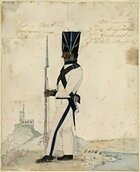
European soldiers had hats such as mitre caps, helmets, shakos and tricorns or unicorns that were uncomfortable and especially for dress occasions. They wore fatigue or garrison caps when on garrison duties. The concept was at least 100 years old by the ACW. Frequently the forage cap was in the coat color and the trim was the regimental facing color. Here's a Venezuelan circa 1815 with a forage cap. I think it's exaggerated in size.
Last edited:
- Joined
- Jul 28, 2015
What the heck on a roll, the kepi pictured below belonged to William Harwood Jr. 3rd Va Cav and of note is the leather sweatband, brim and chinstrap. This was not an issued kepi, but most likely a private purchase from a Charleston, SC hatter, it has all of the characteristics of an early to mid war Charleston made cap. Harwood was one of the last confederate officers killed in the ANV and his brother also in the Charles County Troop, brought his effects home.

- Joined
- Jul 28, 2015
View attachment 78725
European soldiers had hats such as mitre caps, helmets, shakos and tricorns or unicorns that were uncomfortable and especially for dress occasions. They wore fatigue or garrison caps when on garrison duties. The concept was at least 100 years old by the ACW. Frequently the forage cap was in the coat color and the trim was the regimental facing color. Here's a Venezuelan circa 1815 with a forage cap. I think it's exaggerated in size.
Exactly, after the Mexican War, the US Army did not officially adopt a fatigue or forage cap and the 1851 & 1854 shako were the standard and issued headgear. The troops hated wearing the shakos and soon beat them into submission and a more comfortable wear, that emulated what was soon to be the 1858 forage cap. The shako is from the 6th Mass Company G and the forage cap from a soldier in the 100 days 9th PA, notice all of the brass exactly to early war regulation. Which looks more comfortable?
- Joined
- Aug 25, 2012
A few years back I stared a data base of Civil War caps worn in photos apear in in the Military Images magazine which I listed by tpye. I gave up the project after indexing several years worth of magazine. The issue being what to call a cap: kepi, forage cap, fatigue capo what. The military units and many Southern caps could be classified in more than one category.
- Joined
- Jul 28, 2015
No doubt that could drive anyone crazy......Federal gear is certainly more standard than Confederate, though I would love to get my hands on a Whipple hat. Early war Confederate pieces certainly run the gamut and are hard to authenticate without provenance, I have an incredible brown velvet McDowell "forage cap" that was purportedly worn by a Georgia officer. There is no way that I can say whether that is true or not, the hat is definitely period, but some say it could be a woman's cap, though I think not considering the wear and sweat stains inside. The forage cap above from Kernstown is homemade (commutation system) and is of 1861 vintage, it was found in the wall of a home used as a field hospital after Kernstown, it came with two other caps, a wheel cap and a slouch hat. The wall gave up cap boxes, pig skin gaters, shell jacket pieces and cut up boots, it was a common practice to go up to the gable and "insulate" by dropping cloth scraps and unusable leather. Probably had something to do with hiding confederate pieces from Yankees as well.

1842
Private
- Joined
- Aug 30, 2015
I have collected CW for 51 years, I still have a problem with hats used by the South.No doubt that could drive anyone crazy......Federal gear is certainly more standard than Confederate, though I would love to get my hands on a Whipple hat. Early war Confederate pieces certainly run the gamut and are hard to authenticate without provenance, I have an incredible brown velvet McDowell "forage cap" that was purportedly worn by a Georgia officer. There is no way that I can say whether that is true or not, the hat is definitely period, but some say it could be a woman's cap, though I think not considering the wear and sweat stains inside. The forage cap above from Kernstown is homemade (commutation system) and is of 1861 vintage, it was found in the wall of a home used as a field hospital after Kernstown, it came with two other caps, a wheel cap and a slouch hat. The wall gave up cap boxes, pig skin gaters, shell jacket pieces and cut up boots, it was a common practice to go up to the gable and "insulate" by dropping cloth scraps and unusable leather. Probably had something to do with hiding confederate pieces from Yankees as well.
A reenactor story. Not true at all.The forage cap was so named because it could carry forage; i.e., taters, eggs, turnips and stuff like that. A wearable bucket, as it were.
- Joined
- Aug 25, 2012
A reenactor story. Not true at all.
I have some real doubts that the caps were called "foraged caps" because soldiers carried forage in them.
Similar threads
- Replies
- 1
- Views
- 110

- Replies
- 5
- Views
- 225

- Replies
- 31
- Views
- 273
Similar threads
- Replies
- 0
- Views
- 1

- Replies
- 4
- Views
- 5

- Learn About Us
- ►About CivilWarTalk
- ►Contact the Webmaster
- ►Meet the Staff
- ►Link to CivilWarTalk
- Join Our Community
- ►Register
- ►Browse Forums
- ►View Today's Discussions
- ►Search the Forum
- Get Help
- ►FAQ
- ►Student Guide
- ►Forum Rules & Etiquette
- ►Copyright / DMCA
 Bringing the