Civil War Muskets

Joined
May 16, 2016
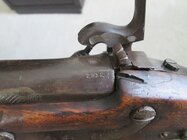
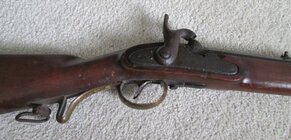
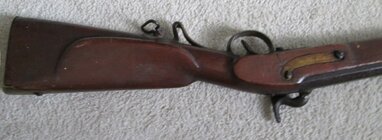
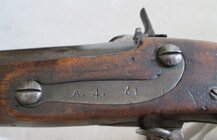
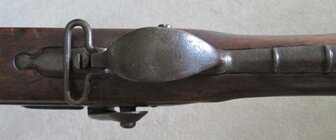
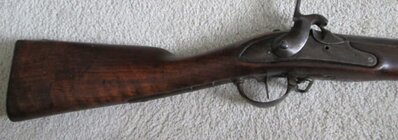
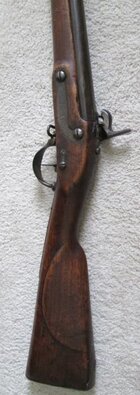
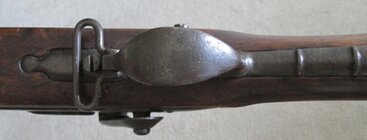
Anyone know what these two are? Models are in two groups of photos: first "photo 0.jpg photo 1.jpg" ... Second"photo one.jpg photo two.jpg " ...
 

Attachments

  • photo 0.JPG
    photo 0.JPG
    212.5 KB · Views: 393
  • photo 1.jpg
    photo 1.jpg
    23.8 KB · Views: 356
  • photo 2.jpg
    photo 2.jpg
    75.2 KB · Views: 435
  • photo 3.jpg
    photo 3.jpg
    47.1 KB · Views: 358
  • phot one.jpg
    phot one.jpg
    27.5 KB · Views: 362
  • photo five.jpg
    photo five.jpg
    51.9 KB · Views: 432
  • photo four.jpg
    photo four.jpg
    33 KB · Views: 353
  • photo six.jpg
    photo six.jpg
    43.4 KB · Views: 335
  • photo three.jpg
    photo three.jpg
    34.5 KB · Views: 339
  • photo two.jpg
    photo two.jpg
    32.3 KB · Views: 308
The first weapon is a Muster 1849 Austro-Hungarian Army (k.k. Army) Kammerbüchse; frequently called a "Garibaldi" rifle in the United States.

The second weapon is a Muster 1842 k.k. Army smoothbore infantry musket converted from tubelock to percussion by Henry Leman of Lancaster, PA, in late 1862 or early 1863. The rear sight on this one is very creative, since Leman removed the Austrian rear sight when he converted the weapons.

Regards,
Don Dixon
 
The first weapon is a Muster 1849 Austro-Hungarian Army (k.k. Army) Kammerbüchse; frequently called a "Garibaldi" rifle in the United States.

The second weapon is a Muster 1842 k.k. Army smoothbore infantry musket converted from tubelock to percussion by Henry Leman of Lancaster, PA, in late 1862 or early 1863. The rear sight on this one is very creative, since Leman removed the Austrian rear sight when he converted the weapons.

Regards,
Don Dixon


Thanks for your expertise!
 
Prior to being imported to arm Federals or Confederates, many of the k.k. Army weapons had served their time with k.k. Army units. A peacetime k.k. Army infantry regiment consisted of 6,886 officers and men in three battalions. A fourth battalion was added during mobilization. The regiment was commanded by a colonel and each of the battalions by a major. So, a k.k. Army regiment was roughly comparable to an American division or small corps, and a k.k. Army battalion was roughly comparable to a small American brigade. The k.k. Army was rank light. A corporal or even a senior private (Gefreiter) was somebody, because he led troops.

k.k. Army weapons were often marked with unit markings on the barrels, butt plates, or side plates. The markings identify the regiment, battalion or company, and the weapon within that unit. I don't have a good crib sheet for unit markings during the System Augustin (tubelock) period, but I would assume that the weapon was issued to the 61st Infantry Regiment (Hungarian) (Graf von Strassoldo), Company A, 4th weapon, when it was in k.k. Army serivce. The markings begin to get to the soul of the weapon.

Regards,
Don Dixon
 
Don is right on the money with the Muster 1849, but I think the other is a Wurttemberg musket, most probably a French M1816 or similar arm. If I'm not mistaken, the small metal plate attached to the stock flat (not the side plate) is unique to those arms.

Cheers,
Garrett
 

Learn About Us
About CivilWarTalk
Contact the Webmaster
Meet the Staff
Link to CivilWarTalk
Join Our Community
Register
Browse Forums
View Today's Discussions
Search the Forum
Get Help
FAQ
Student Guide
Forum Rules & Etiquette
Copyright / DMCA

     Contact Us CivilwarTalk on Facebook CivilWarTalk on YouTube CivilWarTalk on Twitter RSS Feed

Bringing the American Civil War and More to Life.
© 1999 - , CIVILWARTALK, LLC - Site Version 10.0

SlaveryTalk.com - SecessionTalk.com - CivilWarTalk.com - ReconstructionTalk.com
Back
Top