
Si Klegg
Corporal
- Joined
- Jul 13, 2018
- Location
- Bedford UK
Yeah, that's a much better angle, can see a defined shape now. I would never have spotted the repair in those photos, they look very much one-piece soles in those pics.

Agreed, I am glad I posted my picture first. It has been a great teaching experience! I'm always thankful for all of the knowledgeable people here.Yeah, that's a much better angle, can see a defined shape now. I would never have spotted the repair in those photos, they look very much one-piece soles in those pics.

The defined shape is not as critical as it may appear, the brogans I referenced earlier were from the famous find outside of Nashville (hospital site trashpit); the number of shoes pulled out of there was incredible. Most likely after the battles of Franklin and Nashville. The following are all issued brogans the first group were pulled out of the trash pit and the second are non excavated. The trash pit brogans are later war and show evidence of copper rivets on the sides and also nails in the instep (there is one that appears to be a transitional piece as there does not appear to ever have metal nails in the instep) Notice that the first brogan has been cut down by the soldier, for comfort; a typical issue brogan will have four eyelets and the soldier has cut this down to two eyelets. The brogan also has the leather lace which is thin and flat, not square. The heel is severely worn and I can't imagine how comfortable this was to wear, if the soldier wasn't knock kneed when he came into the service, he was when he left.I looked through the site that you referenced. The picture I posted did appear to have a less defined shape due to the angle I took it from. The soles are actually more defined though. Below are images from the seller where you can see the more defined sole.View attachment 208912 View attachment 208913
They look more like this
View attachment 208916
Than this
View attachment 208917
Those are great, thanks for posting them! I see what you mean as the first couple definitely don't have much of a defined sole to them. It's amazing to me how well preserved the leather is after so long in the ground.The defined shape is not as critical as it may appear, the brogans I referenced earlier were from the famous find outside of Nashville (hospital site trashpit); the number of shoes pulled out of there was incredible. Most likely after the battles of Franklin and Nashville. The following are all issued brogans the first group were pulled out of the trash pit and the second are non excavated. The trash pit brogans are later war and show evidence of copper rivets on the sides and also nails in the instep (there is one that appears to be a transitional piece as there does not appear to ever have metal nails in the instep) Notice that the first brogan has been cut down by the soldier, for comfort; a typical issue brogan will have four eyelets and the soldier has cut this down to two eyelets. The brogan also has the leather lace which is thin and flat, not square. The heel is severely worn and I can't imagine how comfortable this was to wear, if the soldier wasn't knock kneed when he came into the service, he was when he left.
I have another pair from an Ohio soldier that have metal eyelets, most likely state issue brogans.
I'll post another group of Confederate brogans, unfortunately they were all over the board and used what they could, though one pair are I'd as Richmond Depot shoes.
View attachment 208922 View attachment 208922 View attachment 208923 View attachment 208924 View attachment 208925 View attachment 208926
The defined shape is not as critical as it may appear, the brogans I referenced earlier were from the famous find outside of Nashville (hospital site trashpit); the number of shoes pulled out of there was incredible. Most likely after the battles of Franklin and Nashville. The following are all issued brogans the first group were pulled out of the trash pit and the second are non excavated. The trash pit brogans are later war and show evidence of copper rivets on the sides and also nails in the instep (there is one that appears to be a transitional piece as there does not appear to ever have metal nails in the instep) Notice that the first brogan has been cut down by the soldier, for comfort; a typical issue brogan will have four eyelets and the soldier has cut this down to two eyelets. The brogan also has the leather lace which is thin and flat, not square. The heel is severely worn and I can't imagine how comfortable this was to wear, if the soldier wasn't knock kneed when he came into the service, he was when he left.
I have another pair from an Ohio soldier that have metal eyelets, most likely state issue brogans.
I'll post another group of Confederate brogans, unfortunately they were all over the board and used what they could, though one pair are I'd as Richmond Depot shoes.
View attachment 208922 View attachment 208922 View attachment 208923 View attachment 208924 View attachment 208925 View attachment 208926

That's the beautiful thing about this site, we are all here to learn.Wow, super images and yes, I see what you mean by the soles on some, I stand corrected, my limited knowledge has come back and bit me on the arris

The soldier that these are attributed to was only in for 7 months, he was discharged for disability so these could very well be his brogans. He entered in Sept '62 and was out in April '63 so these would have been fine for winter camp and more comfortable than boots. The regiment was not fully organized and equipped until 11/1/1862 when it was mustered into service. The regiment performed guard duty around Washington until the Gettysburg campaign.I just received my second pair of Civil War brogans and I am very happy to have them. These brogans appear to be early war and are similar to the Federal variation brogans pictured in Echoes of Glory. This pair was bought from Ebay and the seller stated they belonged to George W.P. Freeland.
Freeland, George W.P.
BATTLE UNIT NAME:
18th Regiment, Pennsylvania Cavalry (163rd Volunteers)
SIDE:
Union
COMPANY:
E
SOLDIER'S RANK IN:
Private
SOLDIER'S RANK OUT:
Sergeant
ALTERNATE NAME:
FILM NUMBER:
M554 ROLL 39
PLAQUE NUMBER:
NOTES:
none
This raises some questions for me. Were Cavalry soldiers issued brogans or boots? These brogans have heavy sole wear that I would think would be more indicative of a foot soldier than a mounted soldier. I'm wondering how accurate the attribution is? The seller said he bought the shoes decades ago directly from the Freeland estate in Dauphin County, PA but that is the only evidence I have to go on. Any thoughts? I will add more photos later when time permits.
View attachment 208674
Not really, contractors were not all alike, there are over 20 known variations of sack coats, so why would shoes be different. I think contractors made their wares as close to spec as possible, while trying to maintain economy of scale and short cut where possible. Missouri Boot and Shoe definitely know what they are doing, but imagine all the shoe suppliers during the war.Wow, super images and yes, I see what you mean by the soles on some, I stand corrected, my limited knowledge has come back and bit me on the arris

I was a little off, they are 12.5" heel to toe. I've taken a couple of comparison pictures of the two pairs side by side and some better pictures of the soles. Let me know if any other pictures would be helpful.What size are they heel to toe measurements?
Thats great information, I hadn't had a chance to dig a whole lot into Mr. Freeland but I did find this which was very interesting to me.The soldier that these are attributed to was only in for 7 months, he was discharged for disability so these could very well be his brogans. He entered in Sept '62 and was out in April '63 so these would have been fine for winter camp and more comfortable than boots. The regiment was not fully organized and equipped until 11/1/1862 when it was mustered into service. The regiment performed guard duty around Washington until the Gettysburg campaign.
Boots seemed to have been preferred when mounted, protecting the legs from branches, though I have seen trousers reinforced, with canvas to perform the same function.
I do get emails from Dave when he has new items available. I love looking at all his treasures.
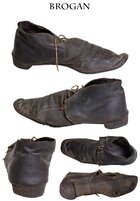
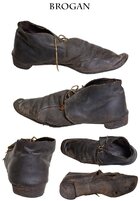
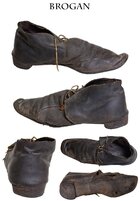
14-06-33 ... My Left Foot: A single Civil War brogan ... A very appealing, obviously used, period brogan. These simple shoes were not only the issue shoe for enlisted men, but were actually preferred by most soldiers to every other form of footwear for comfort. Low heel. Very simple low cut ankle, tied with a thong through three pairs of holes with no eyelets. The cool thing about this one is the period repair to the side. The wearer had no intention of throwing away a shoe that had more miles left in it. A few years ago a great number of CW brogans were excavated from a trash pit in Nashville. My memory says it was near a hospital site. Just about every one of those found showed not only hard use, but crude repairs to make them last just a bit longer. This brogan is not an excavated example. From the same ages old collection as the chevrons listed elsewhere. A really cool piece for a soldier's display …
From Dave Taylor's wonderful site, if you are not on his email list, do so, I consider Dave one of the go to people for Northern uniforms and accouterments.
Keep in mind that the average ACW soldier was 5'6" and less than 150 pounds, a shoe size above current day average size should send a red flag. Not impossible, but as a rule, in the future, size matters, smaller the better.I was a little off, they are 12.5" heel to toe. I've taken a couple of comparison pictures of the two pairs side by side and some better pictures of the soles. Let me know if any other pictures would be helpful.
View attachment 208935 View attachment 208936 View attachment 208937 View attachment 208938 View attachment 208939
I thought they looked large too but they really aren't that much bigger than the minty ones. I am reminded of the statement Abraham Lincoln made about Sheridan "General Sheridan, when this particular war began, I thought a cavalryman should be at least six feet four inches high, but I have changed my mind. Five feet four will do in a pinch." Does this indicate Cavalry men were larger? Maybe, maybe not but it certainly makes one think. I certainly could not wear the Cavalry Shell jackets in my collection but I also wouldn't be able to fit in these shoes. The jury is still out on these shoes but the more I look at them the more I question. I am by no means an expert and I don't question anything you tell me since you are much more knowledgeable than I am. I wish you were able to see these in person because when handling them I definitely get the feeling they are old and I am leaning towards them being original. Dave Taylor is only a few hours drive, I may take them to him to see what he thinks.Keep in mind that the average ACW soldier was 5'6" and less than 150 pounds, a shoe size above current day average size should send a red flag. Not impossible, but as a rule, in the future, size matters, smaller the better.
Having Dave look at them is a great idea, was there a return guarantee?I thought they looked large too but they really aren't that much bigger than the minty ones. I am reminded of the statement Abraham Lincoln made about Sheridan "General Sheridan, when this particular war began, I thought a cavalryman should be at least six feet four inches high, but I have changed my mind. Five feet four will do in a pinch." Does this indicate Cavalry men were larger? Maybe, maybe not but it certainly makes one think. I certainly could not wear the Cavalry Shell jackets in my collection but I also wouldn't be able to fit in these shoes. The jury is still out on these shoes but the more I look at them the more I question. I am by no means an expert and I don't question anything you tell me since you are much more knowledgeable than I am. I wish you were able to see these in person because when handling them I definitely get the feeling they are old and I am leaning towards them being original. Dave Taylor is only a few hours drive, I may take them to him to see what he thinks.
Another aspect of war dated brogans were the holes for stitching (early war and not effective) and the holes for pegs, neither are evidenced on your new acquisition, simply nailed soles throughout. I would expect to at least see the holes in the instep. Again, there were many manufacturers of shoes, but the size and construction of these raise some doubts.The seller didn't really say but I bought them through Ebay and paid with PayPal so if they dont turn out to be authentic and he wont accept a return I can go through PayPal.

14-06-33 ... My Left Foot: A single Civil War brogan ... A very appealing, obviously used, period brogan. These simple shoes were not only the issue shoe for enlisted men, but were actually preferred by most soldiers to every other form of footwear for comfort. Low heel. Very simple low cut ankle, tied with a thong through three pairs of holes with no eyelets. The cool thing about this one is the period repair to the side. The wearer had no intention of throwing away a shoe that had more miles left in it. A few years ago a great number of CW brogans were excavated from a trash pit in Nashville. My memory says it was near a hospital site. Just about every one of those found showed not only hard use, but crude repairs to make them last just a bit longer. This brogan is not an excavated example. From the same ages old collection as the chevrons listed elsewhere. A really cool piece for a soldier's display …
From Dave Taylor's wonderful site, if you are not on his email list, do so, I consider Dave one of the go to people for Northern uniforms and accouterments.



 Bringing the