Brothers at War

ErnieMac

Colonel
Forum Host
Retired Moderator
Joined
May 3, 2013
Location
Pennsylvania
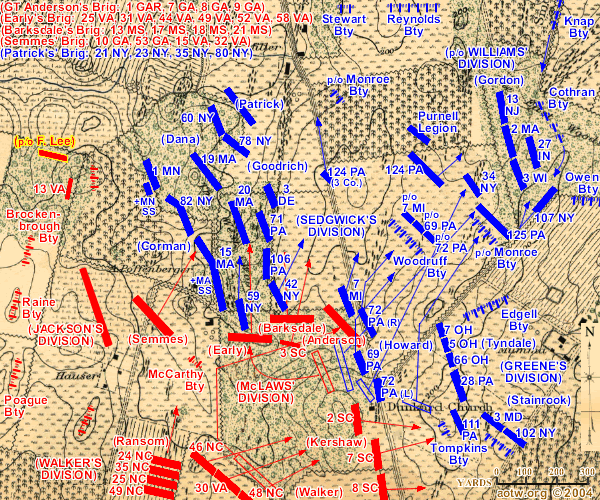
In April, 1861, John G. B. Adams and his brother, Isaac enlisted in Company A, 19th Massachusetts Infantry. Isaac, as described below, was fatally wounded at Antietam. John, who was promoted to 2nd Lieutenant before the battle, survived the war and would publish his memoirs in a book titled Reminiscences of the Nineteenth Massachusetts Regiment from which the following is quoted. Another member of Company A was Daniel W. Spofford, whose brother, Phineas had also enlisted. Phineas, however, had moved south before the war and was an officer in the 8th South Carolina. They all came together in the West Woods as Sedgwick's Division of the II Corps attacked Jackson's command in the West Woods.

"I had not seen my brother since we had advanced in line. He was left general guide of the regiment, and his place was on the left. As soon as we halted I went to the company, but he was not there. The following day I searched the hospitals, but could not find him, and on the morning of the 19th, the rebels having left our front, I went where their lines had been and found him, with Jacob Hazen of Company C and George Carleton of Company B, near an old haystack. He had been shot in the right side of the neck, the ball passing out of the left shoulder; it had cut the spinal nerve, and he could not move hand or foot. I saw at once that he could not live and had him placed in an ambulance and carried to our field hospital. It was the saddest duty of my life. We had left home together, and had often talked of a happy reunion around the old fireside when the war should end. Now I must write to my old mother that one of the three who had bade her good-by in '61 would never return.
…..
While my brother lay wounded on the field inside the rebel lines an officer of the 8th South Carolina came along, and seeing 19 on his cap asked to what regiment he belonged. Being informed that it was the 19th Massachusetts, he said he had a brother in that regiment named Daniel W. Spofford. My brother told him that his brother was wounded in the battle, and might be on the field. He searched for him but did not find him, as he [Daniel] was able to go to the rear before we changed front. Returning, he had my brother carried to the haystack where I found him, and rendered all the assistance possible. The name of the South Carolina officer was Phineas Spofford. Both brothers survived the war. The Union soldier resides in Georgetown, Mass., the rebel in South Carolina, but he often visits his native State."
map_attack_seq_5.gif

The 19th Massachusetts was the right (top) hand regiment of the second line of Sedgwick's Division in the left-center of the page. The 8th South Carolina is shown at the very bottom along the Hagerstown Pike.
 
Last edited:
Given the topic of brothers at war I thought I'd share some results of recent research. I'm trying to find all - as many as I can - of the primary sources related to the 51st Pennsylvania. I came on a small collection of letters written home by three brothers two of whom served in the 51st PA and a third in a different regiment.
One brother was a better writer than the other - his sentence structure and spelling and general ease and length of writing suggest that but both sent home poignant letters. I have yet to read a letter home regardless of the writer that is not in some way very poignant.

Isaiah Henry writes home to his wife on Aug. 5 1864 -
"I am wounded in my nee a slide (slight) one. I got wounded on the 30 of july. Such a sludder (slaughter) I never seed. I wount write much about it. I think you don't care about Such news."

Your loving husband
Isaiah Henry

don't forgid to write to me

Isaiah writes to his sister on Oct. 30 1864

"A person don't know when the deadly Missel Come flying like hail and the road of the Canon and Musketry fairly makes the Earth Shake. I tell you dear Sister it brings a person to reflection."

And his brother Adam writes home Oct 26 1864

"I saw a man shot for Desertion the first one since I been in the army.... he took it very cool ... and died the death of a forsaken soldier."

Yet Adam can write home that he is unhappy to hear rumors that a local girl has claimed he'll marry her when he returns home and his younger brother writes about the food.

George Henry - Nov. 25 1864 - Front of Petersburg

"I like Spech (dried apple) and heard tacks well enough and would have no objection if only I had a little more of them..."
and Dec. 21 on the same theme
"we could eat a little more... though we get along on what we get."


My friends think I'm crazy to spend my free time in libraries reading old letters and my family tolerates it without understanding it. I'm fortunate to be able to post these here and share these small parts of past voices with CivilWarTalkers who care about these voices and the great conflict of which they spoke.
 
Given the topic of brothers at war I thought I'd share some results of recent research. I'm trying to find all - as many as I can - of the primary sources related to the 51st Pennsylvania. I came on a small collection of letters written home by three brothers two of whom served in the 51st PA and a third in a different regiment.
One brother was a better writer than the other - his sentence structure and spelling and general ease and length of writing suggest that but both sent home poignant letters. I have yet to read a letter home regardless of the writer that is not in some way very poignant.

Isaiah Henry writes home to his wife on Aug. 5 1864 -
"I am wounded in my nee a slide (slight) one. I got wounded on the 30 of july. Such a sludder (slaughter) I never seed. I wount write much about it. I think you don't care about Such news."

Your loving husband
Isaiah Henry

don't forgid to write to me

Isaiah writes to his sister on Oct. 30 1864

"A person don't know when the deadly Missel Come flying like hail and the road of the Canon and Musketry fairly makes the Earth Shake. I tell you dear Sister it brings a person to reflection."

And his brother Adam writes home Oct 26 1864

"I saw a man shot for Desertion the first one since I been in the army.... he took it very cool ... and died the death of a forsaken soldier."

Yet Adam can write home that he is unhappy to hear rumors that a local girl has claimed he'll marry her when he returns home and his younger brother writes about the food.

George Henry - Nov. 25 1864 - Front of Petersburg

"I like Spech (dried apple) and heard tacks well enough and would have no objection if only I had a little more of them..."
and Dec. 21 on the same theme
"we could eat a little more... though we get along on what we get."


My friends think I'm crazy to spend my free time in libraries reading old letters and my family tolerates it without understanding it. I'm fortunate to be able to post these here and share these small parts of past voices with CivilWarTalkers who care about these voices and the great conflict of which they spoke.
Interesting thanks for sharing
 
Given the topic of brothers at war I thought I'd share some results of recent research. I'm trying to find all - as many as I can - of the primary sources related to the 51st Pennsylvania. I came on a small collection of letters written home by three brothers two of whom served in the 51st PA and a third in a different regiment.
One brother was a better writer than the other - his sentence structure and spelling and general ease and length of writing suggest that but both sent home poignant letters. I have yet to read a letter home regardless of the writer that is not in some way very poignant.

Isaiah Henry writes home to his wife on Aug. 5 1864 -
"I am wounded in my nee a slide (slight) one. I got wounded on the 30 of july. Such a sludder (slaughter) I never seed. I wount write much about it. I think you don't care about Such news."

Your loving husband
Isaiah Henry

don't forgid to write to me

Isaiah writes to his sister on Oct. 30 1864

"A person don't know when the deadly Missel Come flying like hail and the road of the Canon and Musketry fairly makes the Earth Shake. I tell you dear Sister it brings a person to reflection."

And his brother Adam writes home Oct 26 1864

"I saw a man shot for Desertion the first one since I been in the army.... he took it very cool ... and died the death of a forsaken soldier."

Yet Adam can write home that he is unhappy to hear rumors that a local girl has claimed he'll marry her when he returns home and his younger brother writes about the food.

George Henry - Nov. 25 1864 - Front of Petersburg

"I like Spech (dried apple) and heard tacks well enough and would have no objection if only I had a little more of them..."
and Dec. 21 on the same theme
"we could eat a little more... though we get along on what we get."


My friends think I'm crazy to spend my free time in libraries reading old letters and my family tolerates it without understanding it. I'm fortunate to be able to post these here and share these small parts of past voices with CivilWarTalkers who care about these voices and the great conflict of which they spoke.
It is excellent that you have libraries that have collections of letters available to the general public.
 
On November 28, 1862, Captain William H. Gaston, Co. H, 1st Texas Infantry, wrote home. His letter, though relatively short, addresses several concerns on his mind. He opened by responding to a letter received from his father earlier in the month. Previous letters from William, written shortly after the Battle of Sharpsburg, had never reached Texas. His parents, apparently heard reports of the battle from neighbors who had communication with relatives, but nothing had come from William or his younger brother Robert. William made it plain he had not been remiss in writing home, but the news he conveyed showed there was reason to be worried.

At the time William wrote home, Robert, a lieutenant in the company he commanded, was his biggest concern and had been for some time. Robert had been missing in action since the day of the battle, September 17, 1862. In his letter William wrote "I have been inquiring and hunting for him ever since he was lost. I can hear nothing from him. I feel that he was slain although I cannot give him up yet. There is some chance for him to be alive yet. He may have been badly wounded and still in the hands of the enemy. There has been some of my boys sent back to Maryland that I thought was killed. They saw nothing of Robert but say he may be there somewhere as our boys were scattered all over Md. I hope he may turn up yet someday." As he explained later in the letter "We were overpowered by the enemy and compelled to give up the battlefield leaving behind our killed and wounded with some prisoners & were not permitted to go on the field after the fight. Consequently I cannot tell the result of the missing. We are not lying in sight of the Yankee tents."

Gaston concludes his letter by indicating his health has not been good and that he is thinking of returning home, even if it means resigning his commission to do so. Other sources indicate his illness was typhoid fever. One week after writing the letter William resigned.. He returned to Texas where he spent the remainder of the war on recruiting duty and as a purchasing agent. He would later become a prominent businessman in the growing city of Dallas. Robert was not so fortunate. The 1st Texas had suffered terribly in the Cornfield; 186 of the 226 men it had taken into the fight were casualties. The 1st's battle flag was gone, found lying on the battlefield underneath the body of a young lieutenant with 13 dead and wounded Confederate soldiers lying within arms length of it. A captured Texan officer identified Robert Gaston as the Lieutenant. He is buried in the Washington Confederate Cemetery in Hagerstown MD.

http://www.nps.gov/anti/forteachers/upload/Letters and Diaries of Soldiers and Civilians.pdf
http://books.google.com/books?id=XI...nepage&q=robert gaston 1st texas flag&f=false
 
Given the topic of brothers at war I thought I'd share some results of recent research. I'm trying to find all - as many as I can - of the primary sources related to the 51st Pennsylvania. I came on a small collection of letters written home by three brothers two of whom served in the 51st PA and a third in a different regiment.
One brother was a better writer than the other - his sentence structure and spelling and general ease and length of writing suggest that but both sent home poignant letters. I have yet to read a letter home regardless of the writer that is not in some way very poignant.

Isaiah Henry writes home to his wife on Aug. 5 1864 -
"I am wounded in my nee a slide (slight) one. I got wounded on the 30 of july. Such a sludder (slaughter) I never seed. I wount write much about it. I think you don't care about Such news."

Your loving husband
Isaiah Henry

don't forgid to write to me

Isaiah writes to his sister on Oct. 30 1864

"A person don't know when the deadly Missel Come flying like hail and the road of the Canon and Musketry fairly makes the Earth Shake. I tell you dear Sister it brings a person to reflection."

And his brother Adam writes home Oct 26 1864

"I saw a man shot for Desertion the first one since I been in the army.... he took it very cool ... and died the death of a forsaken soldier."

Yet Adam can write home that he is unhappy to hear rumors that a local girl has claimed he'll marry her when he returns home and his younger brother writes about the food.

George Henry - Nov. 25 1864 - Front of Petersburg

"I like Spech (dried apple) and heard tacks well enough and would have no objection if only I had a little more of them..."
and Dec. 21 on the same theme
"we could eat a little more... though we get along on what we get."


My friends think I'm crazy to spend my free time in libraries reading old letters and my family tolerates it without understanding it. I'm fortunate to be able to post these here and share these small parts of past voices with CivilWarTalkers who care about these voices and the great conflict of which they spoke.
That was fantastic--real speech from real men--not just the figures we have in our minds...
 
It is excellent that you have libraries that have collections of letters available to the general public.
I agree--what a treat! Speaking of treats, I'm FINALLY acquiring "Burnside's Bridge," Francis Barnums most famous and challenging sculpture! It is so rare, weighs 38 pounds (this is pewter, so very finely detailed). Sorry, just had to share that...
 

Learn About Us
About CivilWarTalk
Contact the Webmaster
Meet the Staff
Link to CivilWarTalk
Join Our Community
Register
Browse Forums
View Today's Discussions
Search the Forum
Get Help
FAQ
Student Guide
Forum Rules & Etiquette
Copyright / DMCA

     Contact Us CivilwarTalk on Facebook CivilWarTalk on YouTube CivilWarTalk on Twitter RSS Feed

Bringing the American Civil War and More to Life.
© 1999 - , CIVILWARTALK, LLC - Site Version 10.0

SlaveryTalk.com - SecessionTalk.com - CivilWarTalk.com - ReconstructionTalk.com
Back
Top