Bite Marks on Confederate Roundball/ Olustee

8thFlorida

First Sergeant
Joined
Nov 27, 2016
IMG_1682.JPG
IMG_1687.JPG
IMG_1684.JPG
IMG_1685.JPG
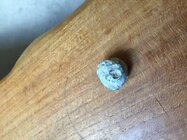
I recently discovered alleged bite marks on two roundballs from the Battle of Olustee. I would appreciate any feedback or methods for determining human bite marks from the Civil War period. I also have a piece of melted lead that seems to have been used for biting during surgeries as well. This is also an interesting find for anyone who appreciates Confederate artifacts.

Good resource: http://pochefamily.org/Books/MeltedLead.html
 

Attachments

  • IMG_1686.JPG
    IMG_1686.JPG
    283.8 KB · Views: 234
Last edited:
Hogs rooting up the ground is pretty common here in Florida. I suspect that most bite marks on bullets were caused by hogs or other animals as opposed to humans. I've personally have never bitten a chunk of lead to test my theory but I would think that a piece of cloth or leather would be preferable if used as a pain measure. I have avoided purchasing "pain" bullets for my collection as I'm convinced it's mostly a myth. Perhaps a professional trained in forensic dentistry could determine if any given bullet has bite marks caused by humans.
 
I have had several "pain" bullets and when I showed them to a dentist, he felt that the marks were probably made by animals, since the spacing of the marks wasn't consistent with a human's bite pattern. I believe that "Bite the Bullet" is more a saying than a fact.
 
Very interesting. I find that I have seen both human and animal characteristics in bite marks on some shot. The research I have seen does lean toward animal marks though. I'd really like to take these to an archaeology department to find out more. A biology department at a university may be helpful as well. I was recommended this course of action as well.
 
I am on the fence with this. I can definitely see that this could be legend. But I would like to see some primary sources that address this question. Is "bite the bullet" a real thing? Not sure at this point.
 
Frankly, I doubt that any ball would have been used to bite on during surgery. Too small. What if the patient had swallowed the bullet and choked on it? I think they would have used something made from wood or leather the patient could cut his teeth in heartily without having to fear he might swallow the thing and die from choking or lead poisoning.
 
Wooden sticks were known as billets, the stick-biting practice might have first been called 'biting the billet' which was then modified to 'biting the bullet'. I also think that during the CW there was no need to bite the bullet, they had ether and chloroform as an effective anaesthesia.
 
Is "bite the bullet" a real thing? Not sure at this point.

Here is an interesting article discussing just that.
http://www.phrases.org.uk/meanings/bite-the-bullet.html

A little teaser:
"I've always believed that, before the days of effective anaesthetics, soldiers were given bullets to bite on to help them endure pain. 'I've always believed' has to be as poor an opening gambit as 'it is widely accepted' or 'a man in a pub told me' on a piece discussing the origins of a phrase.
Is it true or is it just 'believed'? The theory goes that patients undergoing surgery would be given a stick of wood or a pad of leather to bite on in order to concentrate their attention away from the pain and also to protect against biting their own tongues. A bullet, being somewhat malleable and not likely to break the patient's teeth, is said to have been an impromptu battlefield alternative. Lead poisoning would probably have been a secondary concern in those circumstances."
 
Last edited:
Wooden sticks were known as billets, the stick-biting practice might have first been called 'biting the billet' which was then modified to 'biting the bullet'. I also think that during the CW there was no need to bite the bullet, they had ether and chloroform as an effective anaesthesia.

From the article I quoted in my above post:
"An ingenious correspondent has suggested that, as wooden sticks are known as billets, the stick-biting practice might have first been called 'biting the billet' which then modified to 'biting the bullet'. Worth investigating certainly, but my initial enthusiasm was dampened rather by finding that no records of the phrase 'bite the billet' can be found in historical newspapers and other records. That would have been a neat solution but, lacking any supporting evidence, it seems best to discount it."
 
Hope everyone had a GREAT Fathers Day weekend. I have to agree with all above. I have dug many a pain bullet but they were all animal teeth marks. Animal have to bite hard items to keep there teeth sharp. In looking at the round ball and lead I'm going with a squirrel.
 
From the article I quoted in my above post:
"An ingenious correspondent has suggested that, as wooden sticks are known as billets, the stick-biting practice might have first been called 'biting the billet' which then modified to 'biting the bullet'. Worth investigating certainly, but my initial enthusiasm was dampened rather by finding that no records of the phrase 'bite the billet' can be found in historical newspapers and other records. That would have been a neat solution but, lacking any supporting evidence, it seems best to discount it."
Same thing here. I just thought I'd be smart and pass it off as my own, seriously though, I have posted that before, I can't remember which thread though, I think we were discussing re-enactments and someone suggested that the re-enactors had someone playing an injured soldier whom was biting the bullet, I'm pretty sure that biting the billet was where the phrase originated from, billets were made from either hardwood or softwood like maple, I've seen plenty of old pictures where the Royal Navy have injured men biting the billet.
 
I saw several "pain" bullets on display in the National Civil War Museum in Harrisburg, PA. The accompanying description said they were used in emergency surgeries when anesthesia was not available. This seemed hard to believe so I did a bit of follow-up research when I got home. The link below goes to an article written by George Wunderlich, the Executive Director of the National Museum of Civil War Medicine in Frederick, MD. He basically debunks what he calls this "myth." This is an interesting topic @8thFlorida.

http://civilwarscholars.com/2011/10/myth-no-2-biting-on-the-bullet-for-pain-george-wunderlich/
 
I tend to agree with the consensus here that if they are teeth marks they are probably animal. Soft lead isn't really all that soft and those marks appear as though someone or thing really gave it Hell. I would think the tooth would shatter first under that much pressure. I am no orthodontist but that would be way beyond cool if they were human.
 
I tend to agree with the consensus here that if they are teeth marks they are probably animal. Soft lead isn't really all that soft and those marks appear as though someone or thing really gave it Hell. I would think the tooth would shatter first under that much pressure. I am no orthodontist but that would be way beyond cool if they were human.

none of us has teeth that leave behind that kind of bitemarks, let alone the necessary 'biting power' - our jaws are not made for that
 

Learn About Us
About CivilWarTalk
Contact the Webmaster
Meet the Staff
Link to CivilWarTalk
Join Our Community
Register
Browse Forums
View Today's Discussions
Search the Forum
Get Help
FAQ
Student Guide
Forum Rules & Etiquette
Copyright / DMCA

     Contact Us CivilwarTalk on Facebook CivilWarTalk on YouTube CivilWarTalk on Twitter RSS Feed

Bringing the American Civil War and More to Life.
© 1999 - , CIVILWARTALK, LLC - Site Version 10.0

SlaveryTalk.com - SecessionTalk.com - CivilWarTalk.com - ReconstructionTalk.com
Back
Top