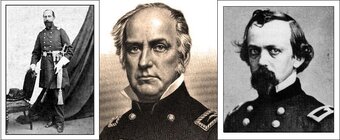
BG Charles P. Stone

NFB22

Sergeant Major
Joined
Jun 21, 2012
Location
Louisville, KY
I recently read an article on the Battle of Ball's Bluff (Oct 21, 1861) and how after the battle Brig. General Charles P. Stone became a scapegoat for the Union defeat in the battle and for the death of Edward Baker.

I can see through further reading that Stone had ruffled some feathers with politicians and that some of these same politicians were angered by the death of Baker at the Battle of Ball's Bluff but my question is why did none of the military speak in favor of Stone instead of letting him be arrested and imprisoned without formal charges of any type? It seems to me Stone had been a model soldier up to that point and from what I've seen its clear the Union defeat at Ball's Bluff was not all his doing.
 
It was political of course. And because of this battle the Joint Committee on the Conduct of the War was started. This comittee turned out to be basically a radical republican "witch hunt". Here is the wikipedia explanation.

Baker's death and the action at Ball's Bluff would have serious consequences for Stone, and also affect the way the American Civil War would be prosecuted. In his official report about the battle on October 24, McClellan did not hold Stone personally responsible for the defeat, saying "The disaster was caused by errors committed by the immediate Commander—not General Stone."

Arrest and imprisonment
Stone bore the brunt of much public criticism; the U.S. Congress Joint Committee on the Conduct of the War was established in the wake of Baker's congressional eulogies and anger over the defeat. This seven-man group called Stone as one of their first witnesses about the Ball's Bluff affair, and all testimony given by him and 38 others was kept secret. Before the end of October 1861, Stone's official report about Ball's Bluff had been leaked to the New York Tribune newspaper, and in it Stone praised Baker's bravery but made clear his shortcomings as a field commander.

Baker's congressional allies, among them Governor Andrew and Senator Sumner, openly denounced this report and began to point accusing fingers at Stone, not at Baker. Stone's loyalty to the Union and position on slavery were more in question than his military abilities and decisions. The committee's questions accused him of improper and frequent communications with the Confederates, of not re-enforcing Baker, of using his men to protect slaveholder property in Maryland, and of returning runaway slaves to their owners—despite the last two of these following Maryland as well as Federal law. Another problem for Stone defending himself was an order from McClellan forbidding him to give testimony "regarding his [McClellan's] plans, his orders for the movement of troops, or his orders concerning the position of troops." This made it impossible for Stone to explain his movements to the committee, but kept McClellan out of the investigation as well.

Under a cloud for suspected disloyalty and treason, Stone was arrested just after midnight on February 8, 1862, on orders of Maj. Gen. McClellan, who was acting under orders from Secretary of War Edwin M. Stanton, dated January 28. Awaiting Stone near his home in Washington were 18 soldiers led by Brig. Gen. George Sykes. When Stone approached, Sykes stated "I have now the most disagreeable duty to perform that I ever had—it is to arrest you." When Stone angrily asked why, Sykes said "I don't know. It's by order of Maj. Gen. George B. McClellan, general-in-chief of the army... I may as well tell you that you are to be sent to Fort Lafayette." This shocked Stone, who stated "That's where they send secessionists! I have been as true a soldier to the Government as any in service."
 
Last edited:
Historian Paul Finkelman referred to him as "incompetent" in a talk a few years ago.

If anything I think that shows, that even today, it's not always about competence.
 
Hi, newbie here! Recently re-read Sears' Chancellorsville book and in it he states that Hooker wanted Stone for his chief of staff but Halleck, for the lack of a better phrase, basically said hell no
 
I see how it was a political mess, but its clear prior to this his superiors were very high on Stone so I don't understand why nobody spoke up for him when the politicians started having their way with him.
 
Timothy J. Reese covers the Stone incident in Sykes Regular Division. He also includes much about Stone's activity in Washington following the outbreak of the war and his subsequent career. He accepted a post war position in the Egyptian Army and designed the pedestal for the Statue of Liberty.
 
Charles_P._Stone2b-285x350.jpg

"Charles P. Stone" by Unknown photographer, restored by Michel Vuijlsteke.
 
I see how it was a political mess, but its clear prior to this his superiors were very high on Stone so I don't understand why nobody spoke up for him when the politicians started having their way with him.
Especially President Lincoln........IIRC, Stone was in charge of Lincoln's safety during the inauguration and I'm not aware of any reason why Lincoln wouldn't have appreciated his efforts.
 
Looking at what the wikipedia article says:

Another problem for Stone defending himself was an order from McClellan forbidding him to give testimony "regarding his [McClellan's] plans, his orders for the movement of troops, or his orders concerning the position of troops." This made it impossible for Stone to explain his movements to the committee, but kept McClellan out of the investigation as well.

Who would be able to be part of the investigation per that order?
 
Looking at what the wikipedia article says:

Another problem for Stone defending himself was an order from McClellan forbidding him to give testimony "regarding his [McClellan's] plans, his orders for the movement of troops, or his orders concerning the position of troops." This made it impossible for Stone to explain his movements to the committee, but kept McClellan out of the investigation as well.

Who would be able to be part of the investigation per that order?

I read that, also from that and other readings it seems to me that he and McClellan were on good terms prior to the Battle of Ball's Bluff. I just don't understand why everybody turned their back on him.
 
Stone also ran afoul of two powerful Massachusetts politicians, governor John Andrew, and senator Charles Sumner, both strong abolitionists. Under his command, general Stone took actions including returning fugitive slaves that angered the two men. That certainly didn't help his cause when he was scapegoated for the Balls Bluff fiasco.
 

Learn About Us
About CivilWarTalk
Contact the Webmaster
Meet the Staff
Link to CivilWarTalk
Join Our Community
Register
Browse Forums
View Today's Discussions
Search the Forum
Get Help
FAQ
Student Guide
Forum Rules & Etiquette
Copyright / DMCA

     Contact Us CivilwarTalk on Facebook CivilWarTalk on YouTube CivilWarTalk on Twitter RSS Feed

Bringing the American Civil War and More to Life.
© 1999 - , CIVILWARTALK, LLC - Site Version 10.0

SlaveryTalk.com - SecessionTalk.com - CivilWarTalk.com - ReconstructionTalk.com
Back
Top