Bent Quillon Fix?

RobertH

Private
Joined
Jan 25, 2019
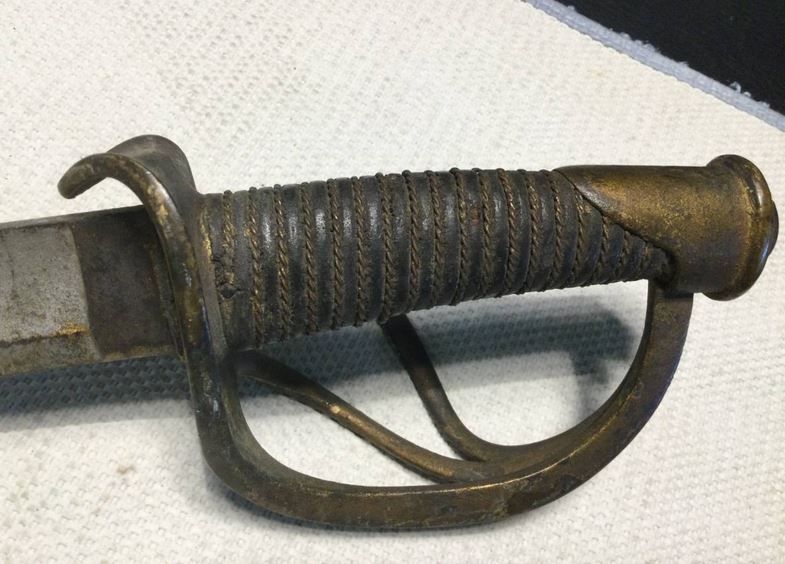
Has anybody here had any luck repairing bent brass? I haven't fully decided if I'll attempt it. Worst case of course is breaking it off. I have read that gently heating it before repairing helps, but I've never done it myself. Anybody ever tried anything like this?
bent quillon.JPG
 
Has anybody here had any luck repairing bent brass? I haven't fully decided if I'll attempt it. Worst case of course is breaking it off. I have read that gently heating it before repairing helps, but I've never done it myself. Anybody ever tried anything like this?View attachment 463589
The bend was done by the cav trooper so I would just leave it as found.
 
So it was a 'thing"? What was the reason they did that?
My Roby cavalry sword has the same bend.there is an older thread which proposes that it was for a variety of things like comfort when reaching and holding the sword and also during battle the opponents sword could be flipped from their hand when their sword was caught in the bend by simply twisting your wrist.
 
I read in one thread on some site (it may have been a sword site) that some of the members of the site were trying to figure out why this was done (bending the quillon). After testing out different scenarios they decided it was not to give a better thumb-hold. If you have ever fenced saber you may have been taught to place your thumb along the grip pointing in the direction of the blade and then wrap your fingers around the grip. In this way you can make cuts by flicking your wrist. If you have an old broad sword from the 17th or 18th century you might notice a thumb ring next to the grip. Instead of laying your thumb along the grip in the direction of the blade you insert it into the ring to give you more leverage. What the sword testers of the message board decided was that when you bring the sword down in a cut, as the blade makes contact with the target it begins to slow down quickly. Meanwhile your hand is still moving as if the sword is continuing at speed in it's arc. What happens is that your hand and the quillon make an uncomfortable collision. By bending the end of the quillon down they could reduce or eliminate that collision and save their hand for something else, like shooting a revolver. Since I was not involved in this bit of experimental archaeology I can't verify the results but it would seem to indicate that those swords with a bent quillon belonged to troopers who used their sword or had used it in the past, while the swords with an unmodified quillon belonged to troopers who shot first and slashed later.

There are some cavalry sabers in the study collection I work with that have bent quillons. Since it was a field modification, for whatever purpose, I leave them as they are. There are some that have had bent quillons that someone has tried to straighten, but you can always tell and it usually looks worse with the quillon being bent up a little or developing cracks along the bend line. I leave these alone too because experience has taught me that many times you make things worse when you try to fix them.
 
I read in one thread on some site (it may have been a sword site) that some of the members of the site were trying to figure out why this was done (bending the quillon). After testing out different scenarios they decided it was not to give a better thumb-hold. If you have ever fenced saber you may have been taught to place your thumb along the grip pointing in the direction of the blade and then wrap your fingers around the grip. In this way you can make cuts by flicking your wrist. If you have an old broad sword from the 17th or 18th century you might notice a thumb ring next to the grip. Instead of laying your thumb along the grip in the direction of the blade you insert it into the ring to give you more leverage. What the sword testers of the message board decided was that when you bring the sword down in a cut, as the blade makes contact with the target it begins to slow down quickly. Meanwhile your hand is still moving as if the sword is continuing at speed in it's arc. What happens is that your hand and the quillon make an uncomfortable collision. By bending the end of the quillon down they could reduce or eliminate that collision and save their hand for something else, like shooting a revolver. Since I was not involved in this bit of experimental archaeology I can't verify the results but it would seem to indicate that those swords with a bent quillon belonged to troopers who used their sword or had used it in the past, while the swords with an unmodified quillon belonged to troopers who shot first and slashed later.

There are some cavalry sabers in the study collection I work with that have bent quillons. Since it was a field modification, for whatever purpose, I leave them as they are. There are some that have had bent quillons that someone has tried to straighten, but you can always tell and it usually looks worse with the quillon being bent up a little or developing cracks along the bend line. I leave these alone too because experience has taught me that many times you make things worse when you try to fix them.
I have a Rev War period sword with the thumb ring and have noticed it was some what popular with the German States (Hessians as we call them). There hard to find in that condition and catch a higher premium $. Like Salterr I also read somewhere it was also bent to trap your opponents sword. I would leave it as is since it was no doubt done during the time period. I also have seen attempts to correct it but stopped half way since the brass was cracking.
 
I think the metal will take a "set" over time, and so even if it could have been straightened back in, say, 1865, it's far too late to try now. And, this was a field modification done by the trooper who used it!
 

Learn About Us
About CivilWarTalk
Contact the Webmaster
Meet the Staff
Link to CivilWarTalk
Join Our Community
Register
Browse Forums
View Today's Discussions
Search the Forum
Get Help
FAQ
Student Guide
Forum Rules & Etiquette
Copyright / DMCA

     Contact Us CivilwarTalk on Facebook CivilWarTalk on YouTube CivilWarTalk on Twitter RSS Feed

Bringing the American Civil War and More to Life.
© 1999 - , CIVILWARTALK, LLC - Site Version 10.0

SlaveryTalk.com - SecessionTalk.com - CivilWarTalk.com - ReconstructionTalk.com
Back
Top