Battery Powell, Corinth, MS battleground

AUG

Major
Retired Moderator
Joined
Nov 20, 2012
Location
Texas
Shiloh National Military Park posted this amazing and pretty rare image of Battery Powell on their FB page. It appears to have been taken shortly after the battle (Battle of Corinth, Oct. 3-4, 1862), quite possibly by the same photographer who took the famous photo of Col. William P. Rogers' body with other Confederate dead around Battery Robinette.

Battery Powell.jpg


On October 4, the second day of the battle, the Confederate 1st Missouri Brigade, then under Col. Elijah Gates, charged across this ground. Despite advancing under withering fire, they stormed up and over the works, fought hand-to-hand with the Federal troops inside and temporarily captured Battery Powell along with many of the artillery pieces in and around it. The Missourians then tried to advance into the town of Corinth, but were met with Federal reinforcements, which drove them back into Battery Powell and eventually out.

Three 20-pound Parrott Rifles of Battery D, 1st Missouri Light Artillery (US), as well as one 12-pounder howitzer and a 6-pound gun from Battery I, 1st Missouri Light Artillery (US) made up the artillery in Battery Powell itself; other batteries were positioned in the surrounding works.

Battery Powell, located alongside the Purdy Road, was situated a half-mile north of the town of Corinth and a mile east of Battery Robinett. It was constructed by contraband only a week before the battle as part of a string of fortifications around the northern side of the town. The "batteries" constructed around Corinth were essentially earthen lunettes meant to house artillery; they were designed to work almost as a strong point in the line of fortifications. Probably more famous was Battery Robinett, which also came under attack on the second day of the battle. Col. William P. Rogers of the 2nd Texas Infantry was infamously killed at Robinett, which added to its fame. However, Battery Powell is probably not as well known; and unlike Robinett, that side of the field and the fortifications were not preserved, but the fighting that occurred there was just as bloody.

Analyzing the photo, note the gabioned parapet and the embrasure for an artillery piece to fire through. Also notice all the trees cut down in front to create clearer field of fire - and all the bullet holes in those left standing. A number of accounts describe the inside of Battery Powell as being "dusty" or very loose, sandy dirt which can obviously be seen here. When Missourian William Ruyle of the 5th Missouri Infantry charged into Battery Powell, he called it "one of the bloodiest places I ever saw. On all sides of me I could see both the enemy and our men lying in the bleaching sun, in the dust which was about six inches deep. Every second it seemed I could see some comrade fall dead or wounded."

Civil War Trust map of the second day of the battle. Note that it also shows modern day roads (Source).
corinth-october-4-1862-jpg.jpg


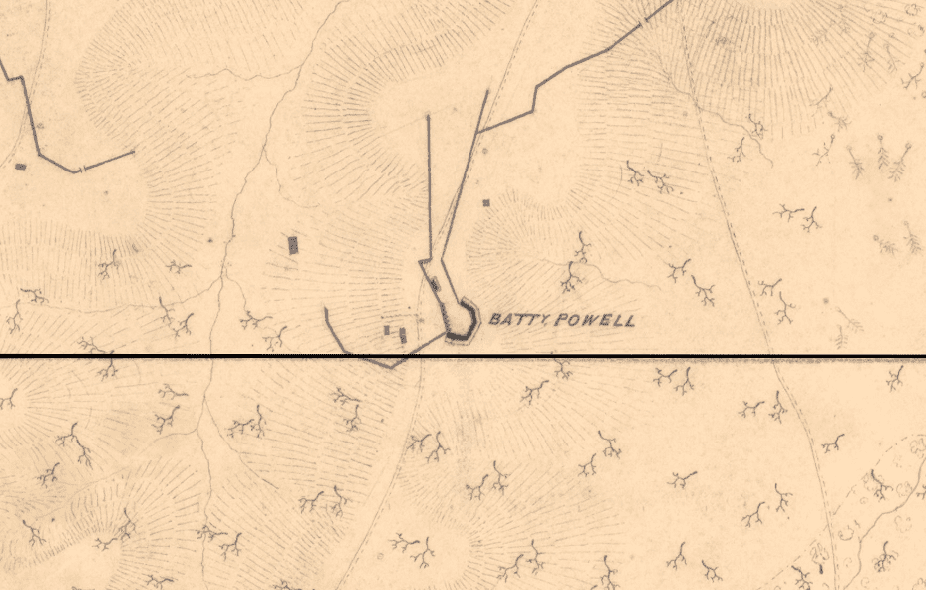
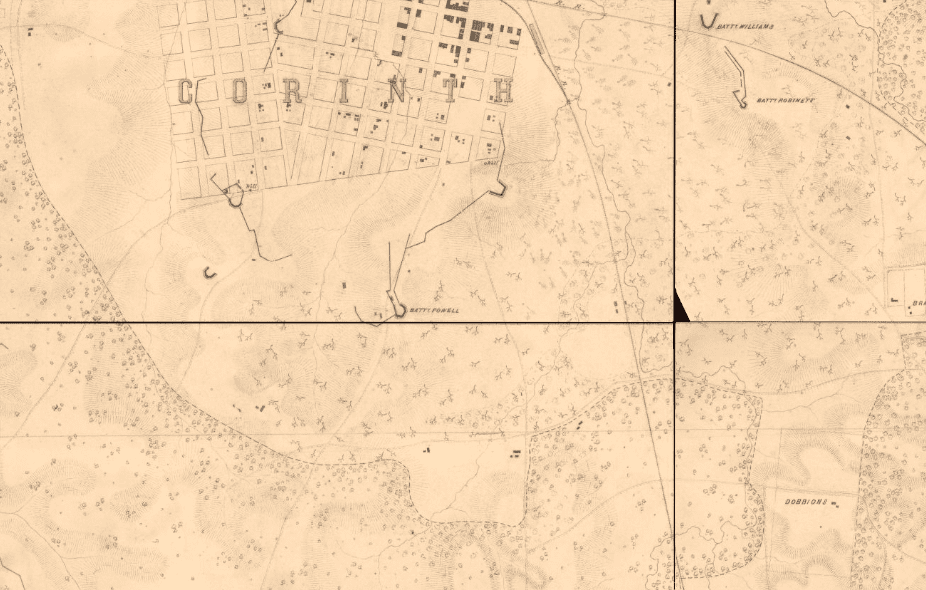
Here is a more detailed map of Battery Powell and the surrounding earthworks from a period map of fortifications around Corinth, MS (Source).
BatteryPowell1.png


BatteryPowell3.png
 
Last edited:
Took a tour and went inside what is left of battery Powell an few years ago. I'll look through my pics and will post them.
Last time I was at Corinth I don't think there was anything left of Battery Powell. I was told that it was located on what is now Taylor Street....
 
I remember the first time I saw this battery. I was with legendary relic hunter Stan Hughes. We found some really nice stuff. He was a great guy and was always ready to help out (to a point) This was back in the late 70's and there really wasn't that much encroachment back then. I would always stop in his auto parts store and pick his brain. My favorite story and I'll keep it short. I drove up from Birmingham to Corinth as I found out they had burned of a big area where the CS camps were. Park the car spent the day hunting got back car was gone. Walked over a mile to a house to use the phone to call the sheriff to report it stolen. Not stolen impounded as I had a case of beer in the back seat and it was a dry county. Called Stan, he came and got me, took me to the impound lot to get my car. Minus the beer. RIP Stan!
 
Shiloh National Military Park posted this amazing and pretty rare image of Battery Powell on their FB page. It appears to have been taken shortly after the battle (Battle of Corinth, Oct. 3-4, 1862), quite possibly by the same photographer who took the famous photo of Col. William P. Rogers' body with other Confederate dead around Battery Robinette.

View attachment 91274

On October 4, the second day of the battle, the Confederate 1st Missouri Brigade, then under Col. Elijah Gates, charged across this ground. Despite advancing under withering fire, they stormed up and over the works, fought hand-to-hand with the Federal troops inside and temporarily captured Battery Powell along with many of the artillery pieces in and around it. The Missourians then tried to advance into the town of Corinth, but were met with Federal reinforcements, which drove them back into Battery Powell and eventually out.

Three 20-pound Parrott Rifles of Battery D, 1st Missouri Light Artillery (US), as well as one 12-pounder howitzer and a 6-pound gun from Battery I, 1st Missouri Light Artillery (US) made up the artillery in Battery Powell itself; other batteries were positioned in the surrounding works. Also, one of the Union regiments in the counter-attack to take back Battery Powell was the 10th Missouri Infantry (US), so the Battle of Corinth was yet another that pitted Missourian against Missourian.

Battery Powell, located alongside the Purdy Road, was situated a half-mile north of the town of Corinth and a mile east of Battery Robinette. It was constructed by contraband only a week before the battle as part of a string of fortifications around the northern side of the town. The batteries constructed around Corinth were essentially earthen redoubts meant to house artillery; they were designed to work almost as a strong point in the line of fortifications. Probably more famous was Battery Robinette, which also came under attack on the second day of the battle. Col. William P. Rogers of the 2nd Texas Infantry was infamously killed at Robinette, which added to its fame. However, Battery Powell is probably not as well known; and unlike Robinette, that side of the field and the fortifications were not preserved, but the fighting that occurred there was just as bloody.

Analyzing the photo, note the gabioned parapet and the embrasure for an artillery piece to fire through. Also notice all the trees cut down in front to create clearer field of fire, and all the bullet holes in those left standing. A number of accounts describe the inside of Battery Powell as being "dusty" or very loose, sandy dirt which can obviously be seen here. When Missourian William Ruyle, in the 5th Missouri Infantry, charged into Battery Powell he called it, "one of the bloodiest places I ever saw. On all sides of me I could see both the enemy and our men lying in the bleaching sun, in the dust which was about six inches deep. Every second it seemed I could see some comrade fall dead or wounded."

Civil War Trust map of the second day of the battle. Note that it also shows modern day roads (Source).
Expired Image Removed

Here is a more detailed map of Battery Powell and the surrounding earthworks from a period map of fortifications around Corinth, MS (Source).
View attachment 91275

View attachment 91276
I think this photo was mis-identified as Battery Robinett, in Earl Hess's book "Banners to the Breeze" Being a Doubting Thomas, I ask: how do we know this is for sure Battery Powell?
 
Took a tour and went inside what is left of battery Powell an few years ago. I'll look through my pics and will post them.
I would be interested in seeing the photos pf Battery F. When I was there in 2003, I missed this site. I have heard it is original earthworks.
 
The photo in Post #1 reveal the reasons why the photo is of Battery Powell and not Battery Robinett. The rampart of Powell was only one gabion basket high while Robinett was two gabion baskets high. This is revealed in the engineering drawings of the fort. The images in Post #11 are definitely of Robinett as you can see Corinth in the background to the east.

The LOC map in post #1 shows a heavily modified Battery Powell as it appeared in the spring and summer of 1863. The new garrison commander, Grenville M. Dodge, built several new forts in town and connected many of them with rifle pits. This drawing clearly shows the covered way constructed behind Powell. An interesting point; the map is drawn upside down with norht at the bottom of the map and south at the top. East is to the left, west to the right.

Tom P
 
Prime1.PNG


You can see here that Robinett was two gabion baskets high for a height of seven feet.

A fascinating detail of this drawing of the seven forts of the Rosecrans Line is that someone penciled in the number and type of guns in the individual forts during the battle. A pair of other drawings show all of the modifications made to the existing forts and the plans for the new ones as well. A July 13, 1863 report from Dodge to the Ordnance Office in Washington lists all of the new forts by name, what weapons are posted in them and what unit is the garrison force.
 
Bump for the anniversary of the battle. I'll post a couple accounts of the attack on Battery Powell from members of the 1st Missouri Brigade.


First is from the diary of Lt. Col. Finley L. Hubbell of the 3rd Missouri Infantry.

Oct. 4th, 1862.—After a sleepless night to me, the morning was ushered in by the booming of artillery from the opposing lines, we, still in position behind the Mobile and Ohio Railroad. The sun rose fair and brilliant on the field in front, soon to become crimsoned with gore, from the best blood of the bravest hearts of a once united brotherhood; but now, alas! arrayed in deadly hostility to each other. What a shame to humanity and civilization! when will these horrors cease? The sharp-shooters were constantly skirmishing in front, but our regiment had only one wounded by them, Lieut. John H. Sterne, badly, in head and arm. Gen. Greene, who had been placed in command of the division, ordered the brigade all to be ready to charge simultaneously. The word was given at about 9 o'clock, when, with a wild shout, our whole brigade jumped swiftly across the railroad, and charged towards the enemy's line, met by a most terrific fire of infantry, grape, bomb, ball, and all other kinds of shot. But, through smoke, fire, and dust the gallant Missourians moved on, right forward to the breast-works, from which they were pouring forth a perfect storm of canister and minnie balls, with battery, both from the right and left, cross-firing upon us. But onward—with shouts of forward! waving of swords—firing of guns— on—they went. Col. Cockerill on our left captured and silenced a battery; while onward went our glorious third regiment right up to the breast-works; when the enemy became panic-stricken, and from behind the breast-works commenced to break away. Soon we were in the ditch, pouring balls into them. Several of our brave regiment fell before reaching there; but nobly stood the little band, amidst the booming of artillery, and fire of musketry. Some of our opponents stood bravely, ineffectually trying to rally and lead back their retreating columns. Never will I forget the sight that now presented itself to my eyes as I stood upon the breast-works. That our small force had obtained the position they now occupied, could hardly be believed; around us stood about forty pieces of artillery, deserted by the enemy.

By this time several of our brave officers lay dead at my feet in the ditch below. Lieut. Duval who died waving his sword and shouting "victory!" and Lieut. Bradshaw, of Company D., who nobly led forward his column, were struck instantly dead. Lieutenant Adams and Capt. C. Kemper, of Company G., wounded. Captains McDowell, Samuel Price both wounded. Lieut. Col. Gause had been disabled on the field and did not reach the fortifications. Col. Pritchard had received a severe wound in the shoulder; he had dismounted from his horse, right up at the breastworks, and was waving his sword cheering on his men, when he received a minnie ball in his shoulder; and I forced him to leave the field. The command of the regiment had now devolved upon me, and with deeper mortification and regret than I ever before experienced, I noticed that no reinforcements came to our assistance, and that the lines on our right were beginning to falter, after we had, by the most exalted valor and desperate charge on record, won the whole day.— But on threads hang the decision of battles—and the fate of armies. A panic seemed to seize all the men on the right and left, until I stood alone, with only about fifty of my own brave boys, who all offered to die with me. But I thought if would be sacrificing their lives to no purpose, and finally gave the painful order to' fall back, which was obeyed. And our gallant boys, almost exhausted, reached the Railroad.
It soon became evident, from the appearance of the troops we met, that we would have to retreat under the most galling and trying circumstances; our wounded lining the roads, making the heart bleed with sympathy. I found that Col. Pritchard had been sent forward in an ambulance. Left our assistant surgeon, Chew, at the hospital to attend to the wounded, and with the remnant of the regiment, we commenced our dispiriting retreat, having done the most brilliant and unexampled fighting. But even the desperate valor of our troops failed against the superior number and position of our opponents. I fear the disaster will be a national one. But it certainly was at a terrible hazard we made the attack. Saw Col. Pritchard this evening on the road, and fear he is very badly hurt. But he has spirit and determination enough in him to bear any thing. He is a brave, cool, honest and just man, and cannot well be spared. May Heaven protect and preserve him.
Hubbell later died June 3, 1863, of wounds received at Champion Hill. His diary was later published in The Land We Love Vol. 6 (1868).


Here is a letter by Thomas Hogan to his father. Hogan was a member of Co. F, 5th Missouri Infantry, a predominately Irish company with roots going back to several prewar Irish militia organizations in St. Louis and Joe Kelly's regiment in the Missouri State Guard.

Iuka, Miss., October 12, 1862.
Dear Father: I arrived here four days ago from Corinth, to which place all the wounded in the late battle were sent to, for which there is good accommodation and good spring water. I suppose, ere this, you have heard some particulars of the battle of Corinth, which, after hard fighting for two days, our forces were compelled to retreat. We lost considerable in killed and wounded, among which was our officers, who suffered severely.
The fighting commenced early Friday morning on our right wing, and was continued until about ten o' clock, when the fight began on our side, by storming the enemy's outer line of intrenchments, which was carried with but little loss to our brigade (1st)—the 3rd and 4th brigades losing considerable. Among the general officers killed in this charge was General Martin, commanding the 4th brigade. Skirmishing continued during the balance of the day, the enemy retreating and we advancing, until we got to the Mobile and Ohio R. R., on the north side of Corinth, and distant from Corinth one mile—our company being thrown out as skirmishers on the east side of the R R. and immediately in front of their batteries; to which place, during the evening of Friday, four of our company were shot by sharpshooters, one of which, John Miller, has since died, and Sergeant Joseph Rumpp, of St. Louis, wounded. During the operation on this day I escaped unhurt, although the men next to me, on both my right and left, were shot. We laid on our arms during Friday night, and Saturday morning we commenced the fight at day-light by cannonading, which continued until about twelve o'clock, when a general charge on the left wing was ordered, which wing was commanded by General Price. We advanced through open hilly ground on which there was not even a single brush to screen a person from the terrible storm of shot and shell from their heavy siege guns, which were in full view for over a mile, and looked like if hell had been let loose. Shells bursting all around you; round shot ploughing the ground every where; grape and cannister sweeping down the hill almost by the bushel, it is a miracle how any one escaped. I was shot in the head, just above the forehead, at one of the forts which our brigade had taken; not, however,without having some narrow escapes, as one musket ball went through my haversack, another through my blanket, across by breast. Our Company suffered severely, losing some twenty out of thirty-five that we went into the field with. Among the killed and wounded from St. Louis in the company was Color Sergeant William Walsh (the poet), and Patrick McGrath, brother of the missing McGrath in your society. The wounded were Sergeant Wm. Gillogley, Sergeant J. Rumpp, Corporal Thomas Hogan, private Cady, ——— Mulloney, and James Hardy missing. None of the officers hurt. I expected to be perfectly well in about six weeks. Edmond and Dennis, both in Wade's battery, are safe and in good health. James Rooney is well; he is down at Tupelo, Miss., working in a government bakery. Father Bannon is safe and well. We have been treated with great kindness by the officers and men of the Federal army, who have done all in their power to alleviate our sufferings.
I am in Company F, 5th Regiment, 1st Brigade, Missouri Volunteers, C. S. A.
No more at present from your affectionate son,
Thomas Hogan.
T. H.
P. S. Give my best love and respects to all friends and acquaintances.

Hogan served throughout the Missouri Brigade's later battles and campaigns - the Vicksburg Campaign and Atlanta Campaign - until he was killed in their charge at Franklin. His father kept and framed his letters, later giving them to Captain Joseph Boyce, veteran of the 1st Missouri Infantry, who donated them to the Missouri Historical Society.
 
@AUG351
Thanks for those great posts by Hubbell and Hogan. Hubbell's diary entry was made 155 years ago yesterday. We gave a number of tours and hikes yesterday to put visitors on the field at the hour the action was taking place. Today I will be leading a tour out to Davis Bridge on the Hatchie River, the scene of the last engagement of Van Dorn's short campaign.

Our anniversary tours are never well attended, though each year we hope for a better turnout. The more well known battlefields like Shiloh, Gettysburg and Antietam have huge turnouts for their anniversary programs. It is very sad actually, that the over 8,000 men who became casualties at Corinth are for the most part forgotten. half in jest I told a co-worker it was the soldier's own fault for not getting shot in a famous battle.

Once upon a time, before I was a Ranger, I studied Shiloh like it was the only battle that took place in the war. I wrote to the park historian George Reaves who answered back very kindly and gave me some very sage advice. He reminded me that Shiloh (nor any of the other big battles) were fought in a vacuum, that I should extend my research to the other, smaller fields in North Mississippi and West Tennessee. It is a message I have endeavored to pass on every day since I became a Ranger. There is a lot more out there.

Tom
 
@AUG351
Thanks for those great posts by Hubbell and Hogan. Hubbell's diary entry was made 155 years ago yesterday. We gave a number of tours and hikes yesterday to put visitors on the field at the hour the action was taking place. Today I will be leading a tour out to Davis Bridge on the Hatchie River, the scene of the last engagement of Van Dorn's short campaign.

Our anniversary tours are never well attended, though each year we hope for a better turnout. The more well known battlefields like Shiloh, Gettysburg and Antietam have huge turnouts for their anniversary programs. It is very sad actually, that the over 8,000 men who became casualties at Corinth are for the most part forgotten. half in jest I told a co-worker it was the soldier's own fault for not getting shot in a famous battle.

Once upon a time, before I was a Ranger, I studied Shiloh like it was the only battle that took place in the war. I wrote to the park historian George Reaves who answered back very kindly and gave me some very sage advice. He reminded me that Shiloh (nor any of the other big battles) were fought in a vacuum, that I should extend my research to the other, smaller fields in North Mississippi and West Tennessee. It is a message I have endeavored to pass on every day since I became a Ranger. There is a lot more out there.

Tom
I look forward to hearing you discuss Corinth et al next Thursday night at the Alabama Civil War Roundtable meeting.
 
I look forward to hearing you discuss Corinth et al next Thursday night at the Alabama Civil War Roundtable meeting.

@redbob I sent an email to Dan Peace last week about my program at the Roundtable; he mistakenly put on the newsletter and website that I would be speaking about Corinth. I will speaking about the Campaign and Battle of Tupelo. Looking forward to seeing you there.

Tom
 
@redbob I sent an email to Dan Peace last week about my program at the Roundtable; he mistakenly put on the newsletter and website that I would be speaking about Corinth. I will speaking about the Campaign and Battle of Tupelo. Looking forward to seeing you there.

Tom
Regardless of what you wish to speak on, you will find a very receptive audience who are very much looking forward to your presentation and I will make the correction on the newsletter.
 

Learn About Us
About CivilWarTalk
Contact the Webmaster
Meet the Staff
Link to CivilWarTalk
Join Our Community
Register
Browse Forums
View Today's Discussions
Search the Forum
Get Help
FAQ
Student Guide
Forum Rules & Etiquette
Copyright / DMCA

     Contact Us CivilwarTalk on Facebook CivilWarTalk on YouTube CivilWarTalk on Twitter RSS Feed

Bringing the American Civil War and More to Life.
© 1999 - , CIVILWARTALK, LLC - Site Version 10.0

SlaveryTalk.com - SecessionTalk.com - CivilWarTalk.com - ReconstructionTalk.com
Back
Top