Battenburg Cake

Joined
Nov 26, 2016
Location
central NC
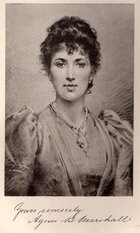
Marshall+Portrait.jpg
The history of the Battenburg Cake is rather complex. A popular theory about its origin tells us it was made to celebrate an important Victorian royal wedding in 1884, but there is a lack of sources to back this up.

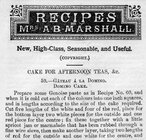
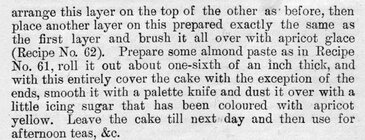
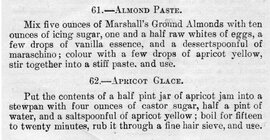
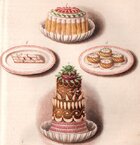
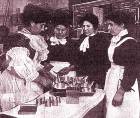
An illustrated recipe for an identical cake called Gateau à la Domino appeared in a July 1898 edition of the Victorian food and housekeeping magazine, The Table, published and edited by Agnes Berthe Marshall. Marshall's four books on cookery and ice cream are fairly well known, but The Table is rarely cited. She launched it on June, 12 1886. There were 1690 weekly issues until June 1918. It was then renamed The Table and Housekeeper's Journal and was published until September, 1939.

In its day The Table was the most important food magazine published in Britain. Agnes Berthe Marshall died in 1905, but The Table continued on for more than 30 years. Her recipe for Domino Cake appeared in 1898, the same year in which recipes for two almost identical cakes - Frederick Vine's Battenburg Cake and Robert Well's Neapolitan Roll were published. The recipe for Domino Cake will follow.
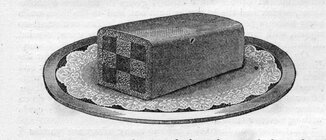
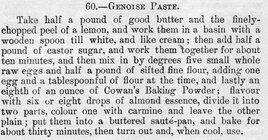
Gateau+a+la+Domino2.jpg
Agnes Berthe Marshall's Gateau à la Domino from The Table, July 2nd 1898.
Source: Catherine Brown, Battenberg Cake; A celebration confection fit to grace a royal wedding. The Herald, March 29, 2003.

Source: Day, Ivan, Food History Jottings, April 18, 2012.
 
Last edited:
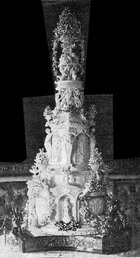
The romantic in me wants to believe the Battenburg Cake was made to celebrate an important Victorian royal wedding in 1884. However, there were actually two weddings between English princesses and Battenburg princes. The first was that of Princess Victoria, Queen Victoria's grandaughter, to Louis of Battenburg in 1884. The second took place the following year, when Louis's brother Henry married Queen Victoria's youngest child Beatrice. The "bride cake" pictured below is that presented to Henry and Beatrice at their wedding in 1885.

cakePrincess+Henry's+.jpg
Source: Day, Ivan, Food History Jottings, April 18, 2012.
 
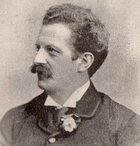
Robert+Wells.jpg

Robert Well's Neapolitan Roll is almost identical to a modern four pane Battenburg Cake. Wells may have called his cake a Neapolitan Roll because of its similarity to the striped Neapolitan ice cream, which was very popular during this period. Striped jellies known as ribbon or ribband jelly had been popular since the 17th century.

A Neapolitan brick of ice cream - also known in the 19th century as hokey pokey:


Source: From Robert Wells, Cakes and Buns. Manchester: 2nd edition nd.c.1900. pp.42-43.
Source: Day, Ivan, Food History Jottings, April 18, 2012.
 
Last edited by a moderator:
Agnes Berthe Marshall wrote four books: Ices Plain and Fancy: The Book of Ices (1885), Mrs. A.B. Marshall's Book of Cookery (1888), Mrs. A.B. Marshall's Larger Cookery Book of Extra Recipes (1891) and Fancy Ices (1894).

Agnes was a busy and industrious lady. She was granted a patent for an improved ice cream machine that could freeze a pint of ice cream in five minutes and also suggested using liquid nitrogen to make ice cream. She is credited with inventing the first portable, edible ice cream cones which she called "cornets."

successmarshall.jpg

Agnes fell from a horse in 1904 and never fully recovered. Sadly, she quickly faded from public memory. A biography was published in 1998 entitled Mrs Marshall: the Greatest Victorian Ice Cream Maker.

Expired Image Removed

Source: Agnes Berthe Marshall Wikipedia
Source: Alchetron
 
Last edited:
A traditional English Battenburg Cake
Northern Light. When my grandfather and grandmother would entertain and have elaborate dinner parties she would have this type of cake as well as homemade ice cream for desert. I can remember as a child that she also served at tea parties perhaps the same cake only much smaller. For example, the picture of the one slice of cake would be equal to four pieces of her cake. A cake made this small I believe has a French term for it which I cannot remember at this time. Thanks for posting this picture which brings back a lot of wonderful childhood memories for me. David.
 
Last edited by a moderator:
Eleanor. This recipe gives one the impression that it might be a very light and moist cake as opposed to a cake batter that is very dense. Did you ever eat this type of cake before? As I mentioned in an earlier post to Northern Light, my grandmother made a cake exactly like the one Northern Light displayed in her post. Also, could the cake be named after the town of Battenburg, Germany? Perhaps our friends in Germany could solve this riddle for us? @Faraway Friend. I believe Agnes Marshall was the first Julia Child and Martha Stewart of her day. By the way, the drawing you have displayed of her in your first post is absolutely magnificent. She is beautiful and seems to display an indefinable charm. David.
 
Eleanor. This recipe gives one the impression that it might be a very light and moist cake as opposed to a cake batter that is very dense. Did you ever eat this type of cake before? As I mentioned in an earlier post to Northern Light, my grandmother made a cake exactly like the one Northern Light displayed in her post. Also, could the cake be named after the town of Battenburg, Germany? Perhaps our friends in Germany could solve this riddle for us? @Faraway Friend. I believe Agnes Marshall was the first Julia Child and Martha Stewart of her day. By the way, the drawing you have displayed of her in your first post is absolutely magnificent. She is beautiful and seems to display an indefinable charm. David.

Interesting thoughts David. In a 2003 newspaper article, food historian Catherine Brown shared:

"But there was nothing to compare with the German pastry cooks' sophisticated use of marzipan, colours, shapes, flavours and allegorical designs. The British were impressed. They tried their hand at the German techniques and some native pastry cooks became almost as good as the Germans. Such was their confidence that when Queen Victoria's granddaughter, Princess Victoria of Hesse-Darmstadt, married Prince Louis of Battenberg in 1884, it was decided that a celebration cake was required, in their own design of course, but appropriately German in style to celebrate the marriage. What else to call it but a Battenberg cake? It was to be unique: a cake to stun British cake-lovers. They took inspiration from the German rococo style of architecture which featured gold (marzipan) with pastel colours (pink and yellow sponge)."


Per Wikipedia:
The cake was purportedly named in honour of the marriage of Princess Victoria, a granddaughter of Queen Victoria, to Prince Louis of Battenberg in 1884. The name refers to the town of Battenberg, Hesse in central Germany and is the seat of the aristocratic family known in Britain as Mountbatten.
 

Learn About Us
About CivilWarTalk
Contact the Webmaster
Meet the Staff
Link to CivilWarTalk
Join Our Community
Register
Browse Forums
View Today's Discussions
Search the Forum
Get Help
FAQ
Student Guide
Forum Rules & Etiquette
Copyright / DMCA

     Contact Us CivilwarTalk on Facebook CivilWarTalk on YouTube CivilWarTalk on Twitter RSS Feed

Bringing the American Civil War and More to Life.
© 1999 - , CIVILWARTALK, LLC - Site Version 10.0

SlaveryTalk.com - SecessionTalk.com - CivilWarTalk.com - ReconstructionTalk.com
Back
Top