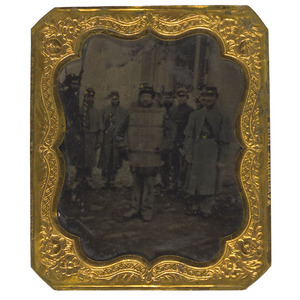
Being made to wear a barrel shirt was a real camp punishment, which was meant to humiliate the one being punished. It was usually reserved for theft and other such offenses which demonstrated utter disrespect shown to others. I know that the 2nd Alabama Cavalry and the 56th Alabama Partisan Rangers used them as a form of punishment in the field from time to time, as some of the men in those two regiments wrote letters home speaking of it, as well as other camp punishments. The offender would be forced to wear the barrel with his head sticking out over the top with excrement piled under his nose. The barrel shirt was open in the sides, with a hole in one end to put through the head, and cover the shoulders and body, down to the small of the legs. It was considered a cloak of shame and humility.
Below is an example of one such letter written by Pvt. Francis Marion "Frank" Moore, I-Troop, 56th Alabama Partisan Rangers, Brig. General Samuel Wragg Ferguson`s brigade. He wrote the following to his wife on 5 Sep 1863, from camp near Pontotoc, MS:
"This kind of service is much easier than infantry, and I would rather be a private in the cavalry than a Captain in infantry. We had some six or eight of the boy`s tried the other day, some for stealing saddles and some for leaving camp without permission. Those for leaving camp were sentenced to (the) guard tent for six days and to dig a sink up each day (latrine). Those for stealing the saddles were sentenced to wear a barrel for six days."
Slightly less serious offenses required the offender to be confined to the guard house with reduced rations or be made to attend to the "sinks" (latrines), requiring them to be daily covered over with a layer of dirt, being completely filled in, or digging new ones. All camp punishments were assigned to those who had been tried, convicted and sentenced to confinement or labor for malfeasance while on duty. Latrines were called "sinks" during the ACW. The typical sink involved digging a trench ten to twelve feet long, one to two feet wide, and six to eight feet deep. A crotched stick would be placed at each end of the trench upon which a long pole, or board with holes cut in it, was placed across the length of the trench to be used as a seat. Each day six to eight inches of dirt was supposed to be shoveled into the sink to cover the waste. Carbolic acid and chlorinated lime was added to sanitize and deodorize the area in an effort to keep the stench down. When the sink was filled to with-in one to two feet from the top and edge, it was supposed to be filled in and a new sink dug. Each regiment was supposed to have a sink dug on the left and right ends of the camp, and then a third sink for the officers near the officer`s quarters. The punishment of being placed on latrine duty was not a desired one.
For minor offenses an offender would be assigned to fatigue duty which consisted of all the irregular work that a soldier is called upon to perform at one time or another. In the field, it includes felling trees, watching and guarding the horses at night, working on roads, building earthworks and breastworks, digging rifle-pits, making or removing obstructions, participating in forage-parties, etc...




 Bringing the