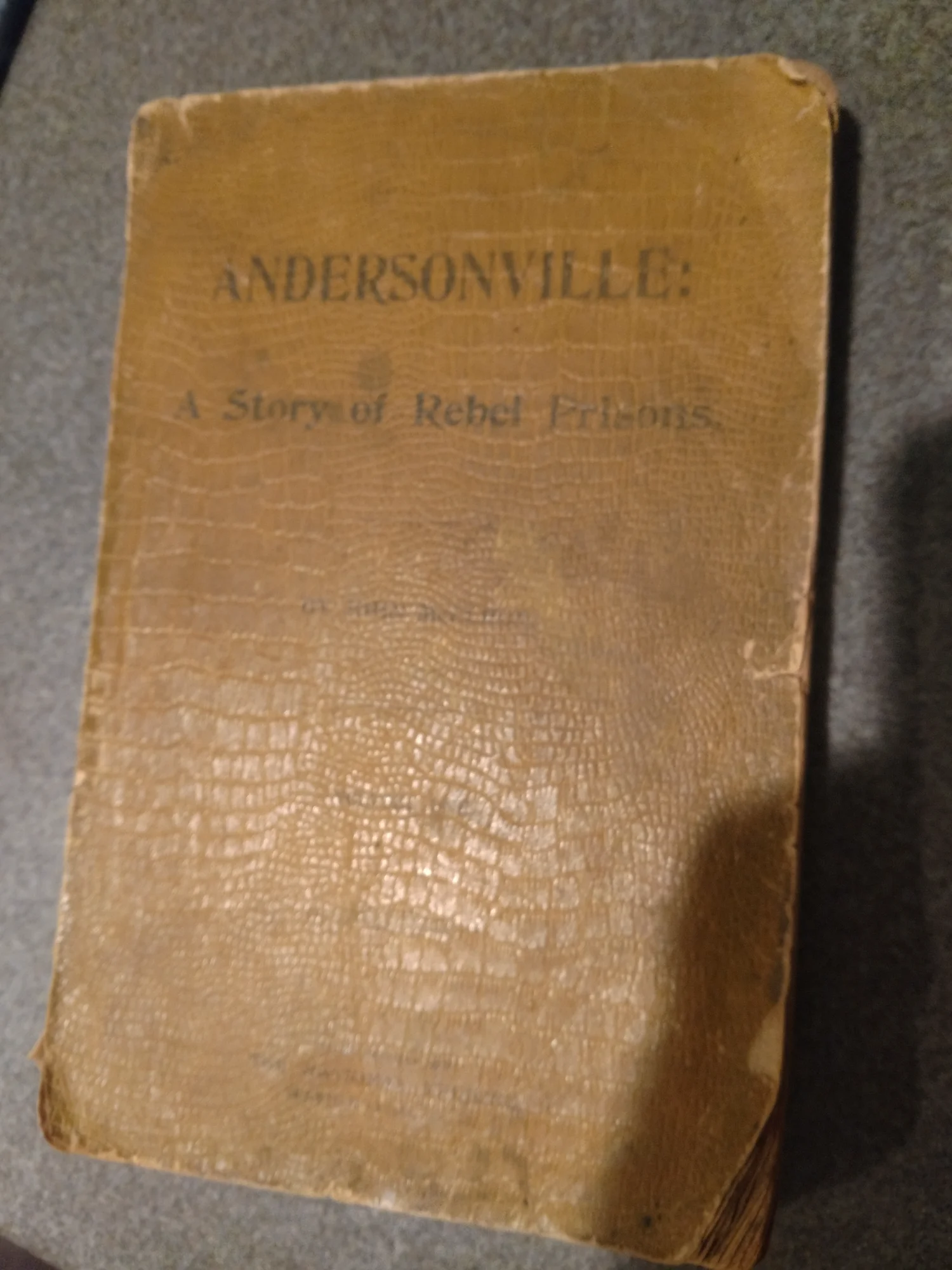
Member Review Andersonville paper back

JackADriscoll

Sergeant Major
Joined
May 5, 2019
I found this book on andersonville in paperback from 1899 for two dollars from habitat for humanity. Great pictures. The condition is questionable as I'm afraid to flop through it but a neat little find.

IMG_20260321_200220672.webp


IMG_20260321_200339536.webp


IMG_20260321_200244657.webp
 
Go ahead and flip through. The first edition was published in 1879 and became a best seller, beginning a glut of prison memoirs from other former prisoners hoping to cash in on the public interest. It's never been out of print and is not particularly rare, although it may be worth a little more than you paid for it, depending on condition.

Just don't take anything he writes at face value. He tended to "spin" the story so that he and his friends were the heroes of the narrative, at the expense of Henry Wirz, the Irish, sailors and any other group that he didn't like. His is one of the three most-quoted prisoner memoirs from Andersonville, and later writers would copy his version of events in their books for things that they didn't remember (because they never happened). The entire second chapter of my book on the raiders is devoted to discrediting his version of events, which proved to be surprisingly easy to do.
 
Go ahead and flip through. The first edition was published in 1879 and became a best seller, beginning a glut of prison memoirs from other former prisoners hoping to cash in on the public interest. It's never been out of print and is not particularly rare, although it may be worth a little more than you paid for it, depending on condition.

Just don't take anything he writes at face value. He tended to "spin" the story so that he and his friends were the heroes of the narrative, at the expense of Henry Wirz, the Irish, sailors and any other group that he didn't like. His is one of the three most-quoted prisoner memoirs from Andersonville, and later writers would copy his version of events in their books for things that they didn't remember (because they never happened). The entire second chapter of my book on the raiders is devoted to discrediting his version of events, which proved to be surprisingly easy to do.
This has been discussed at length on this board before but I find it so interesting how often the first person to write wrong or not can set the dominant narrative and people will quite It taking it as truth and so it goes until someone rights the ship. It's amazing how many liars write the first books while the honest just get on with things.

It's the oldest paper back I've personally ever found.
 
This has been discussed at length on this board before but I find it so interesting how often the first person to write wrong or not can set the dominant narrative and people will quite It taking it as truth and so it goes until someone rights the ship. It's amazing how many liars write the first books while the honest just get on with things.
According to some scholars (Chris Barr, Lesley Gordon), there was a perception that POWs were less "heroic' than other soldiers because they allowed themselves to be captured. Gordon's book deals with the 16th Connecticut, which reportedly turned and ran at their first battle (Antietam; can't say I blamed them) and were captured minutes into their second. According to Chris Barr, who used to be a park ranger at Andersonville, the among the prisoners themselves there was a prejudice against prisoners who accepted parole and took jobs outside the stockade, such as clerking or nursing in the prison hospital. You'll notice, when you read the book that McElroy accuses the sailors who worked in the hospital of stealing food from the sick and dying (how would he know this, being held in the stockade?). I have no doubt that they'd eat a man's rations if he had already died or was too far gone to eat). He neglects to mention that the sailors eventually saved McElroy's favorite boy soldier "Little Red Cap" by smuggling him out of the prison using the identity of a dead sailor when the sailors were paroled).

The 16th Connecticut made a practice of "Waving the bloody shirt" and running a mostly coordinated campaign to prove that they served through suffering while prisoners. At least 12 of them kept diaries, and Robert Kellogg's diary formed the basis for his 1865 book, which, ironically, is one of the best and most reliable memoirs out there (trust me, I read the original diary at the Connecticut Historical Society - it's way more detailed than the usual prisoner's diary and was published the year after the prison closed).

So in the case of Andersonville, it wasn't the first men to write books who messed up the narrative. It was the guy who waited 15 years to write his book and because he sensationalized it and it became a best seller, he messed up all of the subsequent books and became the dominant version of events for the next century and a half.

There is a tendency for post war writers to either quote heavily from McElroy and Ransom (fake diary) or from Kellogg, but not both.
 
Last edited:
Reading this thread raised a question for me, but it's one I'm not sure I'm going to articulate well. If you own a truly rare first edition of a book that had value based on age, rarity and original content but later in its life is proved to be a fake as far as the content is concerned (not its age), is that book still valuable for becoming a famous fake?
 
Reading this thread raised a question for me, but it's one I'm not sure I'm going to articulate well. If you own a truly rare first edition of a book that had value based on age, rarity and original content but later in its life is proved to be a fake as far as the content is concerned (not its age), is that book still valuable for becoming a famous fake?

Yes. I have one book here by a guy named George W. Murray who wrote "A history of George W. Murray, and his long confinement at Andersonville, Georgia. Also the starvation and death of his three brothers at the same place. By himself." He lived four towns over from me. Only trouble was that he was 8 years old at the end of the Civil War, never mentions what regiment he was in, never tells the names of his three brothers who supposedly died at Andersonville, and he ends the book by saying how he's too debilitated from his time at Andersonville to support himself and begs the reader to send him money. He gives his address at the end of the book for donations, and so his birthdate can be crosschecked by the 1865 Mass State census and subsequent US censuses.

In other words, he made the whole thing up as a scam.

I knew that there were serious questions about its veracity before I went looking for a copy, largely because the site I was using generally put the birth and death dates of authors and clearly there was a problem with the birth dates (and everything else) on this guy. The site I got my copy from clearly stated that there were questions about the veracity of it, but charged $200 for it anyway (near the top of the price range at the time for a rare, first edition Andersonville memoir). So I would say that the price of the book was not really impacted by its veracity or lack thereof. If anything, it makes an interesting curio and I can always drag it out if I need to argue with some idiot who insists that anything in a book by a prisoner has to be the truth.
 
Reading this thread raised a question for me, but it's one I'm not sure I'm going to articulate well. If you own a truly rare first edition of a book that had value based on age, rarity and original content but later in its life is proved to be a fake as far as the content is concerned (not its age), is that book still valuable for becoming a famous fake?
I think market rules apply for books - if people want it then it becomes more expsnsive. Noteriety is a huge component of fame. I'd guess a 'rare' and famous lie would be more valuable than a common, less-known truth.

It always amazes me how cheap even rare books are. Compared to other antiques, books sell for low prices.
 
I think market rules apply for books - if people want it then it becomes more expsnsive. Noteriety is a huge component of fame. I'd guess a 'rare' and famous lie would be more valuable than a common, less-known truth.

It always amazes me how cheap even rare books are. Compared to other antiques, books sell for low prices.
To some extent, yes, and to some extent, no. I inherited another historian's collection of first edition Andersonville Memoirs when he died, some of which are autographed. About 10 years ago, I had tickets to the Antiques Road Show and brought a random shoebox full of them in to be appraised. The more common ones, like Kellogg and McElroy were both appraised at about $20 in "Very Good" condition. The one I had that was worth the most was a tiny pamphlet that I'd never heard of and have never come across being mentioned by any modern historian was valued at $250. I'm blanking on the title and the author. Something to do with apple boughs and if I'm not paying attention to where I put it on the shelf, it will take me months to find it again.

A useful hint - if you want to see what a book is worth, go on an online book finder like Alibris or Abebooks and see what they go for. That's what the Road Show guy did. If he knew the dealer listing them, he'd point at that one and say "I know this guy and he's accurate in his pricing." If he didn't know the lister, he'd look at the prices listed, eliminate the outliers (the guys that would charge $10,000 for a used McElroy, for example) and tell me about what the average was for a book in that condition. (Or, as we say in elementary school, he'd look for the mean, the median and the mode). All of the book dealers had their laptops with them, but you don't see that on TV.
 
The Confederates locked children up in that horrible place. Despicable😡😡😡

It makes me wonder: if he wanted to get paid for making up stories about Andersonville, why not just write a novel?
Because his "book" is more of a booklet or a pamphlet at just 32 pages long. An actual novel would have required a lot more pages and work, and my impression of Mr. Murray is that he would prefer not to have to WORK.

Just noticed that Hathitrust has his dates as 1853-1926, which would have made him 10 or 11 when he said he was at Andersonville (Most of the prisoners had been moved elsewhere by the end of 1864, although a few thousand were still there, down from 33,000 in August).
 
I have used text from Ransom, McElroy and numerous other diarists to corroborate information about Camp Lawton. Regardless of the motivation and questioned accuracy, the diaries were all very useful in developing the Camp Lawton museum exhibits. As an archaeologist, the message of "one (radiocarbon) date is no date" was drilled into me. The same holds true for memoirs, other historical documents and eye-witness testimonies.
 
Last edited:
Because his "book" is more of a booklet or a pamphlet at just 32 pages long. An actual novel would have required a lot more pages and work, and my impression of Mr. Murray is that he would prefer not to have to WORK.

Just noticed that Hathitrust has his dates as 1853-1926, which would have made him 10 or 11 when he said he was at Andersonville (Most of the prisoners had been moved elsewhere by the end of 1864, although a few thousand were still there, down from 33,000 in August).
The largest percentage of the prison population was evacuated to Millen, Savannah and the Carolinas between mid-September and the end of November. There were still 4706 POWs at Andersonville at the end of December 1864. They had received 3534 from Albany around Christmas. These were mostly men who had been sent to Millen from Andersonville and then were shuffled to Blackshear, Thomasville and Albany. The population increased to 5046 in January, and 5851 in February, before the final evacuation in late March 1865 when 1500 were sent to Vicksburg. The final monthly recapitulation shows that there were 22 prisoners remaining on May 5 - 17 in the stockade and 5 in the hospital.
 
I have used text from Ransom, McElroy and numerous other diarists to corroborate information about Camp Lawton. Regardless of the motivation and questioned accuracy, the diaries were all very useful in developing the Camp Lawton museum exhibits. As an archaeologist, the message of "one (radiocarbon) date is no date" was drilled into me. The same holds true for memoirs, other historical documents and eye-witness testimonies.
I have four bookcases of published diaries and memoirs scattered throughout the house, plus a few dozen on my kindle (it's easier to search for a specific word or topic or person electronically), so I have lots of sources to choose from. Although, admittedly, it was a lot easier to keep the different accounts straight in my head before I started on chemo. Chemo definitely makes you stupider. Word recall is a problem now, too.

The current work in progress has a chapter that posits that McElroy's regulators were actually a rival gang that took advantage of the attack on "Dowd" to eliminate the competition (the raiders), so I do use his accounts. I really felt like he just couldn't get let go of his 'we saved the whole prison from the raiders" narrative. He holds that the raiders were defeated once and for all with the hanging, and yet somehow they are still trying to "assassinate" Leroy Key and "Sargeant Goody" once they get to Millen.

This excursion into the question of the regulators aside, there are plenty of other sources available and why use one that you know is intentionally flawed?
 
I have four bookcases of published diaries and memoirs scattered throughout the house, plus a few dozen on my kindle (it's easier to search for a specific word or topic or person electronically), so I have lots of sources to choose from. Although, admittedly, it was a lot easier to keep the different accounts straight in my head before I started on chemo. Chemo definitely makes you stupider. Word recall is a problem now, too.

The current work in progress has a chapter that posits that McElroy's regulators were actually a rival gang that took advantage of the attack on "Dowd" to eliminate the competition (the raiders), so I do use his accounts. I really felt like he just couldn't get let go of his 'we saved the whole prison from the raiders" narrative. He holds that the raiders were defeated once and for all with the hanging, and yet somehow they are still trying to "assassinate" Leroy Key and "Sargeant Goody" once they get to Millen.

This excursion into the question of the regulators aside, there are plenty of other sources available and why use one that you know is intentionally flawed?h
Details like that weren't relevant to the museum exhibits at Magnolia Springs. Descriptions of the prison layout, arrivals/departures, and big events such as the election were. McElroy's accounts corroborated those of other diarists so not everything he wrote was incorrect. It is much easier for you to ignore McElroy's writings because your focus is Andersonville, a place that has been written about since its construction. I am working on Millen, for which there is almost no documentation and very few accounts. I don't have the luxury of picking and choosing my sources. However, that doesn't mean that the information I gather from McElroy or Barber or Smith or any or the others who wrote about their imprisonment at Camp Lawton isn't valid or flawed, as you put it. But, again, our focusses and our access to information are different.
 
Details like that weren't relevant to the museum exhibits at Magnolia Springs. Descriptions of the prison layout, arrivals/departures, and big events such as the election were. McElroy's accounts corroborated those of other diarists so not everything he wrote was incorrect. It is much easier for you to ignore McElroy's writings because your focus is Andersonville, a place that has been written about since its construction. I am working on Millen, for which there is almost no documentation and very few accounts. I don't have the luxury of picking and choosing my sources. However, that doesn't mean that the information I gather from McElroy or Barber or Smith or any or the others who wrote about their imprisonment at Camp Lawton isn't valid or flawed, as you put it. But, again, our focusses and our access to information are different.
Definitely different kettles of fish. If you're going to write about a Civil War prison, there's easily more research material relating to Andersonville than any other prison, except maybe Libby.
 

Learn About Us
About CivilWarTalk
Contact the Webmaster
Meet the Staff
Link to CivilWarTalk
Join Our Community
Register
Browse Forums
View Today's Discussions
Search the Forum
Get Help
FAQ
Student Guide
Forum Rules & Etiquette
Copyright / DMCA

     Contact Us CivilwarTalk on Facebook CivilWarTalk on YouTube CivilWarTalk on Twitter RSS Feed

Bringing the American Civil War and More to Life.
© 1999 - , CIVILWARTALK, LLC - Site Version 10.0

SlaveryTalk.com - SecessionTalk.com - CivilWarTalk.com - ReconstructionTalk.com
Back
Top