
KansasFreestater
1st Lieutenant
- Joined
- Mar 14, 2014
I don't think of myself as a banjo fan. (Well, okay, I like "Dueling Banjos" -- but who doesn't?) My favorite "banjo player" is Sufjan Stevens, who isn't even really a banjoist and whose playing is unglamorous, if not downright primitive.
And yet... even I was delighted by what has to be Oklahoma City's best-kept secret: the American Banjo Museum.
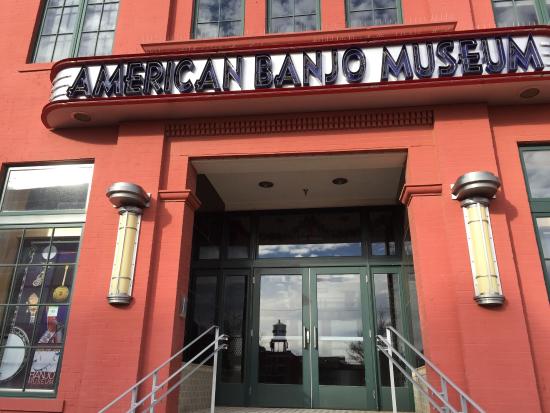
Note the name: American banjo. The pre-American global history of the instrument -- such as in the Far East -- is passed over quickly. As the ground-floor exhibit shows, the history of the American banjo begins with Africans forcibly brought to America as slaves. With that amazing human resourcefulness -- and determination to play music -- that even slavery cannot extinguish, some slaves quickly began fashioning replicas of an instrument they'd played back in their native lands: a hollowed gourd over which was stretched an animal skin, to which strings were then added.
Until I toured the museum, I did not realize that "blackface"shows by white performers pre-dated the American Revolution. Nor that what were called "minstrel shows" were hugely popular from the 1830s to the 1880s. Note the dates; the Civil War hit the "minstrel era" right smack in the middle. You'd think that the war would have killed people's taste for such things. Sadly, that was not the case. Indeed, "minstrel shows" were common well into the early 20th century.
One thing the Civil War did accomplish, as far as the banjo was concerned, was to spread the instrument all over the country -- a little like what happened with baseball -- and to get all kinds of people hooked on playing it: whites as well as blacks; Northerners as well as Southerners.
Expired Image Removed
The one question the museum raised in my mind but could not answer had to do with the very first "scene"-- in which a black slave is teaching his grandson to play the banjo:

It's a very sweet scene, but considering all the eyewitness accounts I've read of slave women having their children torn from their arms and sold away from them, never to be seen again, I had to wonder: How many slaves actually got to know, let alone teach, their own grandchildren? I hope there were more than I think.
And yet... even I was delighted by what has to be Oklahoma City's best-kept secret: the American Banjo Museum.
Note the name: American banjo. The pre-American global history of the instrument -- such as in the Far East -- is passed over quickly. As the ground-floor exhibit shows, the history of the American banjo begins with Africans forcibly brought to America as slaves. With that amazing human resourcefulness -- and determination to play music -- that even slavery cannot extinguish, some slaves quickly began fashioning replicas of an instrument they'd played back in their native lands: a hollowed gourd over which was stretched an animal skin, to which strings were then added.
Until I toured the museum, I did not realize that "blackface"shows by white performers pre-dated the American Revolution. Nor that what were called "minstrel shows" were hugely popular from the 1830s to the 1880s. Note the dates; the Civil War hit the "minstrel era" right smack in the middle. You'd think that the war would have killed people's taste for such things. Sadly, that was not the case. Indeed, "minstrel shows" were common well into the early 20th century.
One thing the Civil War did accomplish, as far as the banjo was concerned, was to spread the instrument all over the country -- a little like what happened with baseball -- and to get all kinds of people hooked on playing it: whites as well as blacks; Northerners as well as Southerners.
Expired Image Removed
Many of the folks here at CWT are familiar with this photo of the crew of the USS Hunchback in the James River, 1862, by Matthew Brady. (A reproduction is on display at the American Banjo Museum.)
Apparently, there's been some conflict among musicologists as to whether the banjo was actually brought to America by slaves. The folks behind the American Banjo Museum come down squarely on the "yes, it was" side of the debate. This is communicated in their historical displays, as well as in their gift shop, where you can purchase a fascinating little one-hour DVD that makes the case.
The one question the museum raised in my mind but could not answer had to do with the very first "scene"-- in which a black slave is teaching his grandson to play the banjo:
It's a very sweet scene, but considering all the eyewitness accounts I've read of slave women having their children torn from their arms and sold away from them, never to be seen again, I had to wonder: How many slaves actually got to know, let alone teach, their own grandchildren? I hope there were more than I think.
Last edited:


 Forum Host


 Bringing the