Additional Service for AWOL/Desertion?

huskerblitz

Major
Joined
Jun 8, 2013
Location
Nebraska
I'm finding conflicting information on issuing additional time (or to make good on enlistment time) for soldiers deserting or going AWOL. I see that punishment was handed out quite a bit for the regiment I'm researching, but I've found some instances where it was later stated it was unenforceable. But a lot of men continued to serve in a veteran unit after their original term of 3 years was complete. So what's the story with this? Anyone know more about time added to an enlistment as punishment?
 

Attachments

  • Additional time.PNG
    Additional time.PNG
    75.5 KB · Views: 190
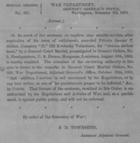
What I think might have happened in this Pvt. Gilbert's case is that he was court martialed under General Order 5 by US force occupying some place in Louisiana which authorized the "serve lost time" plus who knows what else? Digging latrenes, kitchen duty, extra gaurd duty, loss of pay etc. He appealed the extended service & he or a lawyer said Order 329 issued by the Adjudent (sp?). Office of the US Army trumps the Gen Order 5 of a lesser unit therefore he can lose his pay, clean the horse stables etc but no extended service for AWOL time.
As to why you may see so many men serving past there 3 year enlistment is the were offered 30 days leave… bonus &$$$stay in the same Regt if a majority extended their enlistments.
That's two senerios in 0430 hours that come into my mind.
I know 105 years later if you went AWOL for 30 days you got thrown in the brig for 30 days & then had 60 days added to your enlistment for the time you were gone & your time in the brig.
But that's my best guess. I hope that's of some help to you Husker.
 
AWOL would certainly add time to the initial separation date for a soldier. Desertion on the North side of the war was most apt to place the soldier at Fort Leavenworth. ...but yes technically desertion could also add to the required service. The Fort Leavenworth prison was operational even back in those days. That said, this post should not diminished the patriotism of those who continued to serve in the military of their own accord. NARA records normally provide the best accounts for a soldiers AWOL and Desertion time.

These rules were more formal for the North. In the South, though you may find instances of this formality, they could be more forgiving because of family and crops. ...but that is not to say a Southern deserter couldn't be shot by the provosts.
 
Last edited:
What I think might have happened in this Pvt. Gilbert's case is that he was court martialed under General Order 5 by US force occupying some place in Louisiana which authorized the "serve lost time" plus who knows what else? Digging latrenes, kitchen duty, extra gaurd duty, loss of pay etc. He appealed the extended service & he or a lawyer said Order 329 issued by the Adjudent (sp?). Office of the US Army trumps the Gen Order 5 of a lesser unit therefore he can lose his pay, clean the horse stables etc but no extended service for AWOL time.
As to why you may see so many men serving past there 3 year enlistment is the were offered 30 days leave… bonus &$$$stay in the same Regt if a majority extended their enlistments.
That's two senerios in 0430 hours that come into my mind.
I know 105 years later if you went AWOL for 30 days you got thrown in the brig for 30 days & then had 60 days added to your enlistment for the time you were gone & your time in the brig.
But that's my best guess. I hope that's of some help to you Husker.
What normally happens, based on what I have seen, is the charge of desertion is dropped and they are found guilty of being AWOL instead. Only a few of the men have these cards in their files but it could very well be you're right.

Thanks for the reply!
 
Enlistment bounties were the cause of quite a few desertions on the Union side. A new recruit would join one unit to receive a bounty, desert and join a different unit to receive another bounty. I can't prove it, but believe some made a regular racket of this. I have found some NARA records that support this. They often changed their names to confuse the Army. I do wonder if soldiers in this category were considered different than the soldiers with real desertion records. Those with desertion in the face of the enemy. I have not found any records to support it, but believe this probably also happened to the Confederate side after they began to receive pay for enlisting in lieu of another. Anyone run into an instance of this?
 
Yes, I do agree with you. However, in this case a number of the men who deserted were original three-year men. I can't prove this either, but there is some speculation that the issuance of the EP is the source of some of these desertions and resignations from officers.
 
Understood that many of the re-enlistment forms were for 3 years, or for the duration of the war. Could mean only 3 years service, if needed, but the 'for the duration' besides meaning the war could be over in less that 3 and you go home, isn't it also possible, that it really meant 'for the duration' even if it lasted more than 3 years.
 
Understood that many of the re-enlistment forms were for 3 years, or for the duration of the war. Could mean only 3 years service, if needed, but the 'for the duration' besides meaning the war could be over in less that 3 and you go home, isn't it also possible, that it really meant 'for the duration' even if it lasted more than 3 years.
It could. I know a number of men who were court-martialed for being AWOL continued to serve in the veteranized 7th Kentucky I believe primarily because they had to make up time they were gone, i.e. if they left in Jan. 62 and returned Jan. 63 they would be sentenced to forfeit 12 months pay and make good on time, hence serving with the 7th until mustered out.
 
Enlistment bounties were the cause of quite a few desertions on the Union side. A new recruit would join one unit to receive a bounty, desert and join a different unit to receive another bounty. I can't prove it, but believe some made a regular racket of this. I have found some NARA records that support this. They often changed their names to confuse the Army. I do wonder if soldiers in this category were considered different than the soldiers with real desertion records. Those with desertion in the face of the enemy. I have not found any records to support it, but believe this probably also happened to the Confederate side after they began to receive pay for enlisting in lieu of another. Anyone run into an instance of this?
----------------------
DHPatrick… I've read in quite a few Union soldiers diaries, books & letters this being mentioned (bounty jumpers) often & universally negatively. I'm sorry that off the top of my head I can't give you any titles but if I can find the time today I'll see if I can't get you titles to a number of them for you. My understanding is that a number of these bounty jumpers made out pretty well until they were unmasked by someone & punished severly if proven guilty.
 
Yes, I do agree with you. However, in this case a number of the men who deserted were original three-year men. I can't prove this either, but there is some speculation that the issuance of the EP is the source of some of these desertions and resignations from officers.

I must say that is the first I heard of that. Guess I always though the EP was a POW issue - since the president did not have the real authority to proclaim it - unless it was meant to be an executive order. I understand the South and the North had disagreements over prisoner exchange when it came to former slaves/POWs.

----------------------
DHPatrick… I've read in quite a few Union soldiers diaries, books & letters this being mentioned (bounty jumpers) often & universally negatively. I'm sorry that off the top of my head I can't give you any titles but if I can find the time today I'll see if I can't get you titles to a number of them for you. My understanding is that a number of these bounty jumpers made out pretty well until they were unmasked by someone & punished severly if proven guilty.

During my ancestry research, I ran into a fellow who was doing this. It caused me a great deal of confusion because of name changes, until I ran into the results of his court martial at Fort Leavenworth. He married into my family line a few generations ago.

Understood that many of the re-enlistment forms were for 3 years, or for the duration of the war. Could mean only 3 years service, if needed, but the 'for the duration' besides meaning the war could be over in less that 3 and you go home, isn't it also possible, that it really meant 'for the duration' even if it lasted more than 3 years.

Actually I believe the most common enlistment was for one year, initially. I think for both sides, but only real sure of it for the Confederacy. Then when all saw the war was going to be longer, it became at least three years. 'For the duration' I believe was always an option.

For all: I discuss this issue only for my knowledge and understanding. Under no circumstances should anyone believe I wish to degrade the patriotism of the soldiers who fought on either side.
 
Last edited:
I recently re-read The Cormany Diaries: A Northern Family in the Civil War, which contain separate husband-wife diaries of a couple during the Civil War. Samuel Cormany joined the 16th Pennsylvania Cavalry as a private. Due to his having some college education and accounting/bookkeeping experience, he became the company clerk. Eventually he rose to the rank of First Lieutenant and became adjutant. His diary entries contain frequent reference to those who were absent without leave, because he had to write out the arrest warrants and calculate the payroll. Those who were AWOL would have their pay docked for the time they were absent. Since most of the 16th Pa. troopers were from Chambersburg, Samuel's wife Rachel had some unpleasant encounters with the wives of those who had their pay cut. There was no mention of extending the term of enlistment, but since the company was formed in the summer of 1862, the war was over before that became an issue.
 
I must say that is the first I heard of that. Guess I always though the EP was a POW issue - since the president did not have the real authority to proclaim it - unless it was meant to be an executive order. I understand the South and the North had disagreements over prisoner exchange when it came to former slaves/POWs.
Keep in mind the regiment I'm researching is a Kentucky outfit. So they were more impacted by the loss of 1) Slaves or 2) the freeing of them. I do know a few were outspoken in opposition against and at least one officer wanted to resign because of it (he was denied). However, there were a number of resignations from this unit just before and after Jan. 1, 1863.
 
Huskerblitz, They were not happy with EP's decree because of they were serving in a army against it or because they did not want to lose their slaves?
 
Huskerblitz, They were not happy with EP's decree because of they were serving in a army against it or because they did not want to lose their slaves?
This was a Union regiment. Even though I have no idea if any were slave owners themselves, but they wrote of their dissatisfaction of the EP.

Here is one man's view:
""I enlisted to fight for the Union and the Constitution, but Lincoln puts a different construction on things and now has us Union Men fight for his Abolition Platform and thus making us a hord of Subjugators, house burners, Negro thieves, and devastators of private property."
 
Deserting and being AWOL are two (very) different things...
Yes, I know. The reason I mentioned both because some were caught as deserters and others returned on their own. In either case they were tried and had extended service as part of their sentence.
 
Yes, I know. The reason I mentioned both because some were caught as deserters and others returned on their own. In either case they were tried and had extended service as part of their sentence.

AWOL is also in varied degrees. If there is an impromptu roll call and you are out there foraging or doing your business away from camp or something and miss it, you are reported as AWOL...
 
AWOL is also in varied degrees. If there is an impromptu roll call and you are out there foraging or doing your business away from camp or something and miss it, you are reported as AWOL...
Yes, but again I'm going off the charges. If they simply missed a roll call they wouldn't have been formally charged and tried. There is normally a notation stating AWOL has been removed for whatever reason. The ones I'm referring to is more like being gone for a year or so and not because of being sick or on assigned duty elsewhere.
 
AWOL is also in varied degrees. If there is an impromptu roll call and you are out there foraging or doing your business away from camp or something and miss it, you are reported as AWOL...

I don't believe so. Many times they didn't know if a soldier was killed, captured, AWOL, hospitalized or just missing. Lots of unknown things happened in the fog of war. They had a lot of roll calls, missing a regular muster could get some degree of attention.
 

Learn About Us
About CivilWarTalk
Contact the Webmaster
Meet the Staff
Link to CivilWarTalk
Join Our Community
Register
Browse Forums
View Today's Discussions
Search the Forum
Get Help
FAQ
Student Guide
Forum Rules & Etiquette
Copyright / DMCA

     Contact Us CivilwarTalk on Facebook CivilWarTalk on YouTube CivilWarTalk on Twitter RSS Feed

Bringing the American Civil War and More to Life.
© 1999 - , CIVILWARTALK, LLC - Site Version 10.0

SlaveryTalk.com - SecessionTalk.com - CivilWarTalk.com - ReconstructionTalk.com
Back
Top