-
Welcome to CivilWarTalk, a forum about the American Civil War! - Join today! It's fast, simple, and FREE!
You are using an out of date browser. It may not display this or other websites correctly.
You should upgrade or use an alternative browser.
You should upgrade or use an alternative browser.
What is this? A flintlock from when men were bigger?
- Thread starter major bill
- Start date


Rhea Cole
Colonel
- Joined
- Nov 2, 2019
- Location
- Murfreesboro, Tennessee
The 'bigger man' question in the head of this thread raises an interesting question. As a big man, I am qualified to address this issue. There is a reason that military long guns weigh between nine & ten pounds. The Spencer repeating rifle & WWII era M-1 both weigh 9 1/2 pounds, e.g. Swords, baseball bats, framing hammers & blacksmith hammers weigh (+/-) 2 pounds. The daily ration of imperial Roman legionaries weighed (+/-) 3 pounds, an amount that continues down to today. The marching equipment of a Roman infantryman weighed (+/-) 40-60 pounds, is another constant. There are certain ergonomic criteria that are inviolable.
I have a friend who inherited a phenomenal collection of historic long guns. As a result, I have handled match lock & wheel lock muskets. They are unbelievably klunky. For good reason a support stick was standard issue. I am a big man & was impressed at what an effort it took to point & level one of those pieces.
For good reason, the musket pictured above (thanks for posting that.) is essentially a swivel gun. It makes good sense to have a heavy gun mounted on forts or ships.
I have a friend who inherited a phenomenal collection of historic long guns. As a result, I have handled match lock & wheel lock muskets. They are unbelievably klunky. For good reason a support stick was standard issue. I am a big man & was impressed at what an effort it took to point & level one of those pieces.
For good reason, the musket pictured above (thanks for posting that.) is essentially a swivel gun. It makes good sense to have a heavy gun mounted on forts or ships.

Dan Kohli
First Sergeant
- Joined
- May 5, 2021
- Location
- Northern Midwest or thereabouts
The U.S. Army still thought that they were useful since forty of them were issued per siege train.One of my reasons for starting this thread was to have us give some thoughts about changing weapons technology and the Civil War.
Wall guns had been used off and on for defensive works for many centurie. However, wall guns were out of style by the start of the Civil War. What had changed in defensive technology and weapon technology that had rendered wall guns obsolete?
My next thoughts are if large caliber percussion wall guns could have found a use during the Civil War.

History hoarder63
Corporal
- Joined
- Nov 15, 2019
They are called Amusette's or wall or rampart guns. There is first person documentary evidence of the Hessian Jaegers using one in the field against American riflemen near New Brunswick New Jersey in the spring of 1777.Very rare item. The museum claima that there are only be 5 known examples, no examples in private hands. Was functional , but now a Museum display item.View attachment 453788 A Rappahannock Forge War Gun ca. 1775 of some 60 pounds.

FedericoFCavada
First Sergeant
- Joined
- Jan 27, 2015
- Location
- San Antonio, Texas
I have seen two wall guns in Uruguay. One was at Cerro de Montevideo, the other at the fortaleza de Santa Teresa.
I have seen large swivel guns, including those that are small cannon--"esmeriles" in Spanish--and those that are basically enormous blunderbusses with wood stocks fitted for use atop fortress walls, embrasures, or aboard ships during the age of fighting sail.
That one is a neat example, certainly.
Maj. James E. Hicks, U.S. Firearms 1776-1956 (LA: Borden Publishing Co., 1957), 27: "United States Wall Gun, Model 1807" ... The swivel should be made strong enough to support a very heavy charge without givin in any part. The breech of the stock should be strong and about the usual length of a musket. ... Henry Dearborn War Department 23 Decr. 1807.
<><><>
Saml Annin--War Department 1 Aug. 1808
Harpers Ferry
Sir.
I have duly received by Hugh Morgenhart the two boxes containing six wall pieces mentioned in your letter of the 26th ulto.
I am Sir,
Yr. Obt. Sert.
HENRY DEARBORN
<><><>
p. 75: U.S. Wall Rifle, Model 1847
General instructions proposed for making a Rifle Gun or Wall piece.
Diameter of bore 0.75 inch.
Exterior diameter of bore at breech 2.25 inch
Do. Do. Do. , at muzzle 1.75 inch.
Length of Barrel, 30 to 36 inches.
Weight of barrel, about 30 lbs.
grooves to have a uniform twist of 1 turn in six foot.
To carry a conical ball weighing about 3 ounces.
The gun to be sighted for distance up to 800 yards.
To be mounted with a stock and percussion lock; on a convenient tripod stand adapted to being carried on a pack horse, and to be managed by one man.
I have seen large swivel guns, including those that are small cannon--"esmeriles" in Spanish--and those that are basically enormous blunderbusses with wood stocks fitted for use atop fortress walls, embrasures, or aboard ships during the age of fighting sail.
That one is a neat example, certainly.
Maj. James E. Hicks, U.S. Firearms 1776-1956 (LA: Borden Publishing Co., 1957), 27: "United States Wall Gun, Model 1807" ... The swivel should be made strong enough to support a very heavy charge without givin in any part. The breech of the stock should be strong and about the usual length of a musket. ... Henry Dearborn War Department 23 Decr. 1807.
<><><>
Saml Annin--War Department 1 Aug. 1808
Harpers Ferry
Sir.
I have duly received by Hugh Morgenhart the two boxes containing six wall pieces mentioned in your letter of the 26th ulto.
I am Sir,
Yr. Obt. Sert.
HENRY DEARBORN
<><><>
p. 75: U.S. Wall Rifle, Model 1847
General instructions proposed for making a Rifle Gun or Wall piece.
Diameter of bore 0.75 inch.
Exterior diameter of bore at breech 2.25 inch
Do. Do. Do. , at muzzle 1.75 inch.
Length of Barrel, 30 to 36 inches.
Weight of barrel, about 30 lbs.
grooves to have a uniform twist of 1 turn in six foot.
To carry a conical ball weighing about 3 ounces.
The gun to be sighted for distance up to 800 yards.
To be mounted with a stock and percussion lock; on a convenient tripod stand adapted to being carried on a pack horse, and to be managed by one man.
 Forum Host
- Joined
- Aug 25, 2012
So it does appear the US was interested in this kind of thing at the time of the Mexican American War. Because so many Civil War officers gained experience during the Mexican American War, some Civil War officers would have had at least some understanding about large caliber wall guns.I have seen two wall guns in Uruguay. One was at Cerro de Montevideo, the other at the fortaleza de Santa Teresa.
I have seen large swivel guns, including those that are small cannon--"esmeriles" in Spanish--and those that are basically enormous blunderbusses with wood stocks fitted for use atop fortress walls, embrasures, or aboard ships during the age of fighting sail.
That one is a neat example, certainly.
Maj. James E. Hicks, U.S. Firearms 1776-1956 (LA: Borden Publishing Co., 1957), 27: "United States Wall Gun, Model 1807" ... The swivel should be made strong enough to support a very heavy charge without givin in any part. The breech of the stock should be strong and about the usual length of a musket. ... Henry Dearborn War Department 23 Decr. 1807.
<><><>
Saml Annin--War Department 1 Aug. 1808
Harpers Ferry
Sir.
I have duly received by Hugh Morgenhart the two boxes containing six wall pieces mentioned in your letter of the 26th ulto.
I am Sir,
Yr. Obt. Sert.
HENRY DEARBORN
<><><>
p. 75: U.S. Wall Rifle, Model 1847
General instructions proposed for making a Rifle Gun or Wall piece.
Diameter of bore 0.75 inch.
Exterior diameter of bore at breech 2.25 inch
Do. Do. Do. , at muzzle 1.75 inch.
Length of Barrel, 30 to 36 inches.
Weight of barrel, about 30 lbs.
grooves to have a uniform twist of 1 turn in six foot.
To carry a conical ball weighing about 3 ounces.
The gun to be sighted for distance up to 800 yards.
To be mounted with a stock and percussion lock; on a convenient tripod stand adapted to being carried on a pack horse, and to be managed by one man.
S
SeaTurtle
Guest
I have handled match lock & wheel lock muskets. They are unbelievably klunky. For good reason a support stick was standard issue. I am a big man & was impressed at what an effort it took to point & level one of those pieces.
Now imagine trying to aim one of those while there's a burning match-cord in front of your nose

Smaller/lighter versions of long-guns did exist in that period, like the caliver, petronel, and harquebus, which could be fired without a rest. But they were often reserved for mounted troops who needed a carbine-sized weapon, hence by the 17th-century the term "Harquebusier" came to describe a type of mounted troop carrying a carbine.
It seems that infantrymen in that period (circa 17th-century) all had to be fairly robust ... you'd either be hauling around a 16 lb musket, or a 15 ft pike and 50 lb armour ...

7thWisconsin
1st Lieutenant
- Joined
- Nov 21, 2014
Aiming was different then, too. You held your head straight without establishing the stock-cheek weld that we use now. That keeps your face away from the burning thing, or away from the poof of flash from the pan. I´ve had some success aiming my Brown Bess by leveling the piece, and drawing a mental line between the bayonet lug and the breech tang screw. That can be done without dipping your head.Now imagine trying to aim one of those while there's a burning match-cord in front of your nose
Smaller/lighter versions of long-guns did exist in that period, like the caliver, petronel, and harquebus, which could be fired without a rest. But they were often reserved for mounted troops who needed a carbine-sized weapon, hence by the 17th-century the term "Harquebusier" came to describe a type of mounted troop carrying a carbine.
It seems that infantrymen in that period (circa 17th-century) all had to be fairly robust ... you'd either be hauling around a 16 lb musket, or a 15 ft pike with 50 lb body-armour ...
S
SeaTurtle
Guest
Aiming was different then, too. You held your head straight without establishing the stock-cheek weld that we use now. That keeps your face away from the burning thing, or away from the poof of flash from the pan. I´ve had some success aiming my Brown Bess by leveling the piece, and drawing a mental line between the bayonet lug and the breech tang screw. That can be done without dipping your head.
If you go even farther back, the pre-matchlock "handgonners" of the middle-ages fired their pieces tucked under one arm, they didn't even shoulder it, due to needing your other hand free to put a match to the touch-hole to fire the gun. Can't imagine what kind of accuracy you'd have like that, but I guess in those early days accuracy was less important than the noise and psychological impression you'd make with a gun...
Now that you mention it ... when did the cheek-to-stock weld become standard practice for aiming?
7thWisconsin
1st Lieutenant
- Joined
- Nov 21, 2014
I´m betting WW1 or 2. Those were the first time US soldiers were trained to any standard level of accuracy.If you go even farther back, the pre-matchlock "handgonners" of the middle-ages fired their pieces tucked under one arm, they didn't even shoulder it, due to needing your other hand free to put a match to the touch-hole to fire the gun. Can't imagine what kind of accuracy you'd have like that, but I guess in those early days accuracy was less important than the noise and psychological impression you'd make with a gun...
Now that you mention it ... when did the cheek-to-stock weld become standard practice for aiming?
- Joined
- Aug 25, 2012
I was told no touching but did use my finger to give some scale.

S
SeaTurtle
Guest
I´m betting WW1 or 2. Those were the first time US soldiers were trained to any standard level of accuracy.
That late eh? I would have thought that at least by the Spanish-American War there was some standardisation in that field, at least for regular infantry (the volunteer units could be a different story I guess)...
7thWisconsin
1st Lieutenant
- Joined
- Nov 21, 2014
I´m not convinced the level of training of American troops in 1898 was much higher than in 1861.That late eh? I would have thought that at least by the Spanish-American War there was some standardisation in that field, at least for regular infantry (the volunteer units could be a different story I guess)...
FedericoFCavada
First Sergeant
- Joined
- Jan 27, 2015
- Location
- San Antonio, Texas
I know that this is mostly tongue-in-cheek, but kidding aside: Alexander Rose's American Rifle: A Biography has a chapter or two devoted to the cult of marksmanship in the United States and the social construction of various myths of marksmanship in earlier wars (Battle of New Orleans 1815, the American long rifle in the Revolution, etc. etc.). Basically, after the Civil War, there were all kinds of developments that led to an avid popular interest in marksmanship. Matches, contests, fascination with technological change, the science of ballistics, etc. and the National Rifle Association's founding to improve marksmanship among various national guards, local militia, etc. The cult of marksmanship is why the U.S. Ordnance became enamored with the single-shot rifle, and eschewed repeaters for a very long time... Up until just before the 1898 War, in fact.I´m not convinced the level of training of American troops in 1898 was much higher than in 1861.
Bottom line: Just look at the Model 1884 Buffington sight!
7thWisconsin
1st Lieutenant
- Joined
- Nov 21, 2014
But was ¨marksmanship¨ like the ¨militia tradition¨ honored more in the breach than the observance?
History hoarder63
Corporal
- Joined
- Nov 15, 2019
Here is a pic of Revolutionary War reenactors portraying Hessian Jaegers firing amusettes.They are called Amusette's or wall or rampart guns. There is first person documentary evidence of the Hessian Jaegers using one in the field against American riflemen near New Brunswick New Jersey in the spring of 1777.
S
SeaTurtle
Guest
Here is a pic of Revolutionary War reenactors portraying Hessian Jaegers firing amusettes.
View attachment 454476
I had no idea that guns that large were in use that late by foot-troops (as opposed to the wall-guns mounted in fortifications). What was the rationale for employing such large muskets in the field? Were they used for any special situation?

yulzari
Private
- Joined
- Jul 25, 2017
- Location
- Plymouth and Basse Marche
A greater effective range to keep the enemy at a distance. In lieu of light artillery. Often these guns were mounted on light wheeled carriages pulled by the firing team. These are for light infantry who have no business closely engaging the enemy close up. In terms of accuracy we are looking at hitting small groups of soldiers, a cavalry troop or an artillery gun team.I had no idea that guns that large were in use that late by foot-troops (as opposed to the wall-guns mounted in fortifications). What was the rationale for employing such large muskets in the field? Were they used for any special situation?
The answer to increasing range is either more velocity, which is beyond black powder/round ball, or increased mass to retain energy leaving enough to keep it going further until it falls to the ground. One sees this in the Royal Navy version of the Brunswick Rifle where they had the bore increased beyond that of the Infantry version which allowed a further range or increased penetration. However the inevitably increased recoil made it impractical to fire from a fighting top at sea and most stayed in store or the ships gun racks. The wall gun passes the recoil into the wall through an iron yoke and pintle. In the amusette it passed into the light carriage. The sheer mass of these heavy guns made it possible (as the photograph above) to render the recoil bearable for a few shots with the fore end of the gun either on an improvised rest or the shoulder of the largest, dimmest, and soon to be deafest, squaddie in the platoon.
The emergence of the rifle musket removed the need for a large ball with the concomitant heavy recoil by using a longer conical ball with a far lower drag thus allowing the same extended range from normal firing from the shoulder and equipping most of the soldiers with the same. In the ACW there are several threads which point out both the need to have troops carefully trained and practiced in that skill and that neither side could afford the time and ammunition to do so, nor had the trainers who could have done it so actual engagements were little further apart than in the days of smooth bored muskets. Looking at the just prior Crimean War the professional French and British armies did invest in the training and could use their rifle muskets to far exceed the effective range of smooth bore muskets.
Apologies for the overanswering of the question. Lecture mode turned off and normal service mode reengaged.
chitoryu12
Private
- Joined
- May 6, 2019
The amusette guns were also able to be loaded with shot, since they had bores over 1 inch diameter. A crewed bipod-mounted gun deployed with skirmishers was the closest they could get to the modern GPMG concept, firing sprays of bullets at enemy units.
Wall guns continued into the rifling age and some were used in the Civil War. The Cofer Rampart Rifle was a giant .42 caliber gun that used a conical cartridge fired by a separate percussion cap tube.


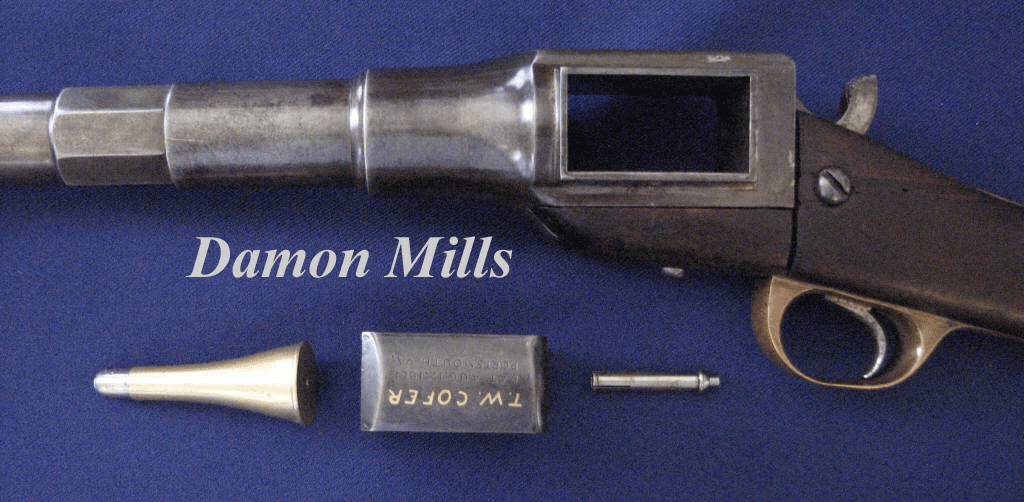
Wall guns continued into the rifling age and some were used in the Civil War. The Cofer Rampart Rifle was a giant .42 caliber gun that used a conical cartridge fired by a separate percussion cap tube.
Similar threads

- Replies
- 19
- Views
- 553

- Replies
- 2
- Views
- 84

- Replies
- 4
- Views
- 155
Similar threads


- Learn About Us
- ►About CivilWarTalk
- ►Contact the Webmaster
- ►Meet the Staff
- ►Link to CivilWarTalk
- Join Our Community
- ►Register
- ►Browse Forums
- ►View Today's Discussions
- ►Search the Forum
- Get Help
- ►FAQ
- ►Student Guide
- ►Forum Rules & Etiquette
- ►Copyright / DMCA
 Bringing the