Dave -
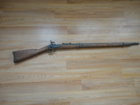
Thank you for taking the time to post a photo, it really did help! As "Historyprof" stated it is a post war alteration.
Here is a brief history of it: It started life as a muzzle loading U.S. Model 1864 Rifle Musket, in .58 caliber. In 1865 Erskin S. Allin, Master Armorer at the Springfield Armory developed a method of altering the thousands of muzzle loading muskets to breech loading cartridge arms. The first ones are Model 1865's, and were converted in late 1865 on through 1866, and were in .58 caliber rim fire. The caliber was quickly determined to be unsatisfactory. Mr. Allin then redesigned the breech mechanisim and caliber. The new version is known as the Model 1866. It had the breech milled out and a trapdoor mechanism mounted on top the breech. The barrel was reamed out and had a liner brazed in and rifled for for the new caliber. The new caliber was .50-70, and was a centerfire, reloadable cartridge. The Gov't altered 52,349 Model 1864 Civil War muskets to this new breech loading design. After 1870 they became obsolete with yet another version, the Model 1870. Once the Model 1866 became obsolete many, many, thousands of them were sold on the open market. France acquired several thousand of them during the Franco-Prussian War, 1870-1871.
The stock markings are quite interesting, but a bit beyond my field of expertise. There is a St. John, New Brunswick, and a St. John, Virgin Islands, and probably more that I don't know about. In my opinion the markings stand for St. John Regt., Gun No. 12. the question now is, which "St. John Regt."?
Jobe



 Bringing the