1863 Tower Enfield

REDL1965

Private
Joined
Sep 4, 2022
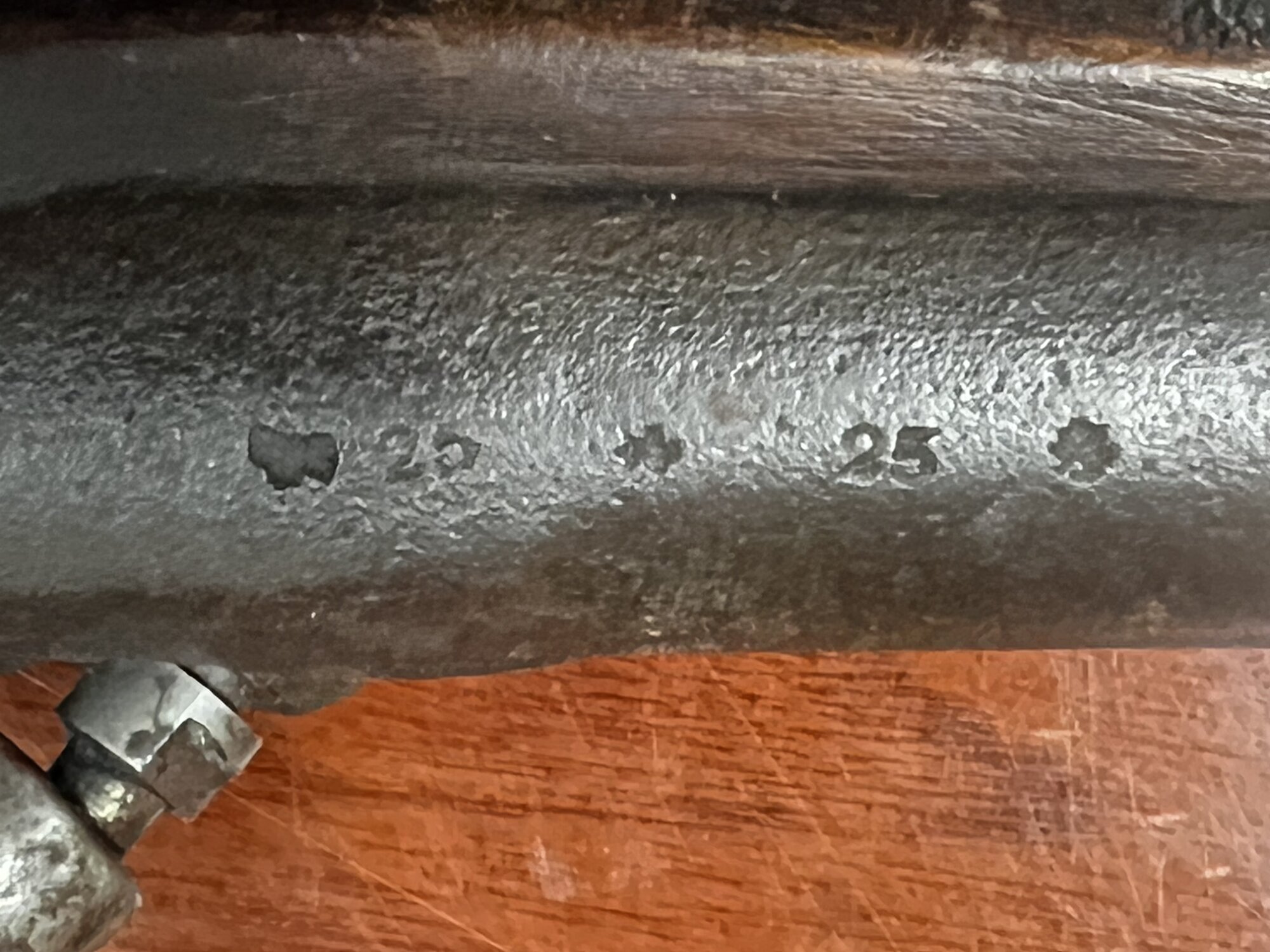
I'm assuming this 1863 Tower is likely Confederate but could use some help. I've pictured various markings. Also, the hammer and nipple are clearly replacements and the gun is a bit "weathered" shall I say. What are the thoughts on derusting something like this. I know the patina will be mostly removed but this isn't a high dollar gun to begin with.

IMG_8976.jpeg


IMG_8971.jpeg


IMG_8970.jpeg


IMG_8972.jpeg


IMG_8973.jpeg


IMG_8974.jpeg


IMG_8975.jpeg


IMG_8977.jpeg
 
I'm not the expert on Enfields, but these seem to be Birmingham Small Arms Trade stampings, generally accepted as not being Confederate. More than likely, it was imported for Federal use, but still decent example.

Did a bit of research and there are quite a few Confederate Tower Enfields with the BSAT stamp.
 
Last edited:
I agree, it would be better to stabilize the rust and leave the patina. Just age the hammer and nipple to match. Remove the casting sprue of course. From everything I've ever read in this site, there isn't anything on it that says Confederate. The North might not have been importing as many in 1863 as the South, but the gun could have literally been sent to any buyer anywhere in the world. It's a nice example of a Civil War era gun. IMHO.
 
It is a pretty standard civilian P53. It was made and proofed as a .577 rifle (25-bore) in Birmingham.. Joseph Bourne (on the barrel) was a founder member of the Birmingham Small Arms Association, which later became BSA. Hammer and nipple are not original.
 
Last edited:
There is no patina on this, or finish, just smooth rust. It doesn't look active, and so if you try to clean it, all you can do is turn the rough brown color into a rough bright silver color, and that will sure look unnatural and much less attractive.
The two small stamps in the wood are also those of the Birmingham Small Arms Trade membership, just smaller than the large round one on the side of the stock. The BSAT was a trade group formed by several leading Birmingham makers, and their mark was meant to create a brand of quality. The wood on your is marked JOSEPH BOURNE, who was a major player in the gun trade. The Birmingham makers sold to North and South and to buyers all over the world.
The North ended purchase contracts for Enfields sometime in 1863 - they had all the Model 1861 and 1863 Springfields with interchangeable parts. The South kept buying until the end of the War becuase there was only modest production in the South. So, a higher percentage of 1863 dated guns would be southern guns, compared to, say, 1861 and 1862 guns. I haven't look up any statistics, but I am pretty sure this general statement is correct.
 
Last edited:
While by the markings it is not a verified Confederate, and not a gun for a Confederate collection, I see nothing definitely saying it is NOT Confederate. It is in the "who knows" category. Nice attic type patina. I've only owned a couple of 1863 Confederates, they both had an "Anchor S" just in front of the buttplate tang. Never had a Confederate with a BSAT roundrel.
 
I was under the wrong impression that the Union wasn't ordering any Enfields in 1863 but that clearly is the case.
I am not sure I understand your comment.

Most Union purchased Enfields are not marked to show they were Union purchased.
Most Confederate purchased Enfields are not marked to show they were Confederate purchased.
Buyers from all over the world purchased Enfields.

The US did cancel all contracts in 1863 - but I think this was the latter part of 1863.
 
As Jeff says, SOME imported P53s appear to have been stamped not all were stamped. However, most will bear regimental or personal markings on the butt or buttplate tang. This has neither. It COULD be a Civil War relic - or maybe not. For example I have a Tranter type 3 pistol that was made around 1860 so it COULD have been used in the Civil War. It probably didn't go any further West than Bristol and more likely saw service in India, however, I have seen these advertised as 'Civil War era' - even the guns made in India and Nepal!
 
I believe the Union cancelled their existing P53 contracts with the Birmingham gunmakers around July 1863 as domestic production was able to meet their needs by that time. Whatever the case there is nothing about this particular unit that ties it to a particular government purchase during the US Civil War from what I can see here.
 

Learn About Us
►About CivilWarTalk
►Contact the Webmaster
►Meet the Staff
►Link to CivilWarTalk
Join Our Community
►Register
►Browse Forums
►View Today's Discussions
►Search the Forum
Get Help
►FAQ
►Student Guide
►Forum Rules & Etiquette
►Copyright / DMCA

     Contact Us CivilwarTalk on Facebook CivilWarTalk on YouTube CivilWarTalk on Twitter RSS Feed

Bringing the American Civil War and More to Life.
© 1999 - , CIVILWARTALK, LLC - Site Version 10.0

SlaveryTalk.com - SecessionTalk.com - CivilWarTalk.com - ReconstructionTalk.com
Back
Top