The James Rifle is an early rifled field gun. Desperate for ordnance at the wars beginning, the U.S. War Department ordered many examples early on, but by the summer of 1863, it was no longer widely used by Northern units. A notable exception was the 2nd Connecticut Battery, which was still equipped with them at Gettysburg. This class of James Rifles actually include 4 different gun types, and all fired elongated shells and were accurate up to 1,500 yards. Some larger Siege Guns were also rifled in the James method, but that's a story for a different article.
ARTILLERY PROFILE


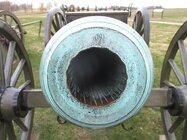
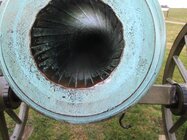
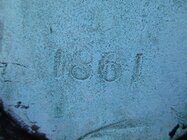
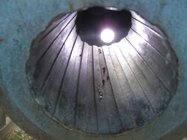
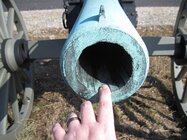
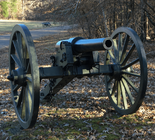
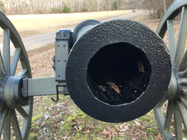
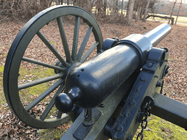
(Above 2 Photos) 14-pdr. James Rifle, Type I
Manassas NBP, ©Mike Kendra, March 2012

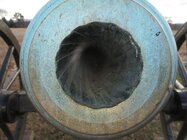
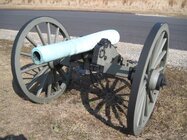
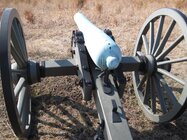
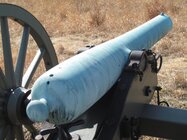
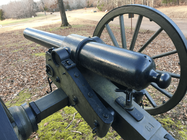
14-pdr. James Rifle, Type II
Gettysburg NMP, ©Mike Kendra, February 2011
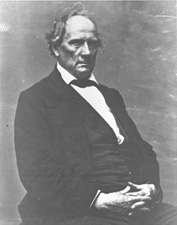
Charles Tillinghast James was a self-educated mechanic and carpenter who turned to public life, serving first as a senator from Rhode Island and later as Major General of the militia. He devoted considerable time and talent to the promotion of rifled cannons and to the projectiles they fired. His close friendship with J. Tyler Ames of Ames Foundry led to the development of these artillery pieces.
Prior to the start of the war, on November 1, 1860 a U.S. Army board recommended that half of the existing smoothbore cannons in forts and arsenals should be rifled according to the plans provided by James. The U.S. Army was so desperate for ordnance, it wanted James to rifle existing 6-lb. Smoothbore Guns in the James Pattern. Rifling the older guns to accommodate the James shells would inexpensively double the weight of shell fired, since the shells were elongated. It was believed this could be done without putting too much stress on the gun barrel. The guns were rifled in the James Pattern to a bore size of 3.67 inches. They would come to be known as Rifled 6-pounders or perhaps 12-pdr. James Rifles.
The designation of "James Rifles" may not have been used early on in the war effort, historically speaking, as they may not have been called that by the War Department. Late in 1861, the Ames Company received an order to produce several 3.8-inch rifles. Although the exact text of the order itself is lost to history, they used a reference to guns called "new model" or Model of 1861. Later, when General McClellan inquired about James rifles, Secretary of War Stanton responded by writing, "James is not known as a manufacturer of guns, and it is not known that he makes any pretense of having invented one. Ames, of Chicopee, manufactures guns, and is the manufacturer of James projectiles..."
So, perhaps it could be inferred that the Type II version of this class was known as the, "New Model Rifle, Model of 1861", a construct of the War Department that simply incorporated the James Pattern of Rifling into it's design, and utilized the James Patent Shell as it's primary ammunition type. At any rate, we will use the common name "James Rifle" to describe this class of artillery.
With the success of the Rifled 6-pounders, starting in early 1861, the War Department ordered James to skip casting new barrels, and use the inventory of existing castings from the older M1841 6 Pounders to create the next generation of James Rifles. These guns typically had 15 rifle grooves. One alteration was made in this design that was to prove chaotic to the ordnance supply system. The bore size was set to 3.8 inches, a new standard for the James Rifle system, a slightly larger bore size than the old 6-lb smoothbore guns being converted to the James Rifle Pattern.
This mismatch in bore sizes would become an extra headache for the ordnance department, and was the first strike against the James Rifles as a group.
Early in the war, the James Rifles proved to be successful field guns; accurate, safe, and reliable. However, they soon suffered from wear on the bronze rifle grooves. The metallic properties of bronze proved to be just too soft for field artillery rifle use during wartime. This would be the second strike against the James Rifle. After just a year, many guns were showing heavy wear, and within three years, most all were removed from service in the East due to having no serviceable rifling.
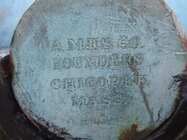
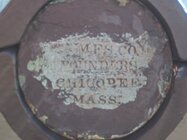
The James Rifle, Type II. was more of a pure "James Rifle", comprising of a smooth bronze barrel similar in shape to the 3-inch Ordnance Rifle, and was produced by the Ames Manufacturing Company of Chicopee, Massachusetts. It usually has 7 or 10 rifle grooves and a distinctive front sight blade. The barrel was rifled in the standard James Pattern 3.8 inch bore. Unfortunately this model also suffered from heavy wear to the rifle grooves under normal use, and didn't have a long service life.
The James Rifle, Type III is the last update to the pure "James Rifle" class, finally switching the bronze out for a more durable Steel design. Sticking to the 3.8 inch bore, these guns were greatly outnumbered and still couldn't trade ammunition with the new iron Parrott and steel Ordnance Rifles that were becoming the standard rifled field artillery pieces of the day.
On October 17, 1862, Charles T. James, was fatally wounded by an accidental explosion from one of his shells, a worker examining a shell mistakenly set it off. This was the final blow to the James Rifle as an Artillery Class. By then other Cannons had proven to be just as effective, or better, and were replacing the James Rifle on the field. By 1863, most of the James rifled guns of all types were removed from service in the East, leaving only a few scattered units. Some in the West lasted a while longer, but without support from Charles T. James, no new updates or improvements were made, and no further guns were manufactured.
The Confederate Army did capture James Rifles during the war, but their usefulness was probably limited to the remaining ammunition in any chests that were also captured. It's likely that captured James Rifles were melted down and turned into Napoleons, or other more useful Rebel arms of the period.
FOR FURTHER READING
 markerhunter.wordpress.com
 markerhunter.wordpress.com
 markerhunter.wordpress.com
 markerhunter.wordpress.com
 markerhunter.wordpress.com
ARTILLERY PROFILE
- Models:
- 14-pdr. James Rifle - Type I
- 14-pdr. James Rifle - Type II, & III
- Rifled 6 Pdr. Guns (Using the James Pattern of Rifling)
- Type: Muzzleloading Rifled Gun
- In Service With: United States Army
- Purpose: Counter-battery & Support the infantry and cavalry forces in the field
- Invented By: the U.S. War Department & Charles Tillinghast James
- Patent: None for cannon, it's possible the overall shape and design should be credited to the War Department and Ames rather than Charles T. James. It's assumed that James himself developed the pattern used to create the rifling pattern, influenced by the design of his Patented Improved Cannon Projectiles.
- Rarity: Uncommon to Rare
- US Casting Foundries:
- Ames Manufacturing Company, Chicopee, Massachusetts
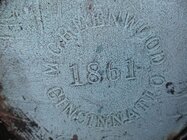
- Miles Greenwood & Company, Cincinnati, Ohio (51 of the Type I Remanufactured Barrels Only)
- Years of Manufacture: 1861 - 1862
- Tube Composition:
- Type I, II, Rifled 6 Pdr: Bronze
- Type III: Steel
- Variants:
- Type I: Made from remanufactured 6-pdr. Gun Barrels
- Type II: Purpose Cast 14-pdr. James Rifles of Bronze
- Type III: Purpose Cast 14-pdr. James Rifles of Steel (Sometimes mistaken for a "12-pdr. Blakely - Type 8")
- Rifled 6-pdrs.: These are not really James Rifles at all, but are rather guns "rifled in the James system". Some of these were clearly experimental guns, others did see service. These guns conform to the typical profile and measurements of a typical 6-pdr. Gun.
- No. Purchased During the Civil War: about 400
- No. of Surviving Pieces Today: Over 150
(Above 2 Photos) 14-pdr. James Rifle, Type I
Manassas NBP, ©Mike Kendra, March 2012
14-pdr. James Rifle, Type II
Gettysburg NMP, ©Mike Kendra, February 2011
- Bore Diameters:
- Type I, II, III: 3.8 inches
- Rifled 6-pdrs: 3.67 inches
- Bore Length:
- Type I & Rifled 6-pdrs: 57.5 inches
- Type II & III: 65 inches
- Rifled 6-pdrs: 57.5 inches
- Rifling Types:
- Type I: 15 rifle grooves
- Type II: Series 1 - 7 rifle grooves
- Type II: Series 2 - 10 rifle grooves
- Type III: 10 rifle grooves
- Rifled 6-pdrs: 6 to 10 rifle grooves
- Trunnion Diameter: 3.67 inches
- Barrel Thickness:
- Type I: at Muzzle - 2.18 inches; at Vent - 3.0 inches
- Type II: at Muzzle - 1.29 inches; at Vent - 3.0 inches
- Tube Length:
- Type I & Rifled 6-pdrs: 65.6 inches
- Type II & III: 74 inches
- Tube Weight:
- Type I & Rifled 6-pdrs: about 880 lbs.
- Type II: 917 lbs.
- Type III: 930 lbs.
- Carriage Type: No. 1 Field Carriage (900 lbs.), 57" wheels
- Total Weight (Gun & Carriage): about 1,800 lbs.
- Horses Required to Pull: 6
- No. of Crew to Serve: Typical - 9, 1 Gunner, 8 Numbered Crew Positions
- Standard Powder Charge: 1.25 lbs. Cannon Grade Black Powder
- Projectiles Types: James & Schenkl and Hotchkiss Types
- Projectiles Weights: 14 lb. bolt (The Rifled 6-pdr. may have been less, perhaps 12 lbs., records have yet to clarify this....)
- Rate of Fire: 2 rounds per minute
- Effective Range:
- Type I: at 5° - 1,700 yards ( 0.96 miles) with a 12 lb. Schenkl shell
- Type I: at 5° - 1,530 yards ( 0.87 miles) with a 14 lb. Hotchkiss shell
- Type II: Max Range - 2,000 yards (1.13 miles)
- Rifled 6-pdr: at 2¼° - 1,000 yards (0.56 miles) with a 14 lb. shot
Charles Tillinghast James was a self-educated mechanic and carpenter who turned to public life, serving first as a senator from Rhode Island and later as Major General of the militia. He devoted considerable time and talent to the promotion of rifled cannons and to the projectiles they fired. His close friendship with J. Tyler Ames of Ames Foundry led to the development of these artillery pieces.
Prior to the start of the war, on November 1, 1860 a U.S. Army board recommended that half of the existing smoothbore cannons in forts and arsenals should be rifled according to the plans provided by James. The U.S. Army was so desperate for ordnance, it wanted James to rifle existing 6-lb. Smoothbore Guns in the James Pattern. Rifling the older guns to accommodate the James shells would inexpensively double the weight of shell fired, since the shells were elongated. It was believed this could be done without putting too much stress on the gun barrel. The guns were rifled in the James Pattern to a bore size of 3.67 inches. They would come to be known as Rifled 6-pounders or perhaps 12-pdr. James Rifles.
The designation of "James Rifles" may not have been used early on in the war effort, historically speaking, as they may not have been called that by the War Department. Late in 1861, the Ames Company received an order to produce several 3.8-inch rifles. Although the exact text of the order itself is lost to history, they used a reference to guns called "new model" or Model of 1861. Later, when General McClellan inquired about James rifles, Secretary of War Stanton responded by writing, "James is not known as a manufacturer of guns, and it is not known that he makes any pretense of having invented one. Ames, of Chicopee, manufactures guns, and is the manufacturer of James projectiles..."
So, perhaps it could be inferred that the Type II version of this class was known as the, "New Model Rifle, Model of 1861", a construct of the War Department that simply incorporated the James Pattern of Rifling into it's design, and utilized the James Patent Shell as it's primary ammunition type. At any rate, we will use the common name "James Rifle" to describe this class of artillery.
With the success of the Rifled 6-pounders, starting in early 1861, the War Department ordered James to skip casting new barrels, and use the inventory of existing castings from the older M1841 6 Pounders to create the next generation of James Rifles. These guns typically had 15 rifle grooves. One alteration was made in this design that was to prove chaotic to the ordnance supply system. The bore size was set to 3.8 inches, a new standard for the James Rifle system, a slightly larger bore size than the old 6-lb smoothbore guns being converted to the James Rifle Pattern.
This mismatch in bore sizes would become an extra headache for the ordnance department, and was the first strike against the James Rifles as a group.
Early in the war, the James Rifles proved to be successful field guns; accurate, safe, and reliable. However, they soon suffered from wear on the bronze rifle grooves. The metallic properties of bronze proved to be just too soft for field artillery rifle use during wartime. This would be the second strike against the James Rifle. After just a year, many guns were showing heavy wear, and within three years, most all were removed from service in the East due to having no serviceable rifling.
The James Rifle, Type II. was more of a pure "James Rifle", comprising of a smooth bronze barrel similar in shape to the 3-inch Ordnance Rifle, and was produced by the Ames Manufacturing Company of Chicopee, Massachusetts. It usually has 7 or 10 rifle grooves and a distinctive front sight blade. The barrel was rifled in the standard James Pattern 3.8 inch bore. Unfortunately this model also suffered from heavy wear to the rifle grooves under normal use, and didn't have a long service life.
The James Rifle, Type III is the last update to the pure "James Rifle" class, finally switching the bronze out for a more durable Steel design. Sticking to the 3.8 inch bore, these guns were greatly outnumbered and still couldn't trade ammunition with the new iron Parrott and steel Ordnance Rifles that were becoming the standard rifled field artillery pieces of the day.
On October 17, 1862, Charles T. James, was fatally wounded by an accidental explosion from one of his shells, a worker examining a shell mistakenly set it off. This was the final blow to the James Rifle as an Artillery Class. By then other Cannons had proven to be just as effective, or better, and were replacing the James Rifle on the field. By 1863, most of the James rifled guns of all types were removed from service in the East, leaving only a few scattered units. Some in the West lasted a while longer, but without support from Charles T. James, no new updates or improvements were made, and no further guns were manufactured.
The Confederate Army did capture James Rifles during the war, but their usefulness was probably limited to the remaining ammunition in any chests that were also captured. It's likely that captured James Rifles were melted down and turned into Napoleons, or other more useful Rebel arms of the period.
FOR FURTHER READING
- Civil War Artillery at Gettysburg, Cole, Philip M, Da Capo Press, New York, N.Y., 2002.
- Field Artillery Weapons of the Civil War, by Olmstead, Hazlett, & Parks, Univ of Delaware Press, 1988.
- Artillery and Ammunition of the Civil War, by Warren Ripley, Battery Press, 1984.
James Rifles, Part 1
In my view, the James Rifle was an early war “fad” that came and past. Much like a teen pop star’s popularity passes quickly, everyone wanted a James Rifle in 1861. But by 1863,…
markerhunter.wordpress.com
James Rifles, Part II – The Type 1
As mentioned in the previous post on James rifled guns, historians of artillery have defined a “true” James rifle as having a 3.80-inch diameter bore. Charles T. James preferred that c…
markerhunter.wordpress.com
James Rifles, Part III – The Type 2
Of the types identified as James Rifles, the most familiar is what some historians have come to call the Type 2. The James Rifle, Type 2 has the same 3.80-inch bore of the other “true James…
markerhunter.wordpress.com
James Rifles, Part IV – The Type 3
The previously mentioned “True James Rifles,” Type 1 and Type 2 shared, beyond a common bore size, bronze construction. Both types also saw active service during the first half of the …
markerhunter.wordpress.com
James Rifles, Part V – Rifled 6-pdr Cannon
This last section on the James field guns includes weapons that retained the standard 6-pounder bore size, 3.67-inch, but were rifled. And there is no real standard as to rifling pattern or extern…
markerhunter.wordpress.com
Last edited:



 Bringing the