What Evidence Is There That Smoothbores At 100 Yards Were More Effective Than Rifles?

Rhea Cole

Colonel
Joined
Nov 2, 2019
Location
Murfreesboro, Tennessee
What Evidence Is There That Smoothbores At 100 Yards Were More Lethal Than Rifles?

I do not know how many times I have heard or read that smoothbore muskets firing round balls or buck & ball were more lethal at 100 yards than rifles. Nobody maintains that at ranges over 100 yards smoothbore muskets were in any way advantageous.

The evidence for the advantage of lethality is always supported by anecdotal evidence. I am not the only person who has noticed that anecdotes say a lot about the author & even more about the person citing them. As objective data, anecdotes are nothing more than footnotes & local color.

Ok, Mr Smarty Pants, how can we find objective contemporary data? The 1860 Ordinance Department long arms tests were conducted using serving soldiers firing at 10' X 10' paper targets.
IMG_3328.webp


IMG_3347.webp
IMG_3346.webp


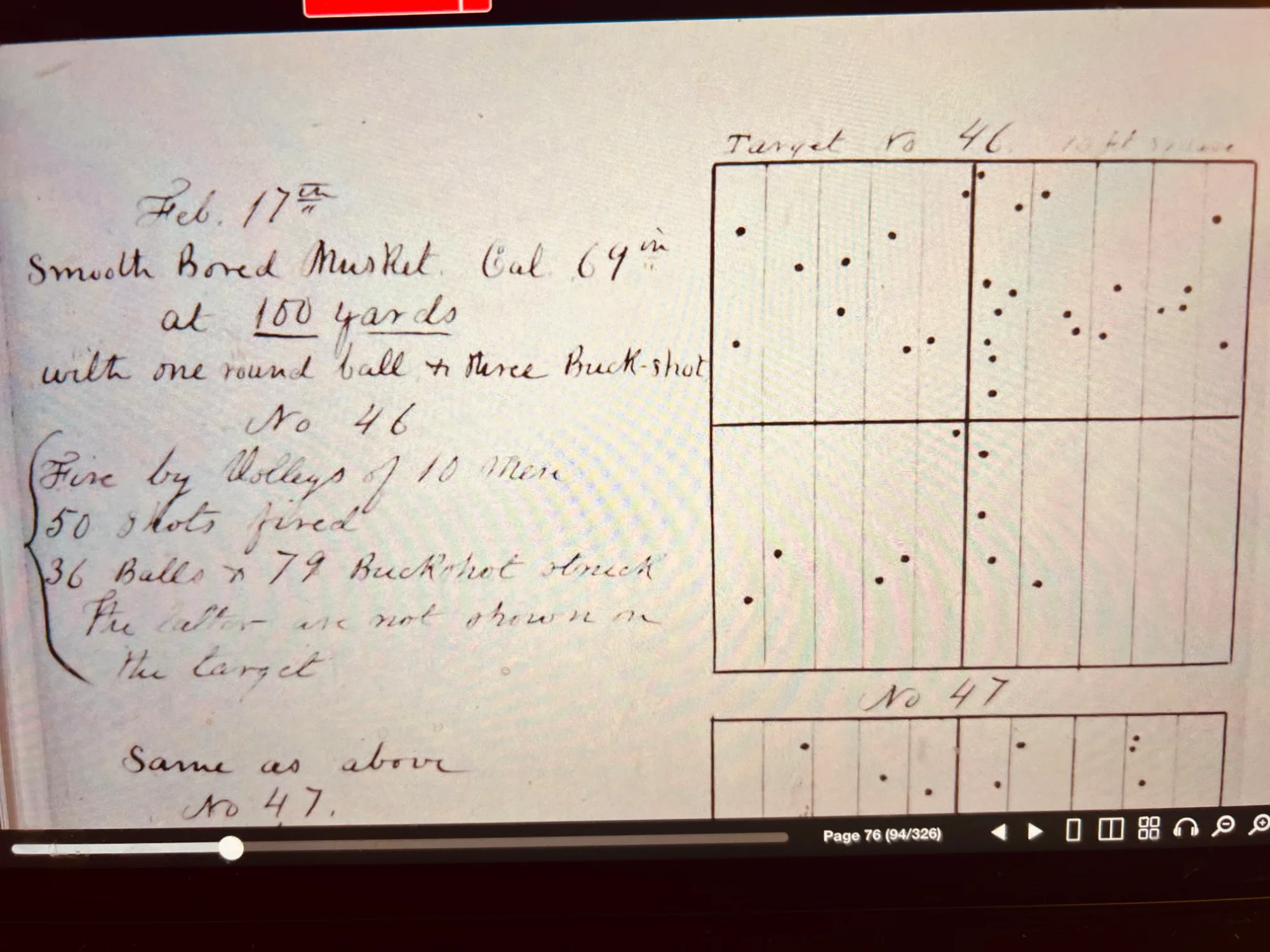
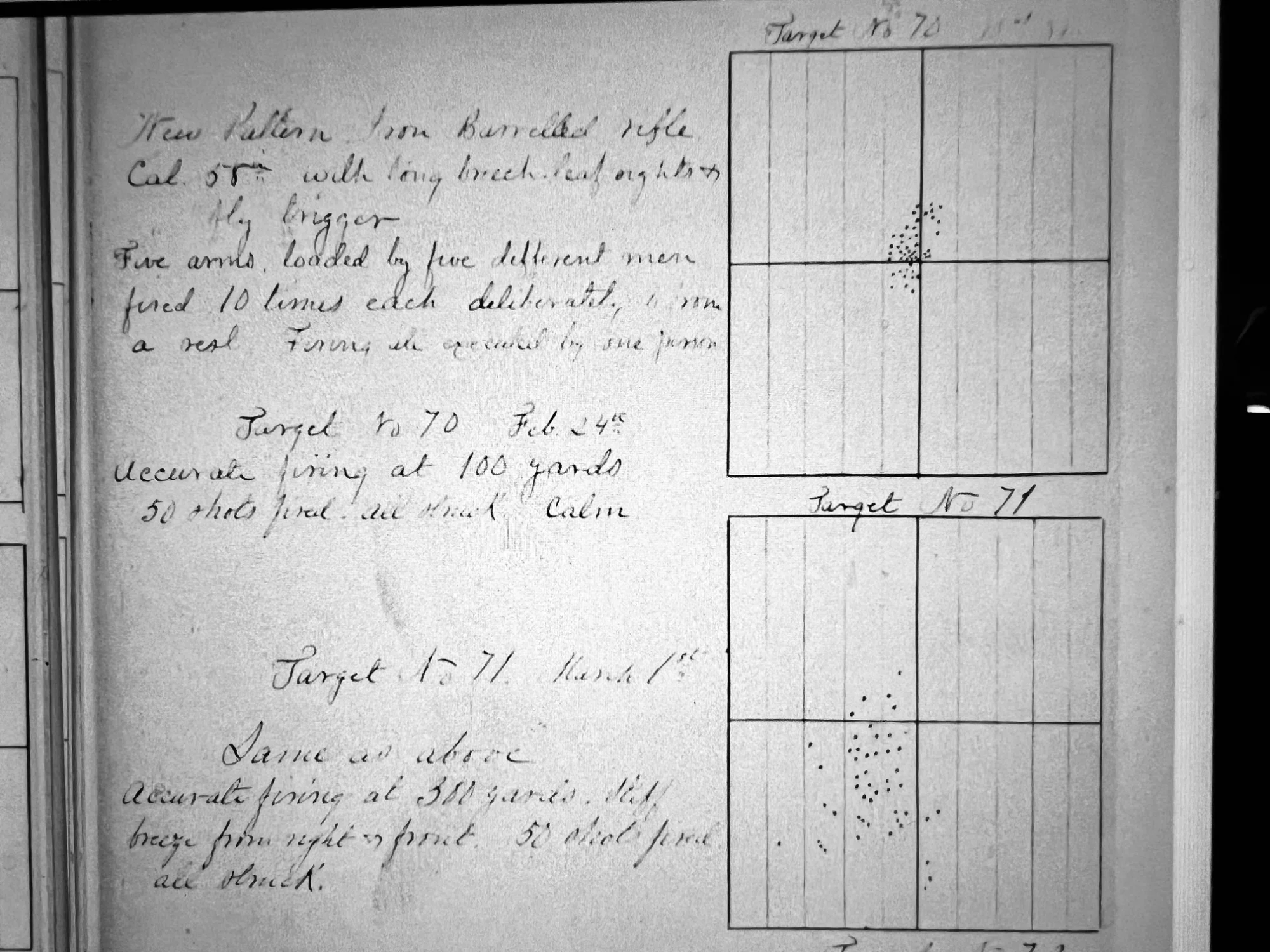
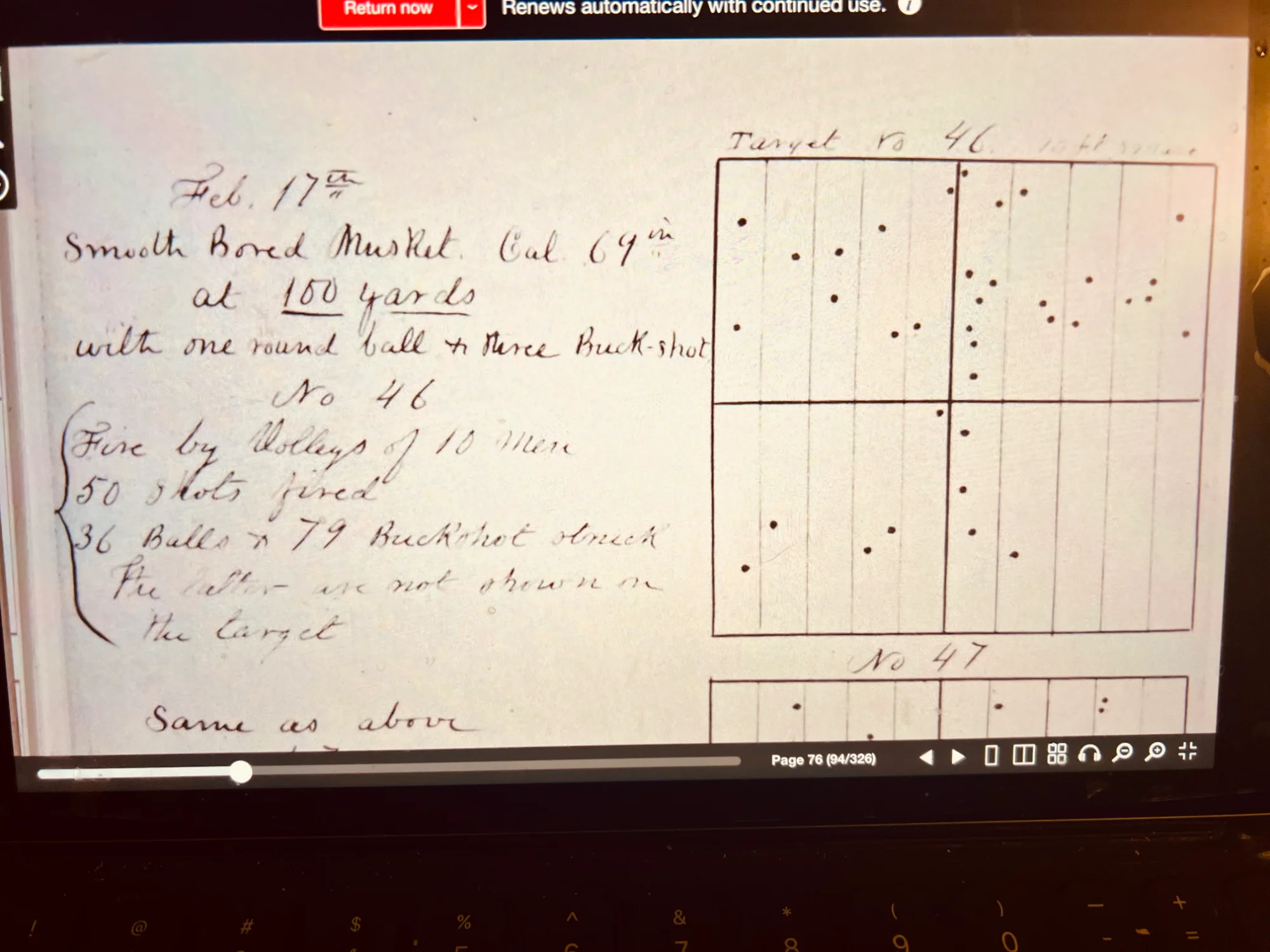
The "killing zone"refers to the 5' 8" average height of Civil War soldiers. The horizontal line on the target is at 5'.

At 100 yards all of the rifle rounds struck the target within the killing zone.

At 300 yards all of the rifle rounds struck the target within the killing zone.

At 100 yards only 10 single smoothbore rounds struck the target within the killing zone.

At 100 yard only 10 balls & > 20 buck shot struck the target within the killing zone.

In a theoretical stand up fire fight at 100 yards for every 50 shots fired 10 smoothbore balls would strike a man sized target & 50 rifle strikes all the way out to 300 yards.

At the 50 yard whites of their eyes range often cited, almost all the smoothbore rounds land within the killing zone… as do all of the rifle rounds. At no point from 50 yards out to 300 are the smoothbore musket strikes in the killing zone more than a fraction of rifle round strikes.

At 500 yards, beyond any registered smoothbore strikes, the rifle rounds strikes are (+/-) = to those of the smoothbore at 100 yards.

I encourage you to reference the Ordinance Bureau test results for yourself. There is no misrepresentation on my part.

Conclusion:

The evidence does not support the claim that at 100 yards smoothbore muskets firing either ball or buck & ball are superior to rifles. In fact, at all ranges from 100 to 500 yards smoothbore target strikes are (+/-) 20 percent to zero of rifle strikes.
 
Last edited:
The 24th Ohio found out "At this Action" they were pinned down by accurate Rifle fire. They shot back and their Smoothbores could not reach the enemy. After advancing within 50 to 75 yards and firing, the enemy retreated. FACT!
Right, but was this the time that Chalmers said they ran out of ammunition? That's why I'm checking the other side of things.

Incidentally, I'm not sure how accurate that rifle fire could have been if they closed through the range of the rifles to their own range, and fought several further actions in the battle, and suffered 4 dead and 28 wounded...


We are going round and round with this. This is from one Chapter. There are 15 more on Smoothbores vs. Rifles. I say, each action needed to be analyzed to find an answer if Rifles beat Smoothbores and at that particular time, the action, if the soldiers told us it did or did not, according to circumstances. I have the research. After you read "ALL" of it you can make up your mind.
I'm sure you've made a very convincing case that the soldiers considered rifles better than smoothbores. I would hardly contest that. What I'm trying to do here is to pick out whether they were making that judgement based on a correct evaluation of the evidence, or if they'd "made their minds up" before the battle even began and so whatever they experienced confirmed what they already thought.

It's very easy to blame a defeat on your weapon - after all, it means the fault isn't with you!
 
If you do not know what your longarms were capable of - and had rarely fired them or seen the results of firing - how could you make any conclusion on capabilities, advantages or disadvantages? That is the point being made.

A rifle can kill out to 900 yards as a unit fire task. It can hit a target and kill at 300-600 yards - IF the soldier IS TRAINED TO AIM AND FIRE IT. A smoothbore is only good out to 100 yards at best, but you have to point it in the right direction and practice it! With either, fall of shot is a significant factor These guys were NOT trained to spot fall of shot but encouraged to reload ASAP. Had they ever examined a decent target to gauge fall of shot? What was their reaction to recoil on first firing on the battlefield? How did it affect their aim?
 
Since this horse isn't quite dead yet 🙂, I'll add my thoughts, for what they've worth.

To me, the importance of the rifled musket is not in its accuracy, but rather how it contributed to the volume of fire; perhaps the most important consideration in linear tactics.

The increased range of the rifled musket meant that it could be loaded and fired several times as an enemy advanced. Combined with rifled artillery, the advancing line would come under an increasing volume of fire. As the enemy got closer, smoothbore cannons and muskets would join in, creating the "withering fire".

The attacker, on the other hand, could not stop to take accurate aim and maintain the advance. Accurate fire would be even more difficult if the defender was entrenched.

There's no argument that skirmishers and sharpshooters took their toll, but they couldn't provide the weight and firepower needed to win the battle.
 
To me, the importance of the rifled musket is not in its accuracy, but rather how it contributed to the volume of fire; perhaps the most important consideration in linear tactics.

The increased range of the rifled musket meant that it could be loaded and fired several times as an enemy advanced. Combined with rifled artillery, the advancing line would come under an increasing volume of fire. As the enemy got closer, smoothbore cannons and muskets would join in, creating the "withering fire".

The attacker, on the other hand, could not stop to take accurate aim and maintain the advance. Accurate fire would be even more difficult if the defender was entrenched.

There's no argument that skirmishers and sharpshooters took their toll, but they couldn't provide the weight and firepower needed to win the battle.
This I think is tricky. In practice in the Civil War a lot of officers held fire until what they considered effective range, which was still quite short (often within the range of a smoothbore).

It's true that the attacker tends to stall out and this leads to a firefight, and that this is a feature of the ACW more than some other wars, but I think this is more the result of insufficient drill and cohesion than the result of more effective ranged fire. With the defenders opening fire at quite short ranges and the slow reload of a rifle-musket (compared even to a smoothbore musket, at least with American ammunition) the result is basically the same dynamic as when attacks stall out in the Napoleonic wars.

The dynamic you describe does happen at Inkerman, which is how we know what it should really look like - absolutely massive casualties for the attacker. Such lopsided and heavy casualties are not common in the ACW.
 
To elaborate on what I mean by that, the defending troops at Inkerman are at a serious manpower and artillery disadvantage, but they have Minie rifles and good range estimation training. The result of this is that they inflict huge casualties on the assaulting Russian columns; by dint of sheer numbers, the Russians push through to hand-to-hand range at one point, but are then repulsed. The Russian forces making the actual attacks are in the first phase over 15,000 men (of the 25,000 present) against about 3,500 British defenders; in the second phase there are a total of 35,000 Russians present and 7,000 British, and this is where they push through to hand-to-hand. There are also attacks in the third phase (when there are 44,000 Russians, though by this point a lot of them are casualties, and 1,600 Frenchmen have joined the 7,000 British defenders), and after that it's mostly a long ranged gun duel.

Over the course of this fighting some 12,000 Russians become casualties; the total Allied casualties is about a third of this (and this may conflate Allied casualties from another engagement).


What I want to compare this with is the attack at Fredericksburg specifically, and more specifically the one in the south. Franklin makes a mass attack with two divisions of 1st Corps (with a third in support which does not actually attack during that sequence) and it reaches close combat range before being repulsed after an extended engagement.

The attacking units of 1st Corps are probably about 11,000 strong (slightly less than 2/3 of the 1st Corps, which was 17,800 PFD on 10th November) and the defending units are (at least) the majority of AP Hill's division; the whole division was about 10,000 men PFD, very roughly. So this is like a 2:3 scale version of the initial attack at Inkerman, except that there are more defenders (potentially a lot more).

The two attacking divisions suffer about 3,000 casualties in the battle, but notably AP Hill's division suffers about 1,600 casualties; the total of the fighting the Left Grand Division is engaged in is about 3,800 Federal casualties and 2,800 Confederate casualties (the total casualties to Jackson's corps).


This looks quite different! If the dynamic were the same as Inkerman we should, bluntly, expect that Meade and Gibbon would be shot to pieces without reaching the Confederate lines. Instead they clearly got there and were engaged in a significant fight at close range, and unlike the Russians at Inkerman they didn't do so with sheer overwhelming numbers.
 
I don't think the popular consciousness really plays a part in this conversation. It's certainly less valuable than that of the officers and men, which we've already established as having little real value due to lack of training and understanding of contemporary tactics.
 
Since this horse isn't quite dead yet 🙂, I'll add my thoughts, for what they've worth.

To me, the importance of the rifled musket is not in its accuracy, but rather how it contributed to the volume of fire; perhaps the most important consideration in linear tactics.

The increased range of the rifled musket meant that it could be loaded and fired several times as an enemy advanced. Combined with rifled artillery, the advancing line would come under an increasing volume of fire. As the enemy got closer, smoothbore cannons and muskets would join in, creating the "withering fire".

The attacker, on the other hand, could not stop to take accurate aim and maintain the advance. Accurate fire would be even more difficult if the defender was entrenched.

There's no argument that skirmishers and sharpshooters took their toll, but they couldn't provide the weight and firepower needed to win the battle.
Yes, it SOUNDS logical, but it didn't work like that - that is what we have been saying.
Volume of fire? No contribution at all since they did not open fire until they were within musket range and the new rifles were not sighted to enable them to be used like that. The wounding and damaging ability was far higher, hence the number of amputations.
 
I don't think the popular consciousness really plays a part in this conversation. It's certainly less valuable than that of the officers and men, which we've already established as having little real value due to lack of training and understanding of contemporary tactics.
Honestly, I think it is valuable because it's how the men come to their initial opinions - and those initial opinions are how they interpret their experiences.

E.C. Downs reported that he enlisted on condition that he receive 'a first-class rifle of the most modern improvement,' though it was several months before he actually received the Enfield which he desired and shortly afterwards he was demanding it be replaced by a Henry repeater. (Interestingly, he says that his privately purchased Henry's accuracy and long range was a marvel compared the best feats of marksmanship he'd seen among experienced hunters - he was himself a hunter, which was what he felt made him so uniquely deserving of a weapon.)

The Henry has a .44 cartridge with 25 grains of black powder, and a 24 inch barrel. The Enfield which he previously had used a .577 cartridge with 68 grains of black powder (behind a ball that was heavier in proportion) and a 39 inch barrel - I cannot see how the Henry's ballistic properties would be better in terms of range. I think that Downs here is having a case of confirmation bias, and well he might, not wanting to think that he's spent $65 on an inferior weapon!
 
Yes, it SOUNDS logical, but it didn't work like that - that is what we have been saying.
Volume of fire? No contribution at all since they did not open fire until they were within musket range and the new rifles were not sighted to enable them to be used like that. The wounding and damaging ability was far higher, hence the number of amputations.

Higher amputations is actually an artefact of the rifles being less lethal than the old round balls. The question is mainly is the round above the speed of sound in tissue, and how quickly it loses energy in the body. Except at very short ranges,* Minie balls were subsonic, and so only created a permanent wound track without cavitation. Round balls created huge cavitation injuries at typical firefight ranges. However, the elongated bullet was better at smashing through long bones.

The existence of cavitation injuries was only reported in 1898. To repost:

I have seen studies at the time, and the smoothbore tended to produce large exit wounds, typically 6" in diameter, without much displaced material outside of the permanent wound track. We now recognise this as the effect of cavitation. Round balls at < 100 yards are faster, and also lose energy quicker when they hit a target. This produces a large temporary cavity.

Contrariwise, if a conical ball didn't hit a bone then it went straight through without producing much cavitation. The exit wounds were typically of similar size to the entry wounds. The rifle-musket projectile's initial velocity is similar to a modern low chamber pressure pistol ball, like .38 or .45 ACP.

The threshold at which cavitation starts is around 1,000 fps with modern shaped projectiles, but it would be lower with less aero(hydro)dynamic forms. Minie balls start below this threshold, and hence never produced temporary cavities. Musket balls with the regulation load have initial velocities of around 1,500 fps, and hence are above this threshold. Worse, as a far less hydrodynamic form, they dump energy much quicker and will induce cavitation at lower velocities.

Modern experiments bare this out - a British .75 flintlock produces huge temporary cavities at 150 yds.

Essentially, if you were hit in the torso with a round-ball at less than 100 yards or so, you we dead. The temporary cavity would rip open the heart and the victim would die. If you were hit with a conical ball and it missed the heart and major blood vessels (i.e. went through the lung) you might live if the wound was promptly treated.

If the hit was in the abdomen, the round ball would likely kill as it shattered hollow organs, whereas a conical ball would depend a lot more on shot placement.

The conical ball was, however, particularly good at smashing through bones. The round ball had a much greater chance of deflecting on a glancing blow to a bone. This led to particularly horrific injuries to the extremities.

* Although the Burton ball in a Springfield is already below 1,000 fps, the crude division between the states, at the muzzle.
 
No. Not talking about cavitation, more like the destruction of bone.

Standard Civil War rifle-muskets (like the Springfield Model 1861) fired massive .58 caliber projectiles made of soft lead. When the soft lead Minié ball struck human tissue or bone, it tended to flatten, mushroom, or fragment, acting similarly to a modern hollow-point round. Its heavy weight (around 500 grains) and low-to-moderate velocity, dumped all its kinetic energy directly into the target. When it hit a bone, it did not just crack it—it splintered and pulverized long bones into tiny fragments. The slow-moving, large bullet often dragged bits of dirty wool uniform and skin into the wound channel, guaranteeing severe infections like gangrene. Due to the extent of bone splintering, field surgeons had very few options other than immediate amputation.

For a round musket ball this was only possible at less than 70 yards. The Minie could do that beyond 700 yards.
 
Minie's certainly did not act like a hollow-point. Note that round musket balls and elongated ones are made of the same material; lead. They deform as much as each other. The difference is the shape, and the sectional density.

The mushrooming of a round was called "setting up" and was a well understood phenomena, especially with respect to armour-piercing naval artillery. The reason steel and chilled-iron projectiles outperformed wrought iron projectiles is that they resisted setting up.

Elongated balls like Minie's (and Nessler's*) were very poor at transferring energy compared to round balls. They usually exited the body intact (fired from a few hundred yards), carrying away most of their energy. Due to this, they only did localised tissue destruction, and shot placement was far more of a factor.

Now, against long bones, the surgeons found there was a significant difference. The round ball tended to break the bone and be embedded in it, but the transferred energy destroyed the soft tissue and muscle around the hit. The Minie, if it struck the centre of the shaft of the bone, went straight through leaving the bone shattered for 3-4 inches. If a Minie struck the bone towards the edge, it would typically be rejected and hence leave a bone bruise or simple break.

This resulted in more amputations of those hit with elongated balls (Minie's, and indeed Nessler's in the Crimea). It may be there is a selection bias here, in that the increased destruction of the soft tissues with round balls (particularly with upper leg hits and the arteries there) meant the wounds were less survivable, and the victim was more likely to bleed out with shock. I am aware of no study on this. In the Crimea, roughly 1 in 7 wounds to the extremities required amputation (or resection), and a quick search suggests about 7% of the wounds to the extremities in the ACW resulted in amputation.

* An elongated ball used in Russian smoothbores in the Crimea, which extended the effective range of a smoothbore to about 400 yards. The loss of precision at long range with a round ball is due to the Magnus effect, which is massively reduced with an elongated ball. The State of North Carolina manufactured Nesslers as a stopgap in the early war.
 
The State of North Carolina manufactured Nesslers as a stopgap in the early war.
They certainly manufactured a flat based short round nosed bullet and called it a "Nessler" but it was not at all like the actual Nessler which included a careful interior shape to encourage the bullet to expand upon firing and alter the centre of gravity. The true Nessler was used by the French army, the Sardinian army and the Russian army.

Personally I would expect the North Carolina bullet to tumble when fired from the intended smoothbore bore musket. The true Nessler attempted to fill the bore when fired to avoid emerging with a random direction from the bouncing off the barrel walls of the round ball with a wide windage, to have a centre of gravity towards the front of the bullet and a straight cylindrical form to act as a drag stabiliser. From what reports I can trace the Nessler improved accuracy at á distance but was inferior to the round ball at close ranges. Possibly due to taking some time to stabilise in flight. Trialled and rejected by both the Union army and the British army as no better than the conventional round ball at practical smoothbore bore ranges. I do wonder if Tamisier grooving of the cylinder walls would stabilise them sooner, but I digress woefully.
 
Last edited:
Right, but was this the time that Chalmers said they ran out of ammunition? That's why I'm checking the other side of things.

Incidentally, I'm not sure how accurate that rifle fire could have been if they closed through the range of the rifles to their own range, and fought several further actions in the battle, and suffered 4 dead and 28 wounded...


I'm sure you've made a very convincing case that the soldiers considered rifles better than smoothbores. I would hardly contest that. What I'm trying to do here is to pick out whether they were making that judgement based on a correct evaluation of the evidence, or if they'd "made their minds up" before the battle even began and so whatever they experienced confirmed what they already thought.

It's very easy to blame a defeat on your weapon - after all, it means the fault isn't with you!
Whether they ran out of ammunition-- I have not looked that up-- or were forced back due to a heavy fire at 50 yards from Smoothbore "Buck and Ball" fire-- the fact is their Colonel stated in his Official Report the enemy retreated. I just read Chalmers's Report on Shiloh and he does mention at least twice they ran out of ammunition's both on 6th and 7th. The times on the 7th or exactly where they were when confronted with the 24th Ohio is not in there. He did report the Confederates with him fell back and he was overwhelmed with superior numbers. I am not covering the Battle on the 7th-- That would take me another 7 years to complete. I am concentrating on the Hornet's Nest for this one. Your posing the question as to whether the 24th Ohio caused Chalmers's to retreat because of no ammunition or Smoothbore fire is a good one. Perhaps you can do the research on that action. Taking apart each statement, action or belief is what I am trying to do. The question for me is "Did it make a difference, Smoothbores vs. Rifles?" Sometimes it did-- depending on a lot of things, terrain, cover, your Officers and Orders, being flanked or overwhelmed, and arms along with Artillery support all contributed.

211777935_2947576662123727_2942146765759222439_n.webp
 
Whether they ran out of ammunition-- I have not looked that up-- or were forced back due to a heavy fire at 50 yards from Smoothbore "Buck and Ball" fire-- the fact is their Colonel stated in his Official Report the enemy retreated. I just read Chalmers's Report on Shiloh and he does mention at least twice they ran out of ammunition's both on 6th and 7th. The times on the 7th or exactly where they were when confronted with the 24th Ohio is not in there. He did report the Confederates with him fell back and he was overwhelmed with superior numbers. I am not covering the Battle on the 7th-- That would take me another 7 years to complete. I am concentrating on the Hornet's Nest for this one. Your posing the question as to whether the 24th Ohio caused Chalmers's to retreat because of no ammunition or Smoothbore fire is a good one. Perhaps you can do the research on that action. Taking apart each statement, action or belief is what I am trying to do. The question for me is "Did it make a difference, Smoothbores vs. Rifles?" Sometimes it did-- depending on a lot of things, terrain, cover, your Officers and Orders, being flanked or overwhelmed, and arms along with Artillery support all contributed.
What I'm getting at here is that we don't know (to my understanding) what range the 24th Ohio considered to be outside the range of their smoothbores. All we know is that they thought they were out of smoothbore range.

We also don't know if the defenders fell back from heavy fire or if they fell back because they ran out of ammunition.

This makes the anecdote less useful. All we have is what the colonel of the 24th Ohio thought, and that's not conclusive - we only have his subjective impression, and while that's more than nothing it's not a good argument by itself. The reason why I want to point this out is that we actually have other battles where e.g. the 35th Massachusetts considered 300 yards to be out of range of their Enfield rifles; these men are clearly underrating their own weapons.
 
What I'm getting at here is that we don't know (to my understanding) what range the 24th Ohio considered to be outside the range of their smoothbores. All we know is that they thought they were out of smoothbore range.

We also don't know if the defenders fell back from heavy fire or if they fell back because they ran out of ammunition.

This makes the anecdote less useful. All we have is what the colonel of the 24th Ohio thought, and that's not conclusive - we only have his subjective impression, and while that's more than nothing it's not a good argument by itself. The reason why I want to point this out is that we actually have other battles where e.g. the 35th Massachusetts considered 300 yards to be out of range of their Enfield rifles; these men are clearly underrating their own weapons.
Not the point-- what the Colonel stated on the 7th, "We found the range too great for our muskets, many of the balls striking the ground in front of the enemy, while theirs fired from the best Rifles flew past us like hail! (...) The enemy held their ground for some time, but our muskets now told with terrible effect at the short range of 50 to 75 yards, and after a stiff resistance they gave way, falling back to the next ridge." A stiff resistance means they were still firing back, so they had ammunition-- The opening shots of the Confederates were from a CS Battery. They had to be far away-- to far for musket fire. This anecdote is not "less useful" when it is written in black and white. Their Smoothbore fire was falling short-- it was effective when within 50 to 75 yards as the Colonel reported. You can refute that with FACTS when you find the actual distances when the firing commenced. It might be somewhere with some deep digging. I have three more quotes like this on distances for Smoothbores at Shiloh and Fort Donelson-- which pretty much covers the 50 to 100 yard effectiveness. The 3rd Iowa opened up on the enemy Infantry 300 yards away and their Officers told them to STOP! For the 35th Mass and 300 yards. At 300 yards the men look like ants-- I live fire in the N-SSA and have done long range shooting. 300 yards even for a Rifle was quite a distance. The Enfield sites were set for 900! To shoot at 900-- they did it-- you needed a spotter with a telescope. I am not saying it did not happen, but to hit a target at 300 yards you need a rest and a spotter-- or you could be wasting ammunition.

From Swartz-- says he is sending me a copy..webp
 
Not the point-- what the Colonel stated on the 7th, "We found the range too great for our muskets, many of the balls striking the ground in front of the enemy, while theirs fired from the best Rifles flew past us like hail! (...) The enemy held their ground for some time, but our muskets now told with terrible effect at the short range of 50 to 75 yards, and after a stiff resistance they gave way, falling back to the next ridge." A stiff resistance means they were still firing back, so they had ammunition-- The opening shots of the Confederates were from a CS Battery. They had to be far away-- to far for musket fire. This anecdote is not "less useful" when it is written in black and white. Their Smoothbore fire was falling short
And did you not find that a bit strange? Their musket balls are literally falling short by hitting the ground in front of the enemy.

That's not why muskets are short ranged. They're short ranged because they're inaccurate at longer ranges due to excessive dispersion.

This officer is doubtless trying to make sense of what is happening, but his explanation for the ineffective musket fire is deeply weird.
 
"I saw all the small arms (…) of the [Confederate] soldiers in Union City, 2,000 were armed with flint-lock muskets altered to percussion. This very inefficient armament is the prevailing one amongst the Southern forces. The Southern leaders and papers purposely misrepresent the character of the arms of their men. As an instance it was reported [in the papers] fifty cases of splendid rifles of the best pattern had arrived in Union City. I saw them opened and every case contained altered smoothbore muskets. [The Officers] complained of the ill feelings and conditions of their men. None has been paid, few properly clothed and properly armed, many were discontented." An opposing view on the killing power of the modern Minie' rifle came out of the DAILY OHIO STATESMAN, Columbus, Ohio, June 6th​, 1861. "Light active troops spread over an extended field with good rifles could slaughter the best drilled columns in the World. Modern tactics
[Hardee's] require a more extended field for maneuvering [and] the intelligence on the part of the soldiers necessary for taking up the proper positions to harass the enemy, [to find cover and deliver fire]. Formerly the position of an Army could approach within 300 yards with no injury from infantry fire. With the modern rifle they could reach out to 1,000 yards."
Propaganda like this meant to convince the new volunteer that his issued smoothbore musket and a bayonet, a heroic charge led by Officers versed in the tactics of Napoleon was the only way to win battles in 1861 and 1862. Regular Army Officers trained in those Napoleonic tactics and who served in the Mexican War of 1846 agreed, "that the smooth bore musket is a better weapon for the [raw] Volunteers. Although the range is less, and its accuracy when firing at small objects not as great as a rifle… [the smoothbore with buck and ball] firing at masses at ordinary range [50 to 100 yards] with unpracticed troops, is more efficient, [a killer]."[1] Well, tell that to Colonel Frederick Jones of the 24th Ohio, whose men were issued 840 converted smoothbore muskets for eight of their Companies. In his Official Report, on the 2nd day, April 7th​, Battle of Shiloh, Colonel Jones stated that his men armed with smoothbores were stalled when they came up to the enemy hidden in a strip of timber near "two log houses."


This statement confuses me. What propaganda? Every quotation made up to that point if anything could be called rifle propaganda, it does not at all favor smoothbores or tactics built for them. You have a really great quote here from the Daily Ohio Statesman, unless I am misreading, have you misunderstood what it is saying? It seems directly influenced by developments such as that so extensively done in the British Army by that point in time. The quote directly states the opinion that extended order troops well-trained with rifles will beat even the best-drilled columns in the world, and that Hardee's needs changes to facilitate it.. Which is, in a tight nutshell how armies like the British Army essentially operate... and certainly the pure opposite of smoothbore propaganda, no? While the quotes directly after it and many like it are that of experienced officers, hardly counting as that.
 
Since this horse isn't quite dead yet 🙂, I'll add my thoughts, for what they've worth.

To me, the importance of the rifled musket is not in its accuracy, but rather how it contributed to the volume of fire; perhaps the most important consideration in linear tactics.

The increased range of the rifled musket meant that it could be loaded and fired several times as an enemy advanced. Combined with rifled artillery, the advancing line would come under an increasing volume of fire. As the enemy got closer, smoothbore cannons and muskets would join in, creating the "withering fire".

The attacker, on the other hand, could not stop to take accurate aim and maintain the advance. Accurate fire would be even more difficult if the defender was entrenched.

There's no argument that skirmishers and sharpshooters took their toll, but they couldn't provide the weight and firepower needed to win the battle.
-In the Civil War, to be sure? Because again as this whole thread has gone 'round and 'round, the Civil War is not fought like a modern war by 1860s standards and really, 1850s on the infantry level. I would attribute a lack of looking at other militaries to this often erroneous perception of the era. This might have been it's most useful ordinary importance in the Civil War; The rifle-musket's contributions to tactics and firearms development is much more than that. You are encouraged to pick up the pair of British Army manuals, 1859's Field Exercises & Evolutions of Infantry + Regulations for Conducting the Musketry Instruction of the Army largely used throughout, with fairly minor tweaks, through to 1889. A British battalion in typical deployment looks alien to anyone only familiar with American tactics, they look entirely different for the most part. You are looking at rifle-muskets through the lenses of tactics not made for them. The greatest development and use of rifle-muskets, greatest potential given to them was not in the Civil War.


In any case that post makes assumptions on how rifles were being used, tactics that did not exist, statements that are unsupported by how they actually were, nor realistically would have been an effective use of them. It isn't like it is up to the US and Confederate armies to teach the world how rifles should be used - much more advanced tactics already exist, and they are not being used by the American armies. It is limiting to look at the technology this way.
 
Last edited:

Learn About Us
About CivilWarTalk
Contact the Webmaster
Meet the Staff
Link to CivilWarTalk
Join Our Community
Register
Browse Forums
View Today's Discussions
Search the Forum
Get Help
FAQ
Student Guide
Forum Rules & Etiquette
Copyright / DMCA

     Contact Us CivilwarTalk on Facebook CivilWarTalk on YouTube CivilWarTalk on Twitter RSS Feed

Bringing the American Civil War and More to Life.
© 1999 - , CIVILWARTALK, LLC - Site Version 10.0

SlaveryTalk.com - SecessionTalk.com - CivilWarTalk.com - ReconstructionTalk.com
Back
Top