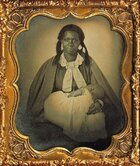
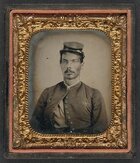
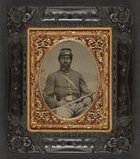
Contrabands

There are some accounts that accompany some of the photos. These aren't meant as the research Alan spoke of earlier, but some details about the slaves who made their way into refugee camps. From testimony by the Superintendent of Contrabands at Fortress Monroe, Virginia, before the American Freedmen's Inquiry Commission:

Yes–Thousands upon Thousands. I went to Suffolk a short time ago to enquire into the state of things there–for I found I could not get any foot hold to make things work there, through the Commanding General, and I went to the Provost Marshall and all hands–and the colored people actually sent a deputation to me one morning before I was up to know if we put black men in irons and sent them off to Cuba to be sold or set them at work and put balls on their legs and whipped them, just as in slavery; because that was the story up there, and they were frightened and didn't know what to do. When I got at the feelings of these people I found they were not afraid of the slaveholders. They said there was nobody on the plantations but women and they were not afraid of them One woman came through 200 miles in Men's clothes. The most valuable information we recieved in regard to the Merrimack and the operations of the rebels came from the colored people and they got no credit for it. I found hundreds who had left their wives and families behind. I asked them "Why did you come away and leave them there?" and I found they had heard these stories, and wanted to come and see how it was. "I am going back again after my wife" some of them have said "When I have earned a little money" What as far as that?" "Yes" and I have had them come to me to borrow money, or to get their pay, if they had earned a months wages, and to get passes. "I am going for my family" they say. "Are you not afraid to risk it?" "No I know the Way" Colored men will help colored men and they will work along the by paths and get through. In that way I have known quite a number who have gone up from time to time in the neighborhood of Richmond and several have brought back their families; some I have never heard from. As I was saying they do not feel afraid now. The white people have nearly all gone, the blood hounds are not there now to hunt them and they are not afraid, before they were afraid to stir. There are hundreds of negroes at Williamsburgh with their families working for nothing. They would not get pay here and they had rather stay where they are. "We are not afraid of being carried back" a great many have told us and "if we are, we can get away again" Now that they are getting their eyes open they are coming in. Fifty came this morning from Yorktown who followed Stoneman's Cavalry when they returned from their raid. The officers reported to their Quartermaster that they had so many horses and fifty or sixty negroes. "What did you bring them for" "Why they followed us and we could not stop them." I asked one of the men about it and he said they would leave their work in the field as soon as they found the Soldiers were Union men and follow them sometimes without hat or coat. They would take best horse they could get and every where they rode they would take fresh horses, leave the old ones and follow on and so they came in. I have questioned a great many of them and they do not feel much afraid; and there are a great many courageous fellows who have come from long distances in rebeldom. Some men who came here from North Carolina, knew all about the [Emancipation] Proclammation and they started on the belief in it; but they had heard these stories and they wanted to know how it was. Well, I gave them the evidence and I have no doubt their friends will hear of it. Within the last two or three months the rebel guards have been doubled on the line and the officers and privates of the 99th New York between Norfolk and Suffolk have caught hundreds of fugitives and got pay for them.

Capt. C. B. Wilder, 9 May 1863
http://www.freedmen.umd.edu/wilder.htm

 
There are some accounts that accompany some of the photos. These aren't meant as the research Alan spoke of earlier, but some details about the slaves who made their way into refugee camps. From testimony by the Superintendent of Contrabands at Fortress Monroe, Virginia, before the American Freedmen's Inquiry Commission:

Yes–Thousands upon Thousands. I went to Suffolk a short time ago to enquire into the state of things there–for I found I could not get any foot hold to make things work there, through the Commanding General, and I went to the Provost Marshall and all hands–and the colored people actually sent a deputation to me one morning before I was up to know if we put black men in irons and sent them off to Cuba to be sold or set them at work and put balls on their legs and whipped them, just as in slavery; because that was the story up there, and they were frightened and didn't know what to do. When I got at the feelings of these people I found they were not afraid of the slaveholders. They said there was nobody on the plantations but women and they were not afraid of them One woman came through 200 miles in Men's clothes. The most valuable information we recieved in regard to the Merrimack and the operations of the rebels came from the colored people and they got no credit for it. I found hundreds who had left their wives and families behind. I asked them "Why did you come away and leave them there?" and I found they had heard these stories, and wanted to come and see how it was. "I am going back again after my wife" some of them have said "When I have earned a little money" What as far as that?" "Yes" and I have had them come to me to borrow money, or to get their pay, if they had earned a months wages, and to get passes. "I am going for my family" they say. "Are you not afraid to risk it?" "No I know the Way" Colored men will help colored men and they will work along the by paths and get through. In that way I have known quite a number who have gone up from time to time in the neighborhood of Richmond and several have brought back their families; some I have never heard from. As I was saying they do not feel afraid now. The white people have nearly all gone, the blood hounds are not there now to hunt them and they are not afraid, before they were afraid to stir. There are hundreds of negroes at Williamsburgh with their families working for nothing. They would not get pay here and they had rather stay where they are. "We are not afraid of being carried back" a great many have told us and "if we are, we can get away again" Now that they are getting their eyes open they are coming in. Fifty came this morning from Yorktown who followed Stoneman's Cavalry when they returned from their raid. The officers reported to their Quartermaster that they had so many horses and fifty or sixty negroes. "What did you bring them for" "Why they followed us and we could not stop them." I asked one of the men about it and he said they would leave their work in the field as soon as they found the Soldiers were Union men and follow them sometimes without hat or coat. They would take best horse they could get and every where they rode they would take fresh horses, leave the old ones and follow on and so they came in. I have questioned a great many of them and they do not feel much afraid; and there are a great many courageous fellows who have come from long distances in rebeldom. Some men who came here from North Carolina, knew all about the [Emancipation] Proclammation and they started on the belief in it; but they had heard these stories and they wanted to know how it was. Well, I gave them the evidence and I have no doubt their friends will hear of it. Within the last two or three months the rebel guards have been doubled on the line and the officers and privates of the 99th New York between Norfolk and Suffolk have caught hundreds of fugitives and got pay for them.

Capt. C. B. Wilder, 9 May 1863
http://www.freedmen.umd.edu/wilder.htm

These are very good details. I'm glad you're doing this thread. I wish more people had bothered to record these individual stories -- with names!
 
One disappointment of the scholarship coming out of the sesquicentennial is the relative lack of work about contrabands/Civil War runaways. By now, there is a good sized body of work about colored soldiers, for example. No longer can we say that black military men are a forgotten part of the Civil War.

But the African descent souther soldier was a subset of the larger group of people who escaped bondage. Many of the stories of contrabands are about women and children living in privation. Their lack of literacy, and perhaps early demise, have resulted in a much smaller record than for black men in the army.

More needs to be told about their stories. In time, perhaps we will see more.

-Alan

While this isn't the serious academic work that you're probably talking about, I did find this website which is about contraband camps and gives information on the camps by state:

http://lastroadtofreedom.com/index.php
 
Great thread. These photos and posts do put a face on the term "contraband." One can only imagine how those folks felt and what fears they had given that their future was more than a gamble. And to be termed "contraband" is pretty much the same as being called property; illegal property. As much as I read I'm always still struck by the reality of the times.
 
Freedmans1-1aca7763-bell.jpg

Harpers_large.jpg

Freedman's Village, Arlington, VA

 
The site Civil War in Helena (Arkansas) has a lot of information about the history of contrabands in Arkansas.

http://civilwarhelena.com/history/helena-an-island-of-freedom-in-confederate-arkansas/

On July 12, 1862, the vanguard of the Union army reached Helena. For two days, the long line—12,000 Union soldiers and more than 2,000 freedom seekers—filed into the city. As word spread that the Union army was there and that refugee slaves were not being turned away, more refugees came into Helena. George E. Flanders, 5th Kansas Cavalry wrote, "The Negroes are flocking to the army from every direction, there are about fifty, big and little in our company. They appear to enjoy themselves, but what is to be done with them, when the army moves again, is more than I can say." What Flanders did not know was that the Union army would not be leaving.

.......A number of the old and less physically able men found work as personal servants. A man named Curtis worked for Dr. Charles Brackett, a surgeon in the 9th Illinois Cavalry, who wrote his wife,The old negro Curtis is putting things 'to rights' in the tent, sweeping in front with a few twigs tied together with string and with this he makes things look neat."
 
Last edited:
]Expired Image Removed

Contraband Camp, Harper's Ferry, WV

By March of 1862 Federal forces established a "contraband" camp (the refugees were officially known as contraband) at Harpers Ferry to accommodate them. That same month one area resident, David Hunter Strother, remarked that "Hitherto the Negroes who had gone went light-handed and as fugitives; now the exodus has commenced in open day, laden with the spoils of the Egyptians. The sensation created is profound."http://www.hallowedground.org/African-American-Heritage/Harpers-Ferry
 
Last edited:
Butler takes a lot of hits- his name comes up, instantly one has to field the silliness attached to white women who had plenty to eat and somewhere to live, merely living down some inane outrage, being called on to stop throwing excrement at soldiers. Butler's legacy has to be ' Contraband'. Not a super way to go through life, having this attached to you but it sure cut the strings of ' ownership' for enslaved people, as they struggled to free themselves.

Super, super thread, 18th, thank you. Am only just catching up with it. Terribly hard to read- but it's not as if one can gloss over this stuff, do not Pass Go, go admire plantations and fiery steeds and famous last words in battle without tripping over the genuine Cause.

It's tough, too- reading so, so, SO many obstacles placed in the path of these unbelievably brave people. They came anyway. Who would not be terrified, all of a sudden living in a world for which most had no preparation? Trained in maybe one thing or nothing, criticized for knowing less. Had to stop reading Keckley's book when she began witching about them, poking fun at their speech patterns, believing there was somewhere to be issued one dress or suit of a clothing a year. She took this to mean they wished charity, instead of this primitive belief system that they were being somehow transferred from one white person to another. It was awful- and one dress? As a formerly enslaved woman, once a rape victim, worked her way to freedom through an unfair amount of hardship, pretty harsh.

Yes, it is to be hoped more backgrounds become available on our Civil War soldiers- black troops literally lined up to serve, eager to serve a country which had so far let their race down. Amazing.
 
The Union Army certainly benefitted from all this additional labor. Every pair of hands performing some logistic service freed another pair to carry a rifled musket. There has been much discussion of Africans in Confederate service in similar roles. We have good numbers on Africans sworn into military service, some 200,000. It would be interesting to study the advantage the Union had with the greater number of contrabands working behind the lines.
 
Thank you for posting these! The ones with the wagons especially make what I've been reading lately (period accounts of missing slaves as the federal army nears) really become real, as slaves take a chance and head toward the lines of the federals.

One thing I'm curious about is: I wonder where the wagons and teams typically came from, such as in the "Arrival of Negro Family in the Lines" just above, or "Fugitive Slaves Crossing the Rappahannock..."

Were they also taken from the owners? What a bold move, to pile everything you had (and more) onto your master's wagon, hitch up a team and drive off into uncertainty, taking not only yourself but probably hundreds of dollars of other things too. Not something a master would be happy to find when he discovered, and yet such a slim barrier against starvation. Would you keep the wagon, stay close and camp by it for a while, or use it to travel as far as possible to some known or unknown location, or sell it, use the money to survive and try to find work as soon as possible? What a challenge.

Had to be a bewildering and frightening experience, with the added uncertainty that they would be well received in the communities they escaped to. If the scornful reception that free black men and women received in Harrisburg after fleeing the Confederates at Gettysburg is any indication, life for escaping slaves must have been constant anxiety and dread, not only for fear of being captured and reenslaved.
 
Last edited:
_58772391_1.gif

Hilton Head

Expired Image Removed

Former Slaves at Hilton Head


fish-hall-plantation.jpg

Fish Hall Plantation, Hilton Head, SC

Negro slaves came flocking into our camp by the hundreds, escaping their masters when they knew of the landing of "Linkum sojers" (sic), as they called us - many of them with no other clothing than gunnysacks (Trinkley 1986)
. Union soldier on Hilton Head
 
Last edited:
The Union Army certainly benefitted from all this additional labor. Every pair of hands performing some logistic service freed another pair to carry a rifled musket. There has been much discussion of Africans in Confederate service in similar roles. We have good numbers on Africans sworn into military service, some 200,000. It would be interesting to study the advantage the Union had with the greater number of contrabands working behind the lines.

You're suggesting that Ben Butler may not have been the worst possible general, that he may have actually effected a change that led to winning the war? :wink:

By war's end, approximately half a million formerly enslaved people and other African American freedmen had sought protection behind Union lines. These "contraband," as they became known, usually lived in camps hastily erected almost anywhere the army was stationed. The large number of runaways who flocked to Union lines belies the outdated and racist notion that enslaved African Americans simply waited for emancipation by singing hymns and strumming banjos; rather, they seized almost every chance to pursue their freedom, often risking death, and in so doing, helped make slavery a central issue of the Civil War. http://www.preservationnation.org/magazine/2011/may-june/the-forgotten.html
 
Last edited:
Letter of a Federal officer, after returning from Sherman's raid in Feb., 1864.

"Do you suppose that it was without a thought of the hated race of " Abolitionists" that I, a slaveholder, when the war began, found and freed a negro one day during our 'raid' through Miss.? He was handcuffed and tied to a tree on the bank of Chunkalo Creek, where his master had left him: when our cavalry came up he was trying to 'run him off to Georgy.'

"I went with him a mile or so to find a key to unlock his handcuffs, and brought them in as a relic for a very-kind friend of mine, Mrs. Ex-governor Harvey, of Wisconsin, who is staying here devoting her time and money to alleviating the hardships of the soldiers. God bless her!

"Next, I found myself put in charge of seven thousand refugee negroes! with two hundred and fifty teams, of every description under the sun, and found it devolve on me to get these "grown-up children" from their camps in the morning into column, on the road, and then in the evening to get them into camp again, for five long days : until at last I thought them safely within sight of the frowning battlements of Vicksburg, and turned them over to Colonel Thomas, chief of contrabands in these parts. I never worked so hard in all my life, as I did those five days, and never expect to again.

"I don't say it was exactly a 'labor of love;' but I found that I could understand and handle them better than more Northern-bred men; and so I conceived it my duty to tell the colonel so, and he immediately set me at it. I could fill sheets with an account of those five days, but am filling too many already, and must postpone rendering an account of my command until some other time.

"But I have been 'superseded:' indeed I was on the day I reached Vicksburg, by one of the best and noblest women I ever knew, Mrs. Ex-governor Harvey, of Wisconsin. She has spent time and fortune, freely, for the last two years or more, in behalf of soldiers; and incidentally of refugees, either black or white.

"Will. M. McLain, 32d Ohio Vol. Inf."
 
Butler takes a lot of hits- his name comes up, instantly one has to field the silliness attached to white women who had plenty to eat and somewhere to live, merely living down some inane outrage, being called on to stop throwing excrement at soldiers. Butler's legacy has to be ' Contraband'. Not a super way to go through life, having this attached to you but it sure cut the strings of ' ownership' for enslaved people, as they struggled to free themselves.

Super, super thread, 18th, thank you. Am only just catching up with it. Terribly hard to read- but it's not as if one can gloss over this stuff, do not Pass Go, go admire plantations and fiery steeds and famous last words in battle without tripping over the genuine Cause.

It's tough, too- reading so, so, SO many obstacles placed in the path of these unbelievably brave people. They came anyway. Who would not be terrified, all of a sudden living in a world for which most had no preparation? Trained in maybe one thing or nothing, criticized for knowing less. Had to stop reading Keckley's book when she began witching about them, poking fun at their speech patterns, believing there was somewhere to be issued one dress or suit of a clothing a year. She took this to mean they wished charity, instead of this primitive belief system that they were being somehow transferred from one white person to another. It was awful- and one dress? As a formerly enslaved woman, once a rape victim, worked her way to freedom through an unfair amount of hardship, pretty harsh.

Yes, it is to be hoped more backgrounds become available on our Civil War soldiers- black troops literally lined up to serve, eager to serve a country which had so far let their race down. Amazing.

"The most marginal people in American life, with no standing in civil or political society, end up being these consequential political activists who understand the war's events in much different ways than the educated policymakers," says Steven Hahn, a professor of history at the University of Pennsylvania, and Pulitzer Prize-winning author of A Nation Under Our Feet.


http://www.preservationnation.org/magazine/2011/may-june/the-forgotten.html
 

Learn About Us
About CivilWarTalk
Contact the Webmaster
Meet the Staff
Link to CivilWarTalk
Join Our Community
Register
Browse Forums
View Today's Discussions
Search the Forum
Get Help
FAQ
Student Guide
Forum Rules & Etiquette
Copyright / DMCA

     Contact Us CivilwarTalk on Facebook CivilWarTalk on YouTube CivilWarTalk on Twitter RSS Feed

Bringing the American Civil War and More to Life.
© 1999 - , CIVILWARTALK, LLC - Site Version 10.0

SlaveryTalk.com - SecessionTalk.com - CivilWarTalk.com - ReconstructionTalk.com
Back
Top