Too many Canadians.

major bill

Brev. Brig. Gen'l
Forum Host
Joined
Aug 25, 2012
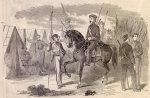
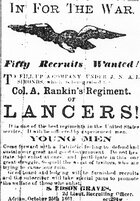
This regiment of lancers were formed in Michigan in 1861. It was said to contain a large number of Canadians. One whole company were Scotsmen. The forming of a regiment by a Canadian colonel and the large number of Canadian officers, were points of contention and the regiment was disbanded. Many of the men were recruited into the 16th Michigan Infantry.
 

Attachments

  • rankins-lancer-regiment.jpg
    rankins-lancer-regiment.jpg
    157.7 KB · Views: 302
  • Lancer 2.JPG
    Lancer 2.JPG
    251.3 KB · Views: 265
This is hugely interesting- one, more thing, gosh, wish so much there were more hours in the day to pursue. WHY were the Canadians so commited to the Union they'd go get shot at when they did not have to? Why so many Scots? Were Canadians also split, with some ' going South ' ?

Our family's Scots Canadian grgrgrandfather simply disappears for these years- poof- we can't find him, and for a couple of years after the war, I think 1867 reappears in a Canadian port report, sea captain. He married terribly late- we just, plain do not know what on earth was occupying him and his teeny ship- did he also become involved in some way? He's SO easy to find otherwise, those years, nothing.

Maybe Pat Young will have something on Canadians and the war.... :). :help:
 
Maybe Pat Young will have something on Canadians and the war.... :smile:. :help:

In 1860, Canada was the fourth largest place of birth for U.S. immigrants, after Ireland, Germany, and England. The 250,000 Canadian immigrants counted in the 1860 Census were more than double the number of immigrants from Scotland (109,000) and three times the number from all of Scandinavia (73,000).

Canadians are the "forgotten immigrants" of American history for reasons I'll address later.
 
One reason the Canadians are "forgotten" is that they identified with a nationality other than Canadian. For example, Edward Paul Doherty, who led the detachment that found and killed John Wilkes Booth was born in Canada in 1840, immigrated to the U.S. in 1860 and joined Corcoran's Irish Legion before moving to the cavalry in 1863. Corcoran's Legion was a highly Irish nationalist unit.
 
THOSE DANG CANUCKS!!!!

soon we'll be overrun with them......


Very interesting article thanks for sharing.
 
Last edited by a moderator:
I've got one set of gg grandparents who were German by birth but lived in Nova Scotia before coming to the US. The grandpa served the CSA but was in Florida so didn't really do much.

I don't see why a Canadian would have joined our shootout either. It would have been quite awkward had England got into it with the US, say if the Trent thing went really sour or some such.

And for the record, Canadians are OK by me. Generally a friendly and polite bunch. I'll be going there in September to help them with their economy.
 
I've got one set of gg grandparents who were German by birth but lived in Nova Scotia before coming to the US. The grandpa served the CSA but was in Florida so didn't really do much.

I don't see why a Canadian would have joined our shootout either. It would have been quite awkward had England got into it with the US, say if the Trent thing went really sour or some such.

And for the record, Canadians are OK by me. Generally a friendly and polite bunch. I'll be going there in September to help them with their economy.

I could see why Canadians might want to join (either side) in the civil war, for many reasons that other immigrants did.

They wanted to be Americans, and they though that service in the army might grant them citizenship or acceptance.

It was also a source of income too.....
 
This regiment of lancers were formed in Michigan in 1861. It was said to contain a large number of Canadians. One whole company were Scotsmen. The forming of a regiment by a Canadian colonel and the large number of Canadian officers, were points of contention and the regiment was disbanded. Many of the men were recruited into the 16th Michigan Infantry.
Just a question. Were these men Canadian immigrants or were they recruited in Canada specifically to serve as soldiers?
 
Have an "arm" of my mother's family who settled in and still live in Ontario, relatively near the Western New York homeplace of the rest of the family. Neither group knew of the other until fairly recently.

As to why fight--interaction between the peoples of what became Canada and the US along border areas and due to joint economic endeavors in particular was common. Friendships, culture and commerce were thus common ties. Opposition to slavery is also mentioned as a common thread. (As an example--if you go over to Ft. Erie, ON today and drive along the Niagara River, there are several markers denoting where "riders" on the Underground Railroad landed after completing their US journey primarily in the Black Rock section of Buffalo, NY). My point here is not to analyze the reasons given, merely to point out some which may have led an estimated 30 to 50,000 Canadians to serve, primarily but not exclusively, among Federal forces.
 
I can see how there would have been cross-border ties that might cause a Canadian to join one side or the other; just never thought it was as many as I now see it was. It still seems like a large number to me but since it happened I can only think I'll need to look a little more into it to really understand the whys.

Learned another thing or two here today.
 
Just a question. Were these men Canadian immigrants or were they recruited in Canada specifically to serve as soldiers?
Interesting question. With the ease with which Canadians could come to the Northern border states, I would be certain that some traveled into the states to specifically enlist/volunteer. Several studies have been published, collectively indicating that many of these men already lived in the United States, and were thus immigrants. In addition, volunteers were signed up in Canada by Union recruiters. At the end of the war, Canada refused to return the approximately 15,000 American deserters and draft dodgers who fled there during the war.
 
Several studies have been published, collectively indicating that many of these men already lived in the United States, and were thus immigrants. In addition, volunteers were signed up in Canada by Union recruiters. At the end of the war, Canada refused to return the approximately 15,000 American deserters and draft dodgers who fled there during the war.

Although they were the fourth largest immigrant group, many of them identified with their ancestral communities. Irish-ancestored Canadians who moved to the U.S typically lived in Irish neighborhoods, not Canadian neighborhoods. The main exception would be French Canadians who typically moved to French Canadian settlements in the U.S., particularly in northern New England.
 
Raised in Buffalo, we had a ton of families, including most of my mother's maternal line, that came from Ontario. (Two lines of that side fought as Loyalists in the American Revolution, then went to Canada right around the time the U.S. Constitution was being written and passing. The other is still in Ontario). Because they were of the United Church of Canada, when they came to Buffalo, the closest church there would have been the Presbyterian, they lived in immediate areas of those Churches. Most of the Catholic-Canadian families that I remember were farmers, notably in Niagara and Orleans counties.
 
Just a question. Were these men Canadian immigrants or were they recruited in Canada specifically to serve as soldiers?

The following link connects to a biography of Colonel Arthur Rankin. It explains much!
http://www.biographi.ca/en/bio/rankin_arthur_12E.html

One additional note. As mentioned in some of the linked blogs and articles, many "Canadians" had U.S.A. roots pre-Revolutionary War, or as immigrants from the U.S. to British North America in the intervening years (1800-1860), so there was a long standing social and political connection. However, many of the young men that went to serve in the Civil War willingly (see "Crimping" in google), went for the "adventure". The winters are long and the work on the farm, in the mine, or lumberjacking, is hard, so many just went for "the fun of it". There are many, many, examples of these young men writing home to see if their family could somehow get them OUT of the army. It wasn't what they thought it was going to be!
 
Arthur Rankin is an interesting side subject of the Civil War. His lancer regiment is widely reported about in period Michigan newspapers.

"We have seen the undress uniform of the Lancers. It consists of dark blue pants with an inch and a half gold stripe on either side; a green, tight fitting jacket with three rows of ornamental buttons running from either shoulder and the chin to a point at the waist; the cap is blue, and is surrounded with an inch and a half gold band. The full dress has not been decided upon. The uniform above described will be far the most showy of any yet."

An article on the Detroit Daily Advertiser on January 13 1962 indicates the lancers are now receiving uniforms, but does not give the color or style. It is possible that the green uniforms described above were the uniforms Coronal Rankin was planning to order from New York, but he subsequently changed his mind, and instead ordered the regiment's uniforms from Samuel Sykes an Company of Detroit. Sykes was to provide two hundred and fifty suits to the 1st Lancers by mid December of 1861. 100 of these uniforms were delivered on December 24.
The Detroit Free Press of March 22 1862 printed a letter from a recently discharged lancer, which details what he had been issued. He had received an overcoat, 1 jacket, 1 pair of shoddy pants, 1 cloth cap, one blanket, 1 pair of boots, 2 cotton shirts, 2 pairs of cotton drawers, and 2 pairs of socks.

The Detroit Daily Advertiser indicates they were to be armed like the 16th Regiment of British Lancers however; originally, they were issued 7 state owned smooth-bore muskets and 12 state owned musketoons. They eventually were armed with lances, carbines, dragoon revolvers and sabers.

Samuel Shaw of Detroit made both the lances and swords. In other source, Samuel Shaw is referred to as W. H Shaw. The lances provided by Shaw were nine feet, seven inches long with eleven inches of that being a double bladed lance head, which was one and a half inches wide at the widest point. The pennons were red and white. When the First United States Lancers were disbanded, the state collected the lances and stored then for further use.

"The Lancers", Detroit Daily Advertiser October 3 1861, p. 1, col. 2.
 

Learn About Us
About CivilWarTalk
Contact the Webmaster
Meet the Staff
Link to CivilWarTalk
Join Our Community
Register
Browse Forums
View Today's Discussions
Search the Forum
Get Help
FAQ
Student Guide
Forum Rules & Etiquette
Copyright / DMCA

     Contact Us CivilwarTalk on Facebook CivilWarTalk on YouTube CivilWarTalk on Twitter RSS Feed

Bringing the American Civil War and More to Life.
© 1999 - , CIVILWARTALK, LLC - Site Version 10.0

SlaveryTalk.com - SecessionTalk.com - CivilWarTalk.com - ReconstructionTalk.com
Back
Top