
I think so. Either that or it could be some kind of flat cap with the top pushed up. There's a really intriguing variety of civilian and military garb all mixed together in these photos.kneeling, white shirt w/vest...is that a wheel hat he's wearing?
-
Welcome to CivilWarTalk, a forum about the American Civil War! - Join today! It's fast, simple, and FREE!
- Home
- Forums
- The War of the Rebellion Forums
- Battles & Events of 1861 to 1865
- Men in Ranks - Battlefield Tactics
You are using an out of date browser. It may not display this or other websites correctly.
You should upgrade or use an alternative browser.
You should upgrade or use an alternative browser.
Support Services - Teamster
- Thread starter Tom Elmore
- Start date

John Winn
Lt. Colonel
- Joined
- Mar 13, 2014
- Location
- State of Jefferson
I saw this at Appomattox and was told it was a Confederate Battle Wagon, any thoughts? Hadn't seen one before.
That's a battery wagon. It carried a variety of tools and equipment that were needed to keep the battery functioning (e.g. spare harnesses, picks and shovels, axes). The chest of the attached limber carried carriage maker's and saddler's tools. According to Coggins in Arms and Equipment of the Civil War one would have weighed about 1289 pounds.

16thVA
First Sergeant
- Joined
- Dec 8, 2008
- Location
- Philadelphia
I've been going through this file of compiled records of prisoner deaths
https://archive.org/stream/selectedrecordso0005unit#page/n35/mode/1up
and on page 60 found
Boyer, Jas. R., citizen, Randolph Co. [W.] Va., captured Gettysburg, July 4, 1863, died on Sept. 13 of acute diarrhea, and buried at Fort Delaware.
I assume he was a teamster or in some support capacity for the ANV.
https://archive.org/stream/selectedrecordso0005unit#page/n35/mode/1up
and on page 60 found
Boyer, Jas. R., citizen, Randolph Co. [W.] Va., captured Gettysburg, July 4, 1863, died on Sept. 13 of acute diarrhea, and buried at Fort Delaware.
I assume he was a teamster or in some support capacity for the ANV.

- Joined
- Jan 12, 2014
- Location
- Baltimore, Maryland
Thanks JohnThat's a battery wagon. It carried a variety of tools and equipment that were needed to keep the battery functioning (e.g. spare harnesses, picks and shovels, axes). The chest of the attached limber carried carriage maker's and saddler's tools. According to Coggins in Arms and Equipment of the Civil War one would have weighed about 1289 pounds.

East Tennessee Roots
Major
- Joined
- Dec 31, 2010
- Location
- Kingsport, Tennessee
A teamster (or wagoner) drove a wagon team of horses or mules. An army on the march, like the Army of Northern Virginia in the summer of 1863, required more than 2,000 teamsters to drive wagons carrying food for men and animals, baggage and other supplies, ammunition, and to transport the sick and wounded. The load capacity varied according to the number of animals in the team (two, four or six), and the condition of the roads. A heavy ordnance wagon with six animals could carry in excess of 2,500 pounds, although an average load might be around 1,500 pounds - the equivalent of 15 boxes containing 15,000 small-arm cartridges for infantry. Empty ordnance wagons could carry weapons gathered up from the battlefield, and additional wounded soldiers. It appears that each regiment had one dedicated ordnance wagon, and there was a separate ordnance train for reserve artillery ammunition. In approaching a battlefield, only ordnance and ambulance trains were allowed to go forward; the rest were held back in large wagon parks, or sent to the rear areas to scour the countryside for forage and supplies of use to the army.
An infantry regiment of 300 men might have three wagons dedicated to carrying food and fodder (under the commissary staff), and another two wagons to carry a change of clothing, knapsacks, etc. for the men, along with the officers' baggage, and cooking utensils (often supplemented by a brigade wagon). Additional wagons would be required at the brigade, division, corps and army levels to meet the food and baggage needs of those staffs. Bear in mind that an individual's daily food ration weighed around two pounds, and at the beginning of a campaign the wagons were loaded with 7-10 days of surplus food (not counting the usual three days' rations carried by the soldiers on their backs).
A teamster might also drive one of the many ambulances in the army, which traveled together and were under the supervision of medical officers on the battlefield (on the march all wagons were controlled by quartermasters). Each regiment could have up to two ambulances (two- or four-animal teams), and at the brigade level and above a wagon carrying medical supplies was typically available. The Confederates, as always, relied heavily upon captured Federal wagons to augment their transportation needs.
Throughout the war, both sides continually downsized the size of their wagon trains to the bare minimum, because a train of several hundred wagons would stretch for many miles, requiring protection and impacting troop movements. While teamsters generally were distant from combat operations, some notable exceptions occurred. Several hundred Confederate teamsters were collected together and armed to successfully defend their train against a Federal cavalry attack during Lee's retreat from Gettysburg, which begs the question about the role enslaved Blacks played. Gen. Early claims they were not allowed to serve as teamsters, but some accounts suggest they did so, at least unofficially, under supervision. A few "wagon masters" were also on hand, whose duty description I defer to other readers to explain. I have not focused here on the cavalry, or the artillery arm, the latter of which required drivers for caissons, limbers, travelling forces, and additional wagons for provisions/baggage, but one can readily discern that the number of teamsters alone constituted roughly three percent of the overall manpower needs of an army on the march.
The difference in the terms may also have been with the two armies, or maybe branches of service ? (Infantry vs. Cavalry)
Union Wagoner Private William A. Blakely Company A 1st Tennessee Cavalry
Confederate Regimental Teamster Private John N. Chase Company G 19th Tennessee Infantry

damYankee
Captain
- Joined
- Aug 12, 2011
The difference in the terms may also have been with the two armies, or maybe branches of service ? (Infantry vs. Cavalry)
Union Wagoner Private William A. Blakely Company A 1st Tennessee Cavalry
Confederate Regimental Teamster Private John N. Chase Company G 19th Tennessee Infantry
View attachment 65485
View attachment 65487
Wow! How cool is that?
My g. g. grandfather George W. Davis was a blacksmith before the war, he also built coaches and wagons, living in Iowa there was demand for his trade, at age 32 ( I think) he joined the 4 Iowa Cav. as a teamster and was quickly promoted to farrier.
He was wounded 3 times, so just remember these were not "safe" jobs.
East Tennessee Roots
Major
- Joined
- Dec 31, 2010
- Location
- Kingsport, Tennessee
Wow! How cool is that?
My g. g. grandfather George W. Davis was a blacksmith before the war, he also built coaches and wagons, living in Iowa there was demand for his trade, at age 32 ( I think) he joined the 4 Iowa Cav. as a teamster and was quickly promoted to farrier.
He was wounded 3 times, so just remember these were not "safe" jobs.
The Union Soldier, Private Blakely, in his pension application, gives "mashed by a wagon" along with his numerous physical ailments among his reasons for applying.

- Joined
- Jul 12, 2007
- Location
- Aledo, IL
One "driver" I know (John King) for Bankhead's/Scott's Battery enlisted in the Battery as a Private, and was later discharged for being over the age of conscription. He then joined as a driver for the battery , with no military rank or status....

MattL
Guest
- Joined
- Aug 20, 2015
- Location
- SF Bay Area
Very informative thread. I had been wondering about this when I possibly found an ancestors Georgia confederate records and it mentioned he was an ambulance driver. I have a couple questions if someone happens to know the answers.
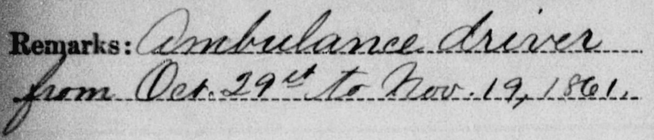
My ancestor enlisted as a private and his final rank was a sergeant. Was that common for an ambulance driver to rise in rank like that? Would he have likely only served as a wagon driver or possibly in other rolls and then just an ambulance driver at times. I am posting some of the roll comments that hopefully someone else can help give insight into those questions.
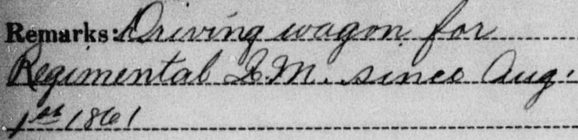
Roll01: Looks like it says he was driving wagon for "Regimental L.M." Does anyone know what that means? (I might have gotten the L wrong)
Roll02: Says "Driving Ambulance"
Roll03: Says "Ambulance Teamster 20 days in Month Dec. 1861"... Does that mean he only was an ambulance driver for 20 days, would he be driving other wagons besides that? Any reason they would not that in particular.
Roll04: Another ambulance driver range
Roll05: Can't really read or understand this if someone else can. his name was William C Thomas (W. C. Thomas) so that part I got, he was in the 11th regiment and I see "11 Ga", other than those two things I'm lost.
Any additional information, interpretation, understanding etc would be greatly appreciated
My ancestor enlisted as a private and his final rank was a sergeant. Was that common for an ambulance driver to rise in rank like that? Would he have likely only served as a wagon driver or possibly in other rolls and then just an ambulance driver at times. I am posting some of the roll comments that hopefully someone else can help give insight into those questions.
Roll01: Looks like it says he was driving wagon for "Regimental L.M." Does anyone know what that means? (I might have gotten the L wrong)
Roll02: Says "Driving Ambulance"
Roll03: Says "Ambulance Teamster 20 days in Month Dec. 1861"... Does that mean he only was an ambulance driver for 20 days, would he be driving other wagons besides that? Any reason they would not that in particular.
Roll04: Another ambulance driver range
Roll05: Can't really read or understand this if someone else can. his name was William C Thomas (W. C. Thomas) so that part I got, he was in the 11th regiment and I see "11 Ga", other than those two things I'm lost.
Any additional information, interpretation, understanding etc would be greatly appreciated
Attachments




- Joined
- Mar 18, 2015
- Location
- Kent, Ohio
5 says that he "received payment of (i.e. 'from') Lt J M Jackson AQM (Acting Quarter Master) 11 Ga. W C Thomas"
Not clear which of 'em was the AQM but probably Lt Jackson
Your ancestor's name was William C Thomas? I don't know why his name would be at the bottom of a roll. Pity you didn't include the full roll image. I can't find a William Thomas in the 11 GA on fold3
Yes, he probably wasn't driving anything on those other days. The company/regimental rolls are supposed to note that a person is present. If they are not present for part of the month, then they record where that person was/what doing. Often that was a detached duty (other than drilling, fighting etc); such as driving, building entrenchments, awol, sick, etc. Some were designated as wagoners, some as backsmiths, but those were not ranks but tasks. AFAIK.
Not clear which of 'em was the AQM but probably Lt Jackson
Your ancestor's name was William C Thomas? I don't know why his name would be at the bottom of a roll. Pity you didn't include the full roll image. I can't find a William Thomas in the 11 GA on fold3
Yes, he probably wasn't driving anything on those other days. The company/regimental rolls are supposed to note that a person is present. If they are not present for part of the month, then they record where that person was/what doing. Often that was a detached duty (other than drilling, fighting etc); such as driving, building entrenchments, awol, sick, etc. Some were designated as wagoners, some as backsmiths, but those were not ranks but tasks. AFAIK.
Last edited:
East Tennessee Roots
Major
- Joined
- Dec 31, 2010
- Location
- Kingsport, Tennessee
Very informative thread. I had been wondering about this when I possibly found an ancestors Georgia confederate records and it mentioned he was an ambulance driver. I have a couple questions if someone happens to know the answers.
My ancestor enlisted as a private and his final rank was a sergeant. Was that common for an ambulance driver to rise in rank like that? Would he have likely only served as a wagon driver or possibly in other rolls and then just an ambulance driver at times. I am posting some of the roll comments that hopefully someone else can help give insight into those questions.
Roll01: Looks like it says he was driving wagon for "Regimental L.M." Does anyone know what that means? (I might have gotten the L wrong)
Roll02: Says "Driving Ambulance"
Roll03: Says "Ambulance Teamster 20 days in Month Dec. 1861"... Does that mean he only was an ambulance driver for 20 days, would he be driving other wagons besides that? Any reason they would not that in particular.
Roll04: Another ambulance driver range
Roll05: Can't really read or understand this if someone else can. his name was William C Thomas (W. C. Thomas) so that part I got, he was in the 11th regiment and I see "11 Ga", other than those two things I'm lost.
Any additional information, interpretation, understanding etc would be greatly appreciated
I believe what you're reading as a "L" is actually a "Q." He was driving for the "Regimental Quartermaster."
Here's another teamster in the 11th Georgia. Possible distant relative of mine :
http://civilwartalk.com/threads/lots-of-soldiers-from-georgia-in-the-anv.88236/#post-698831
MattL
Guest
- Joined
- Aug 20, 2015
- Location
- SF Bay Area
I believe what you're reading as a "L" is actually a "Q." He was driving for the "Regimental Quartermaster."
Here's another teamster in the 11th Georgia. Possible distant relative of mine :
http://civilwartalk.com/threads/lots-of-soldiers-from-georgia-in-the-anv.88236/#post-698831
That makes sense, thanks. Very interesting, thanks for sharing. I see he was from Gilmer County, Georgia. Coincidentally my ancestor William C Thomas was living in Dawson, County Georgia in 1860 in an area that was formed from Gilmer shortly before (he was married in Gilmer County)... I also have other ancestors that lived in Gilmer County.
Looks like they were in different companies though (mine wasn't in the Gilmer county regiment).
MattL
Guest
- Joined
- Aug 20, 2015
- Location
- SF Bay Area
5 says that he "received payment of (i.e. 'from') Lt J M Jackson AQM (Acting Quarter Master) 11 Ga. W C Thomas"
Not clear which of 'em was the AQM but probably Lt Jackson
Your ancestor's name was William C Thomas? I don't know why his name would be at the bottom of a roll. Pity you didn't include the full roll image. I can't find a William Thomas in the 11 GA on fold3
Yes, he probably wasn't driving anything on those other days. The company/regimental rolls are supposed to note that a person is present. If they are not present for part of the month, then they record where that person was/what doing. Often that was a detached duty (other than drilling, fighting etc); such as driving, building entrenchments, awol, sick, etc. Some were designated as wagoners, some as backsmiths, but those were not ranks but tasks. AFAIK.
Here is the fold3 link for him:
http://www.fold3.com/image/20/78629409/
I'm not 100% that was my ancestor, but so far that's the best record fit for him.
- Joined
- Mar 18, 2015
- Location
- Kent, Ohio
Thanks for the link. It proves something about fold3 that I've come to expect. Sometimes a name just doesn't want to come up unless you hit the magic buttons! I tried William C Thomas; W C Thomas; William Thomas; just Thomas (!); and all the above with and without 11 Georgia; just Georgia and no state at all. It encourages me that some of my other failures might just need another try doing SOMETHING different!
MattL
Guest
- Joined
- Aug 20, 2015
- Location
- SF Bay Area
Thanks for the link. It proves something about fold3 that I've come to expect. Sometimes a name just doesn't want to come up unless you hit the magic buttons! I tried William C Thomas; W C Thomas; William Thomas; just Thomas (!); and all the above with and without 11 Georgia; just Georgia and no state at all. It encourages me that some of my other failures might just need another try doing SOMETHING different!
I've had the exact same issue and I don't quite get it, especially since his name is logged correctly. I've found two ways to work around that:
1) I search for the name in "Keyword", this seems to search more of the text for the name and adds more noise but also finds other results that are logged incorrectly (such as under Misc categories)
2) I go to a result like the one linked and just manually browse through the category entries. Can select Georgia, then 11th, then surnames that start with "T" etc. Takes more time but seems to catch things search never brings up.

Pvt.Shattuck
Sergeant Major
- Joined
- Oct 8, 2011
- Location
- St Augustine, FL
If we could suddenly be transported back to those days, I think we would be astounded by the incredibly huge numbers of horses and mules, the piles of manure everywhere, the dirt and dust, the swarms of flies, the stench of sweaty beasts and unbathed men, the vermin, and the crude, filthy, and primitive conditions in general. I also suspect many of those animals were horribly mistreated by modern standards, used and abused until they were used up and finally died in the traces. There were probably dead horses and mules rotting all along the road where the Army had traveled.

Private Watkins
2nd Lieutenant
- Joined
- Apr 12, 2014
- Location
- Oklahoma
This photo was labeled as being that of a teamster or farrier, not sure how one could know for sure, but he does look like some type of support serviceman...

Whatever he did, he looks like he had been working hard...
Whatever he did, he looks like he had been working hard...
Private Watkins
2nd Lieutenant
- Joined
- Apr 12, 2014
- Location
- Oklahoma
So a couple of questions about the above guy in the photo...
- do you think he's military or civilian?
- do you see any clues that might help indicate what he did or what his job was?
- and relative to farriers, would that have been a separately designated job, or just something combined with a teamster or blacksmith job/role...?
- do you think he's military or civilian?
- do you see any clues that might help indicate what he did or what his job was?
- and relative to farriers, would that have been a separately designated job, or just something combined with a teamster or blacksmith job/role...?
East Tennessee Roots
Major
- Joined
- Dec 31, 2010
- Location
- Kingsport, Tennessee
This photo was labeled as being that of a teamster or farrier, not sure how one could know for sure, but he does look like some type of support serviceman...
View attachment 77329
Whatever he did, he looks like he had been working hard...
Blacksmiths & Saddler Company I Union 8th Tennessee Cavalry :
https://books.google.com/books?id=T...ee&source=bl&ots=WLqcoBHgXv&sig=nT71L-eAQxNZs

Poor Sharecropper's Son
Corporal
- Joined
- Jun 29, 2015
- Location
- Caldwell, NJ
My Great Grandfather was a wheelwright for the 7th SC Infantry, so I'm sure he was in the mix with a lot of the stuff described here. Thanks for all the info 
Similar threads

- Replies
- 5
- Views
- 340
- Replies
- 0
- Views
- 114

Similar threads
- Replies
- 0
- Views
- 1
- Replies
- 14
- Views
- 15
- Learn About Us
- ►About CivilWarTalk
- ►Contact the Webmaster
- ►Meet the Staff
- ►Link to CivilWarTalk
- Join Our Community
- ►Register
- ►Browse Forums
- ►View Today's Discussions
- ►Search the Forum
- Get Help
- ►FAQ
- ►Student Guide
- ►Forum Rules & Etiquette
- ►Copyright / DMCA
 Bringing the