
- Joined
- Jan 16, 2015
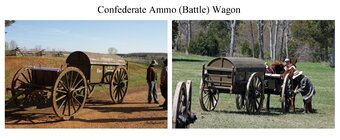
A teamster (or wagoner) drove a wagon team of horses or mules. An army on the march, like the Army of Northern Virginia in the summer of 1863, required more than 2,000 teamsters to drive wagons carrying food for men and animals, baggage and other supplies, ammunition, and to transport the sick and wounded. The load capacity varied according to the number of animals in the team (two, four or six), and the condition of the roads. A heavy ordnance wagon with six animals could carry in excess of 2,500 pounds, although an average load might be around 1,500 pounds - the equivalent of 15 boxes containing 15,000 small-arm cartridges for infantry. Empty ordnance wagons could carry weapons gathered up from the battlefield, and additional wounded soldiers. It appears that each regiment had one dedicated ordnance wagon, and there was a separate ordnance train for reserve artillery ammunition. In approaching a battlefield, only ordnance and ambulance trains were allowed to go forward; the rest were held back in large wagon parks, or sent to the rear areas to scour the countryside for forage and supplies of use to the army.
An infantry regiment of 300 men might have three wagons dedicated to carrying food and fodder (under the commissary staff), and another two wagons to carry a change of clothing, knapsacks, etc. for the men, along with the officers' baggage, and cooking utensils (often supplemented by a brigade wagon). Additional wagons would be required at the brigade, division, corps and army levels to meet the food and baggage needs of those staffs. Bear in mind that an individual's daily food ration weighed around two pounds, and at the beginning of a campaign the wagons were loaded with 7-10 days of surplus food (not counting the usual three days' rations carried by the soldiers on their backs).
A teamster might also drive one of the many ambulances in the army, which traveled together and were under the supervision of medical officers on the battlefield (on the march all wagons were controlled by quartermasters). Each regiment could have up to two ambulances (two- or four-animal teams), and at the brigade level and above a wagon carrying medical supplies was typically available. The Confederates, as always, relied heavily upon captured Federal wagons to augment their transportation needs.
Throughout the war, both sides continually downsized the size of their wagon trains to the bare minimum, because a train of several hundred wagons would stretch for many miles, requiring protection and impacting troop movements. While teamsters generally were distant from combat operations, some notable exceptions occurred. Several hundred Confederate teamsters were collected together and armed to successfully defend their train against a Federal cavalry attack during Lee's retreat from Gettysburg, which begs the question about the role enslaved Blacks played. Gen. Early claims they were not allowed to serve as teamsters, but some accounts suggest they did so, at least unofficially, under supervision. A few "wagon masters" were also on hand, whose duty description I defer to other readers to explain. I have not focused here on the cavalry, or the artillery arm, the latter of which required drivers for caissons, limbers, travelling forces, and additional wagons for provisions/baggage, but one can readily discern that the number of teamsters alone constituted roughly three percent of the overall manpower needs of an army on the march.
An infantry regiment of 300 men might have three wagons dedicated to carrying food and fodder (under the commissary staff), and another two wagons to carry a change of clothing, knapsacks, etc. for the men, along with the officers' baggage, and cooking utensils (often supplemented by a brigade wagon). Additional wagons would be required at the brigade, division, corps and army levels to meet the food and baggage needs of those staffs. Bear in mind that an individual's daily food ration weighed around two pounds, and at the beginning of a campaign the wagons were loaded with 7-10 days of surplus food (not counting the usual three days' rations carried by the soldiers on their backs).
A teamster might also drive one of the many ambulances in the army, which traveled together and were under the supervision of medical officers on the battlefield (on the march all wagons were controlled by quartermasters). Each regiment could have up to two ambulances (two- or four-animal teams), and at the brigade level and above a wagon carrying medical supplies was typically available. The Confederates, as always, relied heavily upon captured Federal wagons to augment their transportation needs.
Throughout the war, both sides continually downsized the size of their wagon trains to the bare minimum, because a train of several hundred wagons would stretch for many miles, requiring protection and impacting troop movements. While teamsters generally were distant from combat operations, some notable exceptions occurred. Several hundred Confederate teamsters were collected together and armed to successfully defend their train against a Federal cavalry attack during Lee's retreat from Gettysburg, which begs the question about the role enslaved Blacks played. Gen. Early claims they were not allowed to serve as teamsters, but some accounts suggest they did so, at least unofficially, under supervision. A few "wagon masters" were also on hand, whose duty description I defer to other readers to explain. I have not focused here on the cavalry, or the artillery arm, the latter of which required drivers for caissons, limbers, travelling forces, and additional wagons for provisions/baggage, but one can readily discern that the number of teamsters alone constituted roughly three percent of the overall manpower needs of an army on the march.


 Forum Host




 Bringing the