What does this mean?

Joined
Dec 18, 2023
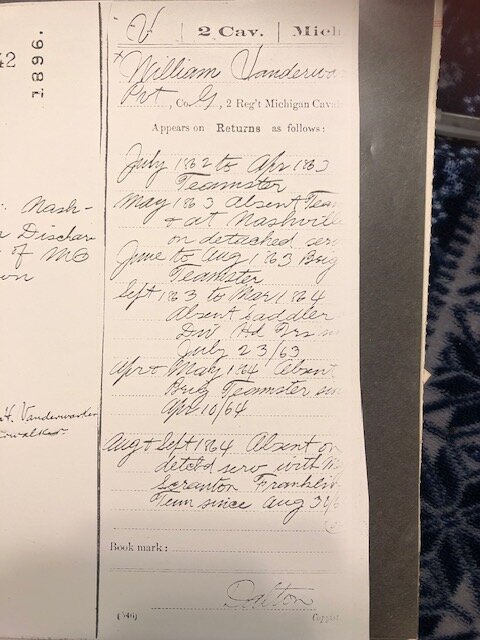
What does "absent on detached service" mean?
image5.jpeg
 
Detached service implies that the individual was sent off to perform a task separate from the rest of the company or regiment. It looks like he and possibly several other members of the regiment were sent off as teamsters. The specifics of their detached service are unclear, possibly to accompany supply trains?

ETA: that last entry appears to mention a Major Scranton (?) who was leading the detachment at Franklin Tennessee. He may have filed a report which could provide some details of the detached service.
 
Detached service implies that the individual was sent off to perform a task separate from the rest of the company or regiment. It looks like he and possibly several other members of the regiment were sent off as teamsters. The specifics of their detached service are unclear, possibly to accompany supply trains?

ETA: that last entry appears to mention a Major Scranton (?) who was leading the detachment at Franklin Tennessee. He may have filed a report which could provide some details of the detached service.
So he was an official soldier at some point? Teamsters did not have official soldier status.
 
My Search found this inquiry about the duty of a Saddler. The Admin should revise the TITLE to add this word so it would be easier to find and also to identify the question when just browsing.

I was researching my ancestors who fought in the 3rd Texas Cavalry and I found one who was a saddler.

William D. Cole Dublin, Pvt - Co. F - Age 22 - Paroled 1865.
Born: 09 Aug 1839 - Fayette, AL
(Nephew of my 3XGreat-Grandfather Richard Wesley Cole)


Service Record states he was assigned "Extra duty as Saddler by order of Genl Whitfield".

Post Dublin1.webp

Next, Record states: "On Daily duty at Madsonville making saddles for Brigade".
The regiment moved to Rome, GA, to join General J.E. Johnson's army that was trying to stop General Sherman's advance on Atlanta. June ended with the battle of Kennesaw Mountain.
"Madsonville" -- Could not find that name. There is now a Madison that is east of Atlanta.

Post Dublin2.webp


These service record cards is missing for some months. This leads up to a general question as to when was he on this duty. For example the first card is for months of September-October 1863. He was counted as Absent which would be for the date of the roll call, which I assume was the last day of October. This card does not give any indication as to how long he was assigned to this duty. Same with the second card.

Q: Since the cavalry was on my move a lot, where would he carry out his duty? I thought he may have returned to Texas at least for a short time. The second card mentions "Madsonville" which I can't find on modern maps.

Q: Any idea as to who was General Whitfield? My search found John Wilkins Whitfield (1818–1879) and AI said he led he 27th Texas Cavalry ("Whitfield's Legion") and he replaced Colonel Sul Ross. There is a connection to the Texas regiments as Sul Ross lead a brigade that included the 3rd Texas Cavalry.
 
Q: Since the cavalry was on my move a lot, where would he carry out his duty? I thought he may have returned to Texas at least for a short time. The second card mentions "Madsonville" which I can't find on modern maps.

Q: Any idea as to who was General Whitfield? My search found John Wilkins Whitfield (1818–1879) and AI said he led he 27th Texas Cavalry ("Whitfield's Legion") and he replaced Colonel Sul Ross. There is a connection to the Texas regiments as Sul Ross lead a brigade that included the 3rd Texas Cavalry.

There is a Madisonville in Texas. Was William a saddler or harness maker prior to the war?

If so, perhaps he was detailed to assist a commercial saddler back in Texas that had been contracted to manufacture saddles for the brigade?

 
Detached from the regiment for the good of the service. That could mean he's a butcher, teamster, nurse, signalman, member of the provost guard, aide to some general, etc.
 
There is a Madisonville in Texas. Was William a saddler or harness maker prior to the war?

If so, perhaps he was detailed to assist a commercial saddler back in Texas that had been contracted to manufacture saddles for the brigade?
He was 22 when he enlisted in 1861. Maybe he was old enough to have gain some experience as an apprentice. I have not checked the Census records for him but I need to see if he has any occupation listed.

I checked various spellings of name of the town. The 3rd Texas Cavalry was recruited from North Eastern Texas and Madisonville is further down south. The regiment spent a long time in Mississippi with much of the time at Yazoo City. A google search found a suburb of Jackson, MS, pulls up a neighborhood of Canton, MS. I'm sure some of the cavalry were in Canton at various times.
 
Was William a saddler or harness maker prior to the war?
After my first reply to your comment, I found him in the 1860 Census.
He is listed as Wm. C. Dublin, 21-year old son of S(urely) B. Dublin of Cherokee County, TX. Cherokee County in NE Texas is where he enlisted.

Q: What is his Occupation? "Peddling"?
His Father works at a hotel and his Mother is a House keeper, probably at that hotel.
Google said: "Peddling is an old itinerant trade where traveling salesmen walked from door to door or traveled through rural areas to sell small goods, tools, and household items directly to customers."
Maybe he was selling saddles and harnesses door to door?

Census 1960 -- WC_Dublin.webp
 
I'm going to use "peddling" the next time the census comes around.

I doubt if he could use "peddling" if he was a traveling repairman. I really don't think tradesmen traveled to do their work. You have to leave the shop and there could be a tool that he'll find that he needs, then he can't finish the job. Better the customer brings the work to the shop.

BTW, there were portable forges (I've used one) but an anvil is another matter. Anyone got a picture of the artificier setup for an artillery unit?
 
It's very strange that he would be assigned as a saddler if he didn't have some kind of prior training or experience.

Also strange that the first card refers to it as "extra duty" which I have usually thought of as a punishment, like being sent to dig latrines for missing drill call.

Maybe if you can find the original order by General Whitfield, it will explain more clearly.
 
Artificers were absolutely essential to keep an army on the move.

1784662045880.webp

In Union Army a saddler / harness maker wore a hollow diamond sleeve patch.

1784662355847.webp

Farrier with horseshoe patch on sleeve above the elbow.

1784662781274.webp


Saddle maker insignia
1784663258046.webp


U.S. Signal Corps sleeve insignia.

1784664103410.webp

Army of the Cumberland Pioneer Brigade crossed hatchet sleeve insignia. He also has Veteran Volunteer sleeve flashes.

I realized that William Dublin was in the Confederate army, which did not have sleeve insignia indicting that a man was an artificer. However, there is nothing like a photo to illustrate a point.

A regiment when formed would have (+/-) 1,000 men. As I am sure that most of you all have noticed that (+/-) 300 men formed the battle line. From the first, regiments detailed men for service as artificers.

In many cases, craftsmen were detailed for the entirety of their enlistment. Saddle makers, harness makers, wheelwrights, farriers & blacksmiths worked tirelessly maintaining an artillery battery. It really was a rolling crafts fair with repairs & horse shoeing at every halt.

Every regiment in the Army of the Cumberland was ordered to detail men who had construction experience, axe men & other engineering skills. These men joined the Pioneer Brigade. As such they provided skilled craftsmen, supervisors & combat engineers.

The Signal Corps did not exist at the beginning of the war. As the Signal Corps was stood up mature, sober men who were educated were detailed to the Signal Corps. The signalists operated in (+/-) six man mobile units. They traveled independently as needed. Signal Corps officers were required to be University graduates. There were only 2,500 men in the Signal Corps, the bulk of those who served were detailed from regiments.

The Confederate artificers, signalists & specialists of all kinds are very hard to quantify. We know that saddlers, harness makers, farriers were detailed to perform essential services. The records, rather the lack of them, have frustrated scholars for over 150 years.

Hope this post gives you some notion of how William Dublin, artificer, would have fit into the greater scheme of things.
 
Hope this post gives you some notion of how William Dublin, artificer, would have fit into the greater scheme of things.
I'm familiar with soldiers being detailed special duty and to other units. I just wish it told how long they were away by stating dates. My surprise is that a soldier would be picked to repair/make saddles. Somewhere I recently read how a cavalry unit made bery crude saddles.

Someone may have said special detail meant they were loaned to another unit. I found a good example of that.
I was researching a small battery called Bunker Battery(title of an old thread of mine). This battery had no roster as you find in Fold3. A unit history listed names of 4 soldiers who were recognized for service in a battle. One name was so unique, I found his regiment. One record said he was on duty with Buckner Battery. Further research determined this artillery only had ~28 men who were on loan. This battery did not have any members except their commander; a Lieutenant. Finally, headquarters—believe the order(in the OR's) was from General S. D. Lee— directed the Lieutenant to return his crew to their regiment, which had moved under another command.
 

Learn About Us
About CivilWarTalk
Contact the Webmaster
Meet the Staff
Link to CivilWarTalk
Join Our Community
Register
Browse Forums
View Today's Discussions
Search the Forum
Get Help
FAQ
Student Guide
Forum Rules & Etiquette
Copyright / DMCA

     Contact Us CivilwarTalk on Facebook CivilWarTalk on YouTube CivilWarTalk on Twitter RSS Feed

Bringing the American Civil War and More to Life.
© 1999 - , CIVILWARTALK, LLC - Site Version 10.0

SlaveryTalk.com - SecessionTalk.com - CivilWarTalk.com - ReconstructionTalk.com
Back
Top