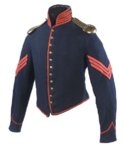
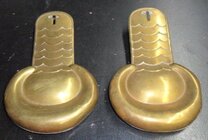
Most Union Cavalry wore brass shoulder scales or epaulets. The brass ones were suppose to ward off sabre blows and the cloth gold braied ones were worn on officers dress uniforms. The brass piece of ones which
@pringmaster has found is from one of them. Nice find. There has to more of it around as when they came apart the pieces would be everywhere.
View attachment 187045
I've got a pair of 1851 Pattern Shoulder scales - Marine Corps Enlisted. Scales, or epaulettes, were adopted in the 1850's for all branches of the military, and were only worn on NCO and Officer uniforms. They were the same size, except that NCO's had brass rivets adorning the scales. A mere glance at the scales indicated a NCO was not of a "gentleman's rank." Officer epaulettes were usually made of cloth and metal with tassels attached to designate rank and status.
The Marine Corps scales are the same as enlisted and NCO scales used by the Army except that they were slightly larger and have fringe plates underneath to hold date fringe - but could be worn without it.
Scales were indeed originally intended to provide slight protection for saber blows years prior to the ACW, but eventually they were worn for adornment only. It was well known long before the ACW that they did not provide adequate protection, so the original intended use had no real bearing by the time the ACW came around, rather it was simply the fact that they were holdovers from old uniform regs that had been in place for years. Much like many uniform regulations items, they looked good, were a visual identifier, and there was no real reason to get rid of them until wartime service led the military to realize they served more as a target for the enemy. They were indeed one additional accoutrement that had little or no use in real life.
By the time of the ACW, most were removed by the wearer and were either discarded or lost. Made of Brass, construction was fragile ad most wartime scales are found broken. Nickel plated scales were often found worn by militia groups.
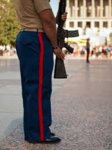
As uniform "holdouts" from prior decades, scales eventually went totally out of service. However, many uniform items stayed in service well past their usefulness or were established for reasons other than we are led to believe. Speaking as a Marine, we have lots of those types of things in our uniforms, even today. The NCO and officer "blood stripe" is an example of a tradition built on rumor - Marine Corps tradition maintains that the red stripe worn on the trousers of officers and noncommissioned officers, commonly known as the "blood stripe," commemorates those Marines killed storming the castle of Chapultepec in 1847. Although this belief is firmly embedded in the traditions of the Corps, it has no basis in fact. The use of stripes clearly predates the Mexican War.
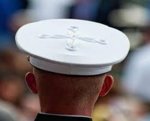
As an example of uniform usefulness that still exists despite the lack of need, the
quatrefoil or four-pointed decoration on the top of a warrant or commissioned Marine officer's dress and service caps was first used with Marine officers on sailing ships so that Marine sharpshooters in the rigging did not shoot their own officers on the deck during close-quarters gun battles (as when crews of opposing ships attempted to board each other's ship). An official part of U.S. Marine Corps officer uniforms since 1859, it's no longer useful in any manner related to it's original purpose and is now simply a uniform adornment that is maintained for looks and heritage.


 Forum Host


 Bringing the