
- Joined
- May 8, 2015
- Location
- Pittsburgh, PA
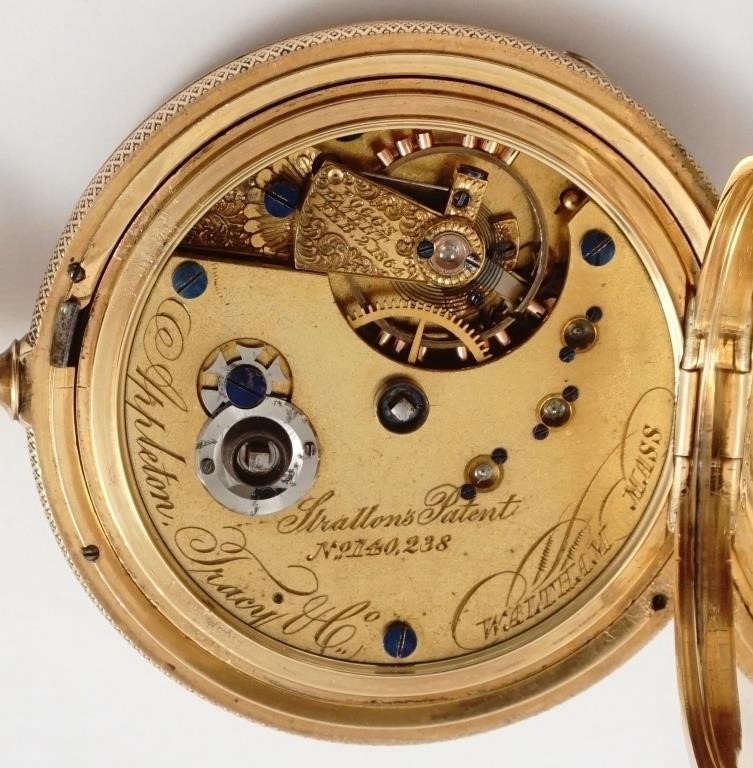
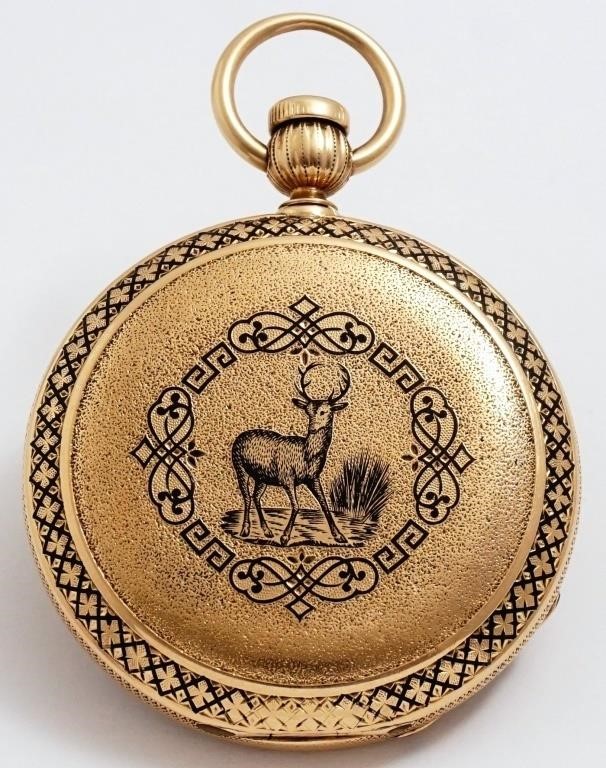
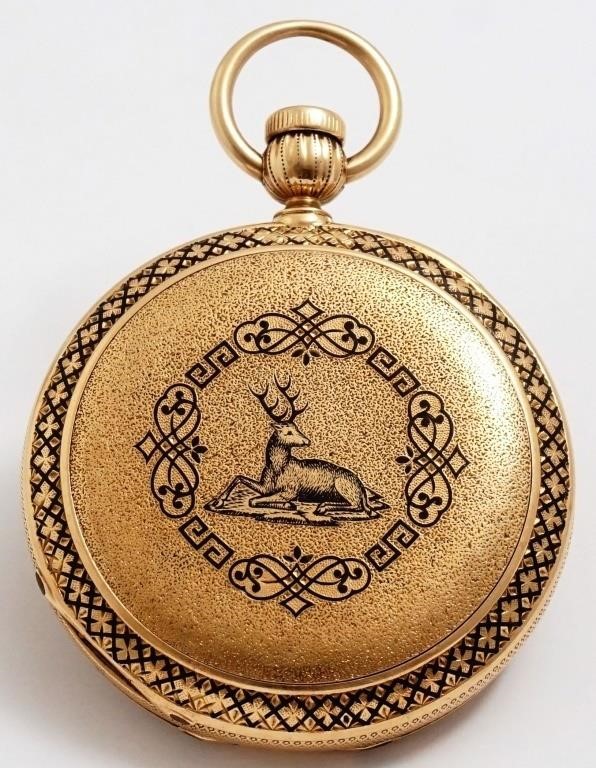
Here is the latest, fifteenth addition to my my Civil War provenance watch collection. I needed my strongest line to reel this mammoth gamefish in at auction last week, as this would have been a very expensive watch even without the Civil War-related provenance. The movement is a Waltham Appleton, Tracy & Co. grade KW16 movement SN 140,238 with Stratton's patent barrel and Fogg's patent notionally isochronous vibrating hairspring stud regulator, which are two scarce and outstanding premium features that appear on some early Waltham watches. The case is an 18K Baldwin's patent reversible (hunting-to-open face) case. The cuvette is engraved:
""Presented to His Honor, Mayor L. A. Harris by the Police of the City of Cincinnati, December 25, 1864,"
I have seen perhaps eight or ten Baldwin reversible cases in my 40+ year watch collecting career, but none as well preserved or as beautiful as this one. Most often, at least one exterior lid of a reversible case shows extensive wear, but not this case. Neither have I seen another Baldwin reversible case with elaborate enamel decoration on it.
Leonard Armstrong Harris, a First Defender, was commissioned as the captain of Company I in the 2nd Ohio Volunteer Infantry on April 17, 1861, only two days after President Lincoln called for 75,000 volunteers to defend the Union. Captain Harris served with the 2nd OH at the Battle of First Bull Run, on July 21, 1861. Harris was promoted to colonel shortly thereafter on August 8, 1861. He was elevated to command of his regiment's brigade from August 10 through November 5, 1862. Harris resigned his commission on account of ill health and a broken leg the following month. The 2nd OH and Harris's 2,260-man brigade played a major role in the Union victories at Perryville (October 8, 1862) and Ivy Mountain (November 8 & 9, 1861). Perryville was the largest Civil War battle in the state of Kentucky, and the Union's hard-earned victory in that very bloody engagement gave the Union the upper hand in the state throughout the rest of the war. Harris's performance in the battle was praised by the Army of the Ohio's commanding general, Don Carlos Buell, who recommended him for promotion to brigadier, but illness prevented Harris from continuing in field command. The illustrious 2nd Ohio Infantry went on to fight in numerous other major battles under other commanders.
Upon returning home to Cincinnati, Harris was elected mayor and given a house. Having partly recovered his health, in 1864 he organized and served as colonel of the 137th Ohio infantry while simultaneously holding his mayoral office. The 137th OH served garrison duty in the forts of Maryland, which were threatened during Confederate General Jubal Early's "Valley Campaign" in May through October of 1864.
A picture of Colonel/Mayor Harris is available here.




""Presented to His Honor, Mayor L. A. Harris by the Police of the City of Cincinnati, December 25, 1864,"
I have seen perhaps eight or ten Baldwin reversible cases in my 40+ year watch collecting career, but none as well preserved or as beautiful as this one. Most often, at least one exterior lid of a reversible case shows extensive wear, but not this case. Neither have I seen another Baldwin reversible case with elaborate enamel decoration on it.
Leonard Armstrong Harris, a First Defender, was commissioned as the captain of Company I in the 2nd Ohio Volunteer Infantry on April 17, 1861, only two days after President Lincoln called for 75,000 volunteers to defend the Union. Captain Harris served with the 2nd OH at the Battle of First Bull Run, on July 21, 1861. Harris was promoted to colonel shortly thereafter on August 8, 1861. He was elevated to command of his regiment's brigade from August 10 through November 5, 1862. Harris resigned his commission on account of ill health and a broken leg the following month. The 2nd OH and Harris's 2,260-man brigade played a major role in the Union victories at Perryville (October 8, 1862) and Ivy Mountain (November 8 & 9, 1861). Perryville was the largest Civil War battle in the state of Kentucky, and the Union's hard-earned victory in that very bloody engagement gave the Union the upper hand in the state throughout the rest of the war. Harris's performance in the battle was praised by the Army of the Ohio's commanding general, Don Carlos Buell, who recommended him for promotion to brigadier, but illness prevented Harris from continuing in field command. The illustrious 2nd Ohio Infantry went on to fight in numerous other major battles under other commanders.
Upon returning home to Cincinnati, Harris was elected mayor and given a house. Having partly recovered his health, in 1864 he organized and served as colonel of the 137th Ohio infantry while simultaneously holding his mayoral office. The 137th OH served garrison duty in the forts of Maryland, which were threatened during Confederate General Jubal Early's "Valley Campaign" in May through October of 1864.
A picture of Colonel/Mayor Harris is available here.
Last edited:


 Bringing the