Vicksburg: Defending against Johnston

Blessmag

Captain
Joined
Jun 19, 2010
Location
Minnesota
"On June 16th we left Haines' Bluff, and marched about two miles down the Yazoo river to Snyder's Bluff, where we went into camp. Our duties here, as they had been at Haines', were standing picket, and constructing fortifications. We had the usual dress parade at sunset, but the drills were abandoned; we had more important work to do. General Joe Johnston, the Confederate commander outside of Vicksburg, was at Jackson, Mississippi, or in that immediate vicinity, and was collecting a force to move on Grant's rear, in order to compel him to raise the siege. Grant thought that if Johnston attacked, it would be from the northeast, so he established a line of defense extending southeast, from Haines' Bluff on the north to Black river on the south, and placed Gen. Sherman in command of this line. As Grant has said somewhere in his Memoirs, the country in this part of Mississippi 'stands on edge', that is to say, it consists largely of a succession of high ridges with sharp, narrow summits. Along this line of defense, the general course of these ridges was such that they were admirably adapted for defensive purposes. We went to work on the ridges with spades and mattocks, and contrasted the strongest field fortifications that I ever saw during the war. We dug away the crests, throwing the dirt to the front, made long lines of breastworks along our entire front, facing, of course, the northeast. Then at various places, on commanding points, were erected strong redoubts for artillery, floored, and revetted on the inner walls with thick and strong green lumber and timbers. On the exterior slopes of the ridges were dug three lines of trenches, or rifle pits, extending in a parallel form from near the base of the ridges almost to the summit, with intervals between the lines. All the trees and bushes in our front on the slopes of the ridges were cut down, with their tops outwards, thus forming a tangled abattis which looked as if a rabbit could hardly get through. And finally, on the inner slope of the ridges, a little below their summits, was constructed a 'covered way' that is a road dug along the sides of the ridges, and over which an army, with batteries of artillery, could have marched with perfect safety. The purpose of these covered ways was to have a safe and sheltered road right along our rear by which any position on the line could be promptly reinforced, if necessary.
The Story of a Common Soldier of Army Life in the Civil War, 1861-1865. Leander Stillwell, Dodo Press, 1920. Pp. 121-122
 
Grant really didn't worry so much about Pemberton, but Grant darn sure wasn't going to have Johnston interfere with his Vicksburg operations!

"I do not know that there was any better than Joe Johnston. I have had nearly all of the Southern generals in high command in front of me, and Joe Johnston gave me more anxiety than any of the others. I was never half so anxious about Lee. By the way I saw in Joe Johnston's book that when I was asking Pemberton to surrender Vicksburg, he was on his way to raise the siege. I was very sorry. If I had known Johnston was coming, I would have told Pemberton to wait in Vicksburg until I wanted him, awaited Johnston's advance, and given him battle. He could never have beaten that Vicksburg army, and thus I wouldhave destroyed two armies perhaps. Pemberton's was already gone, and I was quite sure of Johnston's. I was sorry I did not know Johnston was coming until too late. Take it all in all, the South, in my opinion, had no better soldier than Joe Johnston – none at least that gave me more trouble. "
Around the World by J. Russell Young 1879 - pg 213

Kevin Dally
 
Pretty good answer by certain critics of Johnston's supposed do nothing policy while in Ms. Taking Grant at his word, if Johnston had tried to relieve Vicksburg, Grant was prepared to turn on Johnston first and destroy him before turning to Pemberton. Which Johnston was quite aware of and was determined not to sacrifice both his and Pemberton's armys.
Davis and even Lee did not see it that way, but they were not there and Johnston was.(and Lee was determined not join Johnston in the West, if he could help it)
 
Pretty good answer by certain critics of Johnston's supposed do nothing policy while in Ms. Taking Grant at his word, if Johnston had tried to relieve Vicksburg, Grant was prepared to turn on Johnston first and destroy him before turning to Pemberton. Which Johnston was quite aware of and was determined not to sacrifice both his and Pemberton's armys.
Davis and even Lee did not see it that way, but they were not there and Johnston was.(and Lee was determined not join Johnston in the West, if he could help it)

I still don't know why Johnson didn't try to help Pemberton at Champion Hill. Couldn't he have flanked Grant quite easily?
 
Champion Hill was NOT in Johnston's plans for moving against Grant, and came about as direct disobedience to his orders.

Kevin Dally
 
After being driven from Jackson, Johnston marched North to Canton and along the way two things happened.

The first was that he recieved Pemberton's dispatch informing him that the Army of Mississippi was marching south after Grant's supplylines instead of East to engage the Federal Army. This greatly annoyed Johnston. In his belief the only possible way for the Confederates to secure victory in the campaign was to unite their commands and gain local superiority over the Federals and defeat them in the field, Pemberton marching South did nothing to help this.

The second was that Johnston wrote out an order and sent them through to Pemberton, ordering him to march North and East to link up with him. Johnston knew he was ordering Pemberton into harms way but thought the risk worth the pay off if the two could link up.

Pemberton's reply detailed a route the two armies could take to link up but even as he was writing that reply the Battle of Champion Hill had started.

What scarpered this was that one of the men Johnston trusted to get his message through to Pemberton turned traitor and took it to McPherson instead, who then forwarded it on to Grant. Grant, recognizing the danger Johnston's orders posed to his plan move quickly and decisively to put himself between the two Confederate Commands. The battle of Champion Hill, much like Gettysburg, occured more by chance than by design.

Because of Grant's quick deployment following the discovery of Johnston's plans the Confederate force under Johnston's command had not reorganized itself from being driven from Jackson and while it was welcoming reinforcements it was far from Battle-ready when Champion Hill occured.

Additionally, Pemberton's reply to Johnston's orders only arrived at Johnston's HQ at 7:00pm on May 16th by which time Pemberton had alredy lost at Champion Hill. Upon recieving this message Johnston sent a reply of his own in which he warned Pemberton that Grant's Army had abandoned Jackson and was between the two commands but said he would take the route Pemberton suggested. He then set out the next morning to follow that route and covered fifteen miles before a message arrived from Pemberton explaining why he had not followed Johnston's initial orders and detailing the Confederate defeat at Champion Hill and expressing Pemberton's worry that the line on the Big Black River was weak and stating that he had 60 days rations in Vicksburg.

Johnston then sent Pemberton the message:

"If Haynes' Bluff is untenable, Vicksburg is of no value, and cannot be held. If, therefore you are invested in Vicksburg, you must ultimately surrender. Under such circumstances, instead of losing both troops and place, we must, if possible, save the troops. If it is not too late, evacuate Vicksburg and its dependencies, and march to the northeast."​
On the 18th Johnston set out to move his army to a position so as to meet with Permberton's army coming Northeast from Vicksburg only to recieve another message from Pemberton explaining that the Confederates had been beaten at the Big Black River and had fallen back into Vicksburg.​
Johnston was a day behind events ever since he had been driven from Jackson. Grant had got the drop on him, was a step ahead all along. So while Johnston was close by geographically during the events that led to the seige of Vicksburg he was not close in temporal terms.​
 
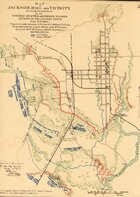
Map of the Battle of Jackson
 

Attachments

  • jacksonbattle1863.jpg
    jacksonbattle1863.jpg
    310.8 KB · Views: 410
As usual(and in this case, correctly) Johnston(conscious that the csa would almost always have inferior numbers) was more interested in saving confederate troops rather than fixed geographical points on a map.


P.S. in fact, it was Pemberton who was almost always a step behind Grant. Pemberton was constantly bedeviled in his decision making, by trying to obey both Johnston's and Davis' instructions concerning Vicksburg. In the end he tried to do both and as feared by Johnston, Pemberton lost both his army and Vicksburg. .
 
Militarily, Johnston followed an appropriate defensive strategy of protecting the military center of gravity; his forces. He pulled back when defending a geographical position would risk his forces too much, and stood his ground (or attacked) when he thought he had the upper hand. Johnston also seemed to have a good grasp of the capacity and limitations of his logistics. Politically, this strategy was not appreciated in that it allowed too much territory (and the territory's resources) to be overrun, and hurt Confederate morale.

To help us evaluate Johnston's judgement, let's look at what happened to the Army of Tennessee when it was taken over by someone who followed a strategy more pleasing to the politicians and populace. Hood demonstrated a much more offensive mindset in his part of the Atlanta campaign, but he took many more casualties and still lost Atlanta. Then, Hood went on the offensive with a mind to retake huge swaths of southern territory, but was willing to fight battles of attrition at Franklin and Nashville. He also did not tailor his operations to his logistical limitations. As a result, he destroyed the Army of Tennessee.

In the Peninsula Campaign/Seven Days Battles, however, Johnston doesn't compare so favorably with his replacement, Lee, who seemed to have a better grasp of balancing maneuver against attrition and was willing to risk great losses if a win promised great results.
 
As usual(and in this case, correctly) Johnston(conscious that the csa would almost always have inferior numbers) was more interested in saving confederate troops rather than fixed geographical points on a map.


P.S. in fact, it was Pemberton who was almost always a step behind Grant. Pemberton was constantly bedeviled in his decision making, by trying to obey both Johnston's and Davis' instructions concerning Vicksburg. In the end he tried to do both and as feared by Johnston, Pemberton lost both his army and Vicksburg. .

Undoubtely Pemberton was bamboozled completely by Grant but the point I was trying to make was that as soon as Grant got wind of Johnston's intentions he moved swiftly to prevent them becoming reality and beat Johnston to the punch.

Johnston, as I said above, was never aware of what was happening in real time. Pemberton was already beaten at Champion Hill before Johnston even knew that the battle had begun, Pemberton had already been beaten at the Big Black River before Johnston even knew that Pemberton has established a defensive line on it and Pemberton was already invested in the Vicksburg defenses when Johnston told him to march Northeast to save the army and began his march to a position nearby to link up.

All of this I said in response to Anyexcuse who asked why Johnston did not support Pemberton at Champion Hill.
 
Well it is true that part of the problem was that Johnston was more concerned with concentrating his army than with planning a decisive battle, while it was Grant who was pushing for a decisive battle, thus having the initiative. But that fact only leads to the other fact Johnston was always planning for Pemberton to break contact with Grant and move North-East to join the rest of Johnston's forces.
If Pemberton had immediately obeyed Johnston's first instruction to fall back and join him(with Pemberton, apparently mistaking Johnston's courtly phrasing as merely a suggestion) he probably would have managed to escape Grant.
It was only after Pemberton was just starting to advance south towards Grant's non-existent supply lines, that Johnston's more imperative instructions arrived telling him to move NE and join up with him, that Pemberton finally decided to obey and even then Grant had to make a desperate lunge to force Pemberton's army to battle at Champions Hill.
If Pemberton had obeyed the first order, he would not have lost valuable time and probably would have been well away from the area before Grant could stop him.
 
Well it is true that part of the problem was that Johnston was more concerned with concentrating his army than with planning a decisive battle, while it was Grant who was pushing for a decisive battle, thus having the initiative. But that fact only leads to the other fact Johnston was always planning for Pemberton to break contact with Grant and move North-East to join the rest of Johnston's forces.
If Pemberton had immediately obeyed Johnston's first instruction to fall back and join him(with Pemberton, apparently mistaking Johnston's courtly phrasing as merely a suggestion) he probably would have managed to escape Grant.
It was only after Pemberton was just starting to advance south towards Grant's non-existent supply lines, that Johnston's more imperative instructions arrived telling him to move NE and join up with him, that Pemberton finally decided to obey and even then Grant had to make a desperate lunge to force Pemberton's army to battle at Champions Hill.
If Pemberton had obeyed the first order, he would not have lost valuable time and probably would have been well away from the area before Grant could stop him.

Concur. I think Johnston felt that he needed to concentrate his forces (ensuring Mass and Unity of Command, two of the principles of war) to allow him to win a decisive battle. He wasn't as astute as Lee to be able to use Maneuver, Surprise, and Economy of Force (three more principles) to concentrate a portion of his Mass against a weaker portion of the enemy's Mass at the decisive point.
 
Someone pls list the battles that Joe Johnston WON in the Civil War.

Kennesaw Mountain!

Kevin Dally
 
Johnston arrived ito take command of his army at Jackson the evening before Grant began his attack the next day. He did well to escape with what forces were available to him at the time, with most of his supplies and materiale'.
As events proved, there was no hope of saving Vicksburg(Or the state) without concentration of force. From the very first that concentration was Johnston's goal. That it did not occur was through no fault of Johnston's efforts or plans(or his orders) it was Pemberton's and, of course, Davis.
 
Militarily, Johnston followed an appropriate defensive strategy of protecting the military center of gravity; his forces. He pulled back when defending a geographical position would risk his forces too much, and stood his ground (or attacked) when he thought he had the upper hand. Johnston also seemed to have a good grasp of the capacity and limitations of his logistics. Politically, this strategy was not appreciated in that it allowed too much territory (and the territory's resources) to be overrun, and hurt Confederate morale.

To help us evaluate Johnston's judgement, let's look at what happened to the Army of Tennessee when it was taken over by someone who followed a strategy more pleasing to the politicians and populace. Hood demonstrated a much more offensive mindset in his part of the Atlanta campaign, but he took many more casualties and still lost Atlanta. Then, Hood went on the offensive with a mind to retake huge swaths of southern territory, but was willing to fight battles of attrition at Franklin and Nashville. He also did not tailor his operations to his logistical limitations. As a result, he destroyed the Army of Tennessee.

In the Peninsula Campaign/Seven Days Battles, however, Johnston doesn't compare so favorably with his replacement, Lee, who seemed to have a better grasp of balancing maneuver against attrition and was willing to risk great losses if a win promised great results.

If you study the Penninsula campaign in comparison with other battles where the enemy maintained control of the nearby rivers or sea, Johnston's withdrawals make sense. During the Pennisula campaign Johnston's army was flanked on both sides by rivers which were navigable by Union gunships. Johnston was always in danger of a Union amphibious landing to his rear, which occured on a couple of occassions (Johnston was able to disengage and withdraw out of the trap). The best he could do was to delay things until other Confederate forces disengaged and come to his assistance. He only withdrew until he got to the point where the rivers narrowed and the channels became rather narrow, at which point batteries were able to prevent Union boats from moving further upriver. Lee was sent by Davis to observe the operations and report back - he reported that Johnston was doing all he could under the circumstances. The time for battle would come when McClellan was forced to spread out in the open .

Now compare this with WWII and MacArthur's attempted defense of the entire island of Luzon (abandoning in the process Plan Orange, which had called for an immediate withdrawal to Fortress Corregidor and Bataan). McArthur's forward strategy of defending territory at the beaches was a disaster, they were quickly overcome by Japanese naval gunnery and flanking amphious landings to his rear. Ultimately, in order to save his army, he had to revert back to Plan Orange and defend from Battaan, but in the process lost lots of valuable supplies due to capture or self-destruction.
 

Learn About Us
About CivilWarTalk
Contact the Webmaster
Meet the Staff
Link to CivilWarTalk
Join Our Community
Register
Browse Forums
View Today's Discussions
Search the Forum
Get Help
FAQ
Student Guide
Forum Rules & Etiquette
Copyright / DMCA

     Contact Us CivilwarTalk on Facebook CivilWarTalk on YouTube CivilWarTalk on Twitter RSS Feed

Bringing the American Civil War and More to Life.
© 1999 - , CIVILWARTALK, LLC - Site Version 10.0

SlaveryTalk.com - SecessionTalk.com - CivilWarTalk.com - ReconstructionTalk.com
Back
Top