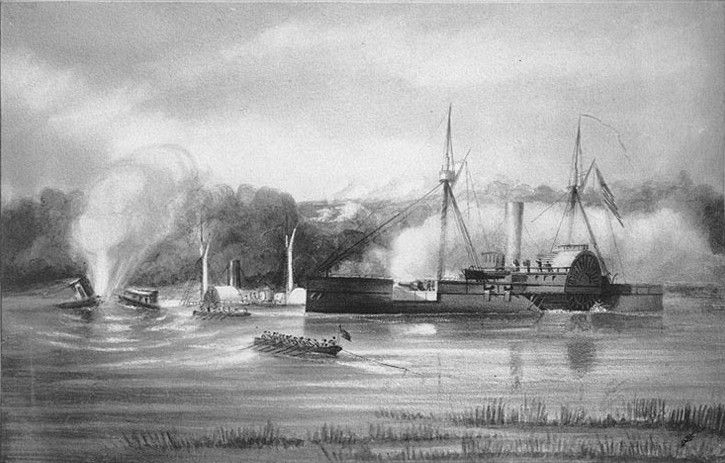
USS Wyalusing and Torpedo Dragging.

Waterloo50

Major
Joined
Jul 7, 2015
Location
England
The USS Wyalusing

USSWyalusing.jpg


I have been reading about the failed Rainbow Bluff Expedition and a report that a gunboat and a tug both hit underwater torpedoes and mines. The USS Wyalusing was forced to withdraw and whilst it did, the Wyalusing and its escorts 'Dragged for torpedoes'. My question(s) is: How was torpedo dragging carried out and what equipment did they use, was there a standard procedure for 'dragging' and was there a civil war equivalent of the modern minesweeper?
Many Thanks.
 
Last edited by a moderator:
I thought that I had better add that I have searched for information on mine dragging but other than the mention of grappling hooks there seems to be very little out there. I did read about whaleboat and a steam launch working together, apparently they used a rope tied between the two which had a chain placed in the middle, the boats would work together to pull the mine to the surface but there is no clear explanation on how this worked or how the mine/torpedo was disarmed. It all sounds a bit hit and miss.
 
It was all very much hit-and-miss, in a rather literal sense... there was no developed method for either minelaying or minesweeping, and both sides were experimenting, basically.
 
In Charleston, the Union attached a number of grapples on a raft and had a monitor push it into what they believed was an area where mines had been planted. It was a miserable failure and the remains of the raft are still in the marsh.
 
Last edited:
In Charleston, the Union attached a number of grapples on a raft and had a monitor push it into what they believed was an area where mines had been planted. It was a miserable failure and the remains of the raft are still in the swamp.
Do you mean that there were torpedoes present and it failed to locate them? That would be a failure.

If it demonstrated that no torpedoes were present, I'd call that a success, if a limited one.
 
Do you mean that there were torpedoes present and it failed to locate them? That would be a failure.

If it demonstrated that no torpedoes were present, I'd call that a success, if a limited one.
There were mines located in and around Charleston harbor and the USS Patapasco was sunk by one. The problem with the raft was that it made the monitor hard to handle and it brought them under the guns of the Charleston fortifications. Often, evidently the only signs that mines or torpedoes were present was when a ship struck one, deserters reported them or some suspicious object was seen in the water such as a float or barrel. In Mobile Bay, many of the mines were swept away from their moorings by storm tides and the ones that remained were often rendered useless by leakage of salt water. After the one Union monitor (USS Tecumseh) was sunk and the other vessels proceeded, it was reported that personnel could hear the firing mechanisms on other mines going off but with no explosions.
 
This surprised me, I found an article on
Civil War Torpedo and Civil War Mine, http://thomaslegion.net/civilwartorpedoescivilwarminesweapons.html

Expired Image Removed
Civil War Remotely Controlled Mines

Frequently used in combination with coastal artillery and hydrophones, controlled mines (or command detonation mines) can be in place in peacetime, which is a huge advantage in blocking important shipping routes. The mines can usually be turned into "normal" mines with a switch (which prevents the enemy from simply capturing the controlling station and deactivating the mines), detonated on a signal or be allowed to detonate on their own. The earliest ones were developed around 1812 by Robert Fulton. The first remotely controlled mines were moored mines used in the American Civil War, detonated electrically from shore. They were considered superior to contact mines because they did not put friendly shipping at risk. Modern examples usually weigh 200 kg (440 lb), including 80 kg (175 lb) of explosives (TNT or hexatonal).
The USS Cairo was only in service for 11 months before making history as the first U.S. marine vessel to be sunk by an electronically detonated mine.
upload_2017-4-17_21-18-49.png
 
The USS Cairo was only in service for 11 months before making history as the first U.S. marine vessel to be sunk by an electronically detonated mine.

Okay, this came up in a recent trivia question.

The mine(s) that sank the Cairo were not electrical in nature, nor were they command-detonated. They were contact mines of a sort, with a pair of mines connected by a line running between the two mines' detonators; the target vessel was intended to strike the line, pulling a sort of rasp through a detonating cap filled with rifle powder. Specifics may be found in John C. Wideman's The Sinking of the USS Cairo (University Press of Mississippi, 1993).

The story that the mines were electrically-activated comes solely from the Union sailors mistaking wires used for anchoring the mines for electrical lines, which they were not.
 
Okay, this came up in a recent trivia question.

The mine(s) that sank the Cairo were not electrical in nature, nor were they command-detonated. They were contact mines of a sort, with a pair of mines connected by a line running between the two mines' detonators; the target vessel was intended to strike the line, pulling a sort of rasp through a detonating cap filled with rifle powder. Specifics may be found in John C. Wideman's The Sinking of the USS Cairo (University Press of Mississippi, 1993).

The story that the mines were electrically-activated comes solely from the Union sailors mistaking wires used for anchoring the mines for electrical lines, which they were not.
I need to obtain a copy of that one...

Apparently the Vicksburg NMP remains unconvinced as all the public information available from them still claims it was an electrically detonated torpedo (mine).

Also at the Courthouse Museum in Vicksburg there is an exibit that has been there as long as I can remember. The informational card states Lt. Ludwell Cowan supposedly carried the relics for years after the event. He was a member of the 1st Mississippi Light Artillery and was stationed near Syder's Bluff during the period when the Cario was sunk. Snyder's Bluff was a Confederate fortification near where the Cairo went down on the Yazoo river.

The description doesn't mention electricity.....but they certainly are wires..........whether the information and provenacne are correct I have no idea. The Vicksburg NMP mentions Acting Masters Zedekiah McDaniel and Francis M. Ewing of the CS Navy as the sailors that "activated" the torpedo.

Guess I have another book to buy.

Capture102.JPG
Capture103.JPG
 
It appears the Confederacy made attempts to develop electric mines but the telegraph wire required to carry the detonation current was in short supply. The method for producing the electrical charge was a Wollaston battery, it contained eighteen pairs of 10 by 12 inch zinc plates immersed in thirty-six gallons of sulphuric acid.

During the Civil War

The first real enhancement and development of torpedoes took place during the American Civil War, namely with Matthew Fontaine Maury. Maury, who was a native Virginian, charted the ocean currents and wrote several books about the geography of the sea. When the outbreak of the Civil War occurred, he resigned his commission in the U.S. Navy and joined the Confederacy, being placed on the advisory council for recommendations for the protection of the Confederate waterways.3 He was a major advocate in defending the southern waterways from the Federal Navy.

Maury assisted Lieutenant Isaac N. Brown and Major General Leonidas Polk in defending the Mississippi River. He proposed that setting electric torpedoes along the river would be the best defense. They planned to place the electric mines on the bluffs of Columbus, Kentucky, to defend the Mississippi from "Cairo to New Orleans". This was the first combat electric mine station in America and probably the world. Maury designed 50 pound, 3-foot long cylindrical containers that could be buoyed across the river. Insulated wire connected them to galvanic batteries and "telegraph key contacts hidden in caves along the thickly wooded bluffs". Other mines were planted on land to prevent Federal troops from coming ashore. Although land and water mines were both electrical, the land mines were laid with squat iron castings with lids that had handles. The lids were fastened by eight bolts, beneath them smaller wooden boxes were placed in order to protect the holes through which the wires from the batteries passed. 4-pound artillery shells filled with canister, grapeshot, and two bushels of gunpowder were placed inside of the cylindrical containers. Six wires then ran from the clusters of mines to a nearby cave or hill.

Maury experimented with tiny cans of powder and a large washtub filled with water. He decided to detonate the mines using a percussion trigger connected with a rope lanyard. This was successful, however he wanted something better- an electric torpedo fired by a spark passing through a long, insulated cable.4 Despite his desire, the cables were not to be had. He dispatched a Southern agent to go to New York, the closest source, to buy telegraph wire from the enemy. This attempt proved to be unsuccessful. It is believed that the agent was picked up by the Union Secret Service in Philadelphia. Moreover, the Confederates made an effort to ask for donations of Indian rubber coats and overshoes from its citizens in order to waterproof the wire. Many answered the call. Despite the generous donations, not enough was received to wrap more than a few hundred feet of cable, when many thousands would be needed for extensive mine laying.

Being that electrical science was still in its infancy; Maury combined efforts with the South's leading expert, Dr. (Major) William Norris, chief signal officer. Norris was originally opposed to the idea, but eventually provided advice and additionally a supply of Federal telegraph cable to Maury. The cable had been washed ashore by a storm and retrieved by the Confederates on Virginia's coast. Despite the wire being frayed and broken from the Atlantic floor, the wire proved to be a "God-send". Being backed by Jefferson Davis and the Confederate Navy Secretary Mallory, Maury began some experiments with the electric mines. For waterproof tanks, or "magazines", several old iron locomotive and steamboat boilers were collected, cleaned, and repaired. The boilers were then filled with gunpowder. A Wollaston battery was used because it was the only one available. It consisted of "banks of cells in which were eighteen pairs of 10 by 12 inch zinc plates immersed in thirty-six gallons of sulphuric acid; it could generate enough current to explode a single charge only a few hundred feet away."5 Because this method worked poorly, a second system of torpedoes were better accommodated for this primitive equipment. They employed "iron magazines of 70 to 160 pounds each, anchored in clusters, or as Maury designated them, "ranges"".6

Source: Milton F. Perry, Infernal Machines: The Story of Confederate Submarine and Mine Warfare, (Louisiana State University Press, 1965) pp 6-15

Wollaston battery
e-large-battery-of-wollaston-built-by-davy-in-1807-at-the-royal-in-picture-id183976643?s=612x612.jpg
 
Last edited:
The British had already developed sweeping techniques against moored mines, which the Russians deployed in 1855. Essentially two ships boats would drag a heavy weighted rope between them (later with barbs) and snag any floating object. Once found it could be cut free and disposed of.
 
The Vicksburg NMP mentions Acting Masters Zedekiah McDaniel and Francis M. Ewing of the CS Navy as the sailors that "activated" the torpedo.

Guess I have another book to buy.

It's worth it. If memory serves me correctly, Wideman is either a descendant or collateral relative of McDaniel, and went to some pains to uncover and tell his story.
 
The middle picture is of USS ex CSS Atlanta in the James River. It has always been said that it shows her with spar torpedo lowered, but that looks to me to be a torpedo rake

I'm quite sure you're right there. Other ironclads photographed at the same time in the same area definitely had "rakes," and there's no reason at all for a torpedo spar to be down/deployed in that situation.
 

Learn About Us
About CivilWarTalk
Contact the Webmaster
Meet the Staff
Link to CivilWarTalk
Join Our Community
Register
Browse Forums
View Today's Discussions
Search the Forum
Get Help
FAQ
Student Guide
Forum Rules & Etiquette
Copyright / DMCA

     Contact Us CivilwarTalk on Facebook CivilWarTalk on YouTube CivilWarTalk on Twitter RSS Feed

Bringing the American Civil War and More to Life.
© 1999 - , CIVILWARTALK, LLC - Site Version 10.0

SlaveryTalk.com - SecessionTalk.com - CivilWarTalk.com - ReconstructionTalk.com
Back
Top