USS General Berry?

corn-fed-erate

Corporal
Joined
Mar 15, 2014
Location
Tar/Roanoke River, NC
Reading a journal of a sailor who was on the Valley City during the Poplar Point engagement on the Roanoke River. He mentions the "line of battle" as the fleet started up the river: Wyalusing, Otsego, General Berry, Bazely, Valley City, Chicopee, Belle, and picket boat # 5. I can't find anything on the General Berry. I have a feeling it was one like the Southfield, Commador Perry, or Commador Hull: the side wheeled, double ended FERRYBOATS. Does anyone have any info for this boat?
 
Reading a journal of a sailor who was on the Valley City during the Poplar Point engagement on the Roanoke River. He mentions the "line of battle" as the fleet started up the river: Wyalusing, Otsego, General Berry, Bazely, Valley City, Chicopee, Belle, and picket boat # 5. I can't find anything on the General Berry. I have a feeling it was one like the Southfield, Commador Perry, or Commador Hull: the side wheeled, double ended FERRYBOATS. Does anyone have any info for this boat?
Found this with a quick Google search. Looks like you have to get the book to get more detail.

https://books.google.com/books?id=9...AEIJDAC#v=onepage&q=CSS General Berry&f=false
 
Ok, so it was a bark. I'm in the dark when it comes to them. What did a civil war era bark look like? Was it a combination sail/steam like the Bombshell?

Maybe Andy can help. He helped a lot with the Bombshell.
 
'Bark' referred to a particular sort of rigging that was popular in that era. But if it was indeed a bark, that makes it a sailing ship; if it was going upriver, it would have had to have been towed.

However, I can't find a record of a USS General Berry, which indicates that it wasn't a US Navy vessel... therefore the 'USS' is incorrect. It could have been an Army-chartered vessel-- I'll check my records this evening, assuming Andy doesn't beat me to it. :D
 
The bark, or barque, rig had three or more masts, square rigged except for the mizzen with all fore-and-aft sails.

Bark was also used as a generic or catchall term for sailing ships, or for those which did not fit neatly into any other category. I even recall the frigate Surprise being referred to as a 'barkie' in one of Patrick O'Brien's novels. I agree it seems odd for a sailing vessel to have been included in the Union squadron, so perhaps it's a generic or slang usage.
 
I have seen it listed as a US Army transport. Battan mentioned it at the beginning of the expidition but never while at Poplar Point. In ORs, in correspondences between Macomb and various boat commanders, every other boat is mentioned at one time or another. From Battan's account Otsego would be towing it. Frankle's infantry was moving against Fort Branch over land. It may have been a vessel used as a "supply barge" for the expidition. They may have had to drop it after Otsego hit torpedoes and sank. Valley City moved to lead to protect dragging operations. The records I have just don't say. Knowing the trouble they had with the 205' double enders navigating the curves of the Roanoke is is had to see them deciding to tow another boat with one.
 
Last edited:
If it was an Army transport, especially a cargo transport, it becomes quite likely that it was a chartered sailing vessel-- almost certainly towed by one of the other vessels. I'll check my copy of Gibson & Gibson later today.
 
Steamer General Berry

https://books.google.com/books?id=w...=onepage&q=Army steamer General Berry&f=false

A lady is asking the government for redress on the lose of the General Berry... It seems to have under contract with the U S Army... details about the steamer ship

https://books.google.com/books?id=q...=onepage&q=Army steamer General Berry&f=false

More..

https://books.google.com/books?id=j...=onepage&q=Army steamer General Berry&f=false

Here a letter from the owner about the lose of his steamer General Berry...

https://books.google.com/books?id=c...=onepage&q=Army steamer General Berry&f=false
 
Aha... there were TWO vessels named "General Berry," a bark and a steamer. The bark, after having served as a transport, was captured and burned by CSS Florida off New York. The steamer, a small sidewheeler, was chartered from Sep 2 1863 through the end of the war and served on the Roanoke River, in the Carolina sounds, and Hampton Roads (via the Albemarle and Chesapeake Canal). Gibson & Gibson, p. 124.
 
A "bark" is a type of sailing rig. A "ship" had three masts with square sails, hung from square yards, on all three masts. It was hugely labor intensive. A "bark" is basically a three-masted ship, but without the square sails on the mizen mast, just fore-and-aft mizen sails. This was done to save on manpower. Square-sails required a lot of men to work. Later, sailing barks lost the square-sails on the main mast as well, to further cut costs, and these became known as "barkentines". When the square sails finally were removed on the fore mast, the ship became a three masted schooner, or tern-schooner.

Likewise, a smaller vessel with only two masts, a fore mast and a main mast, and with square-sails set on both masts, is called a "Brig". But when they began to lose their square sails on the main mast, also for reasons of economy, they became "Brigantines".

The earliest known instance of a US Navy vessel with a bark rig was the 1814 cruise of the US Sloop-of-War Peacock, under Master Commandant Lewis Warrington. He ordered this done, only briefly, off the coast of Africa to give the appearance of being a merchantman, according to a British Admiralty intelligence report, in hopes of luring Brits closer to him.
 
Last edited:
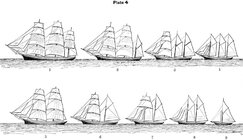
Here is a good breakdown of the basic types of sailing rigs.

From the Text-Book of Seamanship, 1891.
The Ship (1). Three masted, square rigged on all three masts.
The Barque or Bark (2). Three masted, square rigged fore and main, fore and aft rig on mizzen.
The Barkentine (3). Three masted, square rigged fore, fore and aft rig main and mizzen.
The Brig (5). Two masted, square rigged.
The Brigantine. Same as brig but without a square mainsail.
The Hermaphrodite Brig (6). Two masted, square rigged fore, fore and aft rig main.
The Topsail Schooner (7). Two masted, square rigged forward, but with a fore and aft foresail.
The Schooner. Two masted (8), three masted (4), or four masted fore and aft rig.
The Sloop (9). One masted, fore and aft rig.
plate4.jpg
 

Attachments

  • plate4.jpg
    plate4.jpg
    79.5 KB · Views: 48
With the necessary caution that the US Navy term "Sloop of War," often referred to briefly as "sloop," was not a sloop in terms of rigging. (Foreign navies often termed them "corvettes," which I find a bit more descriptive, but that wasn't USN usage, so we're stuck with it.) A "sloop of war" was three-masted, ship- or bark- rigged, and had its main armament on a single gun deck; it was generally (but not always) smaller than a frigate, and was widely used prewar in the patrol- and showing-the-flag role, as it was less costly to operate than larger vessels but still large enough to be a generally good seaboat.
 
Trivia: The first known usage of the term "Corvette" by the US Navy describing one of their own ships, was the USS John Adams in 1809, after she had just been cut down (razeed) from a small frigate to a large, flush-decked ship-rigged sloop of war.
 
With the necessary caution that the US Navy term "Sloop of War," often referred to briefly as "sloop," was not a sloop in terms of rigging. (Foreign navies often termed them "corvettes," which I find a bit more descriptive, but that wasn't USN usage, so we're stuck with it.) A "sloop of war" was three-masted, ship- or bark- rigged, and had its main armament on a single gun deck; it was generally (but not always) smaller than a frigate, and was widely used prewar in the patrol- and showing-the-flag role, as it was less costly to operate than larger vessels but still large enough to be a generally good seaboat.

The Royal Navy also used brig-sloops, two-masted but otherwise meeting the criteria for a naval sloop as Mark described. AFAIK the USN just used "brig" for, well, brigs.

The Hornet and Wasp of the early 1800s were designed as brigs but converted to ships, and thereafter referred to as sloops.
 

Learn About Us
About CivilWarTalk
Contact the Webmaster
Meet the Staff
Link to CivilWarTalk
Join Our Community
Register
Browse Forums
View Today's Discussions
Search the Forum
Get Help
FAQ
Student Guide
Forum Rules & Etiquette
Copyright / DMCA

     Contact Us CivilwarTalk on Facebook CivilWarTalk on YouTube CivilWarTalk on Twitter RSS Feed

Bringing the American Civil War and More to Life.
© 1999 - , CIVILWARTALK, LLC - Site Version 10.0

SlaveryTalk.com - SecessionTalk.com - CivilWarTalk.com - ReconstructionTalk.com
Back
Top