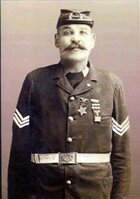
My only known Civil War relative, this is a GAR Photo of my 2nd Great Grandfather Peter Aubrey, he originally enlisted in the 98th New York Infantry in 1861 -62. Re-enlisted in 1863 til the end of the War. In 1864 he was captured in the Battle of Plymouth, NC with the 2nd Massachusetts Heavy Artillery Vols. He was a survivor of Andersonville Prison until his release.
Welcome. I see your ancestor is listed as being "Chief Of Police" at Andersonville. Was he instrumental in putting down the "raiders" ? Source :
Massachusetts Soldiers, Sailors and Marines in the Civil War
PLYMOUTH, N.C.
APRIL 17TH - 20TH, 1864
Plymouth, N. C., April 17-20, 1864. U. S. Forces
commanded by Brig.-Gen. Henry W. Wessells. Plymouth is
situated on the right bank of the Roanoke river, about 8 miles
from Albemarle sound. In April, 1864, it was held by Gen.
Wessells with a force composed of the 16th Conn., 85th N. Y.,
101st and 103rd Pa., and two companies of North Carolina
volunteer infantry; two companies of the 12th N. Y. cavalry,
two companies of the 2nd Mass. heavy artillery, and the 24th
N. Y. independent battery of 6 guns. The line of defenses
extended from 2 miles above the town to half a mile below, the
three principal redoubts being known as Forts Gray, Wessells
and Williams. Along the river in front of the line were the
gunboats Miami, Southfield and Ceres and the picket-boats
Bombshell and Whitehead, all under command of Capt. Charles W.
Flusser of the U. S. navy. The total strength of the garrison
was about 3,000 men. About 4 p.m. on the 17th the
enemy-Hoke's, Ransom's and Kemper's brigades-advanced on the
Washington road and drove in the pickets, the skirmishing
continuing until dark. At daylight on the 18th the
Confederates opened a heavy artillery fire on Fort Gray, at
the upper end of the line of intrenchments, but the garrison
there held out and effectively replied to the enemy's
cannonade. During the day the Bombshell, while communicating
with Fort Gray, received several shots below her water line,
but managed to reach the town, when she sank at the wharf.
The Ceres, which was above Fort Gray when the attack
commenced, passed down under a heavy fire and joined the
squadron in front of the town, losing 9 men in killed and
wounded on the trip. Early on the morning of the 19th the
Confederate ram Albemarle came down the river and engaged the
Southfield and Miami, sinking the former and disabling the
latter, and causing the other vessels to drop down the river
to the sound for safety. The Confederate land forces then
surrounded the town and with the assistance of the Albemarle
succeeded in capturing Fort Wessells but at all other points
they were repulsed with heavy loss. At daylight on the 20th
the attack was again renewed, Fort Gray was captured after a
desperate fight in which the enemy lost heavily, and Wessells
withdrew all his men to Fort Williams, which was an enclosed
work near the center of the line. This gave the enemy
possession of the town and in a short time an artillery fire
was opened upon the fort from four different directions. An
infantry assault on the redoubt was repulsed, but the steady
cannonade from the ram and the land batteries soon began to
tell and at 10 a.m. Wessells displayed a flag of truce, asking
for a conference with the Confederate commander. The
surrender gave the Confederates possession of the government
stores at Plymouth and all the Union troops became prisoners
of war. The total loss in killed, wounded and captured was
2,834 men. 0n the 13th Wessells had asked for reinforcements,
but Gen. Butler declined to send additional troops. Maj.-Gen.
John J. Peck, commanding the District of North Carolina,
directed Gen. Palmer to send all his available infantry to
Wessells' assistance, and these troops had reached the mouth
of the Roanoke, when news of the surrender was received. Had
Wessells received reinforcements when he asked for them there
is no doubt that the Confederates would have met with an
ignominious defeat. As it was he held out for more than three
days against a force that outnumbered his own at least five to
one.
Source: The Union Army, vol. 6

 Forum Host


 Thread Medic


 Bringing the