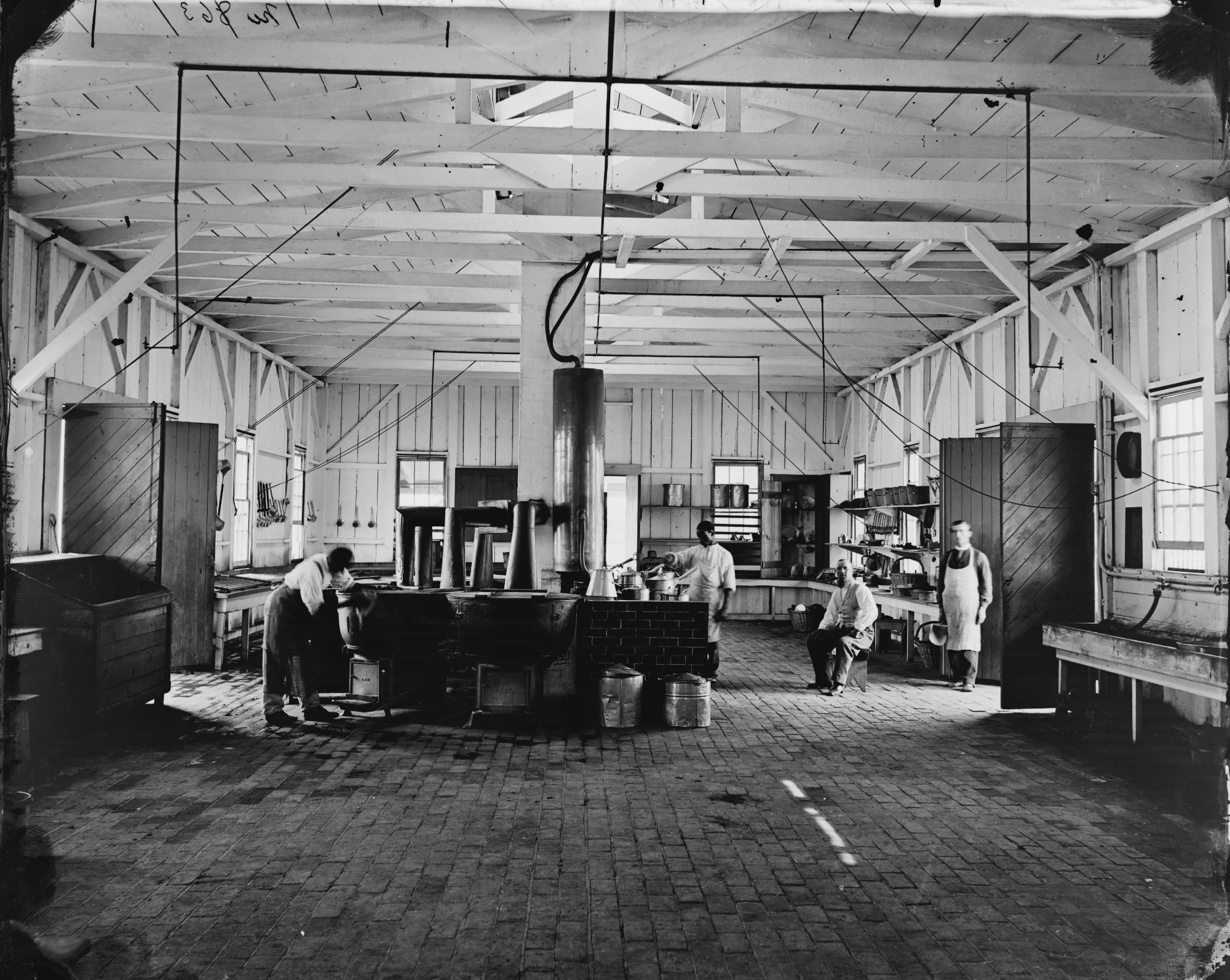
The Soldiers' Rest.

Robert Gray

Sergeant Major
Joined
Jul 24, 2012
Soldiers' Rest: a respite for troops during the Civil War.
Alexandria Times, August 25, 2011.

During the Civil War, thousands of Union soldiers came into Alexandria, some remaining for assignments locally but most passing through on their way to other destinations. Soldiers needed food and shelter during their brief stays in Alexandria before departing on trains, boats and foot. In 1862, to accommodate these troops, the Army initially modified a large
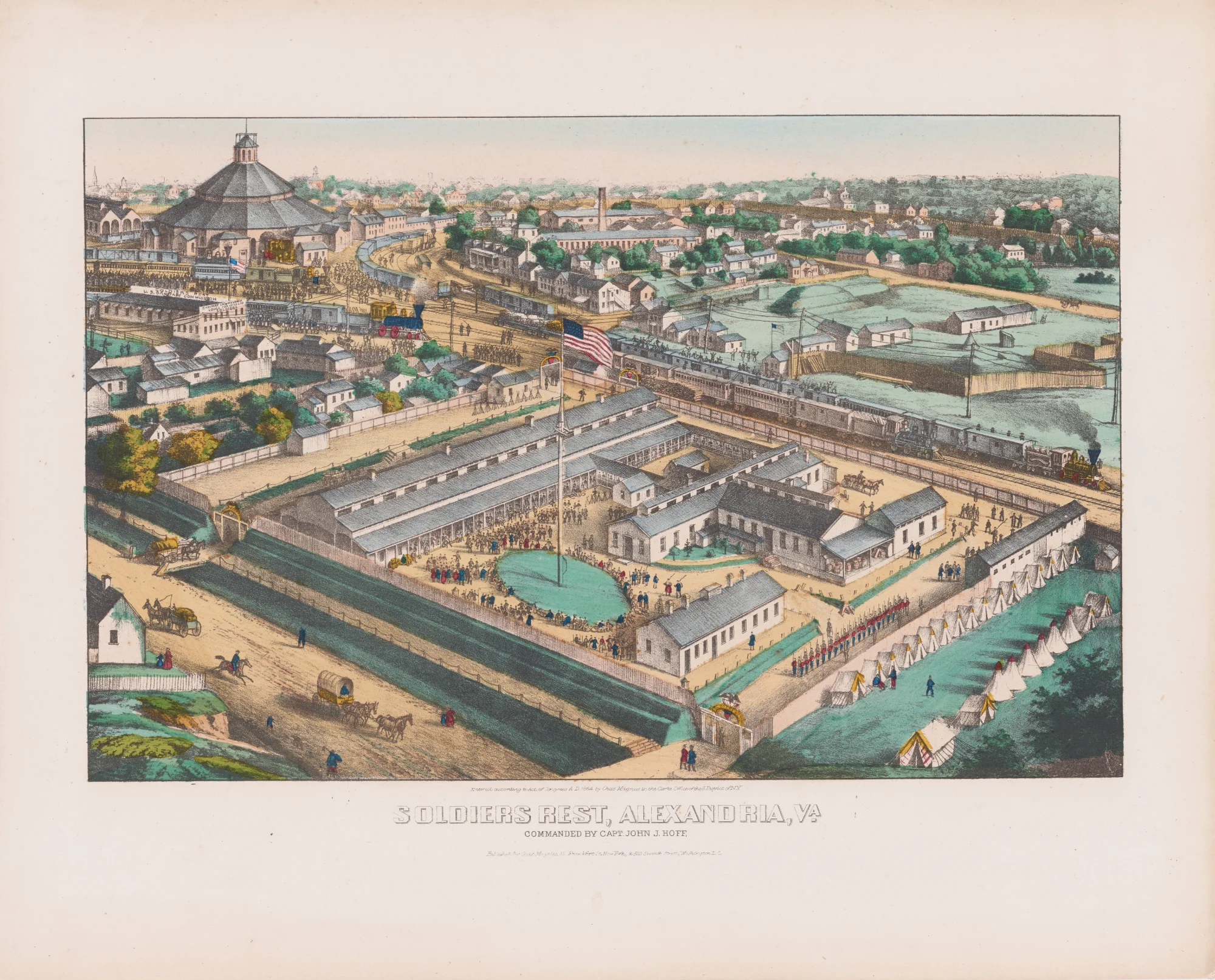
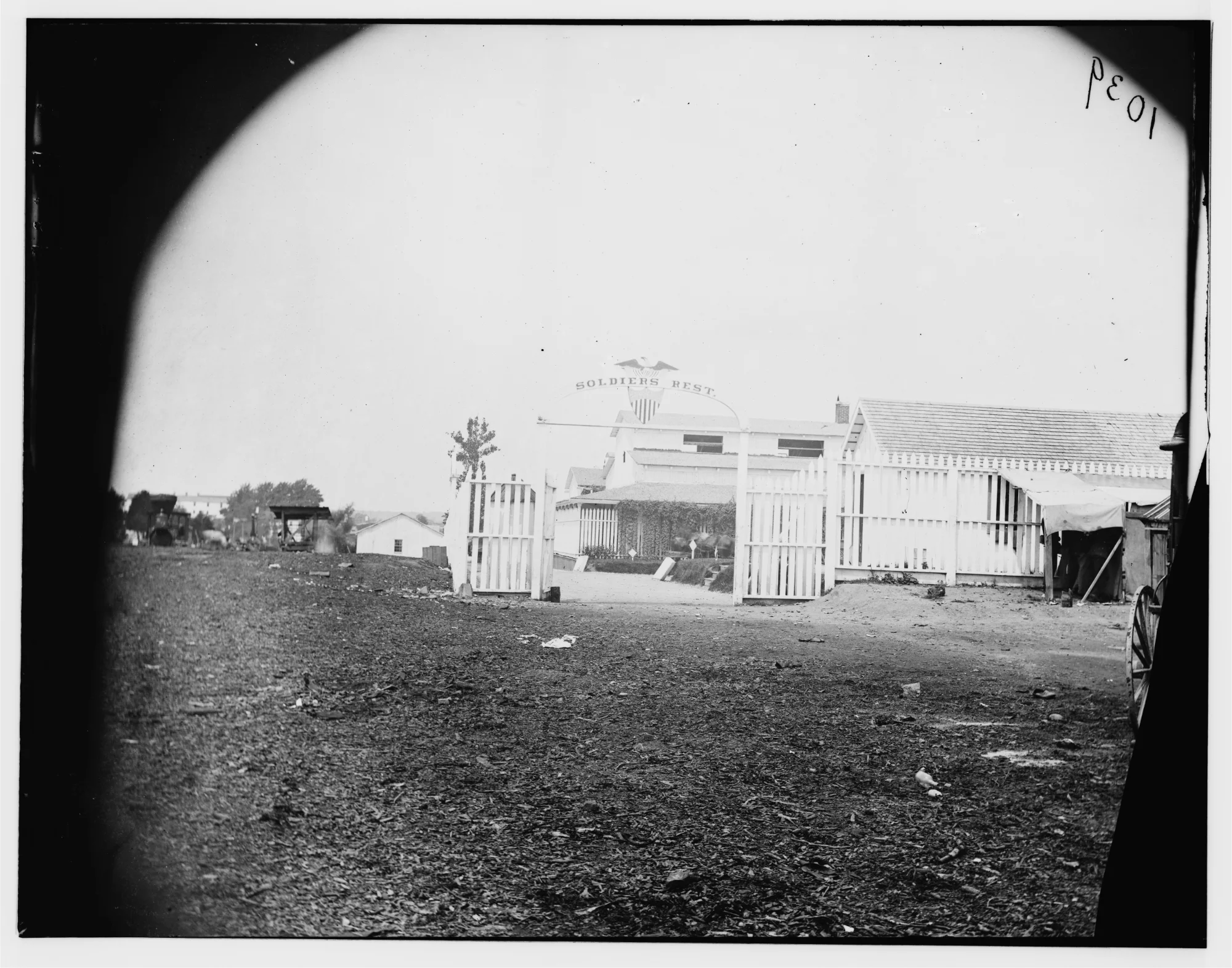
warehouse at the corner of Duke and Union streets to be used as a "rest and retreat." But the following year, a much larger facility was constructed further west on the south side of Duke Street near the Orange & Alexandria Railroad yard being used by the U.S. Military Railroad. The Soldiers' Rest compound included a dormitory, kitchen, dining hall, bath house and guard house. The dormitory, the largest building in Soldiers' Rest, was divided into four areas, one of which
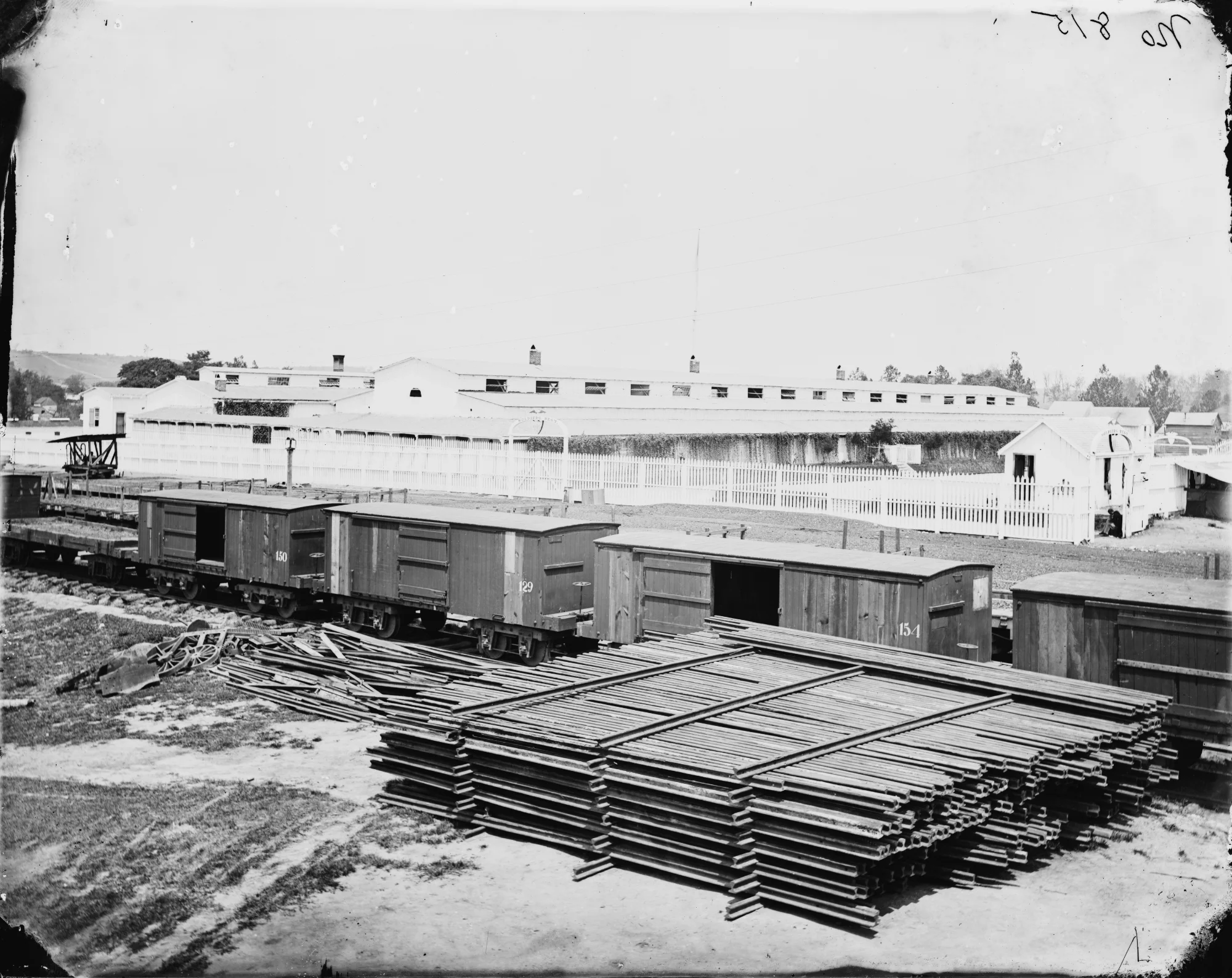
was used as a sitting room for writing and reading. Large stoves heated the dormitory, which was surrounded by a verandah. The kitchen was equipped with six 80-gallon cauldrons and had brick floors to protect the structure from fire. Two rows of tables ran the length of the dining hall, which measured about 180 feet long and 30 feet wide. Construction of Soldiers' Rest, seen just beyond the railroad cars in this photograph, cost an estimated $50,000. In addition to offering a temporary residence for troops, Soldiers' Rest also served as a hospital in 1864, and at times, provided quarters for captured Confederate deserters who pledged an oath of loyalty to the Union. After the war ended some members of the U.S. Colored Troops were quartered there. But by the end of 1866 Soldiers' Rest was closed down and the buildings and fencing were sold at public auction.

Office of Historic Alexandria
City of Alexandria, Virginia

The Jay T. Last Collection of Graphic Arts and Social History, Huntington Digital Library.
Library of Congress.
p16003coll4_1144_full.webp


LC-DIG-cwpb-01306.webp


LC-DIG-cwpb-04241.webp


LC-DIG-cwpb-04280.webp
 
There was also one 8 miles north, in D.C., called "Carver's Barracks," where George Washington University now sits. Built in 1862, it later became Carver General Hospital for the soldiers. There was also a "Soldier's Saloon" right nearby the barracks. My PA 110th grandfather Ephraim mentioned staying there June 14, 15, and 16, 1862 on his way back home to Sinking Valley, PA when he'd had enough of the war. He termed it "The Soldier's Retreat." He slept there on the floor "without a blanket," and "without supper" and hit the saloon for "coffee and soft bread" in the mornings. For more on the barracks: https://www.penncivilwar.com/post/carver-barracks-1
 
Last edited:
This would be termed 'transit accommodation' these days. Also interesting is that last -but-one view of the railyard with new-looking boxcars and that stack of rail.

Pure curiosity got me working on more research. The move West was to the junction of Duke St and West St. Duke St was the street next to the Oval on the drawing apparently. More later - since it is not the layout Alexandria VA has today!!!
 
So how did I know that road was Duke St?
Soldiers-Rest-QM.webp

I just HAD to know what it is like now. HOWEVER, the next bit took some time and a lot of maps for a place I knew NOTHING about! The railroad layout has altered completely ie vanished. The following map is taken from an Historic Alexandria sign for Hooff's Run Tunnel (1877 Hopkins City Atlas of Alexandria,Virginia). It is the nearest to the Civil War I could find and reflects the 12 years of peace, no sign of the Soldiers Rest, for example. My orientation of the map came from the railroad layout.


Some of the Ward boundaries and county labels were erased. Anything in color is my addition. Complete street names are in red, 'Soldiers Rest' is in Green and the viewing direction of the print is a blue arrow. Like most maps of this time, the orientation is taken from the waterfront at the bottom of the map, not True North at the top. Duke Street runs approximately 280 degrees W.
Soldiersrest.webp

It's a good job the artist included the roundhouse!!! (AKA engine house/engine shed). What surprised me was the MAIN lines running along the streets! After the roundhouse the line went left (on this map) at 45 degrees until it reached Wilkes St/S Washington St Junction then straight down the center of Wilkes St to the waterfront. The tunnel it used to descend to the waterfront is still there!!

What is there now? I will let YOU find out!!
 
Soldiers' Rest: a respite for troops during the Civil War.
Alexandria Times, August 25, 2011.

During the Civil War, thousands of Union soldiers came into Alexandria, some remaining for assignments locally but most passing through on their way to other destinations. Soldiers needed food and shelter during their brief stays in Alexandria before departing on trains, boats and foot. In 1862, to accommodate these troops, the Army initially modified a large
warehouse at the corner of Duke and Union streets to be used as a "rest and retreat." But the following year, a much larger facility was constructed further west on the south side of Duke Street near the Orange & Alexandria Railroad yard being used by the U.S. Military Railroad. The Soldiers' Rest compound included a dormitory, kitchen, dining hall, bath house and guard house. The dormitory, the largest building in Soldiers' Rest, was divided into four areas, one of which
was used as a sitting room for writing and reading. Large stoves heated the dormitory, which was surrounded by a verandah. The kitchen was equipped with six 80-gallon cauldrons and had brick floors to protect the structure from fire. Two rows of tables ran the length of the dining hall, which measured about 180 feet long and 30 feet wide. Construction of Soldiers' Rest, seen just beyond the railroad cars in this photograph, cost an estimated $50,000. In addition to offering a temporary residence for troops, Soldiers' Rest also served as a hospital in 1864, and at times, provided quarters for captured Confederate deserters who pledged an oath of loyalty to the Union. After the war ended some members of the U.S. Colored Troops were quartered there. But by the end of 1866 Soldiers' Rest was closed down and the buildings and fencing were sold at public auction.

Office of Historic Alexandria
City of Alexandria, Virginia

The Jay T. Last Collection of Graphic Arts and Social History, Huntington Digital Library.
Library of Congress.
View attachment 585476

View attachment 585477

View attachment 585478

View attachment 585479
Amazing photo. The huge caldrons in the center, with what look like fireboxes under them, with doors. My guess is they shoveled coal into them, could be wood though, but the boxes arent that large. What are the lines with drops suspended from the ceilings, they look like a fire suppression system but I know they arent, gas lighting? and on the far right, almost looks like a wood sink, with spigots, which I guess would be possible with a water tank on the roof?
 
I guess the lines are for opening the roof vents. As for the straight 'pipes', the end just inside the walls on either side and ar very high up. They do not seem to be capable of carrying any weight and far too high to be easily got at. There are no gas lighting appliances on them either.

They may well be coal-fired as the rail freight yard was just next door.
 

Learn About Us
About CivilWarTalk
Contact the Webmaster
Meet the Staff
Link to CivilWarTalk
Join Our Community
Register
Browse Forums
View Today's Discussions
Search the Forum
Get Help
FAQ
Student Guide
Forum Rules & Etiquette
Copyright / DMCA

     Contact Us CivilwarTalk on Facebook CivilWarTalk on YouTube CivilWarTalk on Twitter RSS Feed

Bringing the American Civil War and More to Life.
© 1999 - , CIVILWARTALK, LLC - Site Version 10.0

SlaveryTalk.com - SecessionTalk.com - CivilWarTalk.com - ReconstructionTalk.com
Back
Top