
Robert Gray
Sergeant Major
- Joined
- Jul 24, 2012
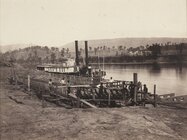
Men of the Quartermaster's Department building transport steamers on the Tennessee River at Chattanooga, 1864 (National Archives)
The geography faced by the western campaigners was quite different from that of their counterparts in the east. Roads were poorer, railroads were fewer, and much of the countryside was untamed. To add to these hazards, the western theater dwarfed the east in terms of square mileage—the west comprised some 385,000 square miles of potential battleground compared to around 95,000 miles in the east.
The importance of rivers in this landscape can hardly be overstated. These swift-running highways afforded the controlling army huge strategic advantages. Soldiers could be swiftly transported to any land point that bordered a controlled waterway. Supply lines were no longer bound to the meager road network. An army that advanced overland with an enemy-controlled river on its flank was in perpetual, crippling danger of surprise attack from the rear.
The rivers were also vital arteries for the Confederate economy, although lines of trade and communication were easily severed by patrolling enemy gunboats. This issue became especially apparent as the Union navy took control of longer and longer swathes of the Mississippi River.
Ultimately, the South's static defense on the rivers could not contend with the irresistible mobile offense executed with such skill by officers such as Foote, Grant, and Farragut. In a military and economic sense, the loss of the inland arteries all but dismembered the Confederacy.
The River War
WINNING THE WEST
BY SAM SMITH
Civil War Trust
The geography faced by the western campaigners was quite different from that of their counterparts in the east. Roads were poorer, railroads were fewer, and much of the countryside was untamed. To add to these hazards, the western theater dwarfed the east in terms of square mileage—the west comprised some 385,000 square miles of potential battleground compared to around 95,000 miles in the east.
The importance of rivers in this landscape can hardly be overstated. These swift-running highways afforded the controlling army huge strategic advantages. Soldiers could be swiftly transported to any land point that bordered a controlled waterway. Supply lines were no longer bound to the meager road network. An army that advanced overland with an enemy-controlled river on its flank was in perpetual, crippling danger of surprise attack from the rear.
The rivers were also vital arteries for the Confederate economy, although lines of trade and communication were easily severed by patrolling enemy gunboats. This issue became especially apparent as the Union navy took control of longer and longer swathes of the Mississippi River.
Ultimately, the South's static defense on the rivers could not contend with the irresistible mobile offense executed with such skill by officers such as Foote, Grant, and Farragut. In a military and economic sense, the loss of the inland arteries all but dismembered the Confederacy.
The River War
WINNING THE WEST
BY SAM SMITH
Civil War Trust


 Bringing the