The Boy at the Hanging

Gettysburg Greg

First Sergeant
Joined
Jun 6, 2010
Location
Decatur, Illinois
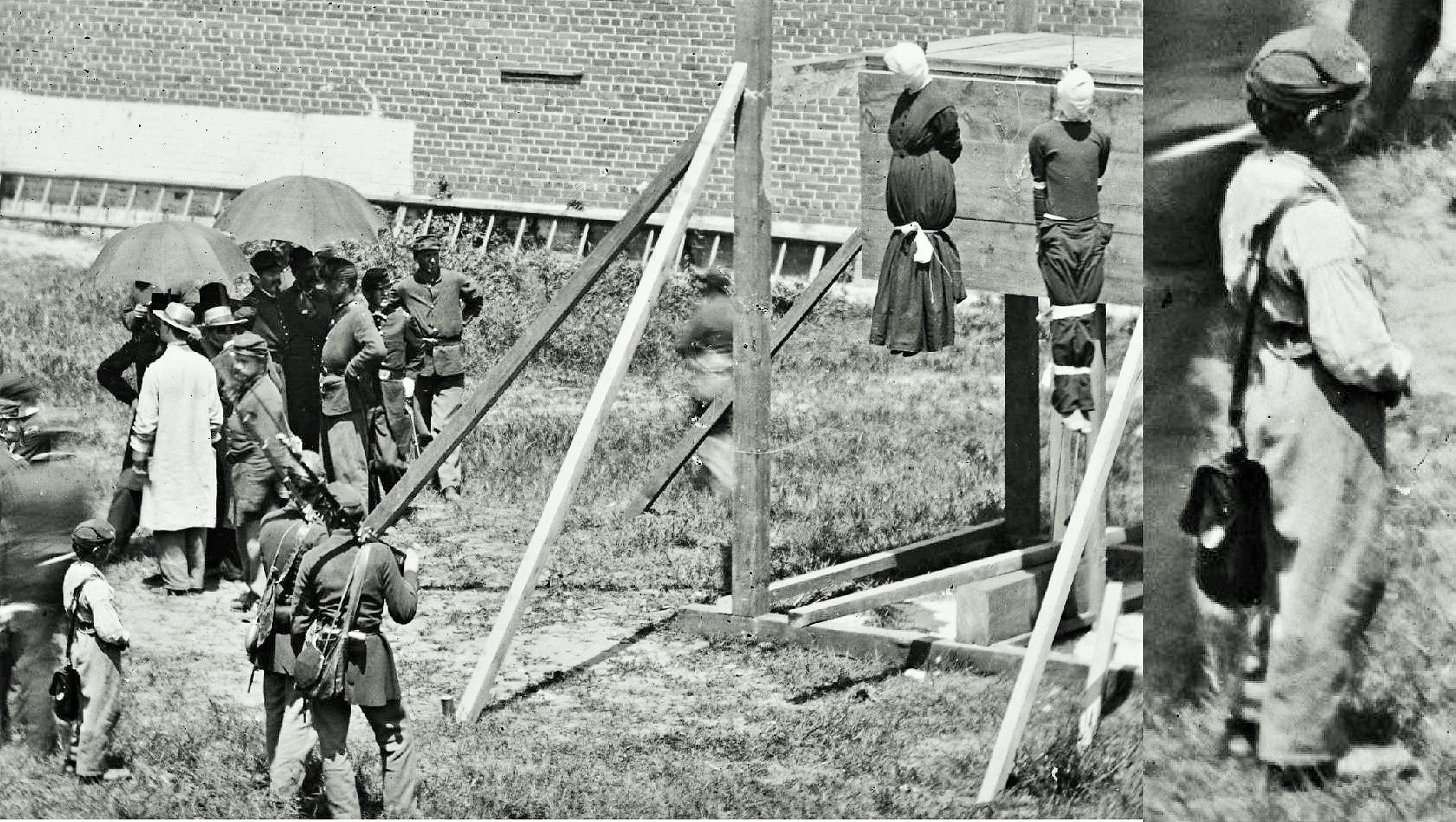
I recently posted one of Gardner's photographs of the scaffolding just before the trap was dropped and the four Lincoln conspirators were hung that focused on one of the soldiers who knocked away the support post. Here is a different photo taken by Gardner that day just after the bodies stopped struggling. I find it also very interesting for a different reason. The cropped image shows the bodies of Mrs. Surratt and Lewis Payne (Powell) hanging still at the end of their ropes. With the deed having been done, some of the witnesses and soldiers appear to be uninterested while a few can't seem to take their eyes off the swaying corpses. My primary interest in this photo, however, is the young boy on the left, wearing a kepi and a knapsack who appears to me to be captivated by the sight before him. On the right is a blow up of the young man who may have been identified as John Collins of the 16th NYVC as per research done by Barry Cauchon in an article that can be found at this link: https://awesometalks.wordpress.com/2009/03/07/3381/
The well-research article may be correct, however John Collins was born in 1843 which would have made him 22 at the time of the photo and he sure doesn't appear to be that old. Whether or not that is the young man's identity, the photo is very powerful and gives us a literal snapshot of this historic moment in time.
x combo.jpg
 
I think there is a misprint in the article. I think the author meant William Collins was born in 1843, not John Collins. The text reads as follows:

"The records of the Sixteenth N.Y. Cavalry confirm that William Collins was a private in Company K. Prior to enlisting in the 16th he served in Company G, 28th New York Infantry.

"According to the regimental history of the 28th N.Y. Infantry John Collins was born September 28, 1843 in Albion, New York. He was in the 28th N.Y. from May 22, 1861 to June 2, 1863. During this time he was captured and paroled by the Confederates twice. He had been promoted to the rank of sergeant when he was mustered out.
He reenlisted as a private in Company K, 16th N.Y.V.C. on June 20, 1863 and served until October 3, 1865. He returned to Albion and farmed there until his death in March 1904. The unit history of the 28th N.Y. said he was one of the members of the Garrett's Farm Patrol and received a share of the Reward money, but this is incorrect. Pvt. Collins had close contacts with members of the Patrol but was not one of them, nor did he receive any Bounty."


From reading the rest of the article, clearly John Collins was not a sergeant in 1863, nor was he captured twice by the Confederates. This whole section is talking about William Collins, so I think the author meant to say William Collins was born in 1843.
 
I think there is a misprint in the article. I think the author meant William Collins was born in 1843, not John Collins. The text reads as follows:

"The records of the Sixteenth N.Y. Cavalry confirm that William Collins was a private in Company K. Prior to enlisting in the 16th he served in Company G, 28th New York Infantry.

"According to the regimental history of the 28th N.Y. Infantry John Collins was born September 28, 1843 in Albion, New York. He was in the 28th N.Y. from May 22, 1861 to June 2, 1863. During this time he was captured and paroled by the Confederates twice. He had been promoted to the rank of sergeant when he was mustered out.
He reenlisted as a private in Company K, 16th N.Y.V.C. on June 20, 1863 and served until October 3, 1865. He returned to Albion and farmed there until his death in March 1904. The unit history of the 28th N.Y. said he was one of the members of the Garrett's Farm Patrol and received a share of the Reward money, but this is incorrect. Pvt. Collins had close contacts with members of the Patrol but was not one of them, nor did he receive any Bounty."

From reading the rest of the article, clearly John Collins was not a sergeant in 1863, nor was he captured twice by the Confederates. This whole section is talking about William Collins, so I think the author meant to say William Collins was born in 1843.
Thanks for taking the time to clarify my misunderstanding. Do you have any suggestion as to who this boy is and how old you think he may be, thanks for your addition to my post. I don't want to pass on erroneous info, there's too much of that out there already. :-)
 
Thanks for taking the time to clarify my misunderstanding. Do you have any suggestion as to who this boy is and how old you think he may be, thanks for your addition to my post. I don't want to pass on erroneous info, there's too much of that out there already. :smile:
Later on in the article the author writes "John Chamberlain Collins was born on September 19, 1850 in Albion, New York."

That would have made him 14 years old at the time of the hanging. The kid in the picture looks younger than that to me, but maybe 14 year olds were smaller then. Other than that, I have no idea who he was, but thanks for the interesting post. I have seen this picture a thousand times and never noticed the kid.

And I dont think you had a misunderstanding. You just reported what the author said.
 
I've often wondered about that lad. One would think that he might have been mentioned later in life for witnessing such a thing. I remember once seeing a What's My Line show where they had a man who was in Ford's theater when Lincoln was shot. Such stories were popular for newspapers back in the day. Odd that he'd not have come forward with his story.

Who knows, maybe he died young and didn't get his chance at momentary fame.
 
I've often wondered about that lad. One would think that he might have been mentioned later in life for witnessing such a thing. I remember once seeing a What's My Line show where they had a man who was in Ford's theater when Lincoln was shot. Such stories were popular for newspapers back in the day. Odd that he'd not have come forward with his story.

Who knows, maybe he died young and didn't get his chance at momentary fame.
I've Got A Secret with Garry Moore. Sam Cunningham did not smoke cigarettes so instead of a carton of Winstons he received about a bushel barrel of Prince Albert.
 
I recently posted one of Gardner's photographs of the scaffolding just before the trap was dropped and the four Lincoln conspirators were hung that focused on one of the soldiers who knocked away the support post. Here is a different photo taken by Gardner that day just after the bodies stopped struggling. I find it also very interesting for a different reason. The cropped image shows the bodies of Mrs. Surratt and Lewis Payne (Powell) hanging still at the end of their ropes. With the deed having been done, some of the witnesses and soldiers appear to be uninterested while a few can't seem to take their eyes off the swaying corpses. My primary interest in this photo, however, is the young boy on the left, wearing a kepi and a knapsack who appears to me to be captivated by the sight before him. On the right is a blow up of the young man who may have been identified as John Collins of the 16th NYVC as per research done by Barry Cauchon in an article that can be found at this link: https://awesometalks.wordpress.com/2009/03/07/3381/
The well-research article may be correct, however John Collins was born in 1843 which would have made him 22 at the time of the photo and he sure doesn't appear to be that old. Whether or not that is the young man's identity, the photo is very powerful and gives us a literal snapshot of this historic moment in time.
View attachment 488374
Do you think the boy might have said something at that moment? It looks like two older soldiers nearby are looking in his direction.
1698600384513.png
 
I recently posted one of Gardner's photographs of the scaffolding just before the trap was dropped and the four Lincoln conspirators were hung that focused on one of the soldiers who knocked away the support post. Here is a different photo taken by Gardner that day just after the bodies stopped struggling. I find it also very interesting for a different reason. The cropped image shows the bodies of Mrs. Surratt and Lewis Payne (Powell) hanging still at the end of their ropes. With the deed having been done, some of the witnesses and soldiers appear to be uninterested while a few can't seem to take their eyes off the swaying corpses. My primary interest in this photo, however, is the young boy on the left, wearing a kepi and a knapsack who appears to me to be captivated by the sight before him. On the right is a blow up of the young man who may have been identified as John Collins of the 16th NYVC as per research done by Barry Cauchon in an article that can be found at this link: https://awesometalks.wordpress.com/2009/03/07/3381/
The well-research article may be correct, however John Collins was born in 1843 which would have made him 22 at the time of the photo and he sure doesn't appear to be that old. Whether or not that is the young man's identity, the photo is very powerful and gives us a literal snapshot of this historic moment in time.
View attachment 488374
Payne might actually still be alive in this picture. Look at his feet. They are still flexed and the toe section has not dropped. Also, his ribcage seems to be expanded - you can see his pecs and two or three ribs on each side.
1698609218476.png

And this group of onlookers seems to be focused on him specifically. Wasn't he the last to die from hanging? I think I read that his neck was not snapped and he instead died by asphyxiation?
1698609612722.png
 
Do you think the boy might have said something at that moment? It looks like two older soldiers nearby are looking in his direction.
View attachment 488405
To me they seem to be looking past him. I recently went through some old photos that were at least 40 years old. The story behind some of them do not match up to what most folks would think. Of course I recently read "In the Shadow of the Roundtops" by Allen Thompson. My whole take on historical events has me reevaluating what I think I know about history. In any case to me he looks like a child , perhaps a musician.
 
Payne might actually still be alive in this picture. Look at his feet. They are still flexed and the toe section has not dropped. Also, his ribcage seems to be expanded - you can see his pecs and two or three ribs on each side.
View attachment 488414
And this group of onlookers seems to be focused on him specifically. Wasn't he the last to die from hanging? I think I read that his neck was not snapped and he instead died by asphyxiation?
View attachment 488415
That is my understanding. That it took several minutes for him to die and the others died instantly. I heard he was raising his knees in an effort to take the pressure off his neck.
 
Payne might actually still be alive in this picture. Look at his feet. They are still flexed and the toe section has not dropped. Also, his ribcage seems to be expanded - you can see his pecs and two or three ribs on each side.
View attachment 488414
And this group of onlookers seems to be focused on him specifically. Wasn't he the last to die from hanging? I think I read that his neck was not snapped and he instead died by asphyxiation?
View attachment 488415
 
To me they seem to be looking past him. I recently went through some old photos that were at least 40 years old. The story behind some of them do not match up to what most folks would think. Of course I recently read "In the Shadow of the Roundtops" by Allen Thompson. My whole take on historical events has me reevaluating what I think I know about history. In any case to me he looks like a child , perhaps a musician.
My thoughts exactly. My impression is that he was a drummer boy. Nothing like a little "traveling music" on your way to be hung.
 
Do you think the boy might have said something at that moment? It looks like two older soldiers nearby are looking in his direction.

The series of pictures of this event make for interesting conjecture, without any further specific information, regarding the young lad featured.

My take.

It seems that the lad was not visible in the picture immediately preceding the trap-doors opening, but later appeared in the picture showing the hanging bodies.

In the picture showing the boy, many of the reporters/officials nearby appeared disinterested in the gallows scene, suggesting the bodies may have by then looked lifeless. Perhaps by this time, and without attracting much attention, the lad ventured forward and became fascinated by the hanging inanimate bodies, apart from attracting the possible gazes of a couple of soldiers. (Apparently, the hanging bodies showed no signs of life after about five or six minutes of dropping; and it reportedly took at least 20 minutes before doctors made examinations to pronounce them all dead).

If admission to the execution was strictly limited (ticket-only), then thought it reasonable to conclude that the young boy was either a relative of one of the reporters/officials present, or more likely was a member (say, a drummer boy) connected to one of the Federal regiments present. (He appeared to be partially wearing a jacketless Union Army uniform (with kepi, trousers and undershirt, as well as some accoutrements). He may not have had any previous experience witnessing battlefield deaths and carnage, hence his apparent hypnotic staring fixation with the hanging lifeless bodies and the look of any paternalistic rebuke by fellow senior members of his regiment.

Merely a perspective.
 
I am glad this was posted, discussions of photos and their details brings more to your attention and makes history more real. My impression is that the boy is a boy, maybe 8 or 9 years old. He is probably not supposed to be there but he has elements of a uniform on and is carrying a bag of some sort which makes him less obvious. One soldier notices him, the soldier with his rifle over his shoulder closest to the viewer, but everyone else is either still watching Lewis Payne die or the other dead conspirators being loaded into an ambulance to be carried away from prying eyes.

If you look at the cap the boy is wearing, it appears to have two badges on top. I know nothing about insignia and how it was worn, but the badge closes to the center of the top looks like an engineer's castle to me. Perhaps he was an officer's son standing outside the gates and after the job was done the interior witnesses started leaving; one noticed the boy and asked him if he wanted to see the bodies, he said, "yes" so the man took of his hat and put it on the boy's head and gave him that leather pouch and said, "if anyone asks, say you are bringing this to your father." That would put a curious, under age boy into the prison yard wearing a hat with, maybe, regulation pants and shoes but no jacket carrying an odd-looking bag, standing a bit off because he's not supposed to be there and if his maw knew she'd skin his hide.

Surely someone has identified a number of men in the image already. The units involved and dignitaries present should be known, so that would reduce the choices.
 
I imagine when the "trap door dropped" most eyes were on Mary Surratt simply for being the first women to be executed by the Federal government. As far as those looking at Powell and without getting too specific and as delicately said as possible (you can goggle to find more detail) perhaps the young boy was watching Powell's body for the physical changes that happen when men are executed by hanging.
 

Learn About Us
About CivilWarTalk
Contact the Webmaster
Meet the Staff
Link to CivilWarTalk
Join Our Community
Register
Browse Forums
View Today's Discussions
Search the Forum
Get Help
FAQ
Student Guide
Forum Rules & Etiquette
Copyright / DMCA

     Contact Us CivilwarTalk on Facebook CivilWarTalk on YouTube CivilWarTalk on Twitter RSS Feed

Bringing the American Civil War and More to Life.
© 1999 - , CIVILWARTALK, LLC - Site Version 10.0

SlaveryTalk.com - SecessionTalk.com - CivilWarTalk.com - ReconstructionTalk.com
Back
Top