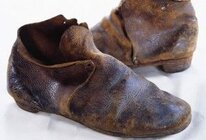
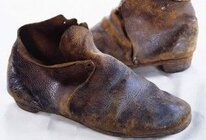
That Most Indispensible Item: Confederate Shoes

Waterloo50

Major
Joined
Jul 7, 2015
Location
England
I've had one of those days where I get to spend some time reading and browsing the internet, its normally during these times that I come across articles about subjects that are often forgotten about or simply overlooked. I was reading an article called ''Plowshares & Bayonets". The article focuses on the importance of shoes or rather the lack of them, I have posted a link because it provides an insight into the problems caused by the lack of decent footwear. The article provides some food for thought e.g. I had never really considered that 'acute deficiencies in shoe stocks coincided directly with seasons of active operations'. There are some very good photos included in the article, some of the re-enactors on the forum may even find the article useful.
http://26nc.org/blog/?p=807

history-network-300x204.jpg
 

Attachments

  • history-network-300x204.jpg
    history-network-300x204.jpg
    12.9 KB · Views: 380
Last edited:
I've had one of those days where I get to spend some time reading and browsing the internet, its normally during these times that I come across articles about subjects that are often forgotten about or simply overlooked. I was reading an article called ''Plowshares & Bayonets". The article focuses on the importance of shoes or rather the lack of them, I have posted a link because it provides an insight into the problems caused by the lack of decent footwear. The article provides some food for thought e.g. I had never really considered that 'acute deficiencies in shoe stocks coincided directly with seasons of active operations'. There are some very good photos included in the article, some of the re-enactors on the forum may even find the article useful.
http://26nc.org/blog/?p=807

history-network-300x204.jpg
In the book "General Lee's Army from victory to collapse" Joseph Glatthar SimonSchuster.com p.445 Glatthat mentions that many divisions and brigades made their own shoes. Early and Rhodes divisions ran their own shoe making and also had tayloring shops. Their would be tremendous variance over what regiment or division fared shoe wise.
In general the South simply lacked shoe factories and it's not profitable to smuggle shoes through the blockade.
Leftyhunter
 

Attachments

  • history-network-300x204.jpg
    history-network-300x204.jpg
    12.9 KB · Views: 105
The 1st North Carolina Infantry was one of those ANV units suffering a shortage of shoes in the wake of the Maryland Campaign.

The official regimental history relates that Gen. D.H. Hill, while at Gordonsville, Va. in Oct. 1862, ordered all his company commanders to equip the barefoot men with moccasins made from "the hides just taken from the beeves."

Harvey Hill, who had some of the unfortunate characteristics of the military martinet, observed that one Private Vanhorne of Company H was still barefoot and ordered that the company's Captain be arrested for disobeying orders. The officers of the 1st NC protested the unjust arrest -- there had not been enough cowhide to provide footwear for all the soldier that needed them -- and Gen. Hill relented.
 
Last edited:
In the book "General Lee's Army from victory to collapse" Joseph Glatthar SimonSchuster.com p.445 Glatthat mentions that many divisions and brigades made their own shoes. Early and Rhodes divisions ran their own shoe making and also had tayloring shops. Their would be tremendous variance over what regiment or division fared shoe wise.
In general the South simply lacked shoe factories and it's not profitable to smuggle shoes through the blockade.
Leftyhunter
Shoes were imported in great quantities. OR 4,Vol. 3, Page 930, Sec War reports on various items brought through the blockade into Charleston and Wilmington from 11/1/63 - 12/8/64. Included is 545,000 pairs of shoes and boots. While it may well be true that this was not enough shoes, it is certainly not true that shoes were not brought through the blockade. Of course, imports would have been fewer earlier in the war.
 
Shoes were imported in great quantities. OR 4,Vol. 3, Page 930, Sec War reports on various items brought through the blockade into Charleston and Wilmington from 11/1/63 - 12/8/64. Included is 545,000 pairs of shoes and boots. While it may well be true that this was not enough shoes, it is certainly not true that shoes were not brought through the blockade. Of course, imports would have been fewer earlier in the war.
I stand corrected! I guess the Confederacy was willing to pay a high premium to import shoes.
Leftyhunter
 
I stand corrected! I guess the Confederacy was willing to pay a high premium to import shoes.
Leftyhunter
Making shoes was really quite labor intensive. Cattle had to be grown and slaughtered and the hides cured -- all three of which required a lot of manpower. Then the hides had to be transported to where the shoes were to be made (in the proper proportion of upper and soles). Shoe thread or pegs had to be made and transported (pegs by the barrel). THEN you made the shoes. Finally, the shoes had to be transported to the troops.

There are numerous vouchers paying soldiers who had been detailed to make shoes, usually for 30 days at a time, but frequently extended to two or three months. There is early-war correspondence about selling the hides from government slaughter houses to tanneries and there are many complaints about hides not being moved quickly enough to keep the shoemakers busy.

Again, we see the Confederacy's major weakness -- lack of manpower to fight and support a full scale war. Importations substituted for some of the lacking manpower.
 
One of the interesting things we found going through records connected with the blockade runner Denbigh was a telegram, a copy of which is in the OR, in which the CS quartermaster in Richmond ordered the transfer of shoe making tools that had just arrived aboard the blockade runner in Mobile to be transferred to a factory being built near the POW camp at Andersonville. (Not sure if it had any specific connection to the POW camp.) It speaks to the importance of shoes, and the ability to make shoes, that these resources were being centrally coordinated by telegraph out of Richmond. That sort of coordination seems very 20th century to me.
 

Learn About Us
About CivilWarTalk
Contact the Webmaster
Meet the Staff
Link to CivilWarTalk
Join Our Community
Register
Browse Forums
View Today's Discussions
Search the Forum
Get Help
FAQ
Student Guide
Forum Rules & Etiquette
Copyright / DMCA

     Contact Us CivilwarTalk on Facebook CivilWarTalk on YouTube CivilWarTalk on Twitter RSS Feed

Bringing the American Civil War and More to Life.
© 1999 - , CIVILWARTALK, LLC - Site Version 10.0

SlaveryTalk.com - SecessionTalk.com - CivilWarTalk.com - ReconstructionTalk.com
Back
Top