
- Joined
- Jul 12, 2015
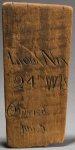
Battlefield grave markers were meant to be temporary and were made of wood. Who knows how many deteriorated and the soldier's identity lost forever.
http://ourwarmikepride.blogspot.com/2013_10_01_archive.html
Monday, October 21, 2013
A temporary grave, and then what?[/paste:font]
I never visit a local historical society in New Hampshire without picking up something new about the state's Civil War history. One night last week after my talk, Jim Tamposi, a member of the Temple Historical Society, showed me a photograph of a temporary grave marker he had seen in a Civil War memorabilia shop in Gettysburg. It was accompanied by the following note:

The rough pine marker
"Temporary grave marker of Horace A. Lampry, Co. B., 2nd New Hampshire Infantry. Killed at the Battle of Oak Grove, June 26th, 1862. Co. B had 22 men killed and wounded out of 42. Lampry's family paid to have his body shipped home. This marker was nailed to the coffin. Lampry is buried in Concord, N.H. Temporary markers were almost always discarded, this being one of only a few that survived."
History is mystery. If I were an American history teacher, I would give the photograph and this note to a student and say: "Your assignment is to see what you can find out about this. Who was Horace A. Lampry? What was the Battle of Oak Grove? What's the story here?"
I devoted a couple of hours to this assignment myself, and I had a blast. I also emailed my friend Dave Morin, a web-diver extraordinaire, about Lamprey (as his last name was actually spelled). The information we found led to the following narrative:
A native of Groton, N.H., Lamprey was an 18-year-old apprentice harness-maker in Concord when the war began. He was the first of five sons of Ephraim and Bridget Lamprey to join New Hampshire infantry regiments during the war. His eldest sister, Delia, served as an army nurse, first at a temporary hospital in Concord and later at Fort Monroe, Va., and in Washington, D.C. (After the war she made $208 a year as a nurse in the Discharged Soldiers' Home in Massachusetts.)

Horace A. Lamprey
Horace enlisted in the 2nd New Hampshire, the state's first three-year infantry regiment, on May 27, 1861. He was a private in Co. B., known as the Goodwin Rifles. The 2nd fought in the first battle of Bull Run less than two months after he joined. On May 5, 1862, the regiment had an even worse fight at Williamsburg, Va., during George B. McClellan's Peninsula campaign.
After the battle of Fair Oaks on June 1, the two armies camped opposite each other in a testy standoff that lasted 3½ weeks. The Confederate army had its back to its capital. Union soldiers climbed trees to see the spires of Richmond, seemingly within easy reach. Picket duty was dangerous and often deadly.
At around 9 a.m. on June 25, elements of McClellan's army advanced in what the New York Times correspondent "Argus" described as "the battle for the hour of whose coming many thousand hearts had throbbed, and many thousand bosoms had beat high."
The reporter was mistaken. McClellan was already thinking defensively, planning his army's retreat across the Peninsula rather than commit it to the capture of Richmond. But he did want to push back the Confederate picket line in a tree-strewn morass at White Oak Swamp.
The 2nd New Hampshire was part of a small force ordered to accomplish this task in what became known as the Battle of Oak Grove. The regiment's commander, Gilman Marston, sent his men to extend both ends of the line of the 1st Massachusetts, which was already fighting. Under fire, the men advanced "through the fallen timber and into a swamp covered with a dense growth of bushes," Marston later reported. Armed with Sharp's Rifles, Co. B., including Private Lamprey, pushed even farther forward. Marston reported that in addition to rebel balls, Union artillery shells began hitting his men.
Co. B bore the brunt of the fight. Lamprey was badly wounded in the head. The Times reported that he suffered "a severe fracture," whether from a Confederate ball or a Union shell it did not say.

Cpl. Thomas B. Leaver
Cpl. Thomas B. Leaver, one of Lamprey's comrades in Co. B and a man well-known to readers for his regular dispatches to Concord's Independent Democrat, was killed outright. He and George H. Damon died at nearly the same moment.
Both of them, but especially Leaver, were well known to Harriet P. Dame, who had served as the 2nd New Hampshire's nurse and resident mother from the beginning of the war. In his 1896 history of the regiment, Private Martin Haynes reported that Dame was caring for wounded soldiers at White House Landing in the rear when the blankets bearing the bodies arrived. When she lifted one blanket, she gasped, "My God! It is Tom Leaver!" She prepared both his body and Damon's for burial and watched as them disappear into a grave under a nearby oak tree.
The wounded Lamprey was carried to the St. Mark, a clipper ship that the U.S. Sanitary Commission, a forerunner of the Red Cross, had just fitted out to care for hundreds of sick and wounded soldiers. The ship drew too much water to make it up the Pamunkey River and was thus anchored in Yorktown harbor. Lamprey died aboard the ship on June 26, one day shy of his 20th birthday.

Harriet P. Dame, guardian angel to the 2nd NH
I'm not sure where he was buried, but I think it was in the cemetery at Yorktown. I suspect the temporary grave marker was originally planted there. The deterioration of its base suggests it was planted in the ground for some time.
The Seven Days battles – McClellan's retreat and Robert E. Lee's pursuit – had begun in earnest with the fight at Oak Grove. Frederick Law Olmsted, the noted landscape designer and social critic, served as executive secretary of the Sanitary Commission in 1862. He was on the Peninsula, at White House Landing, directing care of the wounded in late June. On the evening Lamprey died, he planned to visit the St. Mark, but rumors that Stonewall Jackson was about to attack changed his mind. The hospital ships had to clear out and head to Fort Monroe.
The New York Times reported the July 7 arrival of the S.R. Spaulding, a steam transport, which had towed the St. Mark from the fort to New York harbor in 36 hours. Aboard were 426 sick and wounded soldiers from the Peninsula.
I was not able to learn online when Lamprey's body was removed from its temporary grave and moved to Concord, or by whose request. This afternoon I'm going to the cemetery office in Concord to see what I can find out about those questions. I'll also look for his grave.
http://ourwarmikepride.blogspot.com/2013_10_01_archive.html
Monday, October 21, 2013
A temporary grave, and then what?[/paste:font]
I never visit a local historical society in New Hampshire without picking up something new about the state's Civil War history. One night last week after my talk, Jim Tamposi, a member of the Temple Historical Society, showed me a photograph of a temporary grave marker he had seen in a Civil War memorabilia shop in Gettysburg. It was accompanied by the following note:
The rough pine marker
"Temporary grave marker of Horace A. Lampry, Co. B., 2nd New Hampshire Infantry. Killed at the Battle of Oak Grove, June 26th, 1862. Co. B had 22 men killed and wounded out of 42. Lampry's family paid to have his body shipped home. This marker was nailed to the coffin. Lampry is buried in Concord, N.H. Temporary markers were almost always discarded, this being one of only a few that survived."
History is mystery. If I were an American history teacher, I would give the photograph and this note to a student and say: "Your assignment is to see what you can find out about this. Who was Horace A. Lampry? What was the Battle of Oak Grove? What's the story here?"
I devoted a couple of hours to this assignment myself, and I had a blast. I also emailed my friend Dave Morin, a web-diver extraordinaire, about Lamprey (as his last name was actually spelled). The information we found led to the following narrative:
A native of Groton, N.H., Lamprey was an 18-year-old apprentice harness-maker in Concord when the war began. He was the first of five sons of Ephraim and Bridget Lamprey to join New Hampshire infantry regiments during the war. His eldest sister, Delia, served as an army nurse, first at a temporary hospital in Concord and later at Fort Monroe, Va., and in Washington, D.C. (After the war she made $208 a year as a nurse in the Discharged Soldiers' Home in Massachusetts.)
Horace A. Lamprey
Horace enlisted in the 2nd New Hampshire, the state's first three-year infantry regiment, on May 27, 1861. He was a private in Co. B., known as the Goodwin Rifles. The 2nd fought in the first battle of Bull Run less than two months after he joined. On May 5, 1862, the regiment had an even worse fight at Williamsburg, Va., during George B. McClellan's Peninsula campaign.
After the battle of Fair Oaks on June 1, the two armies camped opposite each other in a testy standoff that lasted 3½ weeks. The Confederate army had its back to its capital. Union soldiers climbed trees to see the spires of Richmond, seemingly within easy reach. Picket duty was dangerous and often deadly.
At around 9 a.m. on June 25, elements of McClellan's army advanced in what the New York Times correspondent "Argus" described as "the battle for the hour of whose coming many thousand hearts had throbbed, and many thousand bosoms had beat high."
The reporter was mistaken. McClellan was already thinking defensively, planning his army's retreat across the Peninsula rather than commit it to the capture of Richmond. But he did want to push back the Confederate picket line in a tree-strewn morass at White Oak Swamp.
The 2nd New Hampshire was part of a small force ordered to accomplish this task in what became known as the Battle of Oak Grove. The regiment's commander, Gilman Marston, sent his men to extend both ends of the line of the 1st Massachusetts, which was already fighting. Under fire, the men advanced "through the fallen timber and into a swamp covered with a dense growth of bushes," Marston later reported. Armed with Sharp's Rifles, Co. B., including Private Lamprey, pushed even farther forward. Marston reported that in addition to rebel balls, Union artillery shells began hitting his men.
Co. B bore the brunt of the fight. Lamprey was badly wounded in the head. The Times reported that he suffered "a severe fracture," whether from a Confederate ball or a Union shell it did not say.
Cpl. Thomas B. Leaver
Cpl. Thomas B. Leaver, one of Lamprey's comrades in Co. B and a man well-known to readers for his regular dispatches to Concord's Independent Democrat, was killed outright. He and George H. Damon died at nearly the same moment.
Both of them, but especially Leaver, were well known to Harriet P. Dame, who had served as the 2nd New Hampshire's nurse and resident mother from the beginning of the war. In his 1896 history of the regiment, Private Martin Haynes reported that Dame was caring for wounded soldiers at White House Landing in the rear when the blankets bearing the bodies arrived. When she lifted one blanket, she gasped, "My God! It is Tom Leaver!" She prepared both his body and Damon's for burial and watched as them disappear into a grave under a nearby oak tree.
The wounded Lamprey was carried to the St. Mark, a clipper ship that the U.S. Sanitary Commission, a forerunner of the Red Cross, had just fitted out to care for hundreds of sick and wounded soldiers. The ship drew too much water to make it up the Pamunkey River and was thus anchored in Yorktown harbor. Lamprey died aboard the ship on June 26, one day shy of his 20th birthday.
Harriet P. Dame, guardian angel to the 2nd NH
I'm not sure where he was buried, but I think it was in the cemetery at Yorktown. I suspect the temporary grave marker was originally planted there. The deterioration of its base suggests it was planted in the ground for some time.
The Seven Days battles – McClellan's retreat and Robert E. Lee's pursuit – had begun in earnest with the fight at Oak Grove. Frederick Law Olmsted, the noted landscape designer and social critic, served as executive secretary of the Sanitary Commission in 1862. He was on the Peninsula, at White House Landing, directing care of the wounded in late June. On the evening Lamprey died, he planned to visit the St. Mark, but rumors that Stonewall Jackson was about to attack changed his mind. The hospital ships had to clear out and head to Fort Monroe.
The New York Times reported the July 7 arrival of the S.R. Spaulding, a steam transport, which had towed the St. Mark from the fort to New York harbor in 36 hours. Aboard were 426 sick and wounded soldiers from the Peninsula.
I was not able to learn online when Lamprey's body was removed from its temporary grave and moved to Concord, or by whose request. This afternoon I'm going to the cemetery office in Concord to see what I can find out about those questions. I'll also look for his grave.


 Forum Host


 These letters are always so eloquent, and so meaningful, too. Thanks so much for sharing. There is a story for every man, and every man has a story to tell.


 Bringing the