Tassels on Hats

RebYell64

Corporal
Joined
Apr 24, 2015
Location
Georgia
index.jpg

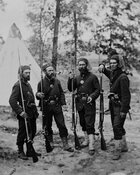
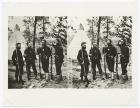
Found this picture on the NYPL labeled as "Group of Infantry." I was inspecting their uniforms and noticed the man on right and noticed something to the right of his head. I thought it to be just a deformation in the foliage behind him, but as I looked at all of their hats, I noticed they all had tassels attached to them. I have never seen this....was there any purpose to the tassels?

Thanks!

-RebYell
 

Attachments

  • index.jpg
    index.jpg
    68.5 KB · Views: 154
According to here, they are from the 4th Michigan Infantry.

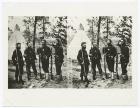
At first I thought their caps were fezes, which were typical of Zouave dress, but according to this, "The 4th's uniform consisted of dark blue kepis or knit Canadian caps with tassels, sack coats and trousers of the same color as the headgear, and russet leather gaiters." Either way, fezes or Canadian caps, the tassels were not unusual for Zouave uniforms; however, the headgear and gaiters appear to be the only thing Zouave about the 4th Michigan....

529441a-8x10-jpg.jpg
 

Attachments

  • 529441a-8x10-jpg.jpg
    529441a-8x10-jpg.jpg
    122 KB · Views: 130
Last edited:
According to Todd's American Military Equipage 1851-1872, the 4th were clothed in state issued flannel sack/fatigue coats, dark blue trousers, leather gaiters and blue Canadian cap with blue tassel (they were also issued dark blue forage caps). They were armed with the M1842 musket. This continued until 1862 when they were issued US Army regular clothing and M1861 Springfield rifled muskets.

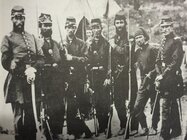
The picture above shows a very early war scenario, Sibley tent, gaiters, pistols carried by enlisted privates. I have attached an additional picture that shows some interesting aspects of the early war regiment:
Officer with cavalry blade, forage caps, along with the Canadian tasseled cap.
 

Attachments

  • IMG_0530.JPG
    IMG_0530.JPG
    256.8 KB · Views: 318
According to Todd's American Military Equipage 1851-1872, the 4th were clothed in state issued flannel sack/fatigue coats, dark blue trousers, leather gaiters and blue Canadian cap with blue tassel (they were also issued dark blue forage caps). They were armed with the M1842 musket. This continued until 1862 when they were issued US Army regular clothing and M1861 Springfield rifled muskets.

The picture above shows a very early war scenario, Sibley tent, gaiters, pistols carried by enlisted privates. I have attached an additional picture that shows some interesting aspects of the early war regiment:
Officer with cavalry blade, forage caps, along with the Canadian tasseled cap.

Although I greatly respect Todd I have some doubts about this. One a unit was in federal service Michigan did not repack qornoutuniforms, this was done by the federal goverment. The 4th Michigan was issued gray uniform by Michigan not blue uniforms so where did these blue uniforms come from? Also when I look at the number of uniforms Michigan paid for and the number of regiments known to have received their first uniforms from Michigan I can not see the 1000 extra blue uniforms needed to repack uniforms for the 4th once they wore out their gray state issued uniform. The federal government had some uniforms made in Detroit in late 1861, but probably only for new regiments forming in Michigan.
 
Last edited:
The State of Michigan, in late 1860, only recommended "a gray uniform of the United States Pattern" for everyone; in late 1860 a survey of the 25 existing state companies, made towards the end of the year found:
  • Infantry-12 companies wore blue, 5 gray, 1 blue and gray and one gray zouave
  • Artillery-All 6 wore blue
I find it more likely that state contractors were manufacturing blue uniforms and as the extant pictures show, continued to do so into 1861.

Major Bill, I know that this is your area (geographically and uniform wise), but the pictures speak for themselves, where did these uniforms come from?
 
index.jpg

Found this picture on the NYPL labeled as "Group of Infantry." I was inspecting their uniforms and noticed the man on right and noticed something to the right of his head. I thought it to be just a deformation in the foliage behind him, but as I looked at all of their hats, I noticed they all had tassels attached to them. I have never seen this....was there any purpose to the tassels?

Thanks!

-RebYell
Its a fez. Just ornamentation, serves no protection against anything.
 

Attachments

  • index.jpg
    index.jpg
    68.5 KB · Views: 84
I do not know and wonder myself. I have seen many reports of the 4th Michigan receiving gray uniforms. One solder wrote in his journal he got a gray uniform, two members of the 4th Michigan wrote home about their gray uniforms and I have seen 4 newspaper reports of the 4th wearing gray uniforms. So there are 7 reports of them being issued gray uniforms by Michiga. This is complicated by a photo suposably showing the 4th leaving Adrain wearing blue unifirms. Both Detriot newspapers have them wearing gray uniforms later that day when the 4th reached Detriot.They received new uniforms during the short train ride? I have to wonder if the 4th Michigan leaving Adrian in pencil on the back of the photo was written later or if it is another unit in Adrian.
 
I've always thought that 4th Michigan uniform was smart looking and easy to maintain. I wish more units had looked like that.
 
The 4th Michigan Volunteer Infantry Regiment nicknamed the Bloody Fourth; mustered into federal service on June 19 1861 in Adrian Michigan. They left the state in gray uniforms. They were also issued gray caped overcoats.[ii] White leggings and brogan shoes were issued with the gray uniforms. The caps were made by S.A. Fuller.[iii] The regiment received white Havelocks in May of 1861. Major Williams wore his Havelock until the Battle of Bull Run when a ball pasted through it.[iv] The Barry Pioneer also indicates they received gray uniforms that were becoming and comfortable.[v] The shirts for the 4th Regiment were from private sources; the shirt's color is not mentioned. Their canteens were made by W. S. Wilcox as were the cutlery and tin wear. W. H. Cleveland provided the regiment's haversacks.[vi]

"We are to receive a uniform of blue. The one we now have is the same color as that of our enemies. In the battle field we would be just as liable to be cut down by friend as foe."[vii] The Adrian company was still wearing their State issued uniforms when they receive new pants on August 3rd 1861. "Part of our uniforms have come, and the boys sport their blue pants this evening on dress parade. This is the first the boys have received from Uncle Sam."[viii] The rest of their uniforms must have arrived soon after the pants because reportedly the 4th Regiment replaced gray uniforms with blue by August 4th 1861.[ix] This likely consisted of dark blue flannel sack coats and dark blue trousers.[x] In one letter a 4th Regiment man indicated it was a loose blouse of blue. For some time they retained their gray forage caps the use of Havelocks continued for some time after the regiment received its blue uniforms. . The state had issued company letters and these could have continued to be worn.

After the first Battle of Bull Run Captain De Golyer returned to Hudson obtain new recruits. De Golyer awarded a contract to Baker Shumway for providing these new recruits with shirts.[xi] The normal practice was for the recruits to received complete uniforms at the Detroit Arsenal before the left the State to join their regiments in the field. The uniforms issued there would not necessarily match what their regiments were currently wearing.

The Hudson Company sent a box of castoff clothing back to Hudson in January of 1862 to include now unneeded gray uniforms.[xii] On October 23 1861 they received dress coat, overcoats and blankets.[xiii]

While still in Detroit some officers of the 4th Regiment wore India rubber garments for protection from the rain. The exact rain garments that were worn are not explained, but cap covers and rain coats were common among officers during the Civil War era.

Later in 1861 the 4th Regiment was photographed in their 'Zouave' uniforms. Please see other sources for this uniform. In October of 1861 they received dress coats, overcoats, drawers and winter blankets.[xiv]

The Hecker's Band from Cleveland Ohio, was selected to be the regimental band for the 4th Infantry Regiment. The uniforms worn by them are not documented, but a photograph of the band exists. Although the image is not too clear, it shows them in dark coats or jackets possibly the nine-button infantry coat, dark trousers and 1839 style cap with light colored bands. Dark bow ties and light colored shirts are worn, with some of the men leaving the top few buttons open. The drum major was given a 5 foot long staff with gilt bands in the middle and at the bottom and the baton was top with a gilt globe head.

The uniform worn by the regimental chaplain, Dr. Henry N. Strong is not known but he wore a dress sword with brass scabbard and he carried a pocket revolver.

The regiment was originally issued 300 Springfield muskets. The state was attempting to secure additional arms for them and by July half of the regiment had arms, said to be a combination of Minnie muskets and "marine musket'.[xv] Their first issued weapons were described as Minnie Muskets for Company A and marine muskets for the rest. The 4th Regiment only used these arms for training and departed the state without any arms. Both arms and accoutrements were transported to Detroit and turned over to the Quartermaster Department.

Soon after arriving at Harrisburg they were issued 'miserable old rusty' altered smooth-bore, bell barreled muskets.[xvi] U.S. Model 1830 flintlock muskets altered to percussion locks, these were originally intended for the Pennsylvania militia.Along with the rusty muskets, the regiment also received belts, cartridge boxes and cap boxes.[xvii].

In August 1861 Companies A and B which were the flank companies, exchanged their muskets for Minnie rifles. Another report states their antiquated rifles were quickly replaced with Springfield Model 1848 muskets on July 8 1861 (The muskets were probably U.S. percussion muskets Model 1842 as no Model 1848 musket exists. The news report must have confused the manufacture date with the model numbers). On June 11 1861, the 4th Regiment A Company and B Company were issued rifles while the remainder of the regiment received 320 Springfield Model 1848 muskets (likely U. S. percussion musket Model 1842). On August 18 1861 the Regiment had Harper's Ferry Muskets.[xviii] In January 1862, the regiment exchanged its old muskets for new Springfield rifles with sword bayonets.[xix] In early 1862, they were photographed with Springfield Model 1842 rifled muskets. In the photographs many men wear bowie knives and several wear pistols. In January 1862 they exchanged their old muskets for new Springfields with sword bayonets.[xx]


"The Military Contract Board", Detroit Free Press, May 23 1861, p. 1, col.1.

[ii] Bertera, Martin N., and Kim Crawford, The 4th Michigan Infantry in the Civil War, Michigan State University Press, East Lansing, Mi., 2010, p. 12.

[iii] Adrian Daily Expositor, May 23 1861, p. 1, col. 4.

[iv] Lansing State Republican, August 31 1861.

[v] "Returned", Barry Pioneer (Hastings Mi.) June 7 1861, p. 3, col. 1.

[vi] "4th Regiment", Adrian Daily Expositor, May 23 1861, P.1, col. 4.

[vii]From Our Adrian Boys, Camp Mansfield July 27 61 signed by J.W.F., Adrian Democratic Enquirer, August 5 1861, p. 1, col. 1.

[viii] "From Our Adrian Boys, Camp Mansfield Aug 3 1861 signed J.A.A.", Adrian Democratic Enquirer, August 19 1861, p. 1, col. 1.

[ix] Adrian Daily Expositor, August 5 1861.Another letter confirms that by August 27 1861 the Fourth Infantry Regiment had replaced d their gray uniforms. "From the Fourth Regiment (exert from a private letter) Camp Union Aug. 18, signed A.C.", Detroit Daily Tribune, August 27 1861, p. 1, col. 1.

[x] Detroit Daily Advertiser, August 31 1861.

[xi] Hudson Gazette, September 21 1861, p. 3, col. 1.

[xii] Adrian Daily Expositor, January 20 1862.

[xiii] Adrian Daily Expositor, letter published November 2 1861.

[xiv] "From Our Adrian Boys, Minner's Hill Va. Oct. 25 1861, signed H.R.," Adrian Daily Expositor, Nov. 2 1861 p. 1, col. 1.

[xv] Bertera, Martin N., and Kim Crawford, The 4th Michigan Infantry in the Civil War, Michigan State University Press, East Lansing, Mi., 2010, p. 12.

[xvi] " Letter from Camp Wilcox Alexandria Jun 23 signed by Brent Kennedy", Jonesville Weekly Independent, July 11 1861, p., 2. col. 3. THIS DOES NOT MATCH THE PARA

[xvii] ""From the Fourth Regiment", Camp Cameron Harrisburg Sunday June 20, Detroit Daily Tribune morning ed., 1, July 4 1861, p. 4, col. 2. Our Fourth Regiment, Detroit Daily Advertise, p. 1, col. 1.

[xviii] "From the Fourth Regiment private Letter from Camp Union dated August 18 1861signed A.C.", Detroit Daily Tribune morning ed., August 27 1861, p.1, col. 1.

[xix] Detroit Free Press, January 21 1862.

[xx] "From the Fourth Regiment", Detroit Daily Tribune, January 21 1862, p. 1, col. 3
 
Last edited:
The 4th Michigan Volunteer Infantry Regiment nicknamed the Bloody Fourth; mustered into federal service on June 19 1861 in Adrian Michigan. They left the state in gray uniforms. They were also issued gray caped overcoats.[ii] White leggings and brogan shoes were issued with the gray uniforms. The caps were made by S.A. Fuller.[iii] The regiment received white Havelocks in May of 1861. Major Williams wore his Havelock until the Battle of Bull Run when a ball pasted through it.[iv] The Barry Pioneer also indicates they received gray uniforms that were becoming and comfortable.[v] The shirts for the 4th Regiment were from private sources; the shirt's color is not mentioned. Their canteens were made by W. S. Wilcox as were the cutlery and tin wear. W. H. Cleveland provided the regiment's haversacks.[vi]

"We are to receive a uniform of blue. The one we now have is the same color as that of our enemies. In the battle field we would be just as liable to be cut down by friend as foe."[vii] The Adrian company was still wearing their State issued uniforms when they receive new pants on August 3rd 1861. "Part of our uniforms have come, and the boys sport their blue pants this evening on dress parade. This is the first the boys have received from Uncle Sam."[viii] The rest of their uniforms must have arrived soon after the pants because reportedly the 4th Regiment replaced gray uniforms with blue by August 4th 1861.[ix] This likely consisted of dark blue flannel sack coats and dark blue trousers.[x] In one letter a 4th Regiment man indicated it was a loose blouse of blue. For some time they retained their gray forage caps the use of Havelocks continued for some time after the regiment received its blue uniforms. . The state had issued company letters and these could have continued to be worn.

After the first Battle of Bull Run Captain De Golyer returned to Hudson obtain new recruits. De Golyer awarded a contract to Baker Shumway for providing these new recruits with shirts.[xi] The normal practice was for the recruits to received complete uniforms at the Detroit Arsenal before the left the State to join their regiments in the field. The uniforms issued there would not necessarily match what their regiments were currently wearing.

The Hudson Company sent a box of castoff clothing back to Hudson in January of 1862 to include now unneeded gray uniforms.[xii] On October 23 1861 they received dress coat, overcoats and blankets.[xiii]

While still in Detroit some officers of the 4th Regiment wore India rubber garments for protection from the rain. The exact rain garments that were worn are not explained, but cap covers and rain coats were common among officers during the Civil War era.

Later in 1861 the 4th Regiment was photographed in their 'Zouave' uniforms. Please see other sources for this uniform. In October of 1861 they received dress coats, overcoats, drawers and winter blankets.[xiv]

The Hecker's Band from Cleveland Ohio, was selected to be the regimental band for the 4th Infantry Regiment. The uniforms worn by them are not documented, but a photograph of the band exists. Although the image is not too clear, it shows them in dark coats or jackets possibly the nine-button infantry coat, dark trousers and 1839 style cap with light colored bands. Dark bow ties and light colored shirts are worn, with some of the men leaving the top few buttons open. The drum major was given a 5 foot long staff with gilt bands in the middle and at the bottom and the baton was top with a gilt globe head.

The uniform worn by the regimental chaplain, Dr. Henry N. Strong is not known but he wore a dress sword with brass scabbard and he carried a pocket revolver.

The regiment was originally issued 300 Springfield muskets. The state was attempting to secure additional arms for them and by July half of the regiment had arms, said to be a combination of Minnie muskets and "marine musket'.[xv] Their first issued weapons were described as Minnie Muskets for Company A and marine muskets for the rest. The 4th Regiment only used these arms for training and departed the state without any arms. Both arms and accoutrements were transported to Detroit and turned over to the Quartermaster Department.

Soon after arriving at Harrisburg they were issued 'miserable old rusty' altered smooth-bore, bell barreled muskets.[xvi] U.S. Model 1830 flintlock muskets altered to percussion locks, these were originally intended for the Pennsylvania militia.Along with the rusty muskets, the regiment also received belts, cartridge boxes and cap boxes.[xvii].

In August 1861 Companies A and B which were the flank companies, exchanged their muskets for Minnie rifles. Another report states their antiquated rifles were quickly replaced with Springfield Model 1848 muskets on July 8 1861 (The muskets were probably U.S. percussion muskets Model 1842 as no Model 1848 musket exists. The news report must have confused the manufacture date with the model numbers). On June 11 1861, the 4th Regiment A Company and B Company were issued rifles while the remainder of the regiment received 320 Springfield Model 1848 muskets (likely U. S. percussion musket Model 1842). On August 18 1861 the Regiment had Harper's Ferry Muskets.[xviii] In January 1862, the regiment exchanged its old muskets for new Springfield rifles with sword bayonets.[xix] In early 1862, they were photographed with Springfield Model 1842 rifled muskets. In the photographs many men wear bowie knives and several wear pistols. In January 1862 they exchanged their old muskets for new Springfields with sword bayonets.[xx]


"The Military Contract Board", Detroit Free Press, May 23 1861, p. 1, col.1.

[ii] Bertera, Martin N., and Kim Crawford, The 4th Michigan Infantry in the Civil War, Michigan State University Press, East Lansing, Mi., 2010, p. 12.

[iii] Adrian Daily Expositor, May 23 1861, p. 1, col. 4.

[iv] Lansing State Republican, August 31 1861.

[v] "Returned", Barry Pioneer (Hastings Mi.) June 7 1861, p. 3, col. 1.

[vi] "4th Regiment", Adrian Daily Expositor, May 23 1861, P.1, col. 4.

[vii]From Our Adrian Boys, Camp Mansfield July 27 61 signed by J.W.F., Adrian Democratic Enquirer, August 5 1861, p. 1, col. 1.

[viii] "From Our Adrian Boys, Camp Mansfield Aug 3 1861 signed J.A.A.", Adrian Democratic Enquirer, August 19 1861, p. 1, col. 1.

[ix] Adrian Daily Expositor, August 5 1861.Another letter confirms that by August 27 1861 the Fourth Infantry Regiment had replaced d their gray uniforms. "From the Fourth Regiment (exert from a private letter) Camp Union Aug. 18, signed A.C.", Detroit Daily Tribune, August 27 1861, p. 1, col. 1.

[x] Detroit Daily Advertiser, August 31 1861.

[xi] Hudson Gazette, September 21 1861, p. 3, col. 1.

[xii] Adrian Daily Expositor, January 20 1862.

[xiii] Adrian Daily Expositor, letter published November 2 1861.

[xiv] "From Our Adrian Boys, Minner's Hill Va. Oct. 25 1861, signed H.R.," Adrian Daily Expositor, Nov. 2 1861 p. 1, col. 1.

[xv] Bertera, Martin N., and Kim Crawford, The 4th Michigan Infantry in the Civil War, Michigan State University Press, East Lansing, Mi., 2010, p. 12.

[xvi] " Letter from Camp Wilcox Alexandria Jun 23 signed by Brent Kennedy", Jonesville Weekly Independent, July 11 1861, p., 2. col. 3. THIS DOES NOT MATCH THE PARA

[xvii] ""From the Fourth Regiment", Camp Cameron Harrisburg Sunday June 20, Detroit Daily Tribune morning ed., 1, July 4 1861, p. 4, col. 2. Our Fourth Regiment, Detroit Daily Advertise, p. 1, col. 1.

[xviii] "From the Fourth Regiment private Letter from Camp Union dated August 18 1861signed A.C.", Detroit Daily Tribune morning ed., August 27 1861, p.1, col. 1.

[xix] Detroit Free Press, January 21 1862.

[xx] "From the Fourth Regiment", Detroit Daily Tribune, January 21 1862, p. 1, col. 3
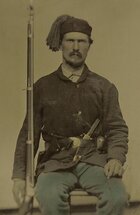
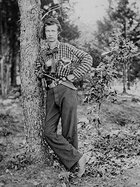
Great research, which explains the Brady photographs and subsequent US issue. I find the issue of trousers prior to the sack coat interesting and shows the "panic" in getting all of the new state regiments outfitted into a homogenous group. The issue of the dark blue regular army issue trousers is also interesting as they were soon replaced with the "sky" blue kersey.

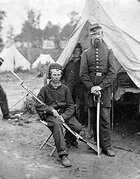
The picture of Pvt Cramer leaning against a tree, shows the haphazard nature of supply, he is wearing an NCO belt, which would not have been tolerated later in the year.

The picture of Pvt Harrison Daniels, is also telling, he is loaded for bear, with a pistol, knife and musket. Regulations would soon pare away the pistol and the knife would be shipped back home or discarded during a lengthy march. He has been issued sky blue kersey trousers and seems proud in his cap.

Interestingly, the above does not mention the Canadian cap, which had to be a source of pride to the unit, since they wore them well into 1862, most certainly only in camp.
 

Attachments

  • HarrisonJeffordsWPrivate.jpg
    HarrisonJeffordsWPrivate.jpg
    33.6 KB · Views: 218
  • 4th Mi Harrison Daniels.jpg
    4th Mi Harrison Daniels.jpg
    96.6 KB · Views: 226
  • pvt Richard I Cramer 4th MI.jpg
    pvt Richard I Cramer 4th MI.jpg
    43.5 KB · Views: 257
The 4th Michigan Volunteer Infantry Regiment was issued gray uniforms; these were perhaps exact copies of the state's dark blue nine-button jackets. E. S. Heinemann & Company (Detroit) supplied the required 1000 gray uniforms for the 4th Regiment in just eight days. Heinemann use 500 hands and 20 sewing machines to complete the task and consumed 21,000 yards of cloth.[ii]

Some more details about the making of the gray uniforms for the 4th Michigan.
The jackets, vests and trousers were all made out of durable gray cloth. "The cloth is very substantial pattern, coat, vest, and pants, are made strong and durable."The cadet gray army cloth[ii] for these uniforms was manufactured by Horace Ranson Gardner & Company's Jonesville Woolen Factory (Jonesville Michigan). "They have a contract to manufacture a number of thousand yards of "Cadet Gray Army Cloth" to be used for the uniforms of the Fourth Michigan Regiment. The Regiment requires 8,000 yards."[iii]


"The Clothes for the Fourth Regiment", Detroit Free Press, June 7 1861, p. 1, col. 1.

[ii]This was also referred to in a period letter as being light gray in color.

[iii] Bertera, Martin N. and Kim Crawford, The 4th Michigan Infantry in the Civil War, Michigan State University Press, East Lansing, MI., 2010, p.11. "Letter from Detroit", Jonesville Weekly Independent, May 16 1861, p. 3 col. 1. "Our Home Industrial Interest", Jonesville Weekly Independent, June 6 1861, p. 3 col. 2.

The 4th Michigan volunteer Infantry Regiment left the state in gray uniforms and many period sources describe the 4th Infantry Regiment's gray uniforms.. The Detroit Daily Advertiser mentioned that the uniforms were like the gray uniforms of the 3rd Infantry Regiment.[ii] The Peninsular Courier (Ann Arbor) observed that they were fully uniformed with gray fatigue suits.[iii] The Toledo Blade stated that the uniforms of the 4th Michigan Volunteer Infantry Regiment were of neat and serviceable gray. They were much like the uniforms of the Wisconsin regiment that had recently passed through Toledo. [iv]


Questions about the uniform's quality began upon issue of these gray uniforms. The men receiving them complained that they were made out of the poorest type of satinet. Additional reports soon followed indicting that many men considered their uniforms to be of cheaply made material. Adding to the wearer dissatisfaction, these uniforms quickly faded and the fading allowed the dirt and grime to become obvious. "Some of the men however, began to complain of their uniforms. They think that as long as the contractors get their pay for making them properly, they should furnish good material and make them so that they will not rip and tear before they have been worn twenty-four hours. Many of the uniforms are made of the poorest kind of satinnet. We did not volunteer for the purpose of complaining, but we do think it is a shame to provide us with uniforms that will not wear a month, when they should wear a year. These will wear out soon, and then we will have to replace them ourselves or go without."[ii]


Detroit Daily Tribune, July 19 1861.

[ii] "From Camp William, Camp 4 Regiment M.V., Camp Williams, Adrian, June 16", Detroit Daily Tribune, June 19 1861, p.1, col. 4.


"The Military Contract Board", Detroit Free Press, May 23 1861, p. 1, col.1.

[ii] "The Fourth Regiment – Presentation of a Flag", Detroit Daily Advertiser, June 24 1861, p. 1, col. 2-3.

[iii] "Correspondence of the Courier, letter from Camp Williams Adrian June 17 1861', Peninsular Courier (Ann Arbor), June 25 1861, p. 2, col. 3.

[iv] "The War Feeling", Adrian Daily Expositor, June 3 1861, p. 1, col. 2.


The jackets, vests and trousers were all made out of durable gray cloth. "The cloth is very substantial pattern, coat, vest, and pants, are made strong and durable."[iii]The cadet gray army cloth[iv] for these uniforms was manufactured by Horace Ranson Gardner & Company's Jonesville Woolen Factory (Jonesville Michigan). "They have a contract to manufacture a number of thousand yards of "Cadet Gray Army Cloth" to be used for the uniforms of the Fourth Michigan Regiment. The Regiment requires 8,000 yards."[v]

"The Fourth Regiment – Presentation of a Flag", Detroit Daily Advertiser, June 24 1861, P. 1, col. 1-3.


[ii] "Uniforms", Detroit Daily Advertiser, June 7 1861, p. 1, col.2 . "The War Feeling", Adrian Daily Expositor, June 7 1861, p. 1, col. .3.


[iii] "The Clothes for the Fourth Regiment", Detroit Free Press, June 7 1861, p. 1, col. 1.


[iv]This was also referred to in a period letter as being light gray in color.


[v] Bertera, Martin N. and Kim Crawford, The 4th Michigan Infantry in the Civil War, Michigan State University Press, East Lansing, MI., 2010, p.11. "Letter from Detroit", Jonesville Weekly Independent, May 16 1861, p. 3 col. 1. "Our Home Industrial Interest", Jonesville Weekly Independent, June 6 1861, p. 3 col. 2.
 
At about the time the 4th Michigan switched to blue uniforms the federal government sent Michigan 3000 pairs of black trousers. Michigan must have issued these black trousers to some regiments or issued them to men being recruited to fill up regiments already in federal service. Is it possible some photos reportedly showing dark blue trousers are in fact black trousers. PI have often wondered where the 3000 pairs of black pants went.
 
At about the time the 4th Michigan switched to blue uniforms the federal government sent Michigan 3000 pairs of black trousers. Michigan must have issued these black trousers to some regiments or issued them to men being recruited to fill up regiments already in federal service. Is it possible some photos reportedly showing dark blue trousers are in fact black trousers. PI have often wondered where the 3000 pairs of black pants went.
Do you know for sure that the Federal Government issued the black trousers, they do not look government spec, but I was not going to argue what the pictures showed. Cramer's pants seem too wide at the ankle for government spec. Just curious if you have found those records?
 

Learn About Us
About CivilWarTalk
Contact the Webmaster
Meet the Staff
Link to CivilWarTalk
Join Our Community
Register
Browse Forums
View Today's Discussions
Search the Forum
Get Help
FAQ
Student Guide
Forum Rules & Etiquette
Copyright / DMCA

     Contact Us CivilwarTalk on Facebook CivilWarTalk on YouTube CivilWarTalk on Twitter RSS Feed

Bringing the American Civil War and More to Life.
© 1999 - , CIVILWARTALK, LLC - Site Version 10.0

SlaveryTalk.com - SecessionTalk.com - CivilWarTalk.com - ReconstructionTalk.com
Back
Top